Welcome to DU!
The truly grassroots left-of-center political community where regular people, not algorithms, drive the discussions and set the standards.
Join the community:
Create a free account
Support DU (and get rid of ads!):
Become a Star Member
Latest Breaking News
Editorials & Other Articles
General Discussion
The DU Lounge
All Forums
Issue Forums
Culture Forums
Alliance Forums
Region Forums
Support Forums
Help & Search
General Discussion
Related: Editorials & Other Articles, Issue Forums, Alliance Forums, Region Forums
William Gibson vs Margaret Thatcher - Cory Doctorow
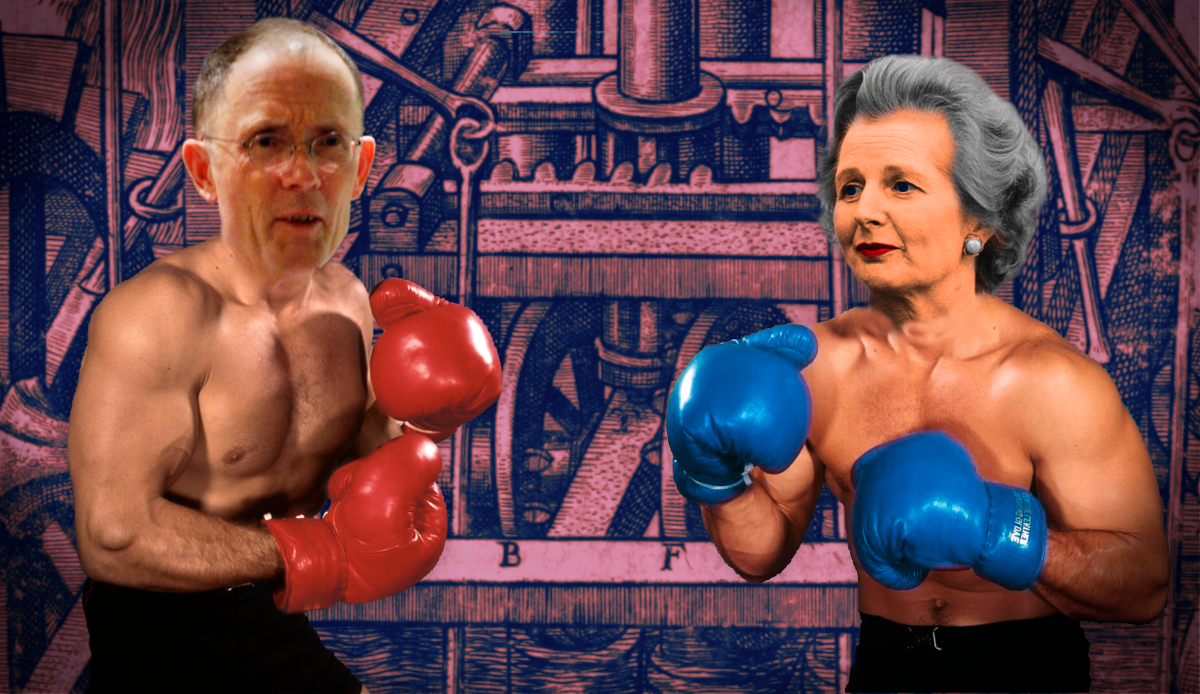
William Gibson is one of history's most quotable sf writers: "The future is here, it's not evenly distributed"; "Don't let the little fuckers generation-gap you"; "Cyberspace is everting"; and the immortal: "The street finds its own uses for things":
https://en.wikiquote.org/wiki/William_Gibson
"The street finds its own uses" is a surprisingly subtle and liberatory battle-cry. It stakes a claim by technology's users that is separate from the claims asserted by corporations that make technology (often under grotesque and cruel conditions) and market it (often for grotesque and cruel purposes).
"The street finds its own uses" is a statement about technopolitics. It acknowledges that yes, there are politics embedded in our technology, the blood in the machine, but these politics are neither simple, nor are they immutable. The fact that a technology was born in sin does not preclude it from being put to virtuous ends. A technology's politics are up for grabs.
In other words, it's the opposite of Audre Lorde's "The master's tools will never dismantle the master's house." It's an assertion that, in fact, the master's tools have all the driver-bits, hex-keys, and socket sets needed to completely dismantle the master's house, and, moreover, to build something better with the resulting pile of materials.
And of course the street finds its own uses for things. Things – technology – don't appear out of nowhere. Everything is in a lineage, made from the things that came before it, destined to be transformed by the things that come later. Things can't come into existence until other things already exist.
Take the helicopter. Lots of people have observed the action of a screw and the twirling of a maple key as it falls from a tree and thought, perhaps that could be made to fly. Da Vinci was drawing helicopters in the 15th century:
https://en.wikipedia.org/wiki/Leonardo%27s_aerial_screw
But Da Vinci couldn't build a helicopter. No one could, until they did. To make the first helicopter, you need to observe the action of the screw and the twirling of a maple key, and you need to have lightweight, strong alloys and powerful internal combustion engines.
Those other things had to be invented by other people first. Once they were, the next person who thought hard about screws and maple keys was bound to get a helicopter off the ground. That's why things tend to be invented simultaneously, by unrelated parties.
TV, radio and the telephone all have multiple inventors, because these people were the cohort that happened to alight upon the insights needed to build these technologies after the adjacent technologies had been made and disseminated.
If technopolitics were immutable – if the original sin of a technology could never be washed away – then everything is beyond redemption. Somewhere in the history of the lever, the pulley and the wheel are some absolute monsters. Your bicycle's bloodline includes some truly horrible ancestors. The computer is practically a crime against humanity:
https://pluralistic.net/2021/10/24/the-traitorous-eight-and-the-battle-of-germanium-valley/
A defining characteristic of purity culture is the belief that things are defined by their origins. An artist who was personally terrible must make terrible art – even if that art succeeds artistically, even if it moves, comforts and inspires you, it can't ever be separated from the politics of its maker. It is terrible because of its origins, not its merits. If you hate the sinner, you must also hate the sin.
"The street finds its own uses" counsels us to hate the sinner and love the sin. The indisputable fact that HP Lovecraft was a racist creep is not a reason to write off Cthulhoid mythos – it's a reason to claim and refashion them:
https://pluralistic.net/2021/01/09/the-old-crow-is-getting-slow/#i-love-ny
The claim that sin is a kind of forever-chemical contaminant that can't ever be rinsed away is the ideology of Mr Gotcha:
We should improve society somewhat.
Yet you participate in society. Curious!
https://thenib.com/mister-gotcha/
In its right-wing form, it is Margaret Thatcher's "There is no alternative":
https://pluralistic.net/2024/10/15/piketty-pilled/#tax-justice
Thatcher demanded that you accept all the injustices and oppressions of capitalism if you enjoyed its fruits. If capitalism put a roof over your head and groceries in your fridge, you can't complain about the people it hurts. There is no version of society that has the machines and practices that produced those things that does not also produce the injustice.
The technological version of this is the one that tech bosses peddle: If you enjoy talking to your friends on Facebook, you can't complain about Mark Zuckerberg listening in on the conversation. There is no alternative. Wanting to talk to your friends out of Zuck's earshot is like wanting water that's not wet. It's unreasonable.
But there's a left version of this, its doppelganger: the belief that a technology born in sin can never be redeemed. If you use an LLM running on your computer to find a typo, using an unmeasurably small amount of electricity in the process, you still sin – not because of anything that happens when you use that LLM, but because of LLMs' "structural properties," "the way they make it harder to learn and grow," "the way they make products worse," the "emissions, water use and e-waste":
https://tante.cc/2026/02/20/acting-ethical-in-an-imperfect-world/
The facts that finding punctuation errors in your own work using your own computer doesn't make it "harder to learn and grow," doesn't "make products worse," and doesn't add to "emissions, water use and e-waste" are irrelevant. The part that matters isn't the use of a technology, it's the origin.
The fact that this technology is steeped in indisputable sin means that every use of it is sinful. The street can find as many uses as it likes for things, but it won't matter, because there is no alternative.
When radical technologists scheme to liberate technology, they're not hoping to redeem the gadget, they're trying to liberate people. Information doesn't want to be free, because information doesn't and can't want anything. But people want to be free, and liberated access to information technology is a precondition for human liberation itself.
Promethean leftists don't reject the master's tools: we seize them. The fact that Unix was born of a convicted monopolist who turned the screws on users at every turn isn't a reason to abandon Unix – it demands that we reverse-engineer, open, and free Unix:
https://pluralistic.net/2025/01/20/capitalist-unrealism/#praxis
We don't do this out of moral consideration for Unix. Unix is inert, it warrants no moral consideration. But billions of users of free operating systems that are resistant to surveillance and control are worthy of moral consideration and we set them free by seizing the means of computation.
If a technology can do something to further human thriving, then we can love the sin, even as we hate the sinners in its lineage. We seize the means of computation, not because we care about computers, but because we care about people.
Artifacts do have politics, but those politics are not immutable. Those politics are ours to seize and refashion:
https://faculty.cc.gatech.edu/~beki/cs4001/Winner.pdf
"The purpose of a system is what it does" (S. Beer). The important fact about a technology is what it does, not how it came about. Does a use of a technology harm someone? Does a use of a technology harm the environment?
Does a use of a technology help someone do something that improves their life?
Studying the origins of technology is good because it helps us avoid the systems and practices that hurt people. Knowing about the monsters in our technology's lineage helps us avoid repeating their sins. But there will always be sin in our technology's past, because our technology's past is the entire past, because technology is a lineage, not a gadget. If you reject things because of their origins – and not because of the things they do – then you'll end up rejecting everything (if you're honest), or twisting yourself into a series of dead-ends as you rationalize reasons that the exceptions you make out of necessity aren't really exceptions.
(Image: Dylan Parker, CC BY-SA 2.0, modified)
https://en.wikiquote.org/wiki/William_Gibson
"The street finds its own uses" is a surprisingly subtle and liberatory battle-cry. It stakes a claim by technology's users that is separate from the claims asserted by corporations that make technology (often under grotesque and cruel conditions) and market it (often for grotesque and cruel purposes).
"The street finds its own uses" is a statement about technopolitics. It acknowledges that yes, there are politics embedded in our technology, the blood in the machine, but these politics are neither simple, nor are they immutable. The fact that a technology was born in sin does not preclude it from being put to virtuous ends. A technology's politics are up for grabs.
In other words, it's the opposite of Audre Lorde's "The master's tools will never dismantle the master's house." It's an assertion that, in fact, the master's tools have all the driver-bits, hex-keys, and socket sets needed to completely dismantle the master's house, and, moreover, to build something better with the resulting pile of materials.
And of course the street finds its own uses for things. Things – technology – don't appear out of nowhere. Everything is in a lineage, made from the things that came before it, destined to be transformed by the things that come later. Things can't come into existence until other things already exist.
Take the helicopter. Lots of people have observed the action of a screw and the twirling of a maple key as it falls from a tree and thought, perhaps that could be made to fly. Da Vinci was drawing helicopters in the 15th century:
https://en.wikipedia.org/wiki/Leonardo%27s_aerial_screw
But Da Vinci couldn't build a helicopter. No one could, until they did. To make the first helicopter, you need to observe the action of the screw and the twirling of a maple key, and you need to have lightweight, strong alloys and powerful internal combustion engines.
Those other things had to be invented by other people first. Once they were, the next person who thought hard about screws and maple keys was bound to get a helicopter off the ground. That's why things tend to be invented simultaneously, by unrelated parties.
TV, radio and the telephone all have multiple inventors, because these people were the cohort that happened to alight upon the insights needed to build these technologies after the adjacent technologies had been made and disseminated.
If technopolitics were immutable – if the original sin of a technology could never be washed away – then everything is beyond redemption. Somewhere in the history of the lever, the pulley and the wheel are some absolute monsters. Your bicycle's bloodline includes some truly horrible ancestors. The computer is practically a crime against humanity:
https://pluralistic.net/2021/10/24/the-traitorous-eight-and-the-battle-of-germanium-valley/
A defining characteristic of purity culture is the belief that things are defined by their origins. An artist who was personally terrible must make terrible art – even if that art succeeds artistically, even if it moves, comforts and inspires you, it can't ever be separated from the politics of its maker. It is terrible because of its origins, not its merits. If you hate the sinner, you must also hate the sin.
"The street finds its own uses" counsels us to hate the sinner and love the sin. The indisputable fact that HP Lovecraft was a racist creep is not a reason to write off Cthulhoid mythos – it's a reason to claim and refashion them:
https://pluralistic.net/2021/01/09/the-old-crow-is-getting-slow/#i-love-ny
The claim that sin is a kind of forever-chemical contaminant that can't ever be rinsed away is the ideology of Mr Gotcha:
We should improve society somewhat.
Yet you participate in society. Curious!
https://thenib.com/mister-gotcha/
In its right-wing form, it is Margaret Thatcher's "There is no alternative":
https://pluralistic.net/2024/10/15/piketty-pilled/#tax-justice
Thatcher demanded that you accept all the injustices and oppressions of capitalism if you enjoyed its fruits. If capitalism put a roof over your head and groceries in your fridge, you can't complain about the people it hurts. There is no version of society that has the machines and practices that produced those things that does not also produce the injustice.
The technological version of this is the one that tech bosses peddle: If you enjoy talking to your friends on Facebook, you can't complain about Mark Zuckerberg listening in on the conversation. There is no alternative. Wanting to talk to your friends out of Zuck's earshot is like wanting water that's not wet. It's unreasonable.
But there's a left version of this, its doppelganger: the belief that a technology born in sin can never be redeemed. If you use an LLM running on your computer to find a typo, using an unmeasurably small amount of electricity in the process, you still sin – not because of anything that happens when you use that LLM, but because of LLMs' "structural properties," "the way they make it harder to learn and grow," "the way they make products worse," the "emissions, water use and e-waste":
https://tante.cc/2026/02/20/acting-ethical-in-an-imperfect-world/
The facts that finding punctuation errors in your own work using your own computer doesn't make it "harder to learn and grow," doesn't "make products worse," and doesn't add to "emissions, water use and e-waste" are irrelevant. The part that matters isn't the use of a technology, it's the origin.
The fact that this technology is steeped in indisputable sin means that every use of it is sinful. The street can find as many uses as it likes for things, but it won't matter, because there is no alternative.
When radical technologists scheme to liberate technology, they're not hoping to redeem the gadget, they're trying to liberate people. Information doesn't want to be free, because information doesn't and can't want anything. But people want to be free, and liberated access to information technology is a precondition for human liberation itself.
Promethean leftists don't reject the master's tools: we seize them. The fact that Unix was born of a convicted monopolist who turned the screws on users at every turn isn't a reason to abandon Unix – it demands that we reverse-engineer, open, and free Unix:
https://pluralistic.net/2025/01/20/capitalist-unrealism/#praxis
We don't do this out of moral consideration for Unix. Unix is inert, it warrants no moral consideration. But billions of users of free operating systems that are resistant to surveillance and control are worthy of moral consideration and we set them free by seizing the means of computation.
If a technology can do something to further human thriving, then we can love the sin, even as we hate the sinners in its lineage. We seize the means of computation, not because we care about computers, but because we care about people.
Artifacts do have politics, but those politics are not immutable. Those politics are ours to seize and refashion:
https://faculty.cc.gatech.edu/~beki/cs4001/Winner.pdf
"The purpose of a system is what it does" (S. Beer). The important fact about a technology is what it does, not how it came about. Does a use of a technology harm someone? Does a use of a technology harm the environment?
Does a use of a technology help someone do something that improves their life?
Studying the origins of technology is good because it helps us avoid the systems and practices that hurt people. Knowing about the monsters in our technology's lineage helps us avoid repeating their sins. But there will always be sin in our technology's past, because our technology's past is the entire past, because technology is a lineage, not a gadget. If you reject things because of their origins – and not because of the things they do – then you'll end up rejecting everything (if you're honest), or twisting yourself into a series of dead-ends as you rationalize reasons that the exceptions you make out of necessity aren't really exceptions.
(Image: Dylan Parker, CC BY-SA 2.0, modified)
https://pluralistic.net/2026/03/17/technopolitics/#original-sin
1 replies
 = new reply since forum marked as read
Highlight:
NoneDon't highlight anything
5 newestHighlight 5 most recent replies
= new reply since forum marked as read
Highlight:
NoneDon't highlight anything
5 newestHighlight 5 most recent replies
= new reply since forum marked as read
Highlight:
NoneDon't highlight anything
5 newestHighlight 5 most recent replies
William Gibson vs Margaret Thatcher - Cory Doctorow (Original Post)
justaprogressive
Yesterday
OP
I like Cory, though I don't always agree with him. I've followed him in the past, though I never keep up
highplainsdem
Yesterday
#1

highplainsdem
(61,796 posts)1. I like Cory, though I don't always agree with him. I've followed him in the past, though I never keep up
with everything any of the people I follow post, because I have too many interests. I've had some nice exchanges with Cory and he's reposted my replies to him at times.
But in his his disagreement with tante, https://bsky.app/profile/tante.cc
https://tante.cc/2026/02/20/acting-ethical-in-an-imperfect-world/
Cory loses.
The problem with generative AI is not one person or multiple people in the history of AI who were unethical. The problem is that the way LLMs work is fundamentally unethical, and there's no way to get around that.
As tante wrote:
Let’s just look at the embedded politics of LLMs: In order to train a capable system you need data. Lots of it. AI companies keep buying books to scan them, they download everything from every legal or illegal source claiming “fair use” (a doctrine that only applies to the US by the way) or that “scraping is always okay”. Capable LLMs require a logic of dominance and of disregarding consent of the people producing the artifacts that are the raw material for the system. LLMs are based on extraction, exploitation and subjugation: To produce these systems – even if you release the end result as open weights for people to use at home – you need to take cultural works, personal writing etc. from people who not only not consented but actively reject that notion. The politics of LLMs is violence. How does one “liberate” that? What’s the case for open source violence?
He uses a so-called “open source LLM” and that’s very much how he presents his values but open-source LLMs do not really exist. You can download some weights but cannot understand what went into them or really change or reproduce them. Open source AI is just marketing and openwashing.
He uses a so-called “open source LLM” and that’s very much how he presents his values but open-source LLMs do not really exist. You can download some weights but cannot understand what went into them or really change or reproduce them. Open source AI is just marketing and openwashing.
I've said before that the only truly fair resultion of the problem the AI peddlers created, with their theft of the world's IP, would be to destroy all illegally trained models including the open source models derived from them, and train new models with only what's in the public domain and what AI companies legally obtain the right to use.
Which no AI companies are willing to do, because they know the value of those current models is almost entirely dependent on the value of the training data. If I recall what I read a couple of years ago correctly, OpenAI has already said in court documents that it can't get the AI models it wants training only on public domain material.
The AI companies want everything they can steal, and that theft is continuing every day.
Cory's argument seems to suggest that people who oppose genAI are like someone hating a powerful engine because the inventor, long ago, was a bad person. That isn't the reason.
It's the ongoing theft, the extraction of all that knowledge and art and creativity without consent. The way that AI engine works is equivalent to all those creative people being ground up to use as fuel, with more being ground up every day.
That isn't a problem that can be washed away or ignored because some people might find the tech useful or entertaining.
Especially when there are other ongoing harms, from the dumbing down of AI users, to harm to both our natural environment and information ecosystem, to surveillance and manipulation, to worsening inequality.
Nothing good that genAI does comes close to outweighing all the harm that it does.