Hawaii Just Found a Way to Keep Corporations Out of Politics

A new law makes clear that corporations derive their powers from states, and they don’t necessarily include the right to spend on elections.
https://prospect.org/2026/05/18/hawaii-state-legislature-citizens-united-corporations-politics/
 Palm trees frame the Hawaii State Capitol, April 23, 2025, in Honolulu, Hawaii. Credit: Mengshin Lin/AP Photo
At a time when giant tech companies and other corporate behemoths loom over our economic, social, and political life, the state of Hawaii has just found a way to limit their hold. Last Thursday, Gov. Josh Green signed into law the first piece of American legislation that curtails corporations’ ability to engage in electoral politics. It doesn’t—because it couldn’t—undo the U.S. Supreme Court’s ruling in
Citizens United, which holds that corporations have the right to spend their resources on political campaigns. That would require another Court ruling striking down
Citizens United, or a constitutional amendment banning such spending. Rather, the Hawaiian law is based on the fact that in the United States, corporations are created and given their powers by the charters of the individual states. Indeed, corporations simply are a legal creation of the state, everywhere they exist, by definition.
The new law simply states that corporations doing business in Hawaii do not have the power to engage in local, state, or federal political campaigns, that that was not one of the powers enumerated in the state’s corporate charter. It further specifies a range of penalties—including losing the right to conduct any business in the state at all—if they do. Corporations’ rights to free speech are not addressed by the new law. “Two hundred and fifty years ago, Jefferson said that people’s rights are self-evident, endowed by their creator, preceding the establishment of governments,” says state Sen. Jarrett Keohokalole, who chairs the Senate Commerce and Consumer Protection Committee that first considered the bill, which was introduced by longtime Sen. Karl Rhoads. “But corporations were, and continue to be, created by state law, as were their powers,” Keohokalole continues. “They are not irrevocable. State charters give corporations limited liability for their founders and owners; they make them eligible for specific kinds of tax breaks, and so on. This legislation clarifies that the powers and privileges granted under Hawaiian law to corporations do not include electioneering.”
Polling has made clear that a supermajority of the American people loathe
Citizens United, with some polls showing that fully 75 percent of the public would like it reversed. Fears of growing corporate and oligarchic dominance aren’t limited to Democrats, as both the polling and the bipartisan majorities in the Hawaiian statehouse have demonstrated. Rhoads’s SB 2471 cleared the Senate with a 25-to-0 vote, and the lower house by a 41-to-9 margin. The idea that states can use their corporate-creating powers to curtail the corporate domination of politics is something new under the American jurisprudential sun—at least, it hasn’t been floated before. It originated with Tom Moore, a former counsel and chief of staff to a member of the Federal Election Commission who is currently a senior fellow at the Center for American Progress. In
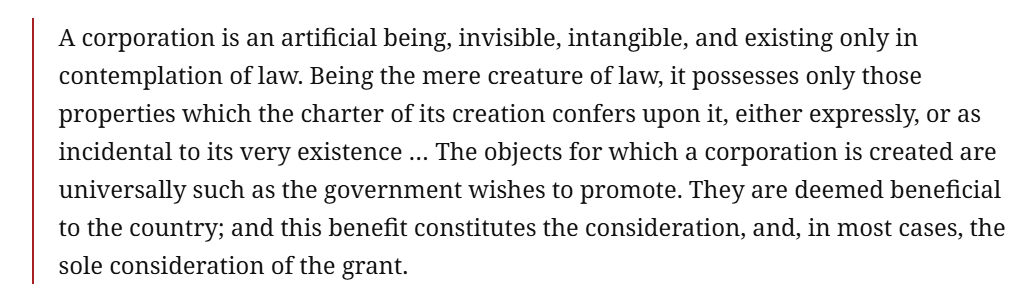
a paper that CAP published last September, Moore wrote that the states’ “underlying authority to define and limit corporate powers never disappeared. It simply went quiet: unused, untested, and unmentioned—until now.” Moore roots his argument in 200 years of law and practice. He cities Chief Justice John Marshall’s 1819 opinion in
Dartmouth v. Woodward, in which Marshall wrote:
He cites Samuel Alito’s opinion in the
Hobby Lobby case, which asserts that “the objectives that may properly be pursued by the companies in these cases are governed by the laws of the States in which they were incorporated.” He cites the example of Texas, which changed its charter in the 19th century to strip banks of the power to issue bills of credit, and New Jersey, which changed its charter in the 20th century to limit the power and scope of holding companies. And crucially, he cites an 1869 Supreme Court ruling that requires corporations to comport with the corporate charter laws of every state in which they do business. That means a corporation chartered in Delaware, which has long been the state that has chartered most corporations, would have to comport—nationwide, in every state—with Hawaii’s laws on corporate powers if and when it sought to sell its products or engage in any kind of business activity in Hawaii. (Ponder for a moment the effect on corporations if such statutes are enacted in states as populous as California and New York.) For good measure, Moore also references the Constitution’s Tenth Amendment, which states that powers not listed in the Constitution—such as the power to create corporations—are reserved to the states.
snip

 = new reply since forum marked as read