General Discussion
Related: Editorials & Other Articles, Issue Forums, Alliance Forums, Region Forums'Horrible' Sea Level Rise Of More Than 3 Feet Plausible By 2100, Experts Say - NBC
'Horrible' sea level rise of more than 3 feet plausible by 2100, experts sayBy John Roach, NBC News
1/6/12
<snip>
Melting glaciers in Antarctica and Greenland may push up global sea levels more than 3 feet by the end of this century, according to a scientific poll of experts that brings a degree of clarity to a murky and controversial slice of climate science. Such a rise in the seas would displace millions of people from low-lying countries such as Bangladesh, swamp atolls in the Pacific Ocean, cause dikes in Holland to fail, and cost coastal mega-cities from New York to Tokyo billions of dollars for construction of sea walls and other infrastructure to combat the tides.
"The consequences are horrible," Jonathan Bamber, a glaciologist at the University of Bristol and a co-author of the study published Jan. 6 in the journal Nature Climate Change, told NBC News.
Estimating how much sea levels will rise from ice sheet melting is one of the more challenging aspects of climate science. Some evidence suggests recent accelerated melting is related to changes in ocean and atmospheric temperature, though natural variability may play an important role. In addition, glaciers respond to external forces such as warmer temperatures in different ways, even when they are located right next to each other. As a result, there is tremendous uncertainty in the scientific community over how the melting will affect sea levels over the next century.
Bamber and colleague Willy Aspinall attempted to find clarity in the chaos using a scientific polling technique common in fields such as predicting earthquakes and volcanic eruptions, but until now not applied to climate science. The pair sent 26 of the world's leading glaciologists a series of questions about the behavior of the Antarctic and Greenland ice sheets. About half replied to the survey in 2010. The respondents were polled again in 2012 to assess the robustness of their answers.
Bamber said this type of approach is "a lot more than an opinion poll." The experts were handpicked to get a representative perspective of world leaders from the ice sheet modeling and observational fields. "We analyzed the results in a very systematic, rigorous, and statistically robust way," he added.
The median estimate from the experts is that the melting ice sheets will contribute 1 foot (29 centimeters) to sea level rise by the year 2100 with a 5 percent chance their contribution could exceed 2.8 feet (84 centimeters). When the effect of thermal expansion (water expands as it warms) is taken into account, the high-end estimate is more than 3 feet (1 meter).
<snip>
More: http://science.nbcnews.com/_news/2013/01/06/16369939-horrible-sea-level-rise-of-more-than-3-feet-plausible-by-2100-experts-say?lite

 = new reply since forum marked as read
Highlight:
NoneDon't highlight anything
5 newestHighlight 5 most recent replies
= new reply since forum marked as read
Highlight:
NoneDon't highlight anything
5 newestHighlight 5 most recent replies

riverbendviewgal
(4,396 posts)but I still feel so sorry for our planet.

dawg
(10,777 posts)I got my first artificial implant just last year.
WillyT
(72,631 posts)

nilram
(3,561 posts)Armed, of course. Don't even think about cutting me off in traffic!
NoOneMan
(4,795 posts)The planet will be "fine" in another hundred thousand years or so. Maybe a little more.
Likely, something else will be here to enjoy it after the cataclysm.
closeupready
(29,503 posts)datasuspect
(26,591 posts)
Mojorabbit
(16,020 posts)
glinda
(14,807 posts)truebrit71
(20,805 posts)...than previously thought...i.e. Arctic ice-free in the summer between 2030-2050 has now become ice-free in the summer THIS DECADE...
I believe we are in for a helluva rude wake-up about climate change on a planetary scale sooner (much sooner) rather than later...
AverageJoe90
(10,745 posts)Yes, Arctic ice has indeed melted faster than predicted. That much is true(though it doesn't discount the possibility that we may still be able to wait another decade, decade and a half or so.).
However, though, most(yes, most, there are a few other exceptions to the rule as well) everything else has been roughly on track so far, including temperature rises.....see my reply to Lunatica.
truebrit71
(20,805 posts)...and the West Antarctic has been found to have been warming THREE times faster than previously thought...http://www.nytimes.com/2012/12/24/science/earth/west-antarctica-warming-faster-than-thought-study-finds.html?_r=0
Coupled with the increasing thaw in Greenland and i think we are in for a rude-awakening much sooner than "a decade and a half or so"...
FarCenter
(19,429 posts)It's unclear whether you can extrapolate from rate of loss of ice coverage over the last decade since now the remaining mid-September ice coverage is over the deep water of the Arctic Ocean basin.
AverageJoe90
(10,745 posts)And he's not exactly in the majority, either. TBH, the possibility does exist that we may see our first relatively ice free Arctic summer at some point in the next 4-8 years......However, though, my money is more on 2024-2030, though, since the most pessimistic projections concerning Arctic ice have actually been about as wrong as the most optimistic ones for some time now.
hhttp://www.newscientist.com/article/dn13779-north-pole-could-be-ice-free-in-2008.html
https://fp.auburn.edu/sfws/sfnmc/web/bet5.html
http://news.nationalgeographic.com/news/2008/06/080620-north-pole.html
So yeah, I can try to find more if you'd like.
kestrel91316
(51,666 posts)NoOneMan
(4,795 posts)Meanwhile, we will have billions upon billions of deaths from famine.
Speck Tater
(10,618 posts)it will be a sea level rise of 30 feet by 2050. I.e., 10 times higher, in half the predicted time.

librechik
(30,957 posts)and exactly why we can't wait to do something--unless it's too late already. Why wonder? nobody in the US will do anything until we are all wading to work. And then the rich will buy waterskis.
the rich are probably already constructing their mega-boats to float them to another part of the world, that hasn't been thrown under water yet. But I feel for the islanders, who will not make it for long. By the turn of the next century, I bet there will be no people left and the planet will recover because of it!

stuntcat
(12,025 posts)It would be bad to alarm the public with the truth about this though.
glinda
(14,807 posts)Because we are goners. Don't want mass hysteria now do we?

Ganja Ninja
(15,953 posts)Global warming is accelerating. That means the time table for predictions will keep moving up. What was 100 years away will be 25 years away. What was 200 years away will be 50 years away and so on.
AverageJoe90
(10,745 posts)And you forget temperature as well. Go check my reply to Lunatica, please. 
stuntcat
(12,025 posts)maybe we'll call a meeting to discuss how to develop a plan to hold a summit to convene the leading scientists so they can meet with their politicians and then perhaps a plan of action could be considered.
 The only thing I'm glad for most days now is that my life is half over. I'm not looking forward to all the extinctions I'll witness the next few decades, but at least I realized what was coming before I gave this to my daughter.

madokie
(51,076 posts)by any stretch of the imagination but I have a problem with the ocean rising three feet. What I'm saying is I don't see that there is that much ice to melt. Where is all this water? Someone help me out here
TIA
WillyT
(72,631 posts)<And...>
More: http://science.time.com/2012/12/24/antarctica-its-getting-hot-at-the-bottom-of-the-planet/?iid=gs-main-mostpop2
I didn't realize the volume of ice at the poles.
HooptieWagon
(17,064 posts)Ice floats because its less dense than water. When it melts, its density increases, and there is no sea rise. You can see for yourself by floating ice cubes in a glass of water, and measuring the water level before and after they melt...or you can read Archimede's Principle (early Greek mathematician).
The sea level rise results from melting glaciers and other ice and snow on land.
The amount that water expands due to warming is very small, especially in the few degrees difference the sea will warm.
WillyT
(72,631 posts)
Article: http://www.scienceagogo.com/news/20130003182520data_trunc_sys.shtml
The Antarctic ice sheet is divided by the Transantarctic Mountains into two unequal sections called the East Antarctic ice sheet (EAIS) and the smaller West Antarctic Ice Sheet (WAIS). The EAIS rests on a major land mass but the bed of the WAIS is, in places, more than 2,500 metres below sea level. It would be seabed if the ice sheet were not there. The WAIS is classified as a marine-based ice sheet, meaning that its bed lies below sea level and its edges flow into floating ice shelves. The WAIS is bounded by the Ross Ice Shelf, the Ronne Ice Shelf, and outlet glaciers that drain into the Amundsen Sea.
Link: http://en.wikipedia.org/wiki/Ice_sheet
HooptieWagon
(17,064 posts)The article states part of it is on land, and part is sitting on seabed.
It is simple physics that floating ice, such as the arctic icecap or Ross ice shelf in antarctica, will not raise the sea level when it melts. Archimedes proved it about 2500 years ago.
WillyT
(72,631 posts)the millions of acres ABOVE sea level, and NOT FLOATING, will...
"Archimedes proved it about 2500 years ago."
HooptieWagon
(17,064 posts)Arcimedes' Principle is the underlying theory behind ship design. In it, he proves that a FLOATING body displaces a volume of water equal in weight to the weight of the floating body. Ice floats because its less dense than water. The underwater portion of the ice displaces a volume of water equal in weight to the total weight of the ice (above and below water). When that ice melts, its weight does not change. Its VOLUME changes, and becomes smaller. When fully melted, its volume equals the volume of the water that was displaced by the original floating ice...thus no change in sealevel.
Ganja Ninja
(15,953 posts)on top of it (Ice that is above sea level) is holding it down. Think of a 5 lb block of ice sitting in a tub with only 1" of water. The ice isn't floating therefore it isn't displacing it's full volume. Once enough melting takes place the shelf will break up and will fully displace it's volume of water. The sea rise will be dramatic and almost instantaneous.
HooptieWagon
(17,064 posts)You could have a 100' tall chunk of ice sitting on the bottom of 10' of water. Most of that ice would cause the sealevel to rise if it melted. However, if that 100' tall piece of ice were floating in 110' of water, it would not cause the sealevel to rise when melted, even though some of the ice was originally above water level.

progressoid
(53,327 posts)
truebrit71
(20,805 posts)
muriel_volestrangler
(106,492 posts)"The sea level rise results from melting glaciers and other ice and snow on land"
and has correctly pointed out that ice grounded below sea level will still contribute something to sea level rise. The mistake was WillyT saying "West Antarctica is different", when HooptieWagon had already correctly said ice on land (like the WAIS) raises sea level when it melts. Other people just haven't been reading HW's posts carefully enough.
WillyT
(72,631 posts)I realize that any ice, already floating, or sitting on the seabed, has ALREADY displaced the water in the ocean.
It's ALREADY factored in.
But... what about the ice ABOVE sea level ?
It hasn't displaced ANYTHING... it's up in the air.


muriel_volestrangler
(106,492 posts)back in #17: "The sea level rise results from melting glaciers and other ice and snow on land. "
You don't have to keep repeating that. HooptieWagon said that in their first post in this thread.
(b) HooptieWagon is right, and you are wrong, about ice that is sitting on the sea floor. When that melts, it does raise sea level; it has 'already displaced' some water, but it has not displaced its entire weight. Ganja Ninja and HooptieWagon gave an example in #39 and #45.
Ice shelves with water below them, but attached to grounded ice or land ice, get complicated - it is possible for them to have an excess of ice above the waterline (which would mean that section of ice would raise sea level), or below it (which would mean sea level would go down), but to be held where they are by the connection to the grounded ice. However, that puts a stress on the ice, which may mean it breaks. In the long term, ice shelves may not have a significant effect on sea levels.
WillyT
(72,631 posts)muriel_volestrangler
(106,492 posts)It doesn't say the ice shelves contribute or not to sea level rise themselves; it says "West Antarctic ice shelves that restrain the region's natural ice flow into the ocean" ... "the Antarctic's Larsen B Ice Shelf, where glaciers at the edge discharged massive sections of ice into the ocean that contributed to sea level rise".
The shelves, being attached to the land ice, hold back the glaciers that are above sea level, and which would otherwise flow faster (thus taking more ice from land into the ocean, where it melts).
The next one that talks about ice shelves says: "Several ice shelves - thick ice floating on the ocean and linked to land - have collapsed around the Antarctic Peninsula in recent years. Once ice shelves break up, glaciers pent up behind them can slide faster into the sea, raising water levels."
Or the next: "The increasing temperatures have caused instability in the Antarctic leading to several significant ice shelves collapsing and disintegrating over the past few years. this then means that the glaciers originally held in place by the ice shelf is given a free path to the ocean and starts to move much faster, increasing the contribution that the glaciers make to global sea level rises.
Andrew Monaghan, from the US National Centre for Atmospheric Research, said that “the stakes would be much higher if a similar event occurred to an ice shelf restraining one of the enormous West Antarctic ice sheet glaciers.”"
So, no, 'those guys' aren't wrong, at all; but they aren't talking about what you were, at all.

Ultraviolet Cat
(42 posts)Land ice melting is only responsible for roughly half of the increase in many models, the other half comes from volume expansion due to the ocean water's temperature increasing.
madokie
(51,076 posts)HooptieWagon
(17,064 posts)The volume change in water over the few degrees of warming would be very small...perhaps just a few inches. Greenland's ice melting would contribute several feet, Antarctica's ice melting would contribute a couple dozen feet. If every single bit of ice and snow on eath melted and flowed into the sea, the sealevel rise would be around 50 feet.
muriel_volestrangler
(106,492 posts)If the weakest emissions cuts were made, temperatures could rise to 3.91 degrees Celsius in 2100 and the sea level rise could increase to 32.3cm, increasing to 139.4cm by 2300.
http://www.reuters.com/article/2012/07/01/climate-sealevel-idUSL6E8HSIDA20120701
HooptieWagon
(17,064 posts)My assumpions for the calculations:
1) a 2degC rise in temp (from 20deg to 22deg) resulting in a decrease in density from . 998203 to .997770. Those numbers are for fresh water, salinity of ocean water varies widely.
2) Ocean volume of 1.3 billion km^3, and an average depth of 3,682 m...which gives an area of about 353,068,984 km^2. These figures do not include Seas and Gulfs, which are but a fraction of the total volume. Volume and average depth from Wiki, I calculated area from that.
3) the calculated rise due to the 2deg temp increase is 1m, assuming the area doesn't increase as the Ocean rises. Of course it will, but I had no way of estimating how much.
The 1m increase is a great deal more than I would have guessed, how ever the volume was far greater than I would have supposed, average depth being 3 or 4 times greater than I would have thought. The figures you cited probably are fairly accurate, after doing this rough calculation.
What I haven't yet seen from any estimates is an allowance made for increased evaporation due to increased area and higher temp. That will be a substantial amount, and will reduce the amount of ocean rise. It is possible that the increased cloud cover from greater evaporation would cause a cooling, depending on how much moisture remained in the air, and how much precipitated (and where).
AverageJoe90
(10,745 posts)It may not sound like much, but there's places in the world, like the Maldives, Nauru, and hell, even Key West here in the States, that are so low lying, they would indeed be seriously endangered by even a 3 foot rise.
FarCenter
(19,429 posts)
CreekDog
(46,192 posts)is 3 feet not significant?
FarCenter
(19,429 posts)Day to day tides, tides during the lunar month, storm and hurricane surge, and wave action due to wind cause much more sea level variation so that 3 feet is only a small percent of the maximum water level that has to be planned for.
CreekDog
(46,192 posts)if you want to say it does not, you have almost NO company at DU or among scientists.
please proceed.
FarCenter
(19,429 posts)So whether 3 feet matter much depends on where you live.
CreekDog
(46,192 posts)again, you don't know what you're talking about.
but thanks for playing.
next contestant Johnny?

FarCenter
(19,429 posts)
OKIsItJustMe
(22,006 posts)On the other hand:
http://www.ipcc.ch/publications_and_data/ar4/wg2/en/ch6s6-2-2.html
[font size=3]Few of the world’s coastlines are now beyond the influence of human pressures, although not all coasts are inhabited (Buddemeier et al., 2002). Utilisation of the coast increased dramatically during the 20th century, a trend that seems certain to continue through the 21st century (Section 6.3.1). Coastal population growth in many of the world’s deltas, barrier islands and estuaries has led to widespread conversion of natural coastal landscapes to agriculture, aquaculture, silviculture, as well as industrial and residential uses (Valiela, 2006). It has been estimated that 23% of the world’s population lives both within 100 km distance of the coast and <100 m above sea level, and population densities in coastal regions are about three times higher than the global average (Small and Nicholls, 2003) (see also Box 6.6). The attractiveness of the coast has resulted in disproportionately rapid expansion of economic activity, settlements, urban centres and tourist resorts. Migration of people to coastal regions is common in both developed and developing nations. Sixty percent of the world’s 39 metropolises with a population of over 5 million are located within 100 km of the coast, including 12 of the world’s 16 cities with populations greater than 10 million. Rapid urbanisation has many consequences: for example, enlargement of natural coastal inlets and dredging of waterways for navigation, port facilities, and pipelines exacerbate saltwater intrusion into surface and ground waters. Increasing shoreline retreat and risk of flooding of coastal cities in Thailand (Durongdej, 2001; Saito, 2001), India (Mohanti, 2000), Vietnam (Thanh et al., 2004) and the United States (Scavia et al., 2002) have been attributed to degradation of coastal ecosystems by human activities, illustrating a widespread trend.
The direct impacts of human activities on the coastal zone have been more significant over the past century than impacts that can be directly attributed to observed climate change (Scavia et al., 2002; Lotze et al., 2006). The major direct impacts include drainage of coastal wetlands, deforestation and reclamation, and discharge of sewage, fertilisers and contaminants into coastal waters. Extractive activities include sand mining and hydrocarbon production, harvests of fisheries and other living resources, introductions of invasive species and construction of seawalls and other structures. Engineering structures, such as damming, channelisation and diversions of coastal waterways, harden the coast, change circulation patterns and alter freshwater, sediment and nutrient delivery. Natural systems are often directly or indirectly altered, even by soft engineering solutions, such as beach nourishment and foredune construction (Nordstrom, 2000; Hamm and Stive, 2002). Ecosystem services on the coast are often disrupted by human activities. For example, tropical and subtropical mangrove forests and temperate saltmarshes provide goods and services (they accumulate and transform nutrients, attenuate waves and storms, bind sediments and support rich ecological communities), which are reduced by large-scale ecosystem conversion for agriculture, industrial and urban development, and aquaculture (Section 6.4.2). [/font][/font]
http://www.ipcc.ch/publications_and_data/ar4/wg2/en/ch6s6-4-2.html
[font size=3]Since the TAR, global and regional studies on the impacts of climate change are increasingly available, but few distinguish the socio-economic implications for the coastal zone (see also Section 6.5). Within these limits, Table 6.4 provides a qualitative overview of climate-related changes on the various socio-economic sectors of the coastal zone discussed in this section.
The socio-economic impacts in Table 6.4 are generally a product of the physical changes outlined in Table 6.2. For instance, extensive low-lying (often deltaic) areas, e.g., the Netherlands, Guyana and Bangladesh (Box 6.3), and oceanic islands are especially threatened by a rising sea level and all its resulting impacts, whereas coral reef systems and polar regions are already affected by rising temperatures (Sections 6.2.5 and 6.4.1). Socio-economic impacts are also influenced by the magnitude and frequency of existing processes and extreme events, e.g., the densely populated coasts of East, South and South-east Asia are already exposed to frequent cyclones, and this will compound the impacts of other climate changes (see Chapter 10). Coastal ecosystems are particularly at risk from climate change (CBD, 2003; Section 6.4.1), with serious implications for the services that they provide to human society (see Section 6.2.2; Box 6.4 and Chapter 4, Section 4.4.9).
…
Since the TAR, some important observations on the impacts and consequences of climate change on human society at coasts have emerged. First, significant regional differences in climate change and local variability of the coast, including human development patterns, result in variable impacts and adjustments along the coast, with implications for adaptation responses (Section 6.6). Second, human vulnerability to sea-level rise and climate change is strongly influenced by the characteristics of socio-economic development (Section 6.6.3). There are large differences in coastal impacts when comparing the different SRES worlds which cannot be attributed solely to the magnitude of climate change (Nicholls and Lowe, 2006; Nicholls and Tol, 2006). Third, although the future magnitude of sea-level rise will be reduced by mitigation, the long timescales of ocean response (Box 6.6) mean that it is unclear what coastal impacts are avoided and what impacts are simply delayed by the stabilisation of greenhouse gas concentration in the atmosphere (Nicholls and Lowe, 2006). Fourth, vulnerability to the impacts of climate change, including the higher socio-economic burden imposed by present climate-related hazards and disasters, is very likely to be greater on coastal communities of developing countries than in developed countries due to inequalities in adaptive capacity (Defra, 2004; Section 6.5). For example, one quarter of Africa’s population is located in resource-rich coastal zones and a high proportion of GDP is exposed to climate-influenced coastal risks (Nyong and Niang-Diop, 2006; Chapter 9). In Guyana, 90% of its population and important economic activities are located within the coastal zone and are threatened by sea-level rise and climate change (Khan, 2001). Low-lying densely populated areas in India, China and Bangladesh (see Chapter 10) and other deltaic areas are highly exposed, as are the economies of small islands (see Chapter 16).
…[/font][/font]
(Oh… and, it turns out, this evaluation was overly optimistic.)
FarCenter
(19,429 posts)OKIsItJustMe
(22,006 posts)The fact that most cities tend to be built on coasts really is irrelevant, isn’t it?
How much more often do you suppose the sort of flooding we saw in “Sandy” would occur if the ocean were 3 feet higher?
But I suppose we can simply move the residents of Long Island and New Jersey somewhere else… That should be fairly easily done, and I’m confident the residents can afford it.
OK, so, how about Bangladesh?
http://vimeo.com/37750260
FarCenter
(19,429 posts)The last hurricane to hit NYC was in 1893. However, Sandy was unprecedented in that only one hurricane had moved westward north of Virginia before, and that was into Maryland. The westward movement was due to a blocking high, and this pattern might be more prevalent due to less fall ice cover in the Arctic.
The topography of NY and NY is not so flat, and by the time you get to 20 feet of storm surge you are into areas where the elevation is generally rising fairly rapidly. So another 3 feet does not enlarge the flood plain a lot.
Bangladesh is not an appropriate place to have a country.
OKIsItJustMe
(22,006 posts)Try telling that to the 150 million Bangladeshis.
This is not an appropriate place for your country, so we’re moving you to… Uh… Where are you going to move them to?
FarCenter
(19,429 posts)But there are a lot of reasons associated with energy, climate, sea level rise, war, famine and pestilence why that is unlikely to happen.
OKIsItJustMe
(22,006 posts)In the midAtlantic, between approximately 900,000 and 3,400,000 people (between 3 and 10 percent of the total population in the midAtlantic coastal region) live on parcels of land or city blocks with at least some land less than one meter above the monthly highest tides. (331)
…[/font][/font]
FarCenter
(19,429 posts)Note that being in an area that floods periodically does not cause people to move. A guy I worked with rented an apartment in a house that was surrounded by water whenever there was a Nor'easter. He put waders on to get to his car when coming to work. The house is most likely gone after Sandy, since it was in one of the areas hard hit.
OKIsItJustMe
(22,006 posts)[font size=4]Significant sea-level rise and storm surge will adversely affect coastal cities and ecosystems around the nation; low-lying and subsiding areas are most vulnerable.[/font]
[font size=3]The rise in sea level relative to the land surface in any given location is a function of both the amount of global average sea-level rise and the degree to which the land is rising or falling. During the past century in the United States, relative sea level changes ranged from falling several inches to rising as much as 2 feet. High rates of relative sea-level rise, coupled with cutting off the supply of sediments from the Mississippi River and other human alterations, have resulted in the loss of 1,900 square miles of Louisiana’s coastal wetlands during the past century, weakening their capacity to absorb the storm surge of hurricanes such as Katrina. Shoreline retreat is occurring along most of the nation’s exposed shores.
The amount of sea-level rise likely to be experienced during this century depends mainly on the expansion of the ocean volume due to warming and the response of glaciers and polar ice sheets. Complex processes control the discharges from polar ice sheets and some are already producing substantial additions of water to the ocean. Because these processes are not well understood, it is difficult to predict their future contributions to sea-level rise.
As discussed in the Global Climate Change section, recent estimates of global sea-level rise substantially exceed the IPCC estimates, suggesting sea-level rise between 3 and 4 feet in this century. Even a 2-foot rise in relative sea level over a century would result in the loss of a large portion of the nation’s remaining coastal wetlands, as they are not able to build new soil at a fast enough rate. Accelerated sea-level rise would affect seagrasses, coral reefs, and other important habitats. It would also fragment barrier islands, and place into jeopardy existing homes, businesses, and infrastructure, including roads, ports, and water and sewage systems. Portions of major cities, including Boston and New York, would be subject to inundation by ocean water during storm surges or even during regular high tides.
…[/font][/font]
muriel_volestrangler
(106,492 posts)For instance, for a 0.7m rise by 2100:

http://www.ipcc.ch/publications_and_data/ar4/wg2/en/ch6s6-5.html
CreekDog
(46,192 posts)the consensus seems to be that you know less than what you're talking about.
CreekDog
(46,192 posts) 
PADemD
(4,482 posts)FarCenter
(19,429 posts)It's all toast in a hurricane. The sea level rise just means that the water is three feet higher on the buildings.
http://fema.maps.arcgis.com/home/webmap/viewer.html?webmap=2f0a884bfb434d76af8c15c26541a545
NoOneMan
(4,795 posts)During the King Tides (which are amazing to observe), 3 more feet would sink parts of Vancouver, BC and destroy their sea walls
http://www.vancouversun.com/news/Storm+surge+climate+change+preview+oceanographer+says/7713499/story.html
FarCenter
(19,429 posts)Were they there 90 years ago?
Why do you think that they can't build sea walls 3 feet higher by 2100?
NoOneMan
(4,795 posts)Seriously, by 2050 our globe is going to be facing massive food system problems and scarcity of fuels to do useful work. Do you think governments are going to have their shit together almost anywhere to rebuild and stave off the environment? As EROEI drops (a very abstract concept), you will see more and more governments slip toward bankruptcy without the means to mobilize the amount of political will, capital, people and energy required to engineer the environment. Add in major crop failures and we are all going to be feeling a little wet.
But yes, in the world of cornucopia, where money grows on trees, food is borne in supermarkets, and oil comes out of the faucet, rebuilding every dyke and levy to compensate for sea level rises is no big deal. I don't think we live in that world.
GliderGuider
(21,088 posts)Seawater infiltration into coastal agricultural land will be much greater, potentially rendering millions of hectares of cropland infertile. There is also the risk of much greater storm surge damage. The storm surge from Sandy was 14 feet - imagine it reaching 20%+ higher, and at least that much farther inland. Given that climate change will result in more frequent and more powerful storms, this risk is anything but insignificant.
While I'm much more concerned about the impact of climate change on crop-growing weather patterns, the effects of rising sea levels must be taken seriously by policy-makers.
uncommonCents
(8 posts)Sunspot cycle has rolled over, so global average temps should be moving down in a few years. Already, warming has stopped or slowed considerably as deomnstrated by Lord Monckton. Even if the planet is warming, there is nothing we can do about it since global average temperatures are driven by the sun. 

lpbk2713
(43,290 posts)But please leave your bullshit stories at the door.

mahina
(20,695 posts)"The former deputy leader of Ukip, Lord Monckton, has been ejected from the Doha climate change talks and permanently banned after impersonating a delegate from Burma on the conference floor. At one of the sessions, Monckton assumed the seat for Burma in place of the real delegate, and addressed the hall from his microphone. He spoke for nearly a minute, before being escorted out.
He was ejected from the conference centre, had his badge revoked, and is thought to have left the country. The UN later confirmed he had been permanently barred from future rounds of the talks. Monckton did not respond to requests for comment by the Guardian.
Monckton told the conference: "In the 16 years we have been coming to these conferences, there has been no global warming at all. If we were to take action, the cost of that would be many times greater than the cost of taking adaptation measures later. So my recommendation is that we should initiate a review of the science to make sure we are all on the right track."
He was booed and heckled by other delegates. Although Monckton is not ethnically Burmese, many small developing countries have advisers from other countries, so his appearance in the hall dressed in a business suit would not have raised suspicions. Earlier, Monckton had been seen dressed in a traditional Arab attire while distributing leaflets on his climate sceptic views...."
Do I need the sarcasm smilie?
AverageJoe90
(10,745 posts)What can I say? This, and his regular appearances on the Alex Jones Show kinda proves that in of itself.
AverageJoe90
(10,745 posts)Every single bit of legitimate climate science says otherwise, that (man-made) Co2 emissions are the primary problem.
Here, I got something. Skeptical Science is a great site for understanding climate change. Check out these pages first:
http://www.skepticalscience.com/global-cooling.htm
http://www.skepticalscience.com/solar-activity-sunspots-global-warming.htm
galileoreloaded
(2,571 posts)Frozen water belongs in the ocean, not on land.
mahina
(20,695 posts)4Q2u2
(1,406 posts)is not the only factor that has to be used in figuring the melt. Floating or not, the ice will exert positive Net Head pressure on the water thus adding influence. Ice also expands when frozen so total surface area is not equal on a one to one basis. In the article it makes mention of 90% of all fresh water being trapped in a frozen state. With an ever expanding population, the basic building block for life needs to meet that demand. Do we need that additional water or is the current level of fresh water able to meet global consupmtion?
Baitball Blogger
(52,625 posts)lunatica
(53,410 posts)So far all their predictions have happened a hell of a lot sooner than their models show.
AverageJoe90
(10,745 posts)Yes, there's definitely been some exceptions: Arctic sea ice was perhaps the best example of such. But other than that, not really so much. Temperatures, for example, have pretty much been on track, as shown by the good folks at SS:
http://www.skepticalscience.com/contary-to-contrarians-ipcc-temp-projections-accurate.html

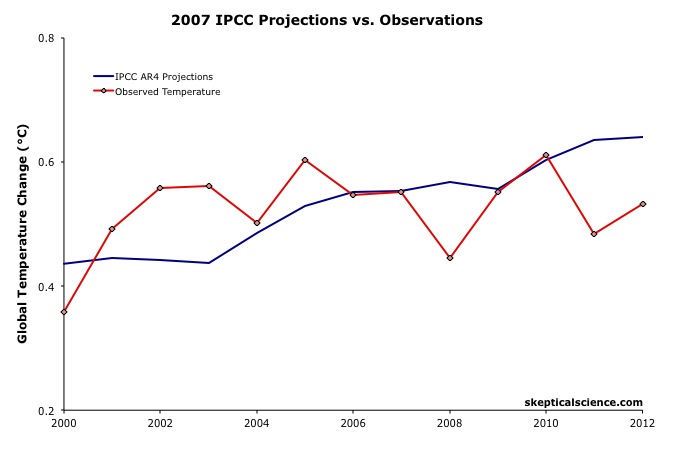
(And 3 feet of sea level rise in just 5 years? I seriously cannot see this happening even in the worst case scenario.)
lunatica
(53,410 posts)and being sarcastic. But the fact it is so far in the future for those of us who are getting older today should be no reason to ignore it. I just wonder about people today who are celebrating the birth of their grandchildren like it's business as usual.
AverageJoe90
(10,745 posts)Sorry about that, then.
lunatica
(53,410 posts) nyliberal59255sd
(1 post)I remember a few years ago that the sea level would increase by 1 ft by 2100, which would still do plenty of damage. 3 feet? I can't even imagine the catastrophe that would occur.
RobertEarl
(13,685 posts)Last edited Mon Jan 7, 2013, 11:04 PM - Edit history (1)
Did you know it was just within the last 1k years that Antarctica has been iced over? Saw a map of the continent showing coastal rivers and a split land base where the WAIS is now. On Edit: Looked closer at the map on my pc... showed a glacier over the 'split land base'. How high? IDK. Maybe just ice at sea level? It was centered on the south pole, tho.
When all that ice melts, as it is really recent ice, this world will have changed, again.
AverageJoe90
(10,745 posts)If I misunderstood something, please do clarify.....
RobertEarl
(13,685 posts)Shocking, isn't it?
No one really knows what Antarctica really looked like 1,000 years ago. But the ancient map showed it with coastal rivers. Which would mean that Antarctica is now coming out of an ice age? It happens.
muriel_volestrangler
(106,492 posts)RobertEarl
(13,685 posts)And the layout of the continent was the same as today. Now how was such a map produced? The thought is that it was copied from a map made circa 600ad.
AverageJoe90
(10,745 posts)Yes, it's true that the idea of a southern continent is as old as the republic, but it wasn't actually discovered until 1773.....by James Cook.
RobertEarl
(13,685 posts)Wait... you are being serious, right?
I guess since America wasn't 'discovered' until the 1500's it did not exist, either? How about the Incas, did they exist before they were discovered?
Don't tell me you are one of those who thinks the world is just 6000 years old, please don't.
muriel_volestrangler
(106,492 posts)We say somewhere is discovered when people get to it (not penguins). So the Americas were indeed discovered when the first people got there 12,000 (or whatever the latest estimate) years ago. But, and I really hope you knew this already, Antarctica doesn't have any indigenous people. No-one lived on it, or visited it. It is well beyond the horizon from Tierra Del Fuego, across an extremely rough ocean that people did not have good enough ships to navigate east-to-west until the 16th century. Going further south was even harder. The ice gets in the way.
Read the Wikipedia entry: http://en.wikipedia.org/wiki/History_of_Antarctica
The Antarctic mainland was not seen until 1820.
The 'map' you saw from the 1500s was a complete guess. It was not accurate. And you have no reason to think it dates from 600AD, or any other time. Perhaps it was the Oronce Fine one, which makes an Antarctic continent far too large, perhaps including a bit of coast of Australia, and reaching up to as far north as Madagascar:

http://xoomer.virgilio.it/dicuoghi/Piri_Reis/Finaeus_eng.htm

Release The Hounds
(467 posts)until I hear from Glen Beck.
(Sarcasm)

geomon666
(7,519 posts)Suck it future generations!
AverageJoe90
(10,745 posts)geomon666
(7,519 posts)It takes that special something out of it if you tell everyone upfront you're being sarcastic.
AverageJoe90
(10,745 posts) Agschmid
(28,749 posts)Good article (but lengthy!): http://www.int-res.com/articles/cr/18/c018p205
Good interactive NY Times tool (this one is just a bit scary!): http://www.nytimes.com/interactive/2012/11/24/opinion/sunday/what-could-disappear.html
Boston w/ 25ft sea level rise!


raouldukelives
(5,178 posts)Hopefully the corporations have a good contingency plan for us to deal with all the destruction heaped upon us by out of control speculation.
I'm sure they must, otherwise, how could anyone with a speck of empathy towards wildlife or future life on this planet support Wall St?
But I've met some. They are good people and I know they want whats best for everyone. So the prudent thing would be for us all to just turn over what is left to them right away for all of our sakes. They know they right thing to do. Millions of ardent supporters can't be wrong.

RebelOne
(30,947 posts)I along with my children and grandkids won't be alive then.
yardwork
(69,524 posts)I hope that my (as yet unborn) grandchildren will still be alive then, along with their children and children's children. And I hope that the world is a good place for them to live. In any case, it's not going to be wonderful right up to 2100. If the sea level rises 3 feet by 2100, it's going to be halfway there in 2063. Or worse.

DreamGypsy
(2,252 posts)Definition of DELUGE
1 a : an overflowing of the land by water
b : a drenching rain
2: an overwhelming amount or number
At the way the earth was abused
By the men who learned how to forge her beauty into power
And they struggled to protect her from them
Only to be confused
By the magnitude of her fury in the final hour
And when the sand was gone and the time arrived
In the naked dawn only a few survived
And in attempts to understand a thing so simple and so huge
Believed that they were meant to live after the deluge
Bon voyage everyone.