General Discussion
Related: Editorials & Other Articles, Issue Forums, Alliance Forums, Region ForumsWhenever labor’s share of income rises a bit, they hold a recession
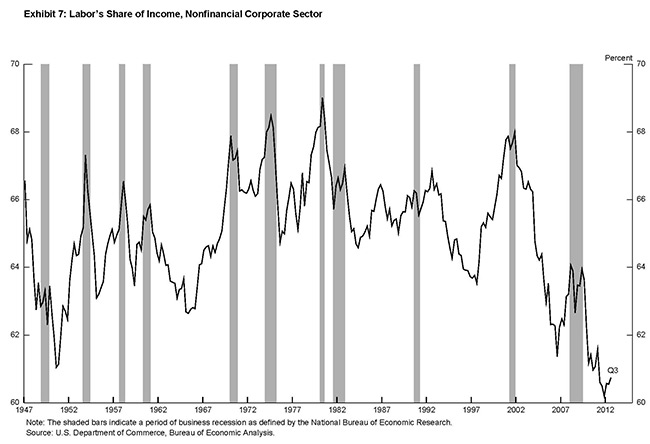
So all you economists out there, tell me why this doesn’t show what I think it does: whenever labor’s share of income rises a bit, they hold a recession. Which takes care of that problem quite nicely.
http://stopmebeforeivoteagain.org/2013/02/riddle-me-this-batman/
Dunno about the hypothesis in general, but I'm personally convinced that the Volker recessions were caused knowingly and deliberately, and specifically to crack down on labor and weed out small businesses.
”… as profit rates fall in the productive sectors of an economy, capitalists begin to shift their investable funds out of reinvestment in plant, equipment and labour power, and instead seek refuge in financial assets.
To fulfil their new role as not only store of value but as investment outlet for overaccumulated capital, those financial assets must be increasingly capable of generating their own self-expansion, and also be protected (at least temporarily) against devaluation in the form of both financial crashes and inflation.
Such emerging needs mean that financiers, who are after all competing against other profit-seeking capitalists for resources, induce a shift in the function of finance away from merely accommodating the circulation of capital through production, and increasingly towards both speculative and control functions.
The speculative function attracts further flows of productive capital, and the control function expands to ensure the protection and the reproduction of financial markets. Where inflation may be a threat, the control functions of finance often result in high real interest rates and a reduction in the value of labour- power (and hence lower effective demand).”
http://www.marxmail.org/faq/overproduction.htm
 = new reply since forum marked as read
Highlight:
NoneDon't highlight anything
5 newestHighlight 5 most recent replies
= new reply since forum marked as read
Highlight:
NoneDon't highlight anything
5 newestHighlight 5 most recent replies
OffWithTheirHeads
(10,337 posts)
Prometheus_unbound
(57 posts)You make it sound like it is
1) A concerted and deliberate effort
2) A secret
It is no such thing. You live in an economic system based on profit. Whenever the investors feel they aren't profiting enough (i.e. high wage share), they fire workers and stop investing. This requires no organisation at all, just the sum of individual actions, although, yes, monetary policy does occasionally create deliberate recessions (1970, 1982, 1991, 2001 were deliberate; 1954, 1958, 1961, 1974-75, 1980 and 2008 weren't) when wages or prices seem to be rising too fast.
I do not disagree with the post, but I think that to treat things like a sort of conspiracy is kind of naive and optimistic: it assumes that people need to hide in order to do bad things. But this is not the case. They can do selfish, socially disruptive things in the open, and anyone who cares to examine the matter will know. Indeed, our economic system is built on this premise.
HiPointDem
(20,729 posts)cali
(114,904 posts)but they really don't explain much of anything.
HiPointDem
(20,729 posts)
bemildred
(90,061 posts)When the situation is inflationary (bubbles), you want to hold hard assets and sell near the top. When the situation is deflationary, you want to have that cash and buy up those hard assets at low prices near the bottom.
When they say "buy low, sell high", they mean them, not you, you get to do the opposite.