General Discussion
Related: Editorials & Other Articles, Issue Forums, Alliance Forums, Region ForumsThis message was self-deleted by its author
This message was self-deleted by its author (bigtree) on Sun Mar 17, 2013, 04:21 PM. When the original post in a discussion thread is self-deleted, the entire discussion thread is automatically locked so new replies cannot be posted.
 = new reply since forum marked as read
Highlight:
NoneDon't highlight anything
5 newestHighlight 5 most recent replies
= new reply since forum marked as read
Highlight:
NoneDon't highlight anything
5 newestHighlight 5 most recent replies

cantbeserious
(13,039 posts)eom
randome
(34,845 posts)It may depend on what region you live in. Obviously more jobs are being created. And obviously the 1% are doing better than the rest of us. But things ARE improving. And I think the GOP is losing steam and we will see more equitable tax rates soon.
Not soon enough, of course.
cantbeserious
(13,039 posts)eom

bigtree
(94,702 posts). . . and it isn't as if there's a dearth of discussion out here about the folks still hurting.
I really don't see the purpose or value in dismissing economic news like this out of hand. It is possible to recognize the faults and challenges of our economy and still acknowledge where we've improved.
nadinbrzezinski
(154,021 posts)It is at the core of the engine. You dismiss that at your peril. Thankfully responsible economists are not.
cantbeserious
(13,039 posts)eom
bigtree
(94,702 posts). . . repelling consumers.
cantbeserious
(13,039 posts)eom
bigtree
(94,702 posts). . . taxes coming due; lack of holiday or seasonal business.
Besides, this report notes that overall spending hasn't taken a hit. Pointing to Walmart to refute that may be anecdotal, but it's hasn't translated in to a spending downturn across the board of U.S. businesses.
cantbeserious
(13,039 posts)Without Consumers, There Is No Recovery!
bigtree
(94,702 posts). . . although business orders in response to that consumer demand certainly play an important role.
And, don't forget about the effect of government spending.

Ikonoklast
(23,973 posts)Almost every retailer showed a lousy February.
You should have such a terrible month as they had.
cantbeserious
(13,039 posts)eom
Ikonoklast
(23,973 posts)If you really want to see how the economy is faring, look to Shipping, especially spot market rates and capacity percentage rates, both up signifigantly the first quarter.
cantbeserious
(13,039 posts)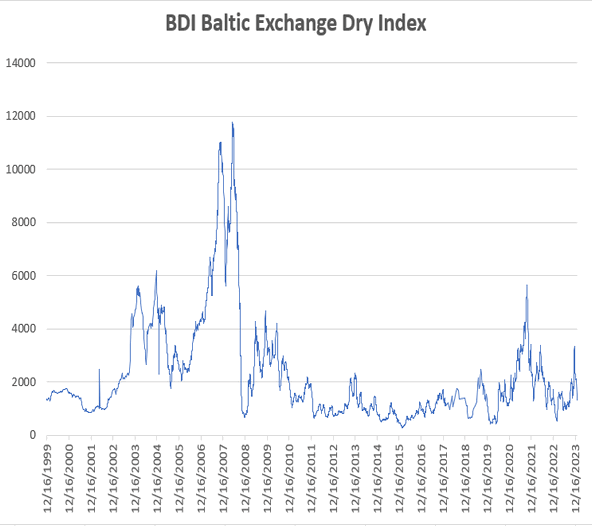
Ikonoklast
(23,973 posts)Look to truckload and railcar capacity, and domestic port export activity, in *this* country.
I don't care much if South Africa isn't shipping chrome ore to China on a bulk freighter.
The Baltic Dry graph shows where massive speculation in bulk commodities will get you.
cantbeserious
(13,039 posts)eom
HiPointDem
(20,729 posts)their sales were below trend, that's the point.

iemitsu
(3,891 posts)without a catastrophic hit to the economy, in fact the economy seems to be doing a bit better. Imagine what might occur if we taxed the rich? The economy would be booming.

jsr
(7,712 posts)to prevent such a tragedy from happening.
bigtree
(94,702 posts). . . more revenue helped the economy improve. That's a no-brainer for most of us. Congress, on the other hand, lives in an alternate, fantasy, reality.
cantbeserious
(13,039 posts)bigtree
(94,702 posts). . . and, even he's reluctant to be overly pessimistic.
" . . . he believes a 'perfect storm' is still possible in 2013"
cantbeserious
(13,039 posts)In other words, all the unemployed workers have ever more competition.
Slow growth is no growth at the worker level.
One again, only the 1% benefit.
bigtree
(94,702 posts). . .just that we look to be heading in the right direction. And, I'm always amazed how quickly some dismiss the jobs created. All of these effects of the economy don't all fall on just one individual. More than the 1% are benefiting; as is the case in most any recovery.
Now, if we can get these republicans to do something more than just oppose this President . . .
cantbeserious
(13,039 posts)eom
dkf
(37,305 posts)As public debt in advanced countries reaches levels not seen since the end of World War II, there is considerable debate about the urgency of taming deficits with the aim of stabilizing and ultimately reducing debt as a percentage of gross domestic product.
Our empirical research on the history of financial crises and the relationship between growth and public liabilities supports the view that current debt trajectories are a risk to long-term growth and stability, with many advanced economies already reaching or exceeding the important marker of 90 percent of GDP. Nevertheless, many prominent public intellectuals continue to argue that debt phobia is wildly overblown. Countries such as the U.S., Japan and the U.K. aren’t like Greece, nor does the market treat them as such.
Indeed, there is a growing perception that today’s low interest rates for the debt of advanced economies offer a compelling reason to begin another round of massive fiscal stimulus. If Asian nations are spinning off huge excess savings partly as a byproduct of measures that effectively force low- income savers to put their money in bank accounts with low government-imposed interest-rate ceilings -- why not take advantage of the cheap money?
Although we agree that governments must exercise caution in gradually reducing crisis-response spending, we think it would be folly to take comfort in today’s low borrowing costs, much less to interpret them as an “all clear” signal for a further explosion of debt.
http://mobile.bloomberg.com/news/2011-07-14/too-much-debt-means-economy-can-t-grow-commentary-by-reinhart-and-rogoff.html
Carmen Reinhart and Kenneth Rogoff have spent countless hours studying financial crises and debt bubbles. And unfortunately for those with an upbeat economic forecast, their news is not good. For one thing, they expect growth to remain challenged for a long time, thanks in part to the aftermath of the debt binge of the 2000s. "In the advanced economies, think of trend growth being a percentage point lower for a decade more, possibly even two decades more," says Rogoff, a Harvard economics professor who in 2009 co-authored This Time Is Different, with Reinhart, who teaches about the international financial system at Harvard's John F. Kennedy School of Government. The two recently came to Manhattan, where they had a lively discussion with a Barron's editor. They agree that the proper regulatory framework to prevent another severe crisis is achievable. "But can we stay there?" Reinhart asks. For the answer to that question and many others, read on.
http://online.barrons.com/article/SB50001424052748703961304578128861988425802.html#articleTabs_article%3D1
cantbeserious
(13,039 posts)
dkf
(37,305 posts)And I don't see why that proves or even supports your point.
cantbeserious
(13,039 posts)eom
dkf
(37,305 posts)Historically large public debt is correlated to lower growth rates.
cantbeserious
(13,039 posts)cantbeserious
(13,039 posts)cantbeserious
(13,039 posts)cantbeserious
(13,039 posts)graham4anything
(11,464 posts)LBJ once famously said "If tomorrow, I walked across the water, the press (naysayers) would say LBJ can't swim".
cantbeserious
(13,039 posts)
FarCenter
(19,429 posts)cantbeserious
(13,039 posts)eom
dkf
(37,305 posts)No point in arguing it when the numbers will be coming in.
cantbeserious
(13,039 posts)Probably spoken by those that have never been unemployed.
dkf
(37,305 posts)cantbeserious
(13,039 posts)eom
FarCenter
(19,429 posts)cantbeserious
(13,039 posts)eom