General Discussion
Related: Editorials & Other Articles, Issue Forums, Alliance Forums, Region ForumsDoes studying science make you a better person?
That’s the implication of newly published research, which finds people who study science — or who are even momentarily exposed to the idea of scientific research — are more likely to condemn unethical behavior and more inclined to help others.
http://www.salon.com/2013/03/23/does_studying_science_make_you_a_better_person_partner/
Research that comes up with conclusions that agree with my own preconceptions is my favorite kind!
 = new reply since forum marked as read
Highlight:
NoneDon't highlight anything
5 newestHighlight 5 most recent replies
= new reply since forum marked as read
Highlight:
NoneDon't highlight anything
5 newestHighlight 5 most recent replies

MineralMan
(152,073 posts)for determining causes and effects. To that extent, I think it does encourage rational thinking about stuff. That's always good.

DavidDvorkin
(20,778 posts)There's also the type of mind that's drawn to science in the first place. That might be a factor, too.
MineralMan
(152,073 posts)Science always attracted me, although I went in a different direction with my career. My father is and was one of the most logical people I've ever known. He was an auto mechanic by trade, and a brilliant diagnostician. He taught me the process he used to correctly determine what was wrong with a system. It was crucial to his making his auto shop successful.
So, maybe I inherited some of that, but I doubt it. I think an emphasis on logical processes is learned. So, yes, I was drawn to the sciences, and away from more intuitional pursuits, but I think it was a learned thing, rather than an inborn one.
I was the kid whose parents explained the difference between the concept of Santa Claus and the reality by the time I was three. Of course, that made me the kid who explained that in Kindergarten and got lots of people ticked off, too. 

AikidoSoul
(2,150 posts)Last edited Mon Mar 25, 2013, 01:27 PM - Edit history (1)
Permit me to make a bet on how he did this....and I do think this is a process that is extremely important, and almost totally neglected in educational institutions, and even with parents teaching kids how to think at an early age. I do believe that intuition is important... if coupled with at least some thinking skills that can be taught, and can before part of that person's "toolkit" for life. Children are not taught that their exquisite brains are tools and that the goal is to use our brains as effectively as possible so that they don't just make associations in a linear way, and good but are trained to develop thinking skills that regularly go outside the narrow path of linear thinking.
Lateral thinking is an actual area of study, a method, created by Dr. Edward DeBono. He was able to get the Brazilian government to teach it to kids before the age of six. If I was able to, I'd get this country to teach the method to kids in pre-kindergarten... when their brains are the most open and able to develop thinking habits.
Frankly I wish all Democratic Party leaders would take these courses and then practice them. It might even be fun and useful to develop a group here on DU that takes these courses online and then discuss them....and THEN....WE CAN CITE PROBLEMS THAT NEED TO BE SOLVED....AND SEE WHAT WE COME UP WITH. HOW FUN AND EXCITING MIGHT THAT BE???!!!!
http://www.edwdebono.com/debono/lateral.htm
http://www.debonogroup.com/?gclid=CO22qpmfmLYCFQ6ynQoddQ0A5w
http://www.lateralthinkingonline.com/Lateral_Thinking.asp?MerchantID=32667&AdID=579621&mm_campaign=5e44343120aa94d4c309a4b74ebb70e0&mm_replace=true&gclid=CKv0m5afmLYCFQ7znAodliAAzg

MineralMan
(152,073 posts)thinking a lot. However, the problem diagnosis system my father used and taught me worked differently than lateral thinking. It was a system that began with the symptoms of the problem. Since he was an auto repair person, that was the system.
Given the symptoms, he would begin by first determining which of the many systems on an automobile was the location of the symptoms. That was generally simple, although some symptoms, like noises in a vehicle can have more than one possible system where the noise is located.
Once the subsystem was located, the nature of the symptoms were examined. For example noises in automobiles are almost never constant. They change. Whether a noise changed according to engine speed, driveline speed, or wheel speed was often one of the factors that was used to narrow down the nature of the symptom. Even within the engine itself, noises can be narrowed down to ones that involved crankshaft speed or valve train speed, which in most engines is half of engine speed.
Once the nature of the symptoms was clear, the process continued, using simple elimination. Given the location of a symptom or symptoms, a list of possible causes is pretty easily determined. By eliminating those possible causes, one by one, using details of the symptoms, along with other symptoms that would be generated by each cause, you end up with the single component or situation that is the cause of the symptom or group of symptoms. Correct that and the problem is solved.
For my father, this was usually a very quick process, since he had solved most automotive problems already many times and the exact nature of the problem symptom generally led to a quick solution. But, as he taught me and my siblings the process, he'd slow it down and guide us through a particular problem and its solution.
It wasn't long before we all learned that this system applied to almost anything we encountered where a problem occurred. From cars and other mechanical systems to health issues and even personal and psychological problems, the same system led to identification of the particular thing that was the source of the problems. That usually led to a solution.
Lateral thinking comes into play when a problem or thing needing a solution isn't limited to a single part of the system, but requires a broader examination of that system and possibly a redesign. It's also a very useful method when it can be applied.
AikidoSoul
(2,150 posts)we do here. What your dad did in the auto repair business is similar to what we do here in the computer services business. That is to diagnose an existing system by referring to patterns that we are already aware of. Problems can be identified by using systematic investigatory protocols.
What I'm talking about is a bit different and pardon, but I should have been more specific. I've read a lot of your posts over the years, and have long thought that you are capable of lateral thinking because of the way you sometimes come at a problem from a sideways position...looking at the situation in a non-linear manner.

MineralMan
(152,073 posts)I appreciate it.
AikidoSoul
(2,150 posts)and the affiliations, conflicts, etc. of the scientists and researchers. It is astonishing how much research is conducted by those actually invested in a profit making venture having to do with the outcome of the research....i.e. drug research, chemicals, and medical devices.... a short list, but you get the picture.
The people who dig deeply into the fuller picture of the scientific research and its participants, are much more likely to dig into the truth of many things.
Fortunately, I know many such people.... and some of them are here on DU.
Hugs to youse guys....you know who you are!

FarCenter
(19,429 posts)In particular, the estimation of error, how error is compounded in calculations, sample sizes needed for given levels of confidence, etc.
This is a necessary companion to logical thinking that prevents overly dogmatic approaches.
DavidDvorkin
(20,778 posts)
Fumesucker
(45,851 posts)I'm reminded of this.

Brigid
(17,621 posts)Ivory tower vs. Real world!

Blanks
(4,835 posts)I don't need no study to prove it.
I'm just trying to be ironic.

GoneOffShore
(18,038 posts)
Wounded Bear
(64,860 posts)IMHO it's more about being reality based rather than mystical....
Don't get me wrong, I think the world needs some mythological thinking for balance and learning. The symbolism in the old stories and tales can teach us important psychological lessons.
BUT, science teaches people to dig for the reality behind what happens in the real world. Frankly, it teaches far more humility about what we know than any 'revealed' religion allows. It teaches people to separate opinion from fact and to know how each applies in situations. And it asks people to prove what they are presenting in a way that others can understand and replicate.
Just because we don't know how something works doesn't make it a miracle.

progressoid
(53,578 posts)



JDPriestly
(57,936 posts)dkf
(37,305 posts)The helical model - our solar system is a vortex - YouTube
► 3:21► 3:21
Aug 25, 2012 - Uploaded by DjSadhu
Sign in to YouTube. Sign in with your YouTube Account (YouTube, Google+, Gmail, Orkut, Picasa ...
progressoid
(53,578 posts)
dkf
(37,305 posts)It's too bad we don't get more exposure in day to day entertainment.
Your post was outstanding btw. I would love to show it to the kids but the explanations on my part would be sadly deficient.
I sincerely hope they come out with more of a science education than I did.
AikidoSoul
(2,150 posts)of what are sometimes referred to as "chemtrails" (MANY people on DU don't think they exist...but keep your mind open and read Teller's own paper and article on that very topic below). He was RayGun's favorite scientist... probably because he was a strong supporter of his "Star Wars" agenda.
I think Teller was an exceptionally arrogant sociopath!

RE: "Chemtrails": In 1998 he wrote article for Hoover Institution where he was a fellow. It was originally called "Sunscreen for Planet Earth" but appeared later in the Wall St. Journal called under the title "The Planet Needs a Sunscreen." The idea was to reduce carbon's heat impact upon the earth by putting dumping particles such as aluminum oxide and other types, into the upper atmosphere.
Though he organized a science conference on this topic in 1997 in Erice, Italy, he would not admit publicly that global warming existed. He was very cagey about this. He didn't want to anger his political / economic supporters. When referring to global warming he would only say that "if it exists" one could mitigate the problem by releasing "small particles" into the atmosphere and that heat would be reflected back into the sky, and that the earth's temperature could be reduced by a small percentage as follows:
*****************************
"Sunscreen for Planet Earth"
http://www.hoover.org/publications/hoover-digest/article/6791
EDWARD TELLER
Sunscreen for Planet Earth
GLOBAL WARMING IS TOO SERIOUS TO BE LEFT TO THE POLITICIANS. HEREWITH A SCIENTIFIC SOLUTION TO THE PROBLEM. (IF THERE IS A PROBLEM, THAT IS.)
Society's emissions of carbon dioxide may or may not turn out to have something significant to do with global warming--the jury is still out. As a scientist, I must stand silent on this issue until it's resolved scientifically. As a citizen, however, I can tell you that I'm entertained by the high political theater that the nation's politicians have engaged in over the last few months. It's wonderful to think that the world is so very wealthy that a single nation--America--can consider spending $100 billion or so each year to address a problem that may not exist--and that, if it does exist, certainly has unknown dimensions.
SNIP.......
In 1979, physicist Freeman Dyson, in his characteristically prescient manner, proposed the deliberate, large-scale introduction of such fine particles into the upper atmosphere to offset global warming, which he thought even then would eventually become a human concern. Some of my colleagues and I have recently surveyed the current technological prospects for such an introduction. We estimated the costs involved and presented our results last August at the Twenty-second International Seminar on Planetary Emergencies. The most expensive such "geoengineering" option appears to be the one long ago proposed by Mr. Dyson, which may cost as much as $1 billion a year. More technologically advanced options along the same lines might cost $100 million.
SNIP
Yet if the politics of global warming require that "something must be done" while we still don't know whether anything really needs to be done--let alone what exactly--let us play to our uniquely American strengths in innovation and technology to offset any global warming by the least costly means possible. While scientists continue research into any global climatic effects of greenhouse gases, we ought to study ways to offset any possible ill effects.
Injecting sunlight-scattering particles into the stratosphere appears to be a promising approach. Why not do that?
Reprinted from the Wall Street Journal, October 17, 1997, from an article titled "The Planet Needs a Sunscreen." Used with permission. C 1997 Dow Jones & Company, Inc. All rights reserved.
Also available from the Hoover Press is the Essay in Public Policy Environmental Fundamentalism, by Thomas Gale Moore. To order, call 800-935-2882.
Edward Teller was a senior research fellow at the Hoover Institution.
His ideas on this topic were later badly reported by CBS News:
http://www.cbsnews.com/stories/2001/01/15/archive/main264362.shtml
Teller co-authored a white paper with two other scientists on the topic of "scattering" particles into the atmosphere. No part of the paper can be quoted according to the authors, so to read any of it you have to go to the full paper accessed here in pdf file format:
http://rense.com/general18/scatteringEdTellerwithnotes.pdf

"Mad Scientist" gets a much deeper meaning when I think about Edward Teller.
True horrors can be created by such a mind. I would not describe Teller as a "good person"! So....noooooo..... studying science doesn't necessarily make you a better person.

laundry_queen
(8,646 posts)There are some parts that aren't so cool - I could do without counting fruit flies. There was always someone who didn't chloroform them properly. 
But overall, yes, cool stuff. I miss it. (well, not the fruit flies. Or cutting up giant clams with green ooze...)

liberal_at_heart
(12,081 posts)Stereotypes and prejudices are only dispelled when people get to know each other. People learn that someone who is different than they are, are more like they are then they ever imagined. They learn to empathize and have compassion. I guess you could learn about a group of people by learning about sociology but it is the act of personal interaction that really makes you learn and become a better person. I love learning about science. I always wanted to be a biologist. But I don't think it is what makes people better people.

uponit7771
(93,533 posts)...accept truths and facts like normal adults
MineralMan
(152,073 posts)at things objectively, which also accomplishes similar things. If you look at people, for example, from an objective point of view, it's clear that there are far more similarities among people than differences. It's hard to maintain bigotry when you see that people are pretty much the same in most respects.
Science is really just a system for looking at things.
AikidoSoul
(2,150 posts)I would add that to "know" a person means the ability to get in that person's shoes. Open mindedness and compassion have a lot to do with making that happen. Many people claim to "know" another, and may even spend years with that person, but their opinions of them show a narrowness of thinking and ugly prejudices that can do great harm.
YoungDemCA
(5,714 posts)nt
gulliver
(14,160 posts)Science is only one way to get it, but it is a good way, imo.
liberal_at_heart
(12,081 posts)"Be like the water my friend." - Bruce Lee

Zoeisright
(8,339 posts)You can see through bullshit and lies and actually understand what's going on.
Apophis
(1,407 posts)Zoeisright
(8,339 posts)eliminate preconceptions and bias. Your last sentence does not apply to science when practiced correctly.
DavidDvorkin
(20,778 posts)I do tend to react that way, but I'm well aware that that's bias, not objetivity.
Tierra_y_Libertad
(50,414 posts)Making the study of science the guidepost is a rather narrow benchmark for personhood.

bhikkhu
(10,789 posts)I don't think you can study philosophy or history without studying science, and even good literature involves quite a bit of "science of the mind" at its core. Its all good, and whatever angle of approach is taken, you wind up with a better understanding of the world, and you wind up a better person than you would be otherwise.
"Than you would be otherwise" being a necessary caveat. Not all science and not all practitioners are "good".
liberal_at_heart
(12,081 posts)are 'good'". I agree. I think sometimes people let their pride get the better of them and they start thinking they are better than other people. Just as you can have arrogant religious people, you can also have arrogant scientific people. Humility is also a good quality in a person and you can learn that from many different things and experiences.
progressoid
(53,578 posts)It would be nice to have similar work for other areas of study. And perhaps education in general.
Generation_Why
(97 posts)awoke_in_2003
(34,582 posts)but, really, I think all are equally important for making a well rounded mind. Welcome to DU 

Nevernose
(13,081 posts)Because I am fully prepared to argue that a poet is just as important as a physicist.
Art_from_Ark
(27,247 posts)There is nothing inherently good or bad about science-- it is basically the pursuit of physical truths, often with no moral compass. This has resulted in inventions and discoveries that can benefit humanity, but also immeasurably harm humanity.
AikidoSoul
(2,150 posts)not designed for the environment, or to promote real health.
AikidoSoul
(2,150 posts)poetry and science.
He/she asked a legitimate question about a narrow topic.
And I do agree with you that BOTH poets and scientists have contributed much to making the world a better place.
Probably poets more so... because many scientists are "LIARS FOR HIRE" these days... like those who work for Monsanto.
But the poster was not talking about those folks... I think it was a sincere question, because if you seriously "study" science... you are likely looking for how to get to the truth of things. A poet does the same thing but in his/her own way.
This thread was not asking about whether you're better person if you study poetry.
DavidDvorkin
(20,778 posts)Yes.
In my experience, people in the sciences tend to straddle both worlds. In their private lives, they're deeply interested in the arts.
Nevernose
(13,081 posts)However, I totally agree with you.
I actually teach poetry, but my students become most fascinated when I go off on a scientific tangent, explaining how thorium reactors work or explain how airplanes fly or how mitochondrial DNA is used in the study of evolution. In fact, I would've been a science teacher had I possessed the slightest ability to process higher math.
There's just as many "poets" for hire, though: Paul Ryan has to get his speechwriters from somewhere, right?
AikidoSoul
(2,150 posts)Bobby Kennedy when he was in Indianapolis shortly after Martin Luther King was murdered, and when standing on the back of a flatbed truck, how he quoted the words of the great poet Aeschylus to calm the crowd. I would also comment that Kennedy's own words about his own brother's murder, had a poetic quality.
He said:
"For those of you who are black and are tempted to ... be filled with hatred and mistrust of the injustice of such an act, against all white people, I would only say that I can also feel in my own heart the same kind of feeling," he said. "I had a member of my family killed, but he was killed by a white man."
He went on to say, "My favorite poem, my — my favorite poet is Aeschylus," "and he once wrote:
Even in our sleep, pain which cannot forget
falls drop by drop upon the heart,
until, in our own despair,
against our will,
comes wisdom
through the awful grace of God.
It has been written that while other American cities rioted and burned after King was killed, there was no violence in Indianapolis.
The poem by Aeschylus is on my fridge, and I always get goose bumpy when I read it.

Sgent
(5,858 posts)but more than likely Philosophy is one of the few liberal arts disciplines which train you how to think. The other liberal arts give you context and information to put into the process, but they do not teach you how to apply that information by themselves.
liberal_at_heart
(12,081 posts)I agree. Making any one thing a bench mark is rather narrow. I like your point that it is usually many things which makes us better.

Igel
(37,704 posts)And it doesn't involve a benchmark of "personhood."
However, the study itself looked at kids from a bunch of majors. Science maors stood out. Humanities and social science majors didn't.
There are good reasons for this.
Tierra_y_Libertad
(50,414 posts)Obviously, they left out science majors in the stripe of Werner von Braun and Mengele.
When I was protesting for civil rights and against the war in Vietnam with other students, Science majors (along with business majors) were notably absent.

Posteritatis
(18,807 posts)
blackspade
(10,056 posts)And this is the type of research that asshats like Coburn want to cut from NSF.
Generation_Why
(97 posts)Like the bullshit of religion, eastern medicine, new age quackery, astrology, etc.
AikidoSoul
(2,150 posts)write off eastern medicine as much of it is very effective, and a lot cheaper than Western style medicine.
"New Age quackery"? Some so called "New Age" ideas are astonishingly smart, effective, and very inexpensive.
Quantum Touch is a good example. Say you have crippling back pain. You pay the QT tech $50.00, and one hr. later throw the crutches in the back seat of the car and drive home with 95% of the pain gone. My own M.D. goes to this QT guy for severe back pain. So do my friends, and so do I. QT works!
The thing is, that anyone can learn the QT technique.... even a child. Nobody has any special "Powers"...but are simply technicians that learn the techniques and the discipline of "direction and intent" which directs healing energy into the body. QT is especially effective for back and bone pains.
Too weird for you? Go ahead and close your mind. If you ever have severe back pain however, instead of having a $30,000 back operation, why not fork the $50.00 and give it a try?
Astrology? It's survived for many thousands of years and has been used by millions of people who would disagree with you. Personally I think there's something to it. I hired an excellent astrologer years ago and she predicted exactly what my life would be like, and the kind of chronic illness I would suffer from later in life. Nothing in my life at the time ever suggested that this was possible, but it all came true. I know reputable business leaders and even scientists, who employ high quality astrologers and swear by them, and make decisions based on their advice.
The world and its extremely complex energies and forces are much more than our tiny minds can fathom... so don't be so quick to piss on them.

Phillip McCleod
(1,837 posts)i don't think you proved the point that you intended to prove.
quantum touch is most assuredly 'quackery' whether it supposedly worked for you or not. astrology is not just quackery, it's insultingly absurd. it's absolutely insulting to ask any modern educated person to give astrology even one second of respect.
hello? mercury in retrograde? galileo spent his last years imprisoned for proving precisely that it's mercury NEVER goes into 'retrograde' and that, in fact, 'retrograde' is an absurd concept.
astrology is based on a geocentric cosmogony. anyone who believes loses.. and deserves to lose.. much of my respect.
LanternWaste
(37,748 posts)And politics. Always add politics as number one to any list of Misinformed Bullshit Opinions, as politics (just another imaginary construct) control our lives to a degree that religion of philosophy could only dream of.
But then I do realize that many people, while scoffing at one set of make-believe constructs, embrace another without even realizing the idiocy of all of them.

valerief
(53,235 posts)when you're smarter, you recognize that you benefit, long-term, from contributing to the common good, as opposed to only taking from it.

demosincebirth
(12,847 posts)like at the local soup kitchens and homeless men centers here in dear ol' Oakland. Just common ol' folks like me.
valerief
(53,235 posts)
liberal_at_heart
(12,081 posts)This is one of the things wrong with politics. Politicians live in their own little bubble, in their expensive houses and car. They get to give themselves raises and take lobby money. Sometimes they vote for the poor, most of the time they don't. But most do not actually get out and help the poor on a one on one personal basis. Sometimes it takes getting out into the soup kitchens to fully understand the problems of the poor.
JI7
(93,908 posts)and then support politicians and policies which hurt the poor.
liberal_at_heart
(12,081 posts)some food. There are lots of poor people who both receive government assistance and go to the food bank or a shelter to get food. Why pick one or the other? Why not vote for the poor and volunteer to actually physically give food to the poor? They are in desperate need of both.
demosincebirth
(12,847 posts)in the trenches.

Duer 157099
(17,742 posts)Most that I know "volunteer" a whole bunch of their free time doing research, which is the best use of their time.
Not everyone has to do everything. Why would you want someone that is working on a cure for a disease to take a break from that to volunteer in a soup kitchen? Just think about it for a moment.
liberal_at_heart
(12,081 posts)serve some food. I myself am an extreme introvert. I have social anxiety issues. My husband is usually the one volunteering us for things. I am usually a little nervous before, but when it is over it feels wonderful to have had the chance to hear people's stories, laugh with them, and share some good food.
valerief
(53,235 posts)Not everyone lives or works near a soup kitchen.

quaker bill
(8,268 posts)but I have been volunteering and organizing volunteers for 20 years at the homeless mens shelter. I am otherwise a professional wetlands ecologist.
demosincebirth
(12,847 posts)
OriginalGeek
(12,132 posts)for the 2 day weekend. I saw some show this weekend about chocolate and it seems that Quaker-owned chocolate factory Cadbury was the first to utilize a 5 day work-week and made it a priority to pay their people a living wage.
Also thank you for helping with both wetlands and homeless men.
quaker bill
(8,268 posts)We also did racially integrated co-educational public schools (well before the civil war). WE tend not to focus too much on what our forebearers accomplished, it can sound a bit overbearing.

Hissyspit
(45,790 posts)How do you know?

Cleita
(75,480 posts)demosincebirth
(12,847 posts)
chervilant
(8,267 posts)I saw a visual post from GOPstoppers that features a big pic of Rachel Maddow and her degrees (PhD from Oxford in PoliSci!) with smaller pics below of my least favorite college dropouts: Rush Limbaugh, Sean Hannity, and Glenn Beck.
The comments about this visual post support the findings of the research you've cited.
Richard Hofstadter's essays on anti-intellectualism are more relevant today than when he wrote them!

ananda
(35,838 posts)Not in any way.
markiv
(1,489 posts)(and yes, i studied science)
these studies say anything and everything, and constantly contradict themselves

DreamGypsy
(2,252 posts)...is that correlation does not imply causality.
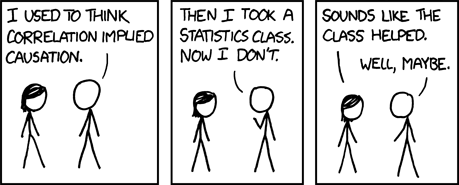
Here's an interesting blog on the topic Human Beings Believe in Cause & Effect as a Survival Strategy:
It is in this same realm that we often run into the confusion of pseudo-science that tries to pin everything on cause and effect or something else entirely. Pseudo-science almost always boils down to someone claiming cause and effect, where what they might be really be observing is simply an unexamined or unexplained relationship between two events or two occurrences. Part of the job of science is to provide a systematic methodology to tease out what these relationships are. In fact, science is aimed at mastering these observed relationships so that we can make “predictions.”
Thanks for the post, DD.

BainsBane
(57,819 posts)or at least gives you the opportunity to become a better person. That education should include science, history, literature, philosophy, art, etc...

VenusRising
(11,252 posts)One of the bonus questions on my last Biology test was, "Do you think it is important to be scientifically literate? Why or why not?" When we went over the tests in class, the teacher (He has a Master's Degree so isn't designated as Professor) said that someone wrote that it was so they could refute scientific arguments against religion. It seems that it is up to the person's point of view and life philosophy as to whether or not studying science can make them better.

felix_numinous
(5,198 posts)is best. Science and math, philosophy and history, civics, english and literature--all of the subjects are related to one another.
I love science but think that the absence of liberal arts and civics, and religion instead of philosophy has caused great harm in our educational system. Public education is meant to create a foundation on which to continue learning in life--teaching us HOW to think rather than WHAT to think.
I believe that LIBERAL arts play a vital role in helping students discover context along with facts and figures. We need to teach how to better relate to each other in a diverse society, and to best relate to the planet, so that science can be used to benefit life, not destroy it.
liberal_at_heart
(12,081 posts)uponit7771
(93,533 posts)YoungDemCA
(5,714 posts) Duer 157099
(17,742 posts) quaker bill
(8,268 posts)I know people who have degrees in science who are entirely self possessed jerks. However, what no one can know is whether they are somewhat less self possessed jerks than they would have been without the study of science. It might improve everyone to some extent, just some are in more need of improvement than others.
If the training in having an open mind and evaluating observations objectively becomes a means of life, then it is likely that the person will be easier to get along with.
It always helps to agree on what reality is, even if you have different ideas on what to do next.

Tikki
(15,296 posts)Tikki
Rozlee
(2,529 posts)from someone that claimed religion was the root of morality. Basically, I believe that the three Abrahamic religions, and really most, if not all religions, tend to be paternalistic toward women, if not downright hostile. Women are a man's reward, not his equals in the world. He can have hundreds of wives and concubines. 78 virgins in heaven. Women given to him if he wins in combat. The hand of the King's daughter. Women have to wait until their prince comes and chances are that he'll have 299 other wives and 700 concubines. Women who are defiled are stoned to death. If a girl is not a virgin on her wedding night, she's dragged back to her father's home and stoned. Nothing about the husband needing to be a virgin. But, religion makes women disposable. That's why I believe that men of science are generally more outraged by acts of violence against women. They've been freed for the most part from the patriarchal chains of superstition ground in misogyny.

joanbarnes
(2,154 posts)toby jo
(1,269 posts)When a need for a morals judgement arises, the answer is right there. Move on. Next situation, please. It's a critical standard they habituate themselves to.
You won't see them on the world's stage modeling hatred, like the new pope and his ' gay people are the work of the lord of darkness', or whatever the bullshit line was he used. A scientist isn't going to teach people how to hate to get their attention.
In my book they score a little higher on the morals standards, but a well-rounded education is a good standard.
LeftishBrit
(41,560 posts)And most do not have dogmatic 'one right answer' moral views, at least, no more than other people.
Of course, some do, and there may differences between different branches of science: in my experience, engineers are often more intolerant of ambiguity than people in more abstract areas of science. But the people who in my experience tend to be most dogmatic and intolerant of ambiguity are politicians, certain religious figures, and certain economists.
BTW, one way in which science shows that there is less of a dichotomy than in popular myths: there aren't 'left-brained' and 'right-brained' people. The left hemisphere is particularly specialized for some abilities - mainly language, and the right hemisphere for others - mainly spatial ability and certain perceptual abilities, but there aren't sharply separate right- and left-brained personality types. Sorry to hijack the thread, but this myth, to some extent promoted by management culture, is a bit of a pet peeve of mine.
I entirely agree that scientists are usually less interested in modelling hatred, and in general in controlling others, than many other people. Partly perhaps because scientists, like artists, tend to have pervasive interests outside of money and power, they would choose another career if they wanted power.
YoungDemCA
(5,714 posts)nt
patrice
(47,992 posts)patrice
(47,992 posts)What is known is always relative to the context that produces it. Even what is known with a high degree of probability cannot be projected into other contexts except hypothetically until it is rationally demonstrated that it is known relative to other contexts too. And even then, no matter how often you "prove" something (and, technically, there is a preference for the word "support" rather than "proof" you can never claim 100% because you can never actually test all contexts, the number of which, to all practical intents and purposes, is infinite.

aquart
(69,014 posts)LeftishBrit
(41,560 posts)And on average, those with an interest in science tend not to be the power-freaks. At least in the UK, students who want glittering careers in media, business or politics tend to study politics, management, economics, or sometimes history, rather than science.
But it certainly doesn't always work. Being a chemistry graduate did not make Maggie Thatcher a nicer person.

TroglodyteScholar
(5,477 posts)A person who is less likely to develop views that can't be supported with facts? Absolutely.
CanSocDem
(3,286 posts)...who are decidedly 'anti-human'. It's getting too long so I'll just name a few off the top of my head.
Rather than name names and risk "personal injury" charges I'll just name some industries that depend on scientific authority for their existence. I invite you to show me their best human qualities...
EPA, AMA, FDA, DEA, USDA etc.......
.
4Q2u2
(1,406 posts)Next up Cat lovers study tells how loving Cats gives you nine lives. What did you think the outcome would be. That a bunch of scientist would make a study on their chosen field and have it reflect badly on them.
hobbit709
(41,694 posts)YoungDemCA
(5,714 posts)..and not just in terms of science, but also in terms of both the study of and interaction with people, from all different backgrounds and life experiences-well, maybe our society would be a better one.
Ignorance and lack of exposure to the "Other" breeds fear, which in turn, breeds prejudice and bigotry.
Just my $0.02 here.
LanternWaste
(37,748 posts)My niece has Down's Syndrome and the equivalent of a sixth grade education; and she's the most honest, forthright, dependable, over-achieving, loving person I've ever know. Or, to put it another way for the sake of any educated idiots, she is indeed and in fact, the best person I've ever known.
But, if the scientists made a study validating themselves, who am I to argue with them?
liberal_at_heart
(12,081 posts)Yes, I tend to agree that love and kindness are the some of the best indicators of whom is a good person, and you don't need to study science to be kind or loving. Your last line also made me giggle a little.
patrice
(47,992 posts)I don't think OP was proposing that being made a better person is a zero-sum commodity associated solely with scientific understanding. One can infer, from OP, that becoming a better person, in addition to being the result of many other things, can also corelate with scientific appreciation of the world, including the many different kinds of people in it.
It's sort of like saying, "There are many different things that can produce light, of which, scientific understanding is just one."
I hope you don't mind me defending science this way; it is often misunderstood how essentially humble science actually is. People don't know that it claims no absolutes, not even itself, even at its very best, most scientific fineness, with its most certain results, it does not claim ownership/absolutes about anything, including the question you raise. Though it might produce an either/or cause statement in a specific situation, that's not it's predetermined objective and it doesn't assume that what it is describing is true of everything. That's its service to truth and that's why I find it delightful.

Recursion
(56,582 posts)How about the over-simplified journalism thereof?
patrice
(47,992 posts)more qualitative approaches to knowledge as much as the more conventionally acceptable quantitative approaches.
That doesn't mean that validity and reliability are any less necessary, just that qualitative research approaches them through other means that are often characterized as being more "naturalistic".
olddots
(10,237 posts)If you get that school book learnin you'll be led to dancing then human sacrifice !!!!!!!!!
patrice
(47,992 posts)It's a delight that is sufficient to itself, doesn't need a justification.
Carl Sagan talked about this, but there have been many others.
DavidDvorkin
(20,778 posts)patrice
(47,992 posts)that can be experience (amongst other ways) through science.
blkmusclmachine
(16,149 posts)
Jamaal510
(10,893 posts)What does this article mean by "better"? Better at what, everything?
Anybody can be a decent human being without having to be really involved in science.

Warren DeMontague
(80,708 posts)particularly the critical kind.
Alkene
(752 posts)working another.
In this article, science majors showed greater moral orientation.
My 25+ years of experience as a lab grunt has exposed me to an all-too-common moral disorientation and ugliness that afflicts self-acknowledged geniuses with an egocentric sense of entitlement and unjustified righteousness in all matters: scientific, philosophical, political, moral, sociological, oenological, etc.
The 'scientific community' is a profession which, like any other, has a sizable percentage of money and power grubbing jack-holes who will gladly make the working life of techs and grad students a veritable Hell if it serves their interest. I have also, unfortunately, worked for a P.I. who committed rather amateurish fraud (I WAS NOT INVOLVED), and so he suffered the punishment of having to leave academia to take a six-figure salary with Schering Plough as a 'bio-stitute'. The justice of that seems convoluted, at best.
A bit of advice to potential science majors: don't even start unless you plan to go all the way to PhD, and even then don't make too many plans unless you have knobby connections; or become an Administrator (so you don't have to actually work)- if you have no shame, a Project Director (so you can commit techs to an infeasible work load while taking credit for it); best of all, learn a real trade; you'll make more money, and end up more likely to 'do science'.
FarCenter
(19,429 posts)The faculties and post-grad ranks are filled with people who have grown up in a variety of cultures and who have not been in the US long enough to absorb US mores and ethical standards.
On other threads, people complain about the treatment of females in software development.
But the treatment of female grad students and post docs by foreign PIs and faculty is atrocious in some universities. In China, it appears that female PhDs are common, but they get no respect from their male superiors, and the attitude is transplanted to US institutions.

deutsey
(20,166 posts)and met some world-class scientists there who were really big assholes.
I also met some scientists there who were really decent people.
