General Discussion
Related: Editorials & Other Articles, Issue Forums, Alliance Forums, Region Forums
The Real Numbers: Half of America in Poverty -- and It's Creeping toward 75%
http://www.alternet.org/economy/real-numbers-half-america-poverty-and-its-creeping-toward-75-0***SNIP
1. Almost half of Americans had NO assets in 2009
Analysis of Economic Policy Institute data shows that Mitt Romney's famous 47 percent, the alleged 'takers,' have taken nothing. Their debt exceeded their assets in 2009.
2. It's Even Worse 3 Years Later
Since the recession, the disparities have continued to grow. An OECD report states that "inequality has increased by more over the past three years to the end of 2010 than in the previous twelve," with the U.S. experiencing one of the widest gaps among OECD countries. The 30-year decline in wages has worsened since the recession, as low-wage jobs have replaced formerly secure middle-income positions.
3. Based on wage figures, over half of Americans are now IN poverty.
According to IRS data, the average household in the bottom 50% brings in about $18,000 per year. That's less than the poverty line for a family of three ($19,000) or a family of four ($23,000).
***SNIP
4. Based on wage figures, 75% of Americans are NEAR poverty.
According to IRS data, the average household in the bottom 75% earns about $31,000 per year. To be eligible for food assistance, a family can earn up to 130% of the federal poverty line, or about $30,000 for a family of four.
 = new reply since forum marked as read
Highlight:
NoneDon't highlight anything
5 newestHighlight 5 most recent replies
= new reply since forum marked as read
Highlight:
NoneDon't highlight anything
5 newestHighlight 5 most recent replies

Democracyinkind
(4,015 posts)We are all invested in the myth way stronger than we are invested in th economy... (how could it be different if all the assets belong to a small minority.)

hfojvt
(37,573 posts)First of all, I don't see where their 47% number comes from. The article says 1 in 4 Americans has zero or negative net worth. And they claim that 47% have zero or negative net worth.
Then to say that half of all Americans are poor, based on an AVERAGE income of the bottom 50%.
Oof. That's ridiculous.
Here's a clue, including the poor in the average, brings the average down. However, lots of people in that group are making more than the average. Might as well say that Bill Gates is poor too, by including him with a group of 10 million poor people.
Let's see, say he makes a billion dollars a year (for the sake of argument) and the poor people make $5,000. So total income for the 10,000,001 people is $51 billion. Their average income is only $5,099. So Bill Gates is poor too.

dixiegrrrrl
(60,187 posts)"the average household in the bottom 50% brings in about $18,000 per year.
That's less than the poverty line for a family of three ($19,000) or a family of four ($23,000)."
But what is the makeup of that "average household"?
the article uses "wages" as a marker, without defining what is included.
So, is retirement income included?
And are seniors included as part of "average household"?
The average retired income is pretty low.
but the average retirement expenses are pretty low.
And both of those figures depend on where you live.
I am NOT arguing that we don't have a serious problem with inequality and poverty.
In fact, it is too serious to have poorly written stories about it.

flamingdem
(40,992 posts)so maybe that is where they cheated
It's a hockey stick, not a bell curve.
I love when people try to do math on the Internet.
hfojvt
(37,573 posts)I hate it when people swallow idiocy on the internet.
and yeah, poverty is based on income, not wealth.
What do I know about math anyway? My degree is only from the University of Minnesota.
Not that I remember, or did anything that complicated.
Uzair
(241 posts)Because you assumed a bell curve, and that's kind of embarrassing considering you have a degree and all. And are you so obtuse and/or stubborn as to deny the correlation between income and wealth?
hfojvt
(37,573 posts)Obtuse and/or stubborn?
Is it really worth the effort to take you to school?
Your "hockey stick" is not about "numbers" the high end takes off because it is measuring "wealth" and not "the number of people with that wealth".
Would you like the stats on income?
For 2009 - 142 million filers of US federal income taxes
with less than zero agi - 2.5 million (presumably business people either creatively using depreciation expenses, or living off their wealth)
less than
$5,000 - 11.64 million
$10,000 - 12.14 million - most of these two groups are teenagers and college students living with other people.
Yet in the statistical combination they are added into the "bottom 50%"
$15,000 - 11.7 million
$20,000 - 11.1 million
$25,000 - 9.87 million
$30,000 - 8.74 million
that's 47.48% of all filers - pretty close to the bottom 50%. The average was $18,000, with about 24.2 million above that average and 43.48 million below it.
$40,000 - 14.55 million
$50,000 - 11.1 million
$75,000 - 19.2 million
That's about 78% of filers now. The "average" was $33,000 - a number that this article writer used to claim that this group was "near poor". Yet look at those last 30 million tax filers and add their IRS averages for their group all by itself.
$50,000 - 11.1 million - $44,817
$75,000 - 19.2 million - $61,470
A full 85% of that group of "near poor" who are making well over that supposed average.
Never mind too that millions of those teenagers that the IRS includes in the bottom 50% are actually adding to the income of families in this last, higher income, group.
Never mind either, that the IRS is measuring AGI, not actual income. I had some $1,300 or so not included even in my wage income because it was taken for my retirement plan, reducing my wage income of $32,800 down to an AGI of just $25,542 after my IRA deduction.
But by all means, let's use these statistics to over-state the problem of poverty in America, a country where apparently almost nobody is rich, and almost everybody is poor or near poor.
As I said, first, they are using the income of teenagers which a) overstates the number and b) understates the income of those at the bottom.
And secondly, they are ignoring that many people make quite a bit more than the "average" income.
A bell curve has nothing to do with that, and I think the details prove me right.
HiPointDem
(20,729 posts)1 bill gates can counterbalance millions of middle income people.
but it takes a lot of very poor people to counterbalance those same middle income people.
median income for 4 person households ranges from $56K in MS to $119K in DC.
four 4 person families with only 1 earner, the range is $34K in MS to $62K in NJ.
http://www.justice.gov/ust/eo/bapcpa/20120501/bci_data/median_income_table.htm
doesn't suggest that this article vastly overestimates the amount of real poverty/near-poverty.
hfojvt
(37,573 posts)doesn't that completely debunk the idea that 75% of the country is only making $31,000 and thus is "poor or near poor"?
Not that people come in four packs anyway.
HiPointDem
(20,729 posts)families is much lower.
hfojvt
(37,573 posts)look, a fair amount of the population of this country lives in
California - median $63,481 for a two person family and higher for 3 and 4 person families
Texas - median $55,653
New York - median $57,884
Florida - $51,299
Pennsylvania - $54,767
Ohio - $51,839
Michigan - $51,660
Illinois - $59,794
and in all of those states, the median even for a single earner family (of any size apparently) is well over $31,000.
Yet this article is gonna claim that 75% of the population is near poor based on an average of $31,000
if 50% of the population in so many states is making over $50,000 a year then there is just no way in hell that 75% of the population is making $31,000 a year.
HiPointDem
(20,729 posts)a labor force participation rate of about 63%.
http://www.ssa.gov/oact/cola/central.html

plus about 2-3 million people in jail.
hfojvt
(37,573 posts)yet my dad makes more money in retirement than I do for working full time.
I know another retired guy who makes over $100,000 a year.
Just because you are not in the labor force, does not mean you are poor. In fact, it often means the opposite - that you are rich enough to not have to sell yourself to the daily grind.
As for median net compensation, that likely includes millions of teenagers. 4 million youths working summer jobs in 1996 http://www.bls.gov/opub/mlr/2000/09/art2full.pdf
Making below median income.
Neither the labor force participation rate, incarceration, nor the median net compensation change the facts about median household income, nor the distribution of income. As in 60% of households making over $33,000 a year and 40% of households making over $53,000 a year. http://www.ctj.org/pdf/taxcompromise2010.pdf
The assertion that because the average income of the bottom 75% is $31,000 (by the RW Tax Foundation's lousy estimate) that 75% are near poor remains absurd.
HiPointDem
(20,729 posts)
yes, not being in the labor force *does* tend to mean you're poor. Because there are more poor and near-poor than wealthy or near-wealthy, duh.
That's why the labor force participation rate for over-55 has gone *up*, not down, since the recession began. Because most people aren't as lucky in their retirement as *your* parents.
1/3 of all retirees rely on SS for 90% or more of their income, and 2/3 rely on it for half or more.
Your parents privileged situation is not the norm, but perhaps the assumption that it is is what gives you your skewed perspective on your own and other people's situations.
Median usual weekly earnings for full-time employees = $773 ($40K/year). That includes overtime earnings.
http://www.bls.gov/news.release/wkyeng.nr0.htm
Median usual yearly income for *all* employed = $27K.
hfojvt
(37,573 posts)and attack me.
So it goes trying to reason with people.
No "not being in the labor force" does NOT mean you are poor.
How do I know this?
Because in my own life, I do NOT have that option. Either I am in the labor force, looking for work, or I am homeless. People who leave the labor force have the option, apparently, to leave the labor force.
I would love to have that option. Who has that option? People with a working spouse. People who are retired. The town where I live is loaded with retired officers. They retire when they are in their 40s, and their retirement pay is, again, more than my wages. Many of them re-enter the labor force anyway. Not because they are "poor" in their retirement, but because they are bored with their freedom, and greedy. If you are really poor, you don't drop out of the labor force because you are discouraged - because you CAN"T.
If you wanna see poverty, in 1890 the labor force participation rate for men over age 65 was 68.3%. By 1940 it had dropped to 41.8% and by 1990 down to 17.6%.
I am not the one with a skewed perspective here, because I am not the one arguing that households making $60,000 a year are "near poor".
HiPointDem
(20,729 posts)force participation rate' statistics, and much of the labor force was in the information sector, so even if it did, they wouldn't be directly comparable to today.
labor force participation today for people over 55 is close to what it was in the 40s, and it's not because people over 55 are bored and greedy; you'd have to explain why they became less bored and greedy circa 1960-1995, and then became bored and greedy again after 1995. and I'll tell you why: social security cost of living adjustments and guaranteed benefit pensions with cost of living adjustments, which began to be downsized and taken away for younger workers starting in the 80s.
Your town is not the world, your parents and the retired officers in your town are not representative of the world. You sound like you were born into comfortable circumstances and resent that your own lifestyle hasn't met your expectations, and that you are the only 'poor' person in the universe. That's the thrust of most of your posts, anyway.
But you're a single person; the only person you need to take care of is you. A one-person 'household' complaining that he's poor but nobody else is.
FYI, the official poverty line for a family of 4 = $23K. In my estimation, that's barely enough to keep one person living like a student, and I think you make more than that (if i'm remembering previous posts correctly).
Which means the 'official' poverty line in no way reflects reality. I'm not saying the OP is correct in the picture it paints, but neither are the official statistics and definitions.
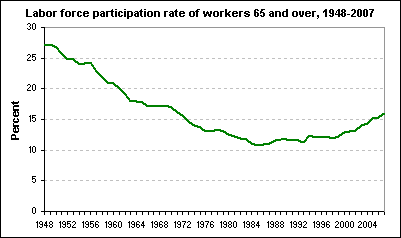
http://research.stlouisfed.org/fred2/graph/?g=iWR

hfojvt
(37,573 posts)but I may know a little bit more about it than some of the people reccing this nonsense.
Arguing that the statement "The true numbers, 50% of the country is poor and 75% is near poor" is a complete load of hooey is not even close to the same thing as arguing that "I am the only poor person in the universe".
And this red herring argument about participation rates is not really germaine to the argument, unless we are gonna argue as well that 50% of the population is over age 55.
I am kinda surprised at that last chart too.
Because from the OP, I would have thought that 50% of the country was in the "lowest fifth".
And yeah, my town is not the world, and neither are my parents and rich friends. But they do provide EXAMPLES of people who are not in the labor force (or who could, if they chose to, drop out of the labor force) and yet are not poor.
HiPointDem
(20,729 posts)means of support, provides a counter-example. as does its homeless camp 2 blocks away.
i'd contend that it's about right that 75% of the population is 'near-poor,' as 75% of the population are about one medical emergency or job loss away from being dispossessed.
hfojvt
(37,573 posts)because they are only one lightning strike, stray bullet, heart attack, or car accident away from being dead.
People are non-poor. Just because something might happen to make them poor, does not make them near-poor. Not until or if that thing actually does happen.
HiPointDem
(20,729 posts)
JNelson6563
(28,151 posts)Bill Gates and I are both billionaires. 
Averages are funny things and you can indeed do what you like with them.
Julie
hfojvt
(37,573 posts)they use data from the Tax Foundation
the Tax Foundation is one of those Rightwing spin tanks.
Generally their data is good, but they are not very good at logic, since their main purpose is not "to find the truth" it is rather "to spin the numbers to make arguments for the rich".
They compare the number of households with the number of tax filers and figure by that, that there are 1.2 tax filers per household.
What they seem to forget is that - almost EVERY teenager and college student who files their own tax return - even if their parents are fairly well off, that kid is going to be included in IRS statistics for the bottom 50%. My nephew, assuming he even makes enough to file taxes, with his part time summer job, will be included in the bottom 50%. His meager income will be part of the average of the bottom 50%. Yet, because he lives with my brother, he, unlike myself, is NOT part of the bottom 50%.
So to get a clearer picture of reality, you really need to take the tax filers who make less than $10,000 and drop them from the statistics because most of them are teenagers and college students still being supported by their parents.
But actually, if you look at reality, my guess is that teenagers from higher income households are more likely to have jobs than teenagers from poorer households. So rather than being cut out of the statistics, much of that income should probably be added to the income of the top 50%.
Also, when they write that
1. the average income of the bottom 50% is $18,000
2. the average income of the bottom 75% is $31,000
Using algebra, I find that the average income of the 50-75% bracket is $57,000.
But yeah, sure, let's pretend like their income is $31,000 a year and that they are almost poor.

SoCalDem
(103,856 posts)you are at the edge of poverty.
ONE serious illness can sink you
ONE job loss can sink you
Most people have little or no savings (hence the credit card debts that most have). Savings @0.075 and CC interest @22% if they have both.
Most cannot afford to send their kids to college/post-high school training, without serious debt incurred by them or the kid
Most people have little or no equity in their homes, even as the homes age & require more and more expensive upkeep
Most people could not sell their home in a hurry (at break-even/small profit) if a job loss happened and they needed to relocate suddenly
Most people work at jobs that offer no defined-benefit pensions, and 401-ks are just another Casino Game, where there are many more losers than winners.

Live and Learn
(12,769 posts)
marions ghost
(19,841 posts)This is the truth.
Egalitarian Thug
(12,448 posts)This is how the game works, it is a long game measured in generations. It creeps up and steadily claims an ever-growing part of your life until you, or your children or grand-children come to thing of it s normal.
This is the frightening effectiveness of the false premise, once you accept it you've lost.
SoCalDem
(103,856 posts)(unless still living with Mom & Dad). For a very long time now, mortgages are pretty much what rent costs, and the "middle classers" are the ones most likely to have a mortgage
SheilaT
(23,156 posts)I do own a car but it's paid for.
So I'm at the edge of poverty? No. I have savings, and I'm a lot more than a couple of paychecks away from homelessness.
When I bought this place four years ago I put 20% down, and I'm honestly unsure of it's exact current value. Probably just about what I paid for it. Which means I'd get that 20% back if I were to sell it tomorrow, but I'll stay here another five years, maybe longer.
The thing about kids and college is this: Unfortunately, too many people, both parents and the kids, have bought into the totally ridiculous idea that everyone needs a four year degree. The kids then decide to major in something that they find very, very interesting, but has almost no real-world application. I'll be the first one to tell young people that if they go to college it's perfectly okay to major in something they love, but never lose sight of the fact they'll need to earn a living at the end of those four (or more) years. And if I'm doing serious college counseling, I'm telling them to look at the certificate programs at their local junior college, and go for something that results in immediate employment.
SoCalDem
(103,856 posts)I do not know you personally, and we too have savings & paid-for cars, but the OP was about the macro, not individuals such as the two of us (and many more as well).
SheilaT
(23,156 posts)you're at the edge of poverty. I just wanted to point out that's not quite true for everyone, and as you've kindly pointed out, you.
Lack of savings is a huge and complex problem, but not all debt is bad and therefore going to push the debt-holder over the precipice.

RKP5637
(67,112 posts)are in denial. One slip and they are down the cliff ... and climbing out is damn hard because debt piles up quickly. I've known many with $100k + salaries per year, now just scraping to get by ... and by no fault of their own. ... illness, freak auto accidents, layoffs, and the damn nonsense of this place called a country hell bent and determined to outsource every job not nailed down to low labor markets ... and then somehow expecting people to consume to prop up the economy. It's a ridiculous model.
closeupready
(29,503 posts)Which is why we will ALL likely have to live with this bullshit for a very long time.

dotymed
(5,610 posts)this disparity sped-up after the recession and subsequent bail-out?
Not a coincidence, just common sense.
When you pay-off a degenerative gamblers debts and then allow them to create the rules for the game
WTF do you think will happen?
Solutions?
1. Reinstate Glass Steagall
2. Reinstate The Fairness Doctrine
3. Raise taxes to pre-Reagan levels
4. Socialize health care
5. legalize marijuana (great income generator) and also ends another "wedge issue" that is meant to distract us.
6. bargain w/big pharma for fair prices
7. REMOVE AMERICA FROM ALL FREE TRADE AGREEMENTS
All Progressive moves. Most already proven to work and indicative of 1st world countries.
Adopt Democratic socialism as our form of government. capitalism has destroyed democracy
every person deserves freedom and a non-repressive govt.

tomg
(2,574 posts)
ctsnowman
(1,904 posts)
CrispyQ
(41,177 posts)That says it all right there. We are not a 1st world country, anymore. The mega-corps have taken over & the 1% use them to behave how they want without responsibility or accountability.
Excellent post, dotymed.

lunatica
(53,410 posts)

woo me with science
(32,139 posts)1. Further gutting of financial regulations.
2. Further consolidation of media.
3. Most of the Bush tax cuts have been made permanent.
4. Austerity is the goal, and the President seeks to cut Social Security.
5. The for-profit health insurance cartel has been entrenched into the system with a mandate.
6. The President is on track to sign the most massive job-killing, wage-destroying free trade Agreement in history, also known as NAFTA on Steroids, the Trans-Pacific.
We are corporate-owned now, even the Democratic Party. How far do tolerate this?
dotymed
(5,610 posts)WHERE IS THE REAL 4TH ESTATE?
IF REAL JOURNALISTS with the MSM had the INTEGRITY to TELL THE IMPORTANT TRUTHS and probably had an
alternate income.
They would probably be fired. If they did it in secession the damn may burst, ideally
they would be rehired with an air of responsibility.
Isn't that what the press is supposed to do?

raouldukelives
(5,178 posts)Corruption Inc
(1,568 posts)which is payoff politicians so things like Glass-Steagall and socialized medicine never get passed. The corrupt bankers need to be taken to trial instead of being levied fines, that's where the accountability begins.
The solutions such as yours are already out there, they get stopped every time by corruption. Address corruption or nothing changes.
Arugula Latte
(50,566 posts)Everything follows from separating government from its corporate masters.
Not that I'm optimistic that will ever happen.

noiretextatique
(27,275 posts)nothing can get done (except for corporations and the wealthy) until we have SANE campaign financing laws. and your are correct: it is not going to happen.
elehhhhna
(32,076 posts)our Pres would propose a return to those tax rates you mentioned and call it the "Reagan Budget Plan"
100 bucks says he gets board seats on several hedge funds the day he leaves the WH. LOL just occurred to me he probably already has that shi+ lined up.

dionysus
(26,467 posts)
change the method of determining poverty, lower the bar, if someone has a phone, or a car, they can't be poor! 
1StrongBlackMan
(31,849 posts)to make this read better (or worse) ... either is possible.
I've hated these type of reports, ever since my grad school Research Methods days.

Auntie Bush
(17,528 posts)Those people just have to learn to tighten their belts and stop envying the top 2-3%. Heaven forbid they want more and cause taxes to be raised on the rich.
BuelahWitch
(9,083 posts)No self respecting poor person would EVER have air conditioning! And if it's central air, well, they're on their way to hobnobbing with Paris Hilton! 
DotGone
(182 posts)2bornot2b
(8 posts)Those are awful numbers but we need to be intellectually honest.
The average household in the bottom 50% brings in about $18,000 per year does not mean that the entire bottom 50% bring in about $18,000. It means that about half of the bottom 50% or 25% (approximately since this is average and not median) bring in less than $18,000 and the other half bring in more than $18,000.
The same goes for point 4. It is about 37% and not 75%.
1StrongBlackMan
(31,849 posts)in my post ...
The point you raised and the expanding inequity points, put me on notice that this would be another, "that's interesting; but likely, inaccurate" report/study on poverty. Yes the numbers look bad; but I've learned that before I give any such reports more than a "that's interesting", I need to know/see the data set.
T
magical thyme
(14,881 posts)"It means that about half of the bottom 50% or 25% (approximately since this is average and not median) bring in less than $18,000 and the other half bring in more than $18,000."
If half bring in less and half more than $18,000, you are talking median. With average, we don't know. 99% of the bottom half could be below $18,000 with 1% being above $18,000. Or the reverse. But the total/n = $18,000.
What we also don't know with the data provided is the size of the households. Are these single person households? Two person? Families? Or a mix, in which case what are the percentages within the mix?
dixiegrrrrl
(60,187 posts)
magical thyme
(14,881 posts)my iq tests between 135 and 155, depending on whether I'm in a manic or depressive phase, have low blood sugar, got a decent night's sleep, or whatever.
I'm not sure how I'm going to read anything on a given day, never mind how anybody else will! 

summer-hazz
(112 posts)^^^^^
me too!

Either way you slice it...
It's disturbing.
Uzair
(241 posts)The deniers in this thread are assuming that the distribution of income is normal - also known as a bell curve. The reality is that the distribution of income and wealth is not a bell curve, but a hockey stick. The article is spot on.

karynnj
(61,215 posts)You don't need an assumption of what the distribution looks like to show that statements in the article are just wrong.
Uzair
(241 posts)If you assume that when you plot income on the x-axis and you plot frequency on the y-axis that you get a nice, normal distribution (aka a bell curve), then you can "show" the statements in the article to be "false".
Unfortunately, the actual distribution looks something like this:

Put income increasing on the x-axis and number of people on the y-axis.
With this distribution, (the actual reality of the situation), the statements in the article are completely correct.
karynnj
(61,215 posts)to mean all people (households) in the group are below or near that average. I am not assuming ANY distribution at all - and clearly not a normal distribution. It is pretty obvious that it is not a normal distribution. You are the one bringing up assumptions of distributions. (It would be very hard to construct a distribution where nearly everyone below 50% is close to or lower than the average $18,000 AND nearly everyone below 75% is close to or lower than the average $31,000. This would NOT be true with the curve you listed - even if the entire population below 75% was the part < 1 on your scale.)
By the way, I worked as a statistician at AT&T Bell Labs for more than 20 years. That I was hired and not fired suggests that they were more confident in my abilities than you.
Uzair
(241 posts)I'm dismayed that Bell Labs didn't fire you, considering your total lack of understanding here. I'm not assuming any distribution either, I'm stating the actual fact: The distribution of income among Americans is the one I linked into my post.
With that distribution, everything, everything the article says is true. Fortunately for them, that's the distribution.
You can't make ANY statements about anything without knowing what the distribution looks like, so I don't know how you can possibly make any conclusions at all if you're not even THINKING about the distribution. Clearly, your post above assumed a bell curve, because your statements would be right if the distribution was a bell curve.
Too bad it's not.
woo me with science
(32,139 posts)karynnj
(61,215 posts)I am NOT assuming a bell curve - and NOTHING I have said suggests that. The ONLY thing I assumed was the pieces of information given - that the "average" of the below 50% was $18,000 and the "average" of the below 75% was $31,000. Whether you assume that they are speaking of median or mean - something THEY should have specified, the statement that 75% of people were near poverty is very likely NOT true.
Your graph has very little resolution in the very area that is being questioned. It does show that the income distribution is very very skewed. However, plotting that using a linear measure for income means that bulk of the data is bunched into a very small area. Very different incomes, as felt by their recipients, will be aggregated into the same printed point. If you seriously wanted to use the actual distribution - from a graph, you could have plotted the distribution of income of the lower 75% of the population and labeled the income axis with the income. That chart would not be anywhere near as skewed.
Here is a link from another poster that shows more detail on the relevant part of the income distribution - http://taxpolicycenter.org/numbers/displayatab.cfm?Docid=3791&DocTypeID=1 From this, you can see what you are missing by using a graph that has extremely poor resolution in exactly the area you are trying to analyze.
I note that you fail to list any credentials at all and are pretty presumptuous in questioning mine and others. Are you out of high school yet? What is your educational background and/or work experience? Only fair - as you stated that a prestigious company where I worked in various analytical groups should have fired my -- rather than giving my good ratings, which they did.
woo me with science
(32,139 posts)Last edited Tue May 28, 2013, 05:16 AM - Edit history (1)
The distribution is heavily skewed. A very few in this country make obscene amounts of money, and the rest don't make much at all.
So imagine ten kids who all get allowances. Say nine of them get five dollars per week, for a total of 45 dollars. The other kid has rich parents who give him 55 dollars per week (to make the math very simple).
That is a total of 100 dollars per week given out in allowance, right? Ten kids, 100 dollars, so the AVERAGE, or MEAN, allowance is ten dollars per week. But 90 percent of the kids are well below the mean.
Does that help?
karynnj
(61,215 posts)Your argument depends on average being computed as the mean. Therefore, for sake of explanation, I will use the more precise concept (the mean) to show that he is wrong.
You know that the mean of the bottom 50% is $18,000 and you know that the mean of the bottom 75% is $31,000. It is very easy to solve for the mean of the group between the 50th percentile and the 75 percentile. This is coming from the distributional information already supplied - so NOTHING is assumed. There are twice as many households in the bottom 50 % than are in the (50% to 75%) group. You know the means of the the below 50% and the below 75% groups. You then know the mean of the (50% to 75%) group can be solved for.
2/3 (mean of below 50%) + 1/3 (mean of 50% to 75%) equals the mean of below 75%. Substituting in what you know:
2/3(18,000) + 1/3 (X) = 31000.
This means X or the mean of the 50% to the 75% group is $57000.
Now, I cannot say how many of the people will be above $30,000, it is pretty clear that nowhere near 76% are near poverty.
His example is using a MORE skewed distribution than happens when you are looking at the TRUNCATED income distribution that ends at the 75%. (The distribution plot shown in this thread is NOT for just the distribution under 75%. Including the very top leads to the lack of resolution at the very part that you are speaking of because the linear scale of income puts a very high percentage of people in the 0 to 1 range. This graph is interesting to show (as if it were needed) the incredible % that the very rich have, but there are many simpler charts that would convey that better - including a very simple bar chart of the median or mean in each quantile - even then it is typical to use a broken bar for the last one rather than scale the entire chart to fit that point. It is not good if you are interested in only the lower 75% of the curve because the scale causes you to lose resolution. The fact is that someone at the mean of the 50% to 75% group is not likely to be "just above poverty".
My original post AGREED that the economic data shows a bad situation. What I did not like was that the statistics were mangled to say things that are likely not true - and THERE WAS NO NEED TO EXAGGERATE as the truth is sufficiently bad. For example, it is very possible that the truth might be that HALF of the households are at incomes where they qualify for some (or all) government assistance. This is pretty troubling - especially as many limits are not defined to be generous.
hfojvt
(37,573 posts)"The distribution is heavily skewed. A very few in this country make obscene amounts of money, and the rest don't make much at all."
From IRS stats, there were 13,480 filers with incomes over $10,000,000 in 2009. Is that your "very few"?
Or are you going to include the 86,329 in the $2 - $5 million range?
There is a fairly sharp drop in frequency after $500,000. Only .631% of tax filers made over $500,000
But is it accurate to say "the rest don't make much at all"?
I dispute that. What about the 3.48 million making between $200,000 and $500,000. From where I sit at $12,000 a year, $200,000 a year is a whole LOT of money. But then, too, so is $80,000. And even more so is $120,000 a year.
There were 11.73 million filers with incomes between $75,000 and $100,000 and another 13.85 million with incomes between $100,000 and $200,000. Those two groups alone are almost 20% of all tax filers. Ask any one of the 58.9 million filers making less than $25,000 if $75,000 is a lot of money. Most of them will tell you it is.
And there are another 19 million tax filers making over $50,000 (and less than $75,000) who are neither poor ($23,550 or near poor (200% of the poverty line is $47,100 and they are making more than that)).

Progressive dog
(7,636 posts)Average (mean) and median have nothing to do with distribution. All you need to know is the difference. I would assume the article was written by someone who doesn't know mean from median.
The article is not just wrong, it is pathetic.
Rex
(65,616 posts)than the bell curve described by so many people in this thread.
Because you're assuming a bell curve. Your assumption is false.
It's a hockey stick.
woo me with science
(32,139 posts)
snappyturtle
(14,656 posts)reason for that? Medians are OK...I'd just like to see modes presented to get a clearer picture.
I also want to know from the IRS how many tax returns yielded federal tax in e.g., 2009 and again in 2011. I'm curious if that wouldn't also tell us more..
Maybe the above is available...I don't know where to begin looking.
1StrongBlackMan
(31,849 posts)There is a reason for how things are reported ... the vast majority of Americans (educated in the U.S.) are just in this side of being numerically illiterate. I'd be willing to bet my next couple of paychecks that most american (educated in the U.S.) couldn't tell you what a median describes ... and fewer could describe the mode.
snappyturtle
(14,656 posts)with a bell curve. Show that. I have seen them and I think it's easier to ascertain a clearer perpective of what's really happening.
Android3.14
(5,402 posts)I suppose if you counted the number of incomes within a range, you could get a reproduction of the same charts (bar charts in this case) to reveal the disparity data. To use the actual mode seems enormously unhelpful, otherwise, except perhaps to reveal how many people are making $18,001 or $18,002 and so on.
snappyturtle
(14,656 posts)average salary of ten people....one who earns $100,000 and the other nine $10,000 isn't helpful...when actually there are nine people wishing they were earning $19,000 almost double their real income. The mode would plainly tell us the facts.
Android3.14
(5,402 posts)The mode is still kind of useless, but you should be able to derive it from this data.
http://taxpolicycenter.org/numbers/displayatab.cfm?Docid=3791&DocTypeID=1
snappyturtle
(14,656 posts)But, let's say at the top where the average (mean) income is $3,000,000+ wouldn't it be interesting to see the numbers of those who are billionaires who are included in establishing this mean? Guess it's just me....thanks again.
karynnj
(61,215 posts)What is sad, is that the numbers are bad enough as they are. Arguing that they are far worse may lead to some debunking this as a strawman to debunking the very true argument that the income gap between the very top and the rest of us is rapidly increasing.
muriel_volestrangler
(106,788 posts)Data comes from the 2010 census, for all aged 15 or older (with those with no income at all excluded - mainly, I'd think, children still at school). The mode is $10,000 to $12,499. The median is about $26,000.
Above the mode, very roughly, the number of people in a group halves for every $25,000 you go up - so there are half as many people on $35k, half as many again on $60k, and so on.
snappyturtle
(14,656 posts)Egalitarian Thug
(12,448 posts)The last figure I saw was below $25K. Three and four income households are becoming the rule.
While the band plays on...
hfojvt
(37,573 posts)here http://www.irs.gov/uac/Tax-Stats-2
although I myself already have many of those tables on my own spreadsheets
bhikkhu
(10,789 posts)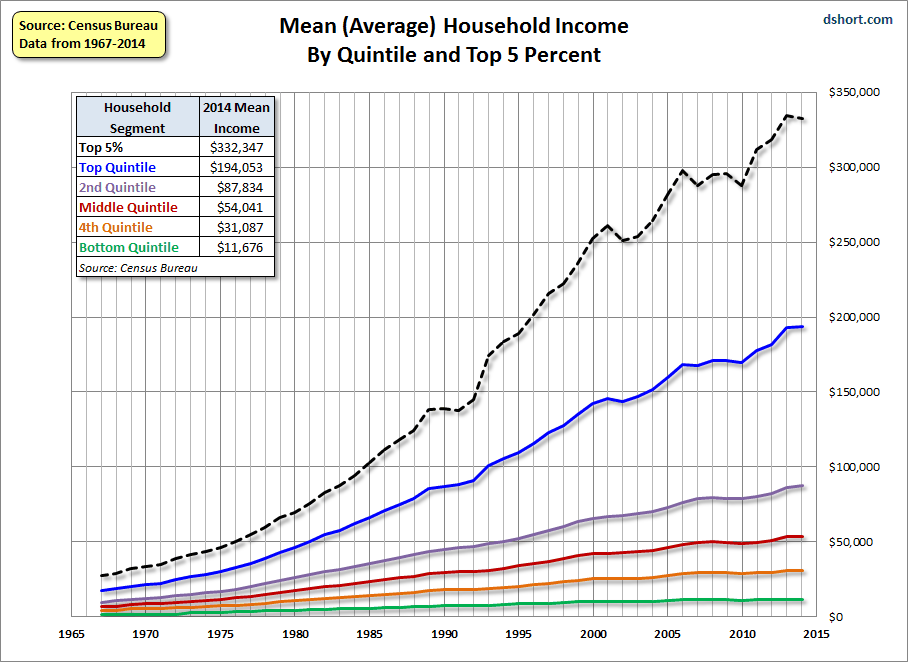
If you look at the household income rates, you find here that the writer of the OP (and definitely the one who came up with the title) may have never taken even high school statistics.
snappyturtle
(14,656 posts)fall in the income ladder. I think it's so interesting to see how close the
quintile were in 1967.....wow.
And thanks for not jumping down my throat about where to look. Been a
long time since I took a couple statistics classes in college back in the
1960s and I just sort of said I don't know where to start because I hadn't
thought about it in a long time AND I've been on DU long enough to know
that others would instantly point me in the right direction. Thank you.
I'm still interested in modes because we all know mean averages are easily
thrown off 'course'. It's just me. Very busy with work for the next few days...will
pursue later.
Response to snappyturtle (Reply #13)
karynnj This message was self-deleted by its author.
caseymoz
(5,763 posts)That's what I never understood before. It's at least one of the leading causes, if not the leading cause of slavery as people have to sell themselves or their children into servitude due to debts they can never pay off. As the disparity in wealth continues to grow, the rentier class will gain money and power to enforce slavery, constitution or not.
I've had shocking conversation with Christian conservatives who have tried to say how "biblical" slavery wasn't wrong, that "chattel" slavery was. They're morally primed to live under "just and righteous" servitude. And we are socially primed by debt.

Stopping messing with the recovery narrative !!!!

Android3.14
(5,402 posts)We either must believe what we read at some site with the pedigree of "epi.3cdn.net", or we have to perform the research ourselves.
The guy does not have the chops to present himself as an authority on economic disparity.
From the DePaul University website, "Paul Buchheit has numerous publications in Cognitive Science, with an emphasis on language development. He has founded several websites that promote awareness of critical global issues among Chicago colleges and high schools. His PhD in Computer Science is from the University of Illinois at Chicago. Email: pbuchhei@depaul.edu"
What a total waste of time.
FarCenter
(19,429 posts)From the article:
Census income figures are about 25% higher, because they include unemployment compensation, workers' compensation, Social Security, Supplemental Security Income, public assistance, veterans' payments, and various other monetary sources. Based on this supplemental income, the average household in the bottom 50% brings in about $25,000, which is just above the $23,000 poverty line for a family of four.
There is a lot of income not reported on W-2s.

dumbcat
(2,161 posts)What part about this is so hard to understand?
You can dress it up and talk about democracy and socialism and a middle class, but in reality, human organization hasn't changed much in a thousand years. There are Lords, and there are Serfs.
Skeeter Barnes
(994 posts)dumbcat
(2,161 posts)I am most definitely a serf.
MindPilot
(12,693 posts)When I look around it doesn't seem like there is much wrong with the economy. Go to Costco or Lowes on the weekend and it's tough to find a parking space. There are more than enough people commuting every day to clog up the freeways. I commented just yesterday that two restaurants I'd noticed had "Help Wanted" signs in the windows. My employer is hiring IT people and engineers about as fast as they can complete the applications. And even my heavily mortgaged Southern California McMansion, which is still worth about one and a half times what I owe on it, went up almost $20,000 last month according to the Zillow.
If I'm living in a bubble, please don't let it burst! If this is a geographic phenomenon, then how do we make it spread out? And--bubble or small outlier of positive economic activity--how did I get so lucky to be in it?

KentuckyWoman
(7,417 posts)Who knows if they pulled numbers out of their derriere or simply twisted up the raw data to get the stats he wanted to support an agenda. There is no way 75% of Americans are below are very close to the poverty level.
Yes it's been getting uglier for the 99ers for a long time now and will get worse before it gets better, but I see no reason to paint it worse that it really is.
flamingdem
(40,992 posts)Do we need another reason?
michigandem58
(1,044 posts)That is one lousy, mistake-riddled analysis, as pointed out above.

Nye Bevan
(25,406 posts)Last edited Mon May 27, 2013, 04:47 PM - Edit history (1)
And 75% are in the bottom three quartiles.
michigandem58
(1,044 posts)and get lots of recs here. 

Quantess
(27,630 posts)These days, it seems half their articles are shrill, worthless, and blaring hyperbole.
Counterpunch is a much better site.
Uzair
(241 posts)Hockey stick. Not bell curve.
michigandem58
(1,044 posts)But let's stick with sound analysis, not stuff like the OP.
flamingdem
(40,992 posts) [center]


 [/center]

MADem
(135,425 posts)galileoreloaded
(2,571 posts)considering they hold the vast majority of private net worth.
ergo, it makes sense that communities that are predominately made up of boomers have a vested interest in promting a "its getting better!!!!!!" mentality.
YOHABLO
(7,358 posts)AnotherMcIntosh
(11,064 posts)southernyankeebelle
(11,304 posts)help they need. It's what the republicans want so they can throw people in their paid jails and get workers for corporations that pay low wages. Watch and see. I tell you I feel sad for my son and the future generations. He lost his job and his wife hasn't worked in awhile. It's tearing them apart. Of course they were rocky from the beginning. We try to help but we have bills ourselves. I am so worried and stressed sometimes I think god please take me but I have a granddaughter that I cherrish and worry about. I have a wonderful supportive husband. But I honestly didn't think that now my 32 yr old son is struggling and we have to help him and his lazy wife. But he went and applied for a job today. It is low wage but it's a job he said. I pray he gets it.
karynnj
(61,215 posts)For example if the average household in the bottom 75% has income of $31,000 - that does not mean that ALL of the bottom 75% make $31,000. In fact, if the median is used rather than the mean, slightly more than half of that bottom 75% make more than $31,000.
The numbers are bad enough - why use poor math to exaggerate? Now, I know this is not the fault of the poster, but seriously did anyone working on this article pass a math course in high school?
bhikkhu
(10,789 posts)Where it say "the average household in the bottom 50% brings in about $18,000 per year. That's less than the poverty line..." that doesn't mean that the bottom half, or half of households, are living in poverty. It means that half of the lower half might be living in poverty, but in any case that's a sloppy way to use the data.
If you look at an actual graph of income distribution here:
Each quintile is 20% of the population. You can see that only the bottom quintile was solidly "poor", while the mean (the average) of the next quintile was higher than poverty level. Which means that some, but probably not most, of the next 20% live in poverty.
Which should be interpreted to say, correctly, that about 30% of US household live in poverty.
That would be somewhat worse, for whatever reason, than this would indicate, but at least in the ballpark:

I know its nitpicking, but I also know I'm going to hear the same sloppy misinterpretation from RW types for weeks, and I will correct them as well.
sulphurdunn
(6,891 posts)on discussing income. That's fine, but the article claims that about half of all Americans have no assets, which is more revealing than income, if true. I wonder how we should define what are asset and who has them? Obviously, owning debt and land and what not is an asset, but is owning a car, a suit, a fishing pole?
bhikkhu
(10,789 posts)just as the primary debt most people have is their mortgage. Not everybody of course, but about 65%, enough to be by far the biggest factor in an assets count.
When housing values goes up, people tend to borrow against their house. When housing values go down, then the asset value of their house drops, while their mortgage remains.
The only real difference (other than other secondary effects rippling through the economy as a whole) is that the resale value of your home has dropped. Which means little except on a balance sheet, unless you were going to sell the house.
In any case, as housing values are in significant rebound, the problem with the lack of assets on paper is heading in a better direction.
sulphurdunn
(6,891 posts)muriel_volestrangler
(106,788 posts)The article (after revision) currently reads):
Analysis of Economic Policy Institute data shows that Mitt Romney's famous 47 percent, the alleged 'takers,' have taken nothing. Their debt exceeded their assets in 2009.
Follow the link, and you see that the report is about the net worth of households, and it says "In 2009, approximately one in four U.S. households had zero or negative net worth, up from 18.6% in 2007."
Somehow, it has gone from about 1 in 4 households (24.8% is the precise figure) to 'almost half of Americans', and I can't see anything in the report that makes the 'almost half' claim. Now, there may be ways of getting there - are they taking Americans of any age? Do they have statistics on size of household compared to wealth distribution that affect the numbers of individuals, or on whether assets like houses are jointly owned? Until we know that, I'd said we ought to stick with "1 in 4 households" as the headline statistic.
For your question about what is an asset, the report uses "tangible assets", which are "housing and consumer durables". So a car would be an asset, but I don't think a suit would be (though I suppose you could claim it has a small resale value on eBay). And they probably didn't count at the level of fishing poles.
karynnj
(61,215 posts)If this is fluid assets minus debts, if you own a $500,000 house, have $80,000 in stocks and cash and have a $90,000 mortgage left - if the value of a home is not included - you have fewer assets than a teenager with no debt and $50 saved from babysitting!
muriel_volestrangler
(106,788 posts)and they subtract mortgages from the tangible assets (since they're secured against them) to report the net tangible assets figure, rather than treating it as a debt to be subtracted from cash etc. So in your example, it would be someone with $410,000 tangible assets, and $80,000 financial assets.
cstanleytech
(28,689 posts)Or to be more specific I blame obama for his healthcare plan because companies are using it as an excuse to cap part time workers hours now to 25 per week for some companies and its a loophole that needs to be addressed.
Personally I am in favor of higher corporate taxes for companies that have a large number of part time workers as well as higher taxes at corporate level based on the disparity in wages for both part time workers and full time workers wages vs upper management and corporate office wages.
Manifestor_of_Light
(21,046 posts)blkmusclmachine
(16,149 posts)BlueStreak
(8,377 posts)"the average household in the bottom 50% brings in about $18,000 per year. That's less than the poverty line for a family of three ($19,000) or a family of four ($23,000)."
Clearly the intention is to imply that half the country is at the poverty level. Indeed, that is EXACTLY what the thread title says.
No, that isn't how statistics work.
If the average income for the bottom 50% is $18K, that means a great many of those in the bottom 50% are far above $18K. If this were a median instead of a mean, that would tell us that only 25% of the public is $18K or lower. If it is the mean, then perhaps 30% are at $18K or below.
I certainly agree that is a huge number and a big national problem (as well as a tragedy for that ~30%), but it does not help anything to grossly misrepresent what the data says. The real data is bad enough. We don't need to pull a "Faux News" with our arguments.
Fire Walk With Me
(38,893 posts)So says the leaked Citigroup memo "The Plutonomy Symposium: Rising Tides Lifting Yachts".
Take the homes of most Americans and they are without major assets. Note that the illegal foreclosure engine, known illegal for years now due to "robosigning" etc., sells many homes directly to Wall Street (the 1%) in quarterly bank bulk sales.
Americans are being stripped of their main asset through fraud and theft. The attack upon the middle class begun by Reagan and his handlers continues unabated. And also according to the memo, the rich drive the US, Canadian, and UK economies, and hits taken by those lower than them in income do not effect the rich.
Robber-baron land-grab disaster capitalism shock doctrine.
The Plutonomy memo:
https://www.box.com/shared/9if6v2hr9h

Donald Ian Rankin
(13,598 posts)I think because it was actively misleading - it was omitting non-wage sources of income.
kitt6
(516 posts)See where that will get you. 
fasttense
(17,301 posts)while the vast majority of people are are the ones they are financially killing.
This is how capitalism always works. A few make more and more because they were lucky, while everyone else make less and less, Just like a game of monopoly, the roll of the dice or luck has more to do with how rich you end up then skill or abilities.
Safetykitten
(5,162 posts)closeupready
(29,503 posts)Don't even need to read the article - kind of common sense, IMO.

MrMickeysMom
(20,453 posts)... over here, will ya? http://www.democraticunderground.com/?com=view_post&forum=1002&pid=2911909
taught_me_patience
(5,477 posts)I guess people "like" what they want to hear!

pnwmom
(110,338 posts)Averages tell us almost nothing -- medians are what should be given.
Also, income figures alone don't tell us very much without knowing about home ownership. Many elderly people are living on low incomes but do have their houses already paid for, and they have Medicare. They are not in the same financial position as young people with the same low income and no house or health insurance.

ProSense
(116,464 posts)first link in the piece, it takes you to the following Census data:
- In 2011, the official poverty rate was 15.0 percent. There were 46.2 million people in poverty.
- After 3 consecutive years of increases, neither the official poverty rate nor the number of people in poverty were statisti¬cally different from the 2010 estimates1
- The 2011 poverty rates for most demographic groups examined were not statistically different from their 2010 rates. Poverty rates were lower in 2011 than in 2010 for six groups: Hispanics, males, the foreign-born, nonciti¬zens, people living in the South, and people living inside metropol¬itan statistical areas but outside principal cities. Poverty rates went up between 2010 and 2011 for naturalized citizens.
- For most groups, the number of people in poverty either decreased or did not show a statistically significant change. The number of people in poverty decreased for noncitizens, people living in the South, and people living inside metropolitan statistical areas but outside principal cities between 2010 and 2011. The number of naturalized citizens in poverty increased.
- The poverty rate in 2011 for chil¬dren under age 18 was 21.9 per-cent. The poverty rate for people aged 18 to 64 was 13.7 percent, while the rate for people aged 65 and older was 8.7 percent. None of the rates for these age groups were statistically different from their 2010 estimates.2
Go to the "Publications" tab for more information.
Income, Poverty and Health Insurance Coverage in the United States: 2011
http://www.census.gov/newsroom/releases/archives/income_wealth/cb12-172.html
- The poverty rate for males decreased between 2010 and 2011, from 14.0 percent to 13.6 percent, while the poverty rate for females was 16.3 percent, not statistically different from the 2010 estimate.
Health Insurance Coverage
- The number of people with health insurance increased to 260.2 million in 2011 from 256.6 million in 2010, as did the percentage of people with health insurance (84.3 percent in 2011, 83.7 percent in 2010).
- The percentage of people covered by private health insurance in 2011 was not statistically different from 2010, at 63.9 percent. This was the first time in the last 10 years that the rate of private health insurance coverage has not decreased. The percentage covered by employment-based health insurance in 2011 was not statistically different from 2010, at 55.1 percent.
- The percentage of people covered by government health insurance increased from 31.2 percent to 32.2 percent. The percentage covered by Medicaid increased from 15.8 percent in 2010 to 16.5 percent in 2011. The percentage covered by Medicare also rose over the period, from 14.6 percent to 15.2 percent. The percentage covered by Medicaid in 2011 was higher than the percentage covered by Medicare.
- In 2011, 9.7 percent of children under 19 (7.6 million) were without health insurance. Neither estimate is significantly different from the corresponding 2010 estimate. The uninsured rate also remained statistically unchanged for those age 26 to 34 and people age 45 to 64. It declined, however, for people age 19 to 25, age 35 to 44 and those age 65 and older.
- The uninsured rate for children in poverty (13.8 percent) was higher than the rate for all children (9.4 percent).
- In 2011, the uninsured rates decreased as household income increased from 25.4 percent for those in households with annual income less than $25,000 to 7.8 percent in households with income of $75,000 or more.
<...>
http://www.census.gov/newsroom/releases/archives/income_wealth/cb12-172.html
Dire information, but I would say a decrease in the poverty rate between 2010 and 2011 is big news, as is the information on health insurance coverage.

deaniac21
(6,747 posts)FreeJoe
(1,039 posts)It was a classic book from the 1950s, I think.
That's what I was reminded of when I read this gem:
4. Based on wage figures, 75% of Americans are NEAR poverty.
According to IRS data, the average household in the bottom 75% earns about $31,000 per year. To be eligible for food assistance, a family can earn up to 130% of the federal poverty line, or about $30,000 for a family of four.
Let's look at this for a second. It says that 75% of Americans are NEAR poverty. The meaningful way to support that would be to give the income of households at the 75 percentile of income. Instead, we get a quote about the average income of households in the bottom 75%. In other words, that's the average income of people at roughly the 37.5 percentile (midway to the 75th percentile). When I see deliberately misleading crap like that, I chuckle and tune out.
Now that I look at it, they do the same thing in #3. The average household in the bottom 50% brings in $18,000 a year. That sounds much more dramatic than saying that 25% of American households earn $18,000 or less.
In #1, it says that half of Americans had NO assets in 2009, but it doesn't give us any comparative time frame. Is that an improvement over 1999 or worse? And by how much?