General Discussion
Related: Editorials & Other Articles, Issue Forums, Alliance Forums, Region ForumsThe Trans-Pacific Partnership: This is What Corporate Governance Looks Like
A three part investigative series. Part 1
In 2008, the United States Trade Representative Susan Schwab announced the U.S. entry into the Trans-Pacific Partnership talks as “a pathway to broader Asia-Pacific regional economic integration.” Originating in 2005 as a “Strategic Economic Partnership” between a few select Pacific countries, the TPP has, as of October 2012, expanded to include 11 nations in total: the United States, Canada, Mexico, Peru, Chile, New Zealand, Australia, Brunei, Singapore, Vietnam and Malaysia, with the possibility of several more joining in the future.
<snip>
I. Trade Representatives: The Global Corporate Lobby
Who negotiates trade agreements? The answer is simple: trade representatives. The term “trade representative” is essentially another way of saying “corporate lobbyist.”
To prove this point, it would be useful to quickly glance over the biographies of the important U.S. Trade Representatives (USTR) since the George H.W. Bush administration, when USTR Carla A. Hills was lead negotiator for NAFTA and the WTO.
Embedded within the U.S. foreign policy establishment, Hills had a long career in government and was the USTR from 1989 to 1993, after which she established and became CEO of Hills & Company, an international consulting firm with a focus on global trade and investment for clients such as the Coca-Cola Company, Procter & Gamble, American International Group (AIG), Novartis, Bechtel, Boeing, Rolls-Royce, Inter-American Development Bank, Pfizer and Chevron.
<snip>
http://andrewgavinmarshall.com/2012/11/19/the-trans-pacific-partnership-this-is-what-corporate-governance-looks-like/
 = new reply since forum marked as read
Highlight:
NoneDon't highlight anything
5 newestHighlight 5 most recent replies
= new reply since forum marked as read
Highlight:
NoneDon't highlight anything
5 newestHighlight 5 most recent replies

Laelth
(32,017 posts)-Laelth

cantbeserious
(13,039 posts)eom

Berlum
(7,044 posts)Last edited Sat Jul 13, 2013, 07:42 AM - Edit history (1)


dipsydoodle
(42,239 posts)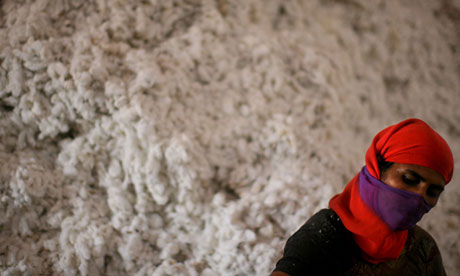
A cotton worker in India. The US refusal to eliminate its cotton and other agricultural subsidies torpedoed the Doha round of trade talks. Photograph: Uriel Sinai/Getty Images.
Though nothing has come of the World Trade Organisation's Doha development round of global trade negotiations since they were launched almost a dozen years ago, another round of talks is in the works. This time the negotiations will not be held on a global, multilateral basis. Rather, two huge regional agreements – one transpacific, and the other transatlantic – are to be negotiated. Are the coming talks likely to be more successful?
The Doha round was torpedoed by the US refusal to eliminate agricultural subsidies – a sine qua non for any true development round, given that 70% of those in the developing world depend on agriculture directly or indirectly. The US position was truly breathtaking, given that the WTO had already judged that America's cotton subsidies – paid to fewer than 25,000 rich farmers – were illegal. Washington's response was to bribe Brazil, which had brought the complaint, not to pursue the matter further, leaving in the lurch millions of poor cotton farmers in sub-Saharan Africa and India, who suffer from depressed prices because of America's largesse to its wealthy farmers.
Given this recent history, it now seems clear that the negotiations to create a free trade area between the US and Europe, and another between the US and much of the Pacific (except for China), are not about establishing a true free trade system. Instead, the goal is a managed trade regime – managed, that is, to serve the special interests that have long dominated trade policy in the west.
There are a few basic principles that those entering the discussions will, one hopes, take to heart. First, any trade agreement has to be symmetrical. If, as part of the Trans-Pacific Partnership (TPP), the US demands that Japan eliminate its rice subsidies, Washington should, in turn, offer to eliminate its production (and water) subsidies, not just on rice (which is relatively unimportant in the US) but on other agricultural commodities as well.
http://www.guardian.co.uk/business/economics-blog/2013/jul/05/free-trade-talks-public-corporate-interest
cali
(114,904 posts)the skeptical to grasp the dangers and the utter vileness of the TPP.
Thanks for posting this, dipsy.

merrily
(45,251 posts)Rich countries' proposal to bypass governments on climate aid rejected
US-led group wanted to give $100bn a year directly to MNCs for projects to tackle climate change in developing countries
http://www.guardian.co.uk/environment/2013/jul/03/climate-aid-climate-change-fund
dipsydoodle
(42,239 posts)
merrily
(45,251 posts)Last edited Sat Jul 13, 2013, 08:30 AM - Edit history (1)
I am grateful for the UN's rejection, but that was not the point of my post.
As grateful as I am to the UN, I don't get to vote on the positions that the UN takes.
Heck, I don't even get to vote on the positions that the US takes. I do get to vote for US "administrations," though. So do others who read here.
And therefore that article that I posted remains relevant to the OP topic and perhaps to readers of this thread, even if the the UN rejected the US's proposal 100 times.
cali
(114,904 posts)merrily
(45,251 posts)We have no powerful, rich lobbies representing us.
In theory, that's why we pay so much for Congress and the President and their massive staffs.
fasttense
(17,301 posts)for all countries signing onto the TPP.
Ron Kirk, Obama’s U.S. Trade Representative, and corporate lobbyist in Austin, Texas, for the investment bank Merrill Lynch (before it was taken over by Bank of America in 2008) main priority since becoming USTR has been the Trans-Pacific Partnership, worked on in secret for nearly four years with several other countries and 600 corporations.
"Kirk explained that “there’s a practical reason” for all the secrecy in the negotiations over the TPP: “for our ability both to preserve negotiating strength and to encourage our partners to be willing to put issues on the table they may not otherwise, that we have to preserve some measure of discretion and confidentiality.”
Indeed, this is “practical.” After all, as he explained, if the talks were not done in secret, the public would be aware of what was being discussed, and if the public knew what was being planned, they would oppose it.
So secrecy is necessary in order to make the agreement as undemocratic and unaccountable as possible, to ensure that corporations get what they want while the public remains in the dark. Deceptive and saturated with disdain for democracy, certainly, but “practical” nevertheless."
All this secrecy is needed to shove this load of crap down the throats of the 99%
It makes you wonder exactly which issues they are putting on the table that they wouldn't put on the table if everyone knew.
Volaris
(11,791 posts)Moar Oil, and Fuck the Polar Bears
Less National Soverignity, and moar Coarpoarite Profitz
Less living wages, moar Slaves for the Masterz
Yeah, it's secret for a reason heh.
cali
(114,904 posts)the defenders can't defend this shit.
KG
(28,797 posts)merrily
(45,251 posts)The defense consisted of things like "hooey." And "the right wing loves things like this, too.
Extraordinarily cogent and persuasive, at the highest levels of analytical examination.
Leading to the clincher conclusion of "Obama's rubber, you're glue. Everything you say bounces off him and sticks to you. Nanananabooboo!"
Okay, I made up the last bit, but not the other comments.

ProSense
(116,464 posts)from this thread: http://www.democraticunderground.com/10023182705
It's hard to imagine we'll ever elect a President who isn't Corporate Capitalist. Corporations have us well and truly corralled, and that sure as hell includes, oh, 97% of our politicians. I'm sure I'll be voting for another Corporatist Capitalist in 2016 whether its Hillary (not my first choice) or Governor O'Malley. Let me be clear, a dem is always better than a repub. at least they push back a little, and a little is better than not at all.
...revealing. I mean, you're pointing this out, and at the same time acknowledging that this applies to every American President past and future.
by David Woolner
<...>
The driving force behind this effort was FDR’s Secretary of State, Cordell Hull, who considered the passage of Smoot-Hawley an unmitigated disaster. Hull had been arguing in favor of freer trade for decades, both as a Democratic congressman and later senator from Tennessee. Given the long-standing protectionist tendencies of Congress — which reached their zenith with the passage of Smoot-Hawley, the highest tariff in U.S. history — Hull faced an uphill struggle to accomplish this task. He also had to overcome FDR’s initial reluctance to embrace his ideas, as the president preferred the policies of the “economic nationalists” within his administration during his first year in office. By 1934, however, FDR’s attitude began to change, and in March of that year the president threw his support behind Hull’s proposed Reciprocal Trade Agreements Act — a landmark piece of legislation that fundamentally altered the way in which the United States carried out foreign economic policy.
Convinced that the country was not ready for a truly multilateral approach to freer trade, Hull’s legislation sought to establish a system of bilateral agreements through which the United States would seek reciprocal reductions in the duties imposed on specific commodities with other interested governments. These reductions would then be generalized by the application of the most-favored-nation principle, with the result that the reduction accorded to a commodity from one country would then be accorded to the same commodity when imported from other countries. Well aware of the lingering resistance to tariff reduction that remained in Congress, Hull insisted that the power to make these agreements must rest with the president alone, without the necessity of submitting them to the Senate for approval. Under the act, the president would be granted the power to decrease or increase existing rates by as much as 50 percent in return for reciprocal trade concessions granted by the other country.
The 1934 Act granted the president this authority for three years, but it was renewed in 1937 and 1940, and over the course of this period the United States negotiated 22 reciprocal trade agreements. Of these, the two most consequential were the agreements with Canada, signed in 1935, and Great Britain, signed in 1938, in part because they signaled a move away from Imperial Preference and hence protectionism, and in part because they were regarded as indicative of growing solidarity among the Atlantic powers on the eve of the Second World War. It is also important to note that Hull, like many of his contemporaries, including FDR, regarded protectionism as antithetical to the average worker — first, because in Hull’s view high tariffs shifted the burden of financing the government from the rich to the poor, and secondly, because Hull believed that high tariffs concentrated wealth in the hands of the industrial elite, who, as a consequence, wielded an undue or even corrupting influence in Washington. As such, both FDR and Hull saw the opening up of the world’s economy as a positive measure that would help alleviate global poverty, improve the lives of workers, reduce tensions among nations, and help usher in a new age of peace and prosperity. Indeed, by the time the U.S. entered the war, this conviction had intensified to the point where the two men concluded that the root cause of the war was economic depravity.
<...>
Of course, it is important to remember that the Roosevelt administration’s efforts to expand world trade were accompanied by such critical pieces of legislation as the National Labor Relations Act and Fair Labor Standards Act, which vastly strengthened the place of unions in American life. The 1930s and ’40s were also years in which the government engaged in an unprecedented level of investment in America’s infrastructure and industry — largely through deficit spending — that helped vastly expand our manufacturing base and render the United States the most powerful industrialized country in the world. Our efforts to expand trade and do away with protection were only part of a broader effort to reform the U.S. economy in such a way as to provide what FDR liked to call “economic security” for every American.
- more -
http://www.nextnewdeal.net/fdrs-comprehensive-approach-freer-trade
President Obama also has a record on trade.
In case you missed it: Good moves by the Obama administration
http://www.democraticunderground.com/1002540300
"It's interesting who doesn't post in threads about this the defenders can't defend this shit."
Maybe some people aren't as focused on the TPP as you are.
cali
(114,904 posts)you know, actually add something of substance, instead of your defensive self-referential links?
pampango
(24,692 posts)Heritage Foundation.
Unfortunately, TPP negotiations to date have included excessive U.S. posturing on environmental standards and labor regulations. There is a danger of further such posturing as a proposed U.S.–European Union FTA moves forward.
http://www.heritage.org/research/reports/2013/07/2013-global-agenda-for-economic-freedom
If the Heritage Foundation thinks that US negotiators are engaging in 'excessive posturing on environmental standards and labor regulations' the negotiators must be doing something right.(One administration strategy) will be the pursuit of trade agreements that notably do not include China. The most important of these is the Trans-Pacific Partnership (TPP), a trade agreement among a growing list of nations bordering the Pacific. It is the Obama administration’s avowed aim to construct a TPP with standards so high — especially rules regarding behavior by state-owned enterprises — that China could never join without transforming its economic system.
http://www.pewglobal.org/2012/12/10/u-s-china-economic-relations-in-the-wake-of-the-u-s-election/
Obama seems to know that we cannot compete with China by lowering standards. China will always win that race. China is vulnerable to an agreement that raises standards since it cannot join unless it does the same. This is the what European countries get out of the EU. Membership brings no tariff barriers but high labor and environmental standards....the negotiation is subject to the U.S. domestic politics. At the very beginning of the negotiation, the United States reminded other countries that the U.S. Congress would not accept a TPP without strong labor and environmental measures. Obviously, the United States aims to lower the comparative advantages of developing countries so as to create more job opportunities for itself.
http://english.peopledaily.com.cn/90777/8113289.html
And China knows that the TPP is not a good deal for them. "Obviously, the United States aims to lower the comparative advantages of developing countries so as to create more job opportunities for itself."
cali
(114,904 posts)It's disgraceful to see that. And China isn't part of the TPP.
Come back with facts.
pampango
(24,692 posts)not relevant to you, so be it. I suppose if I were wedded to the conviction that the TPP was entirely evil, I would not want to accept even the possibility that there can be aspects of the negotiations that liberals would approve of and conservatives are unhappy about.
Of course, China is not part of the TPP. That is the whole point of an agreement with high standards is that China cannot join without fundamental changes in the way their government respects labor rights and environmental standards. And that is why China is not happy about the TPP and wants it defeated so it continue with business as usual.
cali
(114,904 posts)do so some reading. start with Public Citizen. Electronic Frontier. Malaysian Media.
Or keep on defending shit like this:
http://www.citizen.org/documents/renco-la-oroya-memo.pdf
Because tribunals are in the TPP. We know that from the leaked documents. The Tribunals allow corporations to bring grievances against states and nations for preventing the investor from making profits due to environmental or land use laws. Under NAFTA and other trade agreements, corporations prevail 70% of the time.
It may sound incredible, but it's fact.
pampango
(24,692 posts)under discussion. Otherwise they would oppose the negotiations. Perhaps they will be proven wrong.
As the Pew article explains high labor and environmental standards in the TPP are part of Obama's strategy for dealing with China. (No standards or low standards would make China happy. China is not happy with the TPP.) Conservatives, like those at HF, think those standards are under consideration and are complaining about them. And the liberal senators listed above must think the standards are under discussion or they would come out against the agreement right now.
cali
(114,904 posts)the TPP that enables corporations to override the environmental and other laws of nations and states?
You have a lot of nerve using Senator Warren. It's shameless:
Warren on Trans-Pacific Partnership: If people knew what was going on, they would stop it
Senator Elizabeth Warren (D-MA) on Wednesday voiced her opposition to President Barack Obama’s top international trade nominee because of a secretive free trade agreement.
“I am deeply concerned about the transparency record of the U.S. Trade Representative and with one ongoing trade agreement in particular — the Trans-Pacific Partnership,” she said on the Senate floor.
<snip>
http://www.rawstory.com/rs/2013/06/19/warren-on-trans-pacific-partnership-if-people-knew-what-was-going-on-they-would-stop-it/
Senator Sanders also opposed Froman for the same reasons.
pampango
(24,692 posts)a mechanism to prevent countries from subsequently ignoring them on the basis of 'national sovereignty'. The makeup of these tribunals will be important.
In the EU they tend to be liberal and force reluctant governments to live up to labor and environmental commitments. It will be important that such bodies in the TPP be the same. The negotiations are not finished. What has been leaked may or may not be representative of the final agreement.
The NAFTA tribunals may rule in favor of corporations 70% of the time. Do you have a guess as to how often American courts rule in favor of corporations? My guess is a lot hire percentage than that. Should any TPP board be even better. Yes.
My reading of the comments of senators Warren, Sanders and Brown are that they oppose the secrecy ("transparency record" of the negotiations not the negotiations themselves.
cali
(114,904 posts)and you are very confused about the international tribunals. It's not about countries ignoring them. Look, the tribunal system is set up for corporations to bring grievances AGAINST countries (and in the U.S., individual states) whose laws hamper their future profits. The findings of the tribunals (composed largely of lawyers who also represent those self-same corporations when they aren't serving on tribunals) supersede the laws of those nations.
And it's not just NAFTA. Virtually every other trade agreement we have embraces the tribunal system. Peru, Ecuador, etc.

PufPuf23
(9,928 posts)Obama Denies Assuring Canada on NAFTA
First Posted: 03/28/08 03:46 AM ET
SAN ANTONIO — Barack Obama said Monday that his campaign never gave Canada back-channel assurances that his harsh words about the North American Free Trade Agreement were for political show _ despite the disclosure of a Canadian memo indicating otherwise.
According to the memo obtained by The Associated Press, Obama's senior economic adviser told Canadian officials in Chicago that the debate over free trade in the Democratic presidential primary campaign was "political positioning" and that Obama was not really protectionist.
The adviser, Austan Goolsbee, said his comments to those officials were misinterpreted by the author, Joseph DeMora, who works for the Canadian consulate in Chicago and attended the meeting.
In Carrollton, Texas, Obama told reporters: "Nobody reached out to the Canadians to try to assure them of anything."
snip
http://www.huffingtonpost.com/2008/03/03/obama-denies-assuring-can_n_89539.html
Comparing Obama to FDR and the 1930s to now are false equivalencies.
Like NAFTA, the TPP is a pro-corporate and pro-concentrated wealth unlike what was done by FDR to benefit the People and the nation.
From your own quote:
"Of course, it is important to remember that the Roosevelt administration’s efforts to expand world trade were accompanied by such critical pieces of legislation as the National Labor Relations Act and Fair Labor Standards Act, which vastly strengthened the place of unions in American life. The 1930s and ’40s were also years in which the government engaged in an unprecedented level of investment in America’s infrastructure and industry — largely through deficit spending — that helped vastly expand our manufacturing base and render the United States the most powerful industrialized country in the world. Our efforts to expand trade and do away with protection were only part of a broader effort to reform the U.S. economy in such a way as to provide what FDR liked to call “economic security” for every American. "
cali
(114,904 posts)thanks for your post.

great white snark
(2,646 posts)
Not sure how your personal life is but here, no matter the attention you crave, nobody is at your beck and call.
ProSense provided some facts regarding "this shit" so maybe you should be nicer to a person that still cares enough to engage instead of complaining about who is or isn't giving you their time.
cali
(114,904 posts)Pro? Propaganda is what she's provided.
And advice from the likes of you? Uh, no thanks.
Oh, and my track records with predictions? Pretty good, as I don't make many, hon.
PufPuf23
(9,928 posts)I agree that Prosense is no more than a propagandist.
jtuck004
(15,882 posts)NorthCarolina
(11,197 posts)my favorite poster here. Happy to kick and recommend this post.
cali
(114,904 posts)thanks, that's awfully nice of you to say.
Catherina
(35,568 posts)I always look for Cali's posts first thing in the morning. They're a good way to get energized for the day and remember what's at stake.
Civilization2
(649 posts)The 1% care little about abortion rights or gay marriage,. these dominate the media. "free" trade agreements, the elimination of environmental (and all) regulations, and the codifying in law for-profit health-care insurance and endless war and for-profit corporate surveillance, these things they care about,. democracy is the corporate rulers letting 'the people' have marginal input into that what matters marginally to the bottom line, while they control what matters to them.
This is not some fictional future, this is the way it is now, and it will only get worse if nothing is done about it.
Degrowth, Slow Money, Permaculture, Relocalize, etc. Stop supporting your oppressors.
Egalitarian Thug
(12,448 posts)There is only one way to get through these "interesting times", and you have said it.
Refuse to participate in any way that you can.
MrSlayer
(22,143 posts)Because that means you'd rather have Sarah Palin as president......or something.
So where are all the bootlickers on this? I don't seem to see any in these threads.
Thanks Cali.
pampango
(24,692 posts)Or is this just a case of the 'Palin bootlickers' versus the 'Obama bootlickers"?
You know what? Name-calling is more fun than respecting differences of opinion.
MrSlayer
(22,143 posts)It isn't my opinion, it's the fact of the matter. Just look at the policies.
These people certainly aren't New Deal Democrats. Not even close.
If not corporate stooges, what are they?
As far as the bootlicker comment, I don't know what else to call people with a completely misguided view of the people they follow.
Cultists maybe?
Response to MrSlayer (Reply #23)
cali This message was self-deleted by its author.
Catherina
(35,568 posts)While it sounds innocuous enough, the operative word here is extrajudicial, and Democrats and Republicans should be concerned with the sovereignty issues. As the Huffington Post's Zach Carter explains, "Foreign corporations operating within the U.S. would be permitted to appeal key American legal or regulatory rulings to an international tribunal. That international tribunal would be granted the power to overrule American law." Furthermore, the tribunals can order taxpayer compensation for health and environmental policies that inhibit foreign investors' "expected future profits."
Here is what it looks like in practice. Let's say a foreign company wants to do some business in California, but a state law fashioned in Sacramento prohibits or puts limits on parts of the firm's operations due to local environmental standards. (A company only needs to be operating in, not based in, a TPP country to use the regime.) In response, California, a leader nationally on environmental protection, sticks to its standards and enforces its laws.
The firm counters by taking California to one of these extrajudicial TPP trade "courts." Except in this case, the court "judges" are not part of a more reputable international tribunal based in an international institution on par with United Nations or the International Criminal Court. No, in this case, the judges are often private sector lawyers that "rotate between acting as ‘judges' and as advocates for the investors suing the governments." If the company wins the suit, the settlement, which is often in the tens of millions of dollars and occasionally in the billions of dollars, is paid by the "losing" country's taxpayers.
Keep in mind that companies won these lawsuits 70 percent of the time last year. Even when governments win, they have to shell out $8 million on average per case just to defend existing public interest policies. The three cases below are exemplary of what we're dealing with under current trade agreements and what we'll likely see more of with TPP and TTIP.
...
http://www.usnews.com/opinion/blogs/world-report/2013/07/08/us-eu-trade-agreement-needs-more-congressional-oversight
Good morning Cali! Always nice to wake up to your threads. They help keep the outrage focused.

cali
(114,904 posts)hey Catherina, so nice to have your contribution to this thread and good morning!
http://crooksandliars.com/dave-johnson/tpp-deregulation-treaty-not-trade-tre
Catherina
(35,568 posts)Thanks Cali. That was very interesting to read. It popped up in the Latin America Forum, Chile’s ex-chief negotiator drops a bombshell on TPPA, but not in all this detail
From your link:
It is critical to reject the imposition of a model designed according to realities of high-income countries, which are very different from the other participating countries.
Otherwise, this agreement will become a threat for our countries: it will restrict our development options in health and education, in biological and cultural diversity, and in the design of public policies and the transformation of our economies. It will also generate pressures from increasingly active social movements, who are not willing to grant a pass to governments that accept an outcome of the TPPnegotiations that limits possibilities to increase the prosperity and well-being of our countries.
This came across my twitter feed today, the view from Malaysia,
TPP will be another bad pact
By Tun Dr Mahathir Mohamad
UNEQUAL PARTNERS: The Trans-Pacific Partnership Agreement will allow big economies to plunder smaller ones
THE secretary-general of the International Trade and Industry Ministry avers that trade negotiations must be done in secret, I suppose by the officers concerned. There should apparently be no public debate, even within the government.
...
Now, we are negotiating the American-conceived TPP, Trans-Pacific Partnership Agreement. This is another attempt by America to let their huge corporations penetrate the markets of the small countries, in particular, government procurement.
When the GATT (General Agreement on Tariffs and Trade) failed they invented WTO (World Trade Organisation) for the same purpose. That also failed. They then invented Apec (Asia-Pacific Economic Cooperation). Still, they could not achieve their objective. They introduced bilateral free trade agreements.
Then, they promoted a globalised world, a world without borders in which their money can go anywhere, destroy economies and then pull out. In case we have forgotten, they did this in 1997/98.
Still, they cannot get at government procurement. And now they invented TPP, a partnership of unequals, of the strong to take advantage of the weak.
This is going to be legally binding. If we breach the agreement, their corporations can sue the government for billions. I have my doubts about our ability to convince the international arbitrators or courts. We cannot even convince the World Court over Pulau Batu Puteh.
http://www.nst.com.my/opinion/columnist/tpp-will-be-another-bad-pact-1.317645?ModPagespeed=noscript
Nobody wants this thing except the multinationals. Don't we matter? That was a rhetorical question so don't waste your time answering.
Secret discussions, secret rulings, secret trade deals, I'm so sick of it. This is not the transparency we need. "The consent of the governed is not consent if it is not informed".