General Discussion
Related: Editorials & Other Articles, Issue Forums, Alliance Forums, Region ForumsPosted by one of my fav HP posters.
What we now call "public assistance" was established in every colony early in its history in the form of "general assistance," under the old English designation of "poor relief." That also was done in the later States, in their earliest days. The principle that when people have no other means of subsistence they must be supported from public funds has always been a part of the American way of life.
In the first years of the 1930's, the principle was established that the relief of the needy is a responsibility of government at all levels. State governments came to the rescue in 1931; the National Government with the enactment of the emergency relief act of July 1932.
From 1933 on, the National Government carried the major responsibility until passage of Social Security. It was created as part of President Franklin D. Roosevelt's New Deal with the signing of the Social Security Act of 1935 on August 14, 1935.
The Committee on Economic Security would make a later report to the Social Security Board to study the need for and possibility of improving the social security protection of Americans, including, among other methods, health insurance.
This report led to the false belief that the Administration was secretly trying to foist compulsory health insurance on the country. Immediately, the members of the Ways and Means Committee, then considering the social security bill in executive sessions, were deluged with telegrams from all parts of the country protesting against this "nefarious plot."
 = new reply since forum marked as read
Highlight:
NoneDon't highlight anything
5 newestHighlight 5 most recent replies
= new reply since forum marked as read
Highlight:
NoneDon't highlight anything
5 newestHighlight 5 most recent replies

freshwest
(53,661 posts)It's in the Social Security archives. It explains the way the world was, what justice is, how to keep peace by compensation, or guaranteed income. Good read, doesn't take very long, either.

onethatcares
(17,010 posts)I will read that later today. Do I just google Paines Agrarian Justice? Thanks again.
freshwest
(53,661 posts)In the winter of 1795-96 Thomas Paine wrote his last great pamphlet, "Agrarian Justice." The pamphlet was first published in French in Paris. An English edition was brought out in 1797.
In this pamphlet Paine advocated the creation of a social insurance scheme for the aged and for young people just starting out in life. The benefits were to be paid from a national fund accumulated for this purpose. The fund was to be financed by a 10% tax on inherited property. A tax on inherited property was used due to Paine's general philosophy of property rights. Although he based his social insurance scheme on a line of argument that might sound quaint in the present era, in other respects his plan was quite modern, recognizing the problem of income security for the elderly, and the desirability of creating a national fund for this purpose.
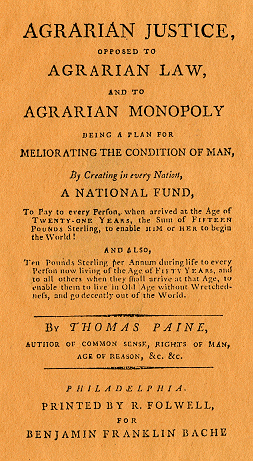
The text link there:
https://www.socialsecurity.gov/history/tpaine3.html
But here is a better one, on its Wikipedia page. All of this is public domain, no restrictions:
Agrarian Justice
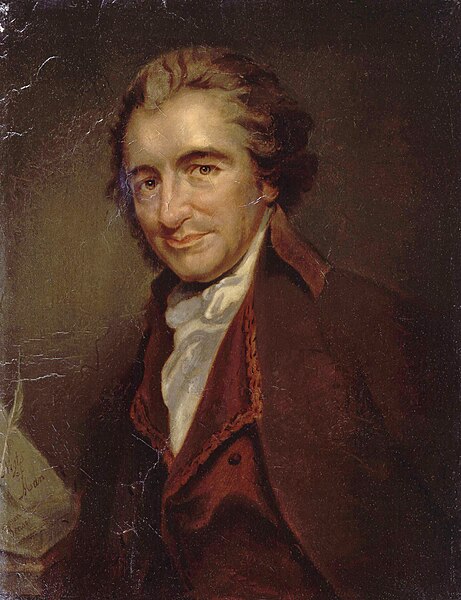
Agrarian Justice is the title of a pamphlet written by Thomas Paine, published in 1797, which advocated the use of an estate tax and a tax on land values to fund a universal old-age and disability pension, as well as a fixed sum to be paid to all citizens on reaching maturity.
It was written in the winter of 1795-96, but remained unpublished for a year, Paine being undecided whether or not it would be best to wait until the end of the ongoing war with France before publishing. However, having read a sermon by Richard Watson, the Bishop of Llandaff, which discussed the "Wisdom ... of God, in having made both Rich and Poor", he felt the need to publish, under the argument that "rich" and "poor" were arbitrary divisions, not divinely created ones.[1]
Proposed system
In response to the private sale of royal (or common) lands, Paine proposed a detailed plan to tax property owners to pay for the needs of the poor, which could be considered as the precursor of the modern idea of citizen's income or basic income. The money would be raised by taxing all direct inheritances at 10%, and "indirect" inheritances - those not going to close relations - at a somewhat higher rate; this would, he estimated, raise around £5,700,000 per year in England.[2]
Around two-thirds of the fund would be spent on pension payments of £10 per year to every person over the age of fifty, which Paine had taken as his average adult life expectancy, with most of the remainder allocated to making fixed payments of £15 to every man and woman on reaching the age of twenty-one, legal majority. The small remainder would then be able to be used for paying pensions to "the lame and blind".[3] For context, the average weekly wage of an agricultural labourer was around 9 shillings, which would mean an annual income of about £23 for an able-bodied man working throughout the year.[4]
Additionally, "a one-time stipend of 15 pounds sterling would be paid to each citizen upon attaining age 21, to give them a start in life."[5]
Philosophical background
The work is based on the contention that in the state of nature, "the earth, in its natural uncultivated state... was the common property of the human race"; the concept of private ownership arose as a necessary result of the development of agriculture, since it was impossible to distinguish the possession of improvements to the land from the possession of the land itself. Thus Paine views private property as necessary, but that the basic needs of all humanity must be provided for by those with property, who have originally taken it from the general public. This in some sense is their "payment" to non-property holders for the right to hold private property.
http://en.wikipedia.org/wiki/Agrarian_Justice
http://en.wikisource.org/w/index.php?title=Agrarian_Justice&printable=yes
We cannot undo the effects of conquest and injustice without creating more of the same by those methods. But we did free people through the Commons, allowing social mobility and community in which to be creative, advance or fall on an fair playing field or a bottom to stand upon.
Privatization is theft of the Commons, an engine of economic apartheid. Only those with wealth will be able to travel certain roads, obtain education to improve their lot or to keep safe, travel to enlarge their fortune and minds and refresh their spirits.
Note in the writing of Paine and others of our Enlightenment, that property holders were considered to be only temporary in this view, not landed oligarchs with no responsibility to compensate those they had disadvantaged in their labors, certainly not allowed to hold in perpetuity the resources of the Earth for only their group, on the basis of race, religion, etc.
The Swiss have just set the monthly stipend for each citizen at $2,800. If we did the same, what a change it would be, and less likely that inequality would still be promoted as the engine of wealth which it is now. The hate being taught us is a tool of social inequality, not rational, not practical for those who hold it.
Equality of all not based on birth gives individuals the freedom to innovate and look to more than just brutish survival. We have reversed the trend that the Founders began. I'm not sure if we will survive the regression.
Just a little to think about.

Kick in to the DU tip jar?
This week we're running a special pop-up mini fund drive. From Monday through Friday we're going ad-free for all registered members, and we're asking you to kick in to the DU tip jar to support the site and keep us financially healthy.
As a bonus, making a contribution will allow you to leave kudos for another DU member, and at the end of the week we'll recognize the DUers who you think make this community great.