General Discussion
Related: Editorials & Other Articles, Issue Forums, Alliance Forums, Region ForumsSlavery, the Rebel flag and the shutdown
Slavery, the Rebel flag and the shutdown
How the toxic effects of white supremacy, seen so clearly in "12 Years a Slave," endure in American politics
BY ANDREW O'HEHIR
Five years before the beginning of the Civil War, Robert E. Lee – future commander of the Confederate States of America’s Army of Northern Virginia – wrote a famous letter to Franklin Pierce, the profoundly inept outgoing president. After praising Pierce for his pro-Southern policies, Lee wrote: “There are few, I believe, in this enlightened age, who will not acknowledge that slavery as an institution is a moral and political evil.” (That phrase was likely meant as a mild rebuke to Pierce, who may not have felt that way.)
This letter has long struck historians as significant because of its apparent paradox: A few years later, Lee would command hundreds of thousands of young men to kill and die for a cause he personally believed was immoral, a cause his great adversary, Ulysses S. Grant, would describe as “one of the worst for which a people ever fought, and one for which there was the least excuse.” Lee was of course not the first white American to be pinioned by this paradox, which was written into our Constitution, with its oblique references to “other persons” existing in certain states who were to be counted as three-fifths of a human being. Nor was he the last.
How are we to understand the Confederate battle flag waved by a demonstrator from Texas outside the White House last week? Some shutdown supporters, fearing media blowback, tried to suggest it was the work of a liberal agent provocateur, or simply a symbol of rebellious high spirits and “Southern heritage.” But the meaning of that particular flag, outside the home of our first black president, in the middle of a conflict loaded with not-so-hidden racial messaging, is not difficult to grasp. It strikes me as evidence that the heavy historical weight of slavery, and what Jimmy Carter has called the “burden of white supremacy,” has not yet been lifted. We ignore it, or agree to overlook it, at our peril.
http://www.salon.com/2013/10/19/slavery_the_rebel_flag_and_the_shutdown/
 = new reply since forum marked as read
Highlight:
NoneDon't highlight anything
5 newestHighlight 5 most recent replies
= new reply since forum marked as read
Highlight:
NoneDon't highlight anything
5 newestHighlight 5 most recent replies

bemildred
(90,061 posts)Scuba
(53,475 posts)
Gore1FL
(22,983 posts)Scroll down to the Oct 15, 2013 date range and look for the post.
I'd post the the name here, but I don't know if doing so is a violation of any DU rules or not. He has made himself a public figure, but I'd prefer not to take any chances.
If he isn't a racist dumb-fuck Teabilly, he's doing a good imitation of one.
Edited to add here is an article that outed him the on Oct 14:
http://www.washingtonpost.com/blogs/post-partisan/wp/2013/10/14/ugly-rebel-yell-in-front-of-the-white-house/
Obviously they were sympathetic to the flag.
Hoyt
(54,770 posts)Last edited Sat Oct 19, 2013, 09:18 PM - Edit history (1)
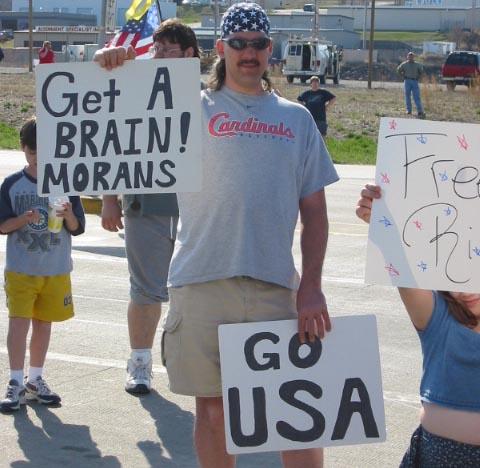
which when carried by a Tbaggers is just as bigoted. My calculations are that 93.532% of the people parading outside the White House were bigoted, callous, hateful, right wingers.

ThoughtCriminal
(14,757 posts)is the new "Get a Brain Morans"


Enthusiast
(50,983 posts)
Uncle Joe
(65,569 posts)This letter has long struck historians as significant because of its apparent paradox: A few years later, Lee would command hundreds of thousands of young men to kill and die for a cause he personally believed was immoral, a cause his great adversary, Ulysses S. Grant, would describe as “one of the worst for which a people ever fought, and one for which there was the least excuse.” Lee was of course not the first white American to be pinioned by this paradox, which was written into our Constitution, with its oblique references to “other persons” existing in certain states who were to be counted as three-fifths of a human being. Nor was he the last.
Lee didn't support secession but when Virginia seceded, his choice came down to either taking Lincoln's offer; commanding the Union Troops as the Supreme Commander to which would result in battling and killing his family, friends and neighbors or fighting to defend Virginia; an entity much older than the young United States to which Lee's ancestors had played a prominent role in that state's history.
Had Virginia remained in the Union I have no doubt Lee would've become a Union General.
Lee made the same choice as Sophie choosing the entity; child or state with the most memories.

IrishAyes
(6,151 posts)He's lucky I wasn't in charge after Appomatox. I'd have hanged him from the yardarm for treason. That's all he was - a treasonous, self serving bastard.
At least his daughter had the sense to run off and marry a damnedYankee.
If Lee had done the right thing by accepting Lincoln's offer, it would've carried great weight with the rest of the South and doubtless would've shortened the war by years. All that unnecessarily shed blood is on his hands.

freshwest
(53,661 posts)Uncle Joe
(65,569 posts)practiced from a Northern, Southern, Eastern, Western or Midwestern point of view.
IrishAyes
(6,151 posts)Alluding to a Sophie's choice implies that Lee deserves some degree of understanding and sympathy. He most emphatically does not. He chose to compound the horror of war many fold. He was guilty therefore of mass murder, an early southern version of Pol Pot. The fact that he had plenty of fellow travelers (my apologies to his innocent horse) offers no cover at all. Not a bit. I cannot imagine a more vile sociopath.
Uncle Joe
(65,569 posts)is entirely up to the viewer, but he had no good choice.
Having said that, Lee never murdered anyone, he fought them on the battlefield whether you wish to accept that reality or not.
The dynamic of regionalism held true with both sides of that bloody conflict, they either fought for their states, or their states didn't secede in which case they fought for the union.
Slavery was the major issue of the war but to deny regionalism's role in fanning the flames, leading up to and intensifying the fighting is to host delusion.
IrishAyes
(6,151 posts)caused by insane secessionists and their willing collaboraters is not meeting those victims on a field of honor, but rather one of the murderer, plain and simple. Delusions? Maybe you should look that up in the dictionary for yourself. The North didn't invade an innocent, peace loving South but rather one that chose to sully the sacrifices of patriots who went before for nothing more than their own selfish ends. If that isn't evil personified, please explain what is.
Once again, he did have a good choice. He could've accepted Lincoln's offer and saved countless lives instead of making a short sighted infamous decision, trying to cover it with the fig leaf of that hypocritical statement that Virginia was his mother and that he couldn't fight his mother. Lee belongs right down there with Pol Pot, Hitler, Stalin and such. He had no qualms sacrificing many another's sons.
(later)
Are you aware that Southern leaders, according to documents of the time, planned to carry their 'peculiar institution' as far into Mexico and Central America as their swords could take them as soon as they finished whupping them damnYankees? If Lee was the flower of the South, it must be a stinkweed.
Uncle Joe
(65,569 posts)they believed in their cause, that's true especially for the first few years.
Hundreds of thousands of Confederates fought and died for different reasons, many of them did believe the North would invade just as many Americans later bought the B.S. about Spain blowing up the Maine all the way to Iraq has WMDs.
Had Lee accepted Lincoln's offer after Virginia seceded, he would've been fighting and killing his own family, friends, neighbors and state.
You might actually believe killing your own family and friends constitutes a "good choice" but I seriously doubt it.
Your comparisons of Lee to Pol Pot, Hitler and Stalin are ludicrous, he never committed genocide but don't let the facts get in the way of your "righteous wrath."
IrishAyes
(6,151 posts)Supporting secession is the same as causing the war. While the North did indeed enthusiastically fight for the Union by and large, they wouldn't have had to go to war if the South hadn't caused one. The bloodiest in our history, btw. Please explain how Pol Pot et al were/was any worse than the whole damned Confederacy leadership? The North didn't want war. The South did and dragged them into it by seceding and incidentally firing the first shots.
Whitewash that if you can.
........................
Oh, and one other thing. Southern apologists can't legitimately deny that much of the present South has a large contingent of very sincere and serious secessionists in waiting, with various similar pockets scattered across the country. Let them try it again if they're that stupid. Let them try, and they'll find out what fools they are in short order. People who don't want to see that movie again (although it would be a short) have not only a right but a duty to righteous indignation.
Uncle Joe
(65,569 posts)down and tender his resignation until after Virginia had already seceded, Lee had no control over that.
Pol Pot, Hitler and Stalin committed genocide Lee never committed genocide.
http://dictionary.reference.com/browse/genocide?s=t
gen·o·cide/ˈdʒɛnəˌsaɪd/ Show Spelled [jen-uh-sahyd] Show IPA
noun
the deliberate and systematic extermination of a national, racial, political, or cultural group.
Make no mistake about it some in the North did want war, just as people in the South wanted war.
Both sides were excited about war, that's what regionalism does to a nation.
IrishAyes
(6,151 posts)beforehand or after. He could've cooled some jets if he'd chosen, and he did a most evil and wicked thing by going along with the crowd. As a major factor in an unnecessary war, yes he does deserve an extra helping of blame. Using the thin cover of family and region as an excuse for an indefensible course of action will not erase one spot of blame from his 'noble' (gag!) head. I'm glad pigeons poop on his likeness. Given a chance, I probably would too! 
Now, excuse me, it's almost midnight here and I hear my coach pulling up.
Let's not resume this tomorrow, shall we?
Uncle Joe
(65,569 posts)Have a good night, IrishAyes.
coldmountain
(802 posts)Watch the "Home Guard" in action in the movie "Coldmountain". Many Southerners didn't want to fight. And yes the war was about slavery.

thucythucy
(9,154 posts)Actually, the south instituted the draft of military age men (except for those with enough slaves or money, who were exempted) before the north. It also, arbitrarily, decided that anyone who enlisted in the insurgent army had done so for the duration, even if the paper they signed said for one year, or two years, or three months. Anyone who disagreed with their feet was a deserter, and a common form of punishment for desertion in those days was death.
So yes, the military of which Lee was such an important part did indeed drag very many folks onto the battlefield.
Lee had other choices beside turning traitor and prolonging a criminal war, or "killing his relatives." He could have resigned his commission outright, and fought no one at all. Or he could have evacuated his family from the region--unlike many poor southerners who were stuck in place, Lee had the means to do so.
And while I wouldn't compare him to Pol Pot or Hitler, your comparing him to a (fictional) mother packed off to Auschwitz who had to watch as one of her children was led away to be gassed is equally, if not more, ludicrous.
If anything, I'd place Lee in the same category as Rommel or Albert Speer--gifted technocrats who served a thoroughly evil cause. But then, both Rommel and Speer eventually saw the light and tried at last to stop Hitler--for which Rommel paid with his life. Speer survived, but after the war was tried for crimes against humanity and sentenced to twenty years at Spandau Prison.
Lee was most fortunate to have escaped the usual consequences of his treason.
Uncle Joe
(65,569 posts)His daughter was the strongest secessionist and I believe he felt the least likely to waver in following him.
Lee was a man of strong duty and honor having served in the military his entire life, he could not sit idly by while his nation and home state were going through the greatest crisis of his and even our time.
Lee was compelled to defend one or the other, that was his life's training and there was no third choice.
Lee's sense of duty and honor gained him respect even in the North among his enemies because duty and honor were higly regarded and they considered him a man of conscious whether they disagreed and/or even fought against him in deadly combat.
http://en.wikipedia.org/wiki/Robert_E._Lee
After the war, as President of what is now Washington and Lee University, Lee supported President Andrew Johnson's program of Reconstruction and intersectional friendship, while opposing the Radical Republican proposals to give freed slaves the vote and take the vote away from ex-Confederates. He urged them to rethink their position between the North and the South, and the reintegration of former Confederates into the nation's political life. Lee became the great Southern hero of the War, a postwar icon of the "Lost Cause of the Confederacy" to some. But his popularity grew even in the North, especially after his death in 1870. He remains one of the most revered, iconic figures of American military leadership.[7]
(snip)
Lee privately ridiculed the Confederacy in letters in early 1861, denouncing secession as "revolution" and a betrayal of the efforts of the founders. Writing to his son William Fitzhugh, Lee stated, "I can anticipate no greater calamity for the country than a dissolution of the Union." While he was not opposed in principle to secession, Lee wanted all peaceful ways of resolving the differences between North and South—such as the Crittenden Compromise—to be tried first, and was one of the few to foresee a long and difficult war.[60]
The commanding general of the Union Army, Winfield Scott, told Lincoln he wanted Lee for a top command. Lee accepted a promotion to colonel on March 28.[61] He had earlier been asked by one of his lieutenants if he intended to fight for the Confederacy or the Union, to which Lee replied, "I shall never bear arms against the Union, but it may be necessary for me to carry a musket in the defense of my native state, Virginia, in which case I shall not prove recreant to my duty."[62] Meanwhile, Lee ignored an offer of command from the CSA. After Lincoln's call for troops to put down the rebellion, it was obvious that Virginia would quickly secede. Lee turned down an April 18 offer by presidential aide Francis P. Blair to command the defense of Washington D.C. as a major general, as he feared that the job might require him to invade the South. When Lee asked Scott, who was also a Virginian, if he could stay home and not participate in the war, the general replied "I have no place in my army for equivocal men."[60]
Lee resigned from the Army on April 20 and took up command of the Virginia state forces on April 23.[22] While historians have usually called his decision inevitable ("the answer he was born to make", wrote one; another called it a "no-brainer"
 given the ties to family and state, recent research shows that the choice was a difficult one that Lee made alone, without pressure from friends or family. His daughter Mary Custis was the only one among those close to Lee who favored secession, and wife Mary Anna especially favored the Union, so his decision astounded them. While Lee's immediate family followed him to the Confederacy, others, such as cousins and fellow officers Samuel Phillips and John Fitzgerald, remained loyal to the Union, as did 40% of all Virginian officers.[60]
The Confederacy did institute the draft first because they had far less man power, over three to one advantage to the Union.
The more industrialized Union's draft gave exclusions to anyone with enough commutation money to pay off someone else to take their place.
I believe the amount was $150, a relatively large sum in those days, particuarly if you were a newly arrived immigrant, it was as with many other conflicts a rich man's war.
http://en.wikipedia.org/wiki/American_Civil_War
In the first year of the war, both sides had far more volunteers than they could effectively train and equip. After the initial enthusiasm faded, reliance on the cohort of young men who came of age every year and wanted to join was not enough. Both sides used a draft law—conscription—as a device to encourage or force volunteering; relatively few were actually drafted and served. The Confederacy passed a draft law in April 1862 for young men aged 18 to 35; overseers of slaves, government officials, and clergymen were exempt.[123] The U.S. Congress followed in July, authorizing a militia draft within a state when it could not meet its quota with volunteers. European immigrants joined the Union Army in large numbers, including 177,000 born in Germany and 144,000 born in Ireland.[124]
When the Emancipation Proclamation went into effect in January 1863, ex-slaves were energetically recruited by the states, and used to meet the state quotas. States and local communities offered higher and higher cash bonuses for white volunteers. Congress tightened the law in March 1863. Men selected in the draft could provide substitutes or, until mid-1864, pay commutation money. Many eligibles pooled their money to cover the cost of anyone drafted. Families used the substitute provision to select which man should go into the army and which should stay home. There was much evasion and overt resistance to the draft, especially in Catholic areas. The great draft riot in New York City in July 1863 involved Irish immigrants who had been signed up as citizens to swell the machine vote, not realizing it made them liable for the draft.[125] Of the 168,649 men procured for the Union through the draft, 117,986 were substitutes, leaving only 50,663 who had their personal services conscripted.[126]
North and South, the draft laws were highly unpopular. An estimated 120,000 men evaded conscription in the North, many of them fleeing to Canada, and another 280,000 Northern soldiers deserted during the war,[127][128] along with at least 100,000 Southerners, or about 10% all together.[129] However, desertion was a very common event in the 19th century; in the peacetime Army about 15% of the soldiers deserted every year.[130] In the South, many men deserted temporarily to take care of their families,[131] then returned to their units.[132] In the North, "bounty jumpers" enlisted to get the generous bonus, deserted, then went back to a second recruiting station under a different name to sign up again for a second bonus; 141 were caught and executed.[133]
Motivation
Perman and Taylor (2010) say that historians are of two minds on why millions of men seemed so eager to fight, suffer and die over four years:
"Some historians emphasize that Civil War soldiers were driven by political ideology, holding firm beliefs about the importance of liberty, Union, or state rights, or about the need to protect or to destroy slavery. Others point to less overtly political reasons to fight, such as the defense of one's home and family, or the honor and brotherhood to be preserved when fighting alongside other men. Most historians agree that, that no matter what a soldier thought about when he went into the war, the experience of combat affected him profoundly and sometimes altered his reasons for continuing the fight."[135]
Regarding the comparisons to Rommel and Speer, the difference betwene Nazi Germany and the Confederacy are as night and day.
Hitler over threw Germany's democracy, going so far as to the burn the German Parliment and declaring himself dictator, he also committed mass genocide.
The Confederacy despite that entity's many flaws did neither, the state legislatures elected by the people in those states chose to leave the union.
It was a democratic process.
Had Lee tried to kill Jefferson Davis, he would've betrayed democracy at all levels as it was known in that time, not to mention against his family which either supported secession from the outset or followed him to defend it.
_______________________________________________________________________________
This following is a response to the OP
From my post #11 to the OP's #19
I didn't feel compelled to respond to your straw man argument that slavery wasn't the major cause or issue leading to the Civil War as I clearly posted upthread post # 11 that it was.
Furthermore I see your continuous regionalist OPs and posts as being no different than the lunatic flying the Confederate Flag.
You both seek nothing but division of our nation, something Presidents even as disparate as Andrew Jackson and Abraham Lincoln firmly opposed.
You don't attack policies or political philosphy, you attack locations and arbitrary boundaries doing nothing but throwing hand grenades in to crowds of people because you don't like one or more of the people in said crowd.
Regionalism is racism's twin, both are nothing but mass generalities, the former based due to the color of someone's skin and the latter on where they were born or live.
Your ongoing attempts at dividing the Democratic Party specifically and the nation in general along regional lines only serves to aid the Republican Party.
My post# 11
Slavery was the major issue of the war but to deny regionalism's role in fanning the flames, leading up to and intensifying the fighting is to host delusion.

struggle4progress
(126,695 posts)