General Discussion
Related: Editorials & Other Articles, Issue Forums, Alliance Forums, Region ForumsThis was the month by month unemployment rate from nov 83 to nov 84
1983-11-01 8.5
1983-12-01 8.3
1984-01-01 8.0
1984-02-01 7.8
1984-03-01 7.8
1984-04-01 7.7
1984-05-01 7.4
1984-06-01 7.2
1984-07-01 7.5
1984-08-01 7.5
1984-09-01 7.3
1984-10-01 7.4
1984-11-01 7.2
At the height of the Reagan recession unemployment reached 10.8. By June of 84 it was 7.2 and lower than Jan 81. Reagan went on to win in a landslide.
There is no evidence that the economy is going to see the drops in unemployment to match the 84 drops. My guess is that the rate in June of 12 will be, at the very best, 8 and more probably around the 8.5 it is now.
This will be a very tough race. Honestly the main reason he has a shot at this, at all, is the incredible weakness of the GOP field combined with his success in foreign policy and non economic domestic policy. Those who think that this race will be a cakewalk are just plain engaging in wishful thinking. Obama has been very lucky in his choice of enemies but unless his economic luck changes for the better, this race will be a nail biter. This will be a Truman-Dewey, not a Reagan Mondale.
 = new reply since forum marked as read
Highlight:
NoneDon't highlight anything
5 newestHighlight 5 most recent replies
= new reply since forum marked as read
Highlight:
NoneDon't highlight anything
5 newestHighlight 5 most recent replies
"At the height of the Reagan recession unemployment reached 10.8. By June of 84 it was 7.2 and lower than Jan 81. Reagan went on to win in a landslide.
There is no evidence that the economy is going to see the drops in unemployment to match the 84 drops. My guess is that the rate in June of 12 will be, at the very best, 8 and more probably around the 8.5 it is now."
...given that the current economic crisis is the worst since the Great Depression and the unemployment rate is 8.6 percent, it may be "wishful thinking" to believe that it will be 8.5 percent 10 months from now.

dsc
(53,443 posts)Reagan saw pretty consistent drops in unemployment for both of 83 and 84. In contrast, we have seen the rate rise for most of the year with a .4% drop just this month. Without that drop, there would have been no drop at all this year. In comparison, 83 saw a 2.1% drop (10.4 to 8.3). The trajectory in Reagan's case was very positive, ours appears to be fairly flat. We won't be running a morning in America campaign.

pscot
(21,044 posts)our economy had a manufacturing base. Now it's all banksters and health care and peddling Chinese goods. It's not clear where the jobs are supposed to come from this time around. If the Euro goes under we could see complete economic chaos. It's a bad time to be cursed with the kind of feckless leadership we're seeing, both here and in Europe.
...American people aren't going to get into nuance. The unemployment rate was 9.8 in November 2010, and it's 8.6 percent now.
If they cared about nuance, I suspect that when the unemployment rate bounced up .3 percent in June 1984 that would have been cause for panic.
There has been 21 consecutive months of job growth. Sure anything could happen, but the trend is positive.
dsc
(53,443 posts)which is when that rate would have been reported. Mondale's only lead was at the end of July after he named Ferraro.
http://www.ronaldreaganweb.com/ronaldreaganweb/1984.htm#July
Note the headlines listed.
"actually there was a bit of a jump for Mondale in July which is when that rate would have been reported."
...a bit of a stretch isn't it?
dsc
(53,443 posts)which was admittedly largely convention driven but the fact remains that the GOP was actually worried at that time in the campaign. Then the rate fell again and we never got traction.
"He had a 15 point jump which was admittedly largely convention driven ..."
...but it's still a stretch to link that to a .3 percent bump in the unemployment rate.

tritsofme
(19,933 posts)Most of the recent decrease can be attributed to people leaving the labor force. As conditions improve and they reenter the labor force the unemployment rate will likely rise.
I have seen statistics saying that the U3 unemployment rate would be closer to 11% if the labor force participation was held constant at 2008 levels, that shows there is a lot of slack in the current number, and further declines shouldn't be expected, and could even be a negative development.

ProSense
(116,464 posts)"Most of the recent decrease can be attributed to people leaving the labor force. As conditions improve and they reenter the labor force the unemployment rate will likely rise. "
...if conditions are improving anything could happen, such as the ratio of job openings per person improves.
The fact is that there are variables, but to say that a positive trend and the potential that conditions will continue to improve are troubling is a stretch.
Yo_Mama
(8,303 posts)Employment population ratio, no disability, entire population:

Employment population ratio, no disability, 65 & over:

Long time series, employment population ratio:

has been moving sideways of late, but you can see the drop associated with the stimulus. It went from a high of near 7 to 1 down to 4 to 1
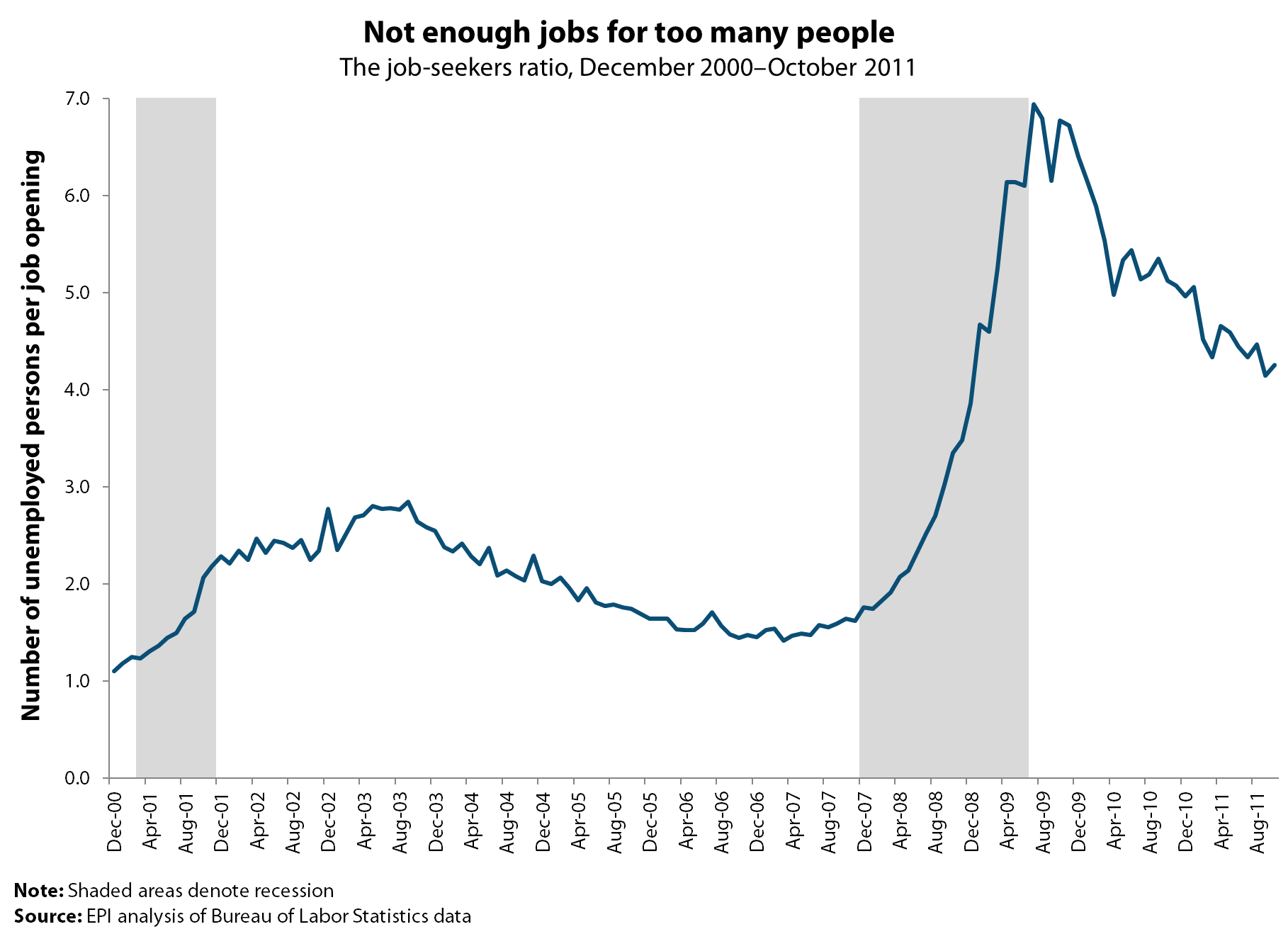
http://www.epi.org/publication/job-seekers-ratio-remains-4-1-34th-straight/
Yo_Mama
(8,303 posts)Generally, that ratio even close to 3 means that jobs are hard to get and any significant cyclical effects in any significant industry will produce rapidly rising unemployment rates.
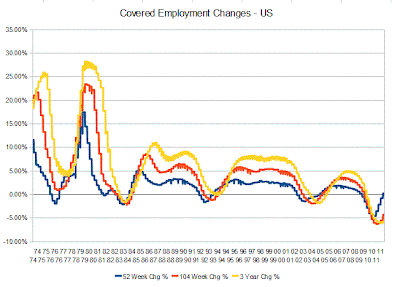
Regarding actual jobs, I posted two graphs in this thread that are very strong measures. Covered employment changes (a count of all workers contributing to unemployment insurance) is a very strong measure of absolute measures of employment. That shows the movement of total jobs in the economy over time.
The employment/population ratio is compiled from a survey, but is pretty strong. It incorporates the other side of the equation - growth in population.
You can't substitute a graph like this, which only tangentially suggests employment/unemployment rates for strong measures to argue that the trend is up. Not only is that data weak, it includes a significant number of job postings that are actually not available to US citizens - the H1-B postings. I sampled industrials (utilities, electronics, etc) and I came up with over 52% H1-B postings.
We can make the argument from the covered jobs graph that things improved this year - that we finally got back to the position where the economy is finally adding net jobs. But we cannot claim that the overall picture for the worker out there is improving - the employment/population ratio would have to improve for that to happen.
In a lot of ways we are losing ground still!
Real average hourly earnings for non-supervisory workers have dropped 2.1% over the year:
http://www.bls.gov/news.release/realer.t02.htm
Youth unemployment levels just don't drop. This is the 16-19 employment/population ratio long time series. Given the small sample, there has been no statistically significant improvement since 2009. The hard NSA numbers for November:
2009: 24.9
2010: 24.8
2011: 25.0

The one trap the Democratic party should not fall into is to attempt to portray the economy as better than it is. This just frightens people - failure of government officials to even acknowledge problems is the surest way to get your butts thrown out of office:
The average voter doesn't blame the current administration for this downturn - they know full well that it began long before this administration arrived. But the average voter WILL blame the administration for a bunch of happy talk that conflicts with what the average voter is experiencing.
Real personal incomes in the US are falling. As of Q3 real personal per capita income (includes social benefits) was 32,335 compared to Q1's 32,670. Most of this is due to inflation, but the reality is that although I think real personal per capita income will rise this quarter, unless inflation falls significantly next year we are extremely likely to subside into another downturn, although hopefully it will be brief. If you look at the employment/population ratio graph, you'll see that it is bottoming each year around February, even seasonally adjusted. First quarter will not be strong.
Yo_Mama
(8,303 posts)This is a graph showing the change (%) of covered employment by over 1, 2 & 3 year time sequences. It points out the huge difference between the recovery in the 80s and our current recovery:
To go further, Obama's reelection campaign will be deeply affected by the youth vote. Obama won by a huge margin last election - but among the components of that victory were both a literal landslide among the young voter, and a huge growth in first time voters, who are of course largely young.
With the horrible youth unemployment stats, I think votes for Obama in this population group will be far suppressed in comparison to 2008. This is the time series for 16-19 unemployment rates:

One of the reasons young people are winding up with so much college debt is that they can earn less while going to school and before starting college - higher education is being used as a substitute for a job.
Another problem is that "student" jobs are increasingly becoming "retiree" jobs.

boxman15
(1,033 posts)I think Obama would still win, but it wouldn't be a blowout by any measure, especially considering 8% unemployment by November 2012 would be a very pleasant surprise. It would be a very, very close race, and we'll have to do all we can to ensure Obama stays in the White House.
If it's Newt or some other crazy person, then Obama would win by close to Reagan-Mondale proportions simply because many will be drawn away by his/her extremism. I know many conservatives and moderate Republicans in my family who have said they'd either sit out or vote Obama if Newt or a fringe candidate is president.

JDPriestly
(57,936 posts)Neither Obama nor Congress is willing to do that now.
dsc
(53,443 posts)which, of course, we can't do since they are already 0.

ellisonz
(27,776 posts)No mercy.

bluestate10
(10,942 posts)The unemployment rate could drop a minimum of 1.5% by November 2012. I estimate that 1.5% will be on the low end of the drop. There are factors at work, one which NO ONE is talking about yet, that will cause the rate of unemployed to plunge faster than any at any time in the history of this country. That plunge started at the end of the second quarter of this year and will accelerate throughout next year and the years beyond.

Kick in to the DU tip jar?
This week we're running a special pop-up mini fund drive. From Monday through Friday we're going ad-free for all registered members, and we're asking you to kick in to the DU tip jar to support the site and keep us financially healthy.
As a bonus, making a contribution will allow you to leave kudos for another DU member, and at the end of the week we'll recognize the DUers who you think make this community great.