General Discussion
Related: Editorials & Other Articles, Issue Forums, Alliance Forums, Region ForumsThe U.S. prison population fell two consecutive years; 2010 the largest decrease since 1977
<..>
- A new report out from the Bureau of Justice Statistics (BJS) this month revealed that the number of adults behind bars, on probation, or on parole in the U.S. declined 1.3% in 2010, the second consecutive year of decline since BJS began reporting this data since 1980.
- The same report revealed that the total U.S. prison population fell to 1.6 million, a decline of 0.6 percent during 2010 – the first decline in the total prison population in nearly four decades.10,881 fewer people were in state prisons in 2010 – the largest yearly decrease since 1977.
- <...>
- The United States Sentencing Commission took another step toward creating fairness in federal sentencing by voting to retroactively apply the new Fair Sentencing Act (FSA) guidelines to individuals sentenced before the law was enacted. This decision will help ensure that over 12,000 people — 85 percent of whom are African-Americans — will have the opportunity to have their sentences for crack cocaine offenses reviewed by a federal judge and possibly reduced.
- <...>
http://www.aclu.org/blog/criminal-law-reform/criminal-justice-reform-2011-good-bad-and-work-ahead
When you look at the spike in the prison population from 1980 through the Bush years, this is welcomed news. As the ACLU points out, there is much more that can be done.
 = new reply since forum marked as read
Highlight:
NoneDon't highlight anything
5 newestHighlight 5 most recent replies
= new reply since forum marked as read
Highlight:
NoneDon't highlight anything
5 newestHighlight 5 most recent replies

Cirque du So-What
(29,882 posts)They've developed quite a taste for cheap prison labor, so I imagine there's a lot of lobbying on their part to keep prisons filled to overflowing - by hook or by crook.

ProSense
(116,464 posts)to take a lot to end the prison for profits and cheap labor trend. One of the provisions in the transportation bill.
http://www.senate.gov/legislative/LIS/roll_call_lists/roll_call_vote_cfm.cfm?congress=112&session=2&vote=00048
ProSense
(116,464 posts)nanabugg
(2,198 posts)
DippyDem
(660 posts)Too many things wrong with the prison system. Profit is a HUGE motivating factor! Moreover we house more prisoners per 1000 than anywhere in the world. Something is very wrong.

Uncle Joe
(65,511 posts)There simply should be no profit motive for locking up the American People.
If that industry isn't eliminated this downturn will only be temporary.
Thanks for thread, ProSense. 

Warren DeMontague
(80,708 posts)Fortunately, we're still throwing pot smokers in prison cells like there's no tomorrow, so there's little danger of those wonderful buildings going empty.

SidDithers
(44,333 posts)Sid

marlakay
(13,384 posts)have to keep those private prisons busy!
Comrade Grumpy
(13,184 posts)48.7% drug war prisoners, according to the BOP: http://www.bop.gov/news/quick.jsp
The Fair Sentencing Act was a first baby step in the right direction, but there is tremendous inertia and vested interests behind the federal drug war.
By vested interests, I don't mean conspiracy theories about corporations. I mean the drug war bureaucracies, law enforcement, the legal profession, prison builders and contractors--people and institutions that are directly benefiting from the status quo.
ProSense
(116,464 posts)48.7% drug war prisoners, according to the BOP: http://www.bop.gov/news/quick.jsp
...it is, and that 48.7 pecent is significant:
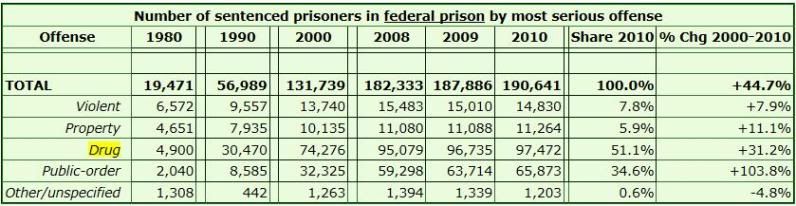
Source: http://drugwarfacts.org/cms/?q=node/62
Current percentages from the Federal Bureau of Prisons, as of February 25, 2012:
That's the lowest number of drug offenders since 2008.
In fact, the percentage is down from about 56.3 percent in 2000, and is at a pre-1990 low.
Now, it's time to end the war on drugs, the for-profit prison industry and put in place policies that help people to turn their lives around once they're released from the system.
Comrade Grumpy
(13,184 posts)The tiny decrease in total prisoners is because of reductions at the state level. The states figured out in the last few years of recession that they can't afford their incarceration binge.
The federal prison population is still increasing, although not as fast as in recent decades. Here's some history:
http://www.bop.gov/about/history.jsp
Pursuant to Pub. L. No. 71-218, 46 Stat. 325 (1930), the Bureau of Prisons was established within the Department of Justice and charged with the "management and regulation of all Federal penal and correctional institutions." This responsibility covered the administration of the 11 Federal prisons in operation at the time.
As time has passed and laws have changed, the Bureau's responsibilities have grown, as has the prison population. At the end of 1930, the agency operated 14 facilities for just over 13,000 inmates. By 1940, the Bureau had grown to 24 facilities with 24,360 inmates. Except for a few fluctuations, the number of inmates did not change significantly between 1940 and 1980, when the population was 24,252. However, the number of facilities almost doubled (from 24 to 44) as the Bureau gradually moved from operating large facilities confining inmates of many security levels to operating smaller facilities that each confined inmates with similar security needs.
As a result of Federal law enforcement efforts and new legislation that dramatically altered sentencing in the Federal criminal justice system, the 1980s brought a significant increase in the number of Federal inmates. The Sentencing Reform Act of 1984 established determinate sentencing, abolished parole, and reduced good time; additionally, several mandatory minimum sentencing provisions were enacted in 1986, 1988, and 1990. From 1980 to 1989, the inmate population more than doubled, from just over 24,000 to almost 58,000. During the 1990s, the population more than doubled again, reaching approximately 136,000 at the end of 1999 as efforts to combat illegal drugs and illegal immigration contributed to significantly increased conviction rates.
Liberal_in_LA
(44,397 posts)
Kick in to the DU tip jar?
This week we're running a special pop-up mini fund drive. From Monday through Friday we're going ad-free for all registered members, and we're asking you to kick in to the DU tip jar to support the site and keep us financially healthy.
As a bonus, making a contribution will allow you to leave kudos for another DU member, and at the end of the week we'll recognize the DUers who you think make this community great.