General Discussion
Related: Editorials & Other Articles, Issue Forums, Alliance Forums, Region ForumsTariffs were very strong American worker wage protection, HENCE corporations hate tariffs.
Our government was once able to use tariffs to level the playing and paying field regarding cheap imports from low wage countries. We did so in part to protect American wages and to keep American wages and US made goods competitive vs low wage made goods. Tariffs were also an American economy protector.
Throughout the 90's and into the 2000's, we all but ended tariffs as part of NAFTA, WTO, most favorable nation status etc.
Tariffs also helped fund our govt. We used tariffs to fund govt going back to the Revolutionary War.
Under Bill Clinton..
From 1998-2000, America balanced its budget and ran annual budget surpluses. We were actually paying down our national debt. A first since Ray-gun destroyed our budgetary process and wrecked fiscal responsibility in 1981.
Bill Clinton also shares blame in the debt game. NAFTA began the process of slowly removing tariffs from trade with nations negotiated into the trade pact, Canada and Mexico. Since then, free trade and most favorable nation status has expanded near globally already and our leaders are now pushing to make it global. Tariffs are becoming a thing of the past.
And America is going bankrupt in large part.
Under Bush, after ending tariffs, America slid back into record annual deficit spending, exploding national debt, and the return of fiscal recklessness. Also caused by Bush's 2001 and '03 tax cuts that were reckless giveaways to the wealthiest. Unfunded wars and an unfunded Medicare drug benefit that only benefited big pharma also contributed to soaring deficits.
Bush gave tax incentive to corporations to move jobs to China and thus 'create' jobs in China, as part of the 2001 tax cut law.
Tariffs would make said laws moot. There'd be no ultra-cheap junk imported from China if tariffs were imposed on said imports. American made products could compete with low wage nations, once again if we re-imposed tariffs.
We can work toward a balanced budget with the revenues generated from re-imposing tariffs. We can restore jobs and protect our wages and our job security by re-imposing tariffs.
Ending tariffs is a corporate wage-busting tool meant to drive down wages and exploit low-wage workers for maximum corporate profits.
While we starve and our nation dies.
More proof that multi-national corporations are the #1 threat to America and our sovereignty. Moreso than any terrorist org.
Terrorists wish they could harm America the way that corporations have.
 = new reply since forum marked as read
Highlight:
NoneDon't highlight anything
5 newestHighlight 5 most recent replies
= new reply since forum marked as read
Highlight:
NoneDon't highlight anything
5 newestHighlight 5 most recent replies

truedelphi
(32,324 posts)Which might be why our elected puppets want a secret, non-transparent "Trade Agreement " like the TPP. I imagine that it is going to ensure that other nations are not allowed tariffs. And the TPP sure won't restore a decent tariff system here.
B Calm
(28,762 posts)if it cost a manufactor $1.00 in labor costs to make a product here, but the same manufactor can go to China and have it made for 10 cents, then there should be a ninety cent tariff if they want to sell it here!
This would put an immediate stop to off shoring American jobs and unemployment would be zilch!

pampango
(24,692 posts)FDR got rid of them a second time in the 1930's after republicans raised tariffs again in the 1920's. And corporations loved high tariffs (which is why republicans raised them.) It protected them from competition and preserved domestic monopolies.
Tariffs and excise taxes meant that almost the entirety of federal tax revenue came from the poor while the rich paid virtually nothing. This spawned enormous outrage.
Everyday Americans hated the tax system of the Gilded Age. The federal government gathered taxes in two ways. First, it placed high tariff rates on imports. These import taxes protected American industries from competition. This allowed companies to charge high prices on products that the working class needed to survive while also protecting the monopolies that controlled their everyday lives. Second, the government had high excise taxes on tobacco and alcohol, two products used heavily by the American working class.
Today, we are supposed to hate paying taxes. They are our “tax burden.” We vote for politicians who will reduce our taxes, even if that means destroying the welfare state. Conservatives’ century-long war against taxes has paid off by convincing everyday Americans to think taxes are a horrible thing that pays for government waste.
Our ancestors knew this was not true. The income tax was the most popular economic justice movement of the late 19th and early 20th century. This truly grassroots movement forced politicians to act in order to stay in office, leading to the 16th Amendment to the Constitution in 1913. That’s right, the income tax was so popular that the nation passed a constitutional amendment so that the right-wing Supreme Court couldn’t overturn it.
Corporations immediately organized against this. In a strategy we can recognize today, the Chamber of Commerce distorted the bill’s purpose, telling the public that the income tax would drive them into poverty, even though the bill did not affect working-class people. Yet the Chamber made little headway in the face of this overwhelmingly popular movement.
http://mobile.alternet.org/alternet/#!/entry/the-hidden-progressive-history-of-income-tax,51754f28da27f5d9d0a7ea44/1
FDR campaigned against high tariffs, lowered them during his presidency and set up the low-tariff trade system of the post-WWII world.
TheFrenchRazor
(2,116 posts)wisely, and they need to be used to stop this country's race to the bottom.

brentspeak
(18,290 posts)while hiding behind FDR's avatar, trying to suck Democrats in while parroting US Chamber of Commerce propaganda. On a Democratic site, no less.
How many times on this site do people have to call you out on this?
First of all, not only are you falsely implying that the article you excerpted above is somehow arguing against the imposition of new tariffs (it's not), you apparently were unaware that the article's author is actually completely opposed to today's so-called "free trade" agreements.
Second of all -- and this is for other DUer's out there; I've already responded to you specifically on this numerous times -- FDR only wanted to lower tariff on imports on the sole conditions that a) corresponding partner nations lower their tariffs on American exports as well; and b) the lowering of import tariffs on foreign goods into the US must also be accompanied by a rock-solid guarantee that American domestic production would not be compromised (a stipulation that every subsequent US trade agreement after FDR has completely ignored):
https://www.princeton.edu/~achaney/tmve/wiki100k/docs/Reciprocal_Tariff_Act.html
The Reciprocal Trade Agreements Act (enacted June 12, 1934, ch. 474, 48 Stat. 943, 19 U.S.C. § 1351) provided for the negotiation of tariff agreements between the United States and separate nations, particularly Latin American countries. The Act served as an institutional reform intended to authorize the president to negotiate with foreign nations to reduce tariffs in return for reciprocal reductions in tariffs in the United States. It resulted in a reduction of duties.
President Franklin D. Roosevelt was authorized by the Act for a fixed period of time to negotiate on bilateral basis with other countries and then implement reductions in tariffs (up to 50% of existing tariffs) in exchange for compensating tariff reductions by the partner trading country. Roosevelt was also instructed to maximize market access abroad without jeopardizing domestic industry, and reduce tariffs only as necessary to promote exports in accord with the "needs of various branches of American production.".
Therefore, FDR's trade policy was the opposite of today's free trade agreements, which are authored deliberately to relocate domestic industry to overseas facilities and which are not required at all to consider domestic American production.
The very last thing in the world FDR wanted was for American corporations to move their domestic manufacturing facilities overseas so that the corporations could then import their cheap, foreign-made back into the United States. That was a nightmare scenario that FDR did not want, but it is the scenario that you and the people who provide your talking points support.
DU Globalist, weird ehh?
pampango
(24,692 posts)pampango
(24,692 posts)I did not claim anything for the article other than that it makes the case that getting rid of high tariffs was a progressive victory. And that corporations thrived under high tariffs then at the expense of the working class.
Which is quite different from the republican policy of unilaterally raising tariffs which he was starting to reverse. He had campaigned against those republican high tariffs in 1932 and the RTAA was his first move to reverse them.
As you know FDR's plan for the post-WWII world was for international organizations to govern international politics (the UN), finance (the IMF and World Bank) and trade (the ITO and GATT). He wanted to make it more difficult for countries to unilaterally raise tariffs as republicans had done in the 1920's.
FDR believed in the value of trade. He believed in lowering tariffs not raising them. He believed that multilateral governance of trade would make it difficult for countries to unilaterally raise tariffs.
How far would FDR have gone in supporting lower tariffs? I don't know. He considered high tariffs to be isolationist republican policy because that's what came before him. Perhaps he would have reversed his position in time.
It certainly seems that he believed that domestic policies were more important than trade in improving living standards. Empowering unions, raising taxes on the rich, making the safety net better, tighter corporate regulation government spending to boost employment - all liberal domestic policies that made life better for American workers. This is the same combination of liberal domestic policies and trade that progressive countries follow today.
brentspeak
(18,290 posts)And today, corporations are thriving under low tariffs, very much at the expense of the working class.
"FDR believed in the value of trade."
Meaningless statement. Who doesn't believe in the value of trade? Of course FDR believed in the value of trade. What FDR did not believe in was lopsided "trade" which would harm the working person, a situation we have today.
You keep waltzing around the central issue regarding today's "trade" as pursued for the past several decades by the US government: low tariffs on cheap imports, flooding the US marketplace with products that have displaced US manufacturers, while the biggest US-owned corporations have simply offshored their manufacturing facilities overseas, employing foreign workers in place of American workers, or otherwise forcing down the wages of those remaining American workers.
That is not "trade", that is not what FDR wanted. And that closes the book on your attempts to propagandize Business Roundtable 1% talking points on DU while hiding behind the avatar of an American president who would have rejected them summarily.
pampango
(24,692 posts)low tariffs. Focusing on tariffs and trade in general to control corporations or as the source of or the solution to the problems of the working class is misguided.
The "low tariffs" were designed by FDR to promote trade after WWII and the multilateral institutions (GATT and the ITO) that were designed to govern trade were his means to make it difficult for national governments to revert to the high tariffs republicans had enacted in the 1920's. FDR was like Woodrow Wilson in this respect. They both favored low tariffs.
Imports are 13.8% of the US economy ($2.3 trillion of $16.66 trillion). Imports are 37.5% of Germany's economy, 42.4% of Sweden's, 25.8% in Canada. Germany is 'flooded' with 3 times as much "products that have displaced US (German) manufacturers" yet their manufacturing sector is thriving, their unions are strong and their manufacturing wages are higher than in the US.
Germany, Sweden, Canada and many other developed countries follow the FDR model of promoting trade while pursuing liberal domestic policies that support unions, impose high and progressive taxes, maintain effective safety nets and have healthy middle classes. I know "that can't be done in a world where 'rich' countries trade too much with 'poor' countries." It 'can't happen' but it does.
brentspeak
(18,290 posts)to prevent you from drowning in your own B.S.
Germany, Sweden, Canada and many other developed countries follow the FDR model of promoting trade while pursuing liberal domestic policies that support unions, impose high and progressive taxes, maintain effective safety nets and have healthy middle classes.
You left one important thing out: all three of those nations assess high tariffs on cheap foreign imports.
Both Germany and Sweden impose high tariffs on incoming industrial goods, between 19-25%; neither nation has been so stupid as to allow cheap imports to flood their markets. That is why both countries still have viable middle classes -- and why the United States no longer has a viable middle class.
Canada, similarly, has maintained high tariffs on cheap Chinese imports, and is therefore in a better position economically than the USA.
Looks like those nations follow the "FDR model" of protective tariffs much more than you're willing to admit.
pampango
(24,692 posts)As such it does not penalize imports. A tariff only applies to imports and makes them more expensive than domestically produced goods.
If the VAT really were a tariff of 19-25%, German imports would not be 37.5% of their economy while in the US - with negligible tariffs - imports are only 13.8% of our economy.
That said if you believe that a 19-25% VAT would be a good thing for the US to adopt that is something we could discuss. It would raise the cost of everything imported and everything produced and consumed here, so there would be some pain involved, but it might be a good funding source for our safety net - as it is in Europe.
Canada does not have 'high tariffs' on Chinese imports. The article you quoted deals with the change in Canadian tariffs that apply to China due to Canada no longer considering China to be a poor country. Canada, like the US, the EU and most developed countries, have special low tariffs for imports from really poor countries in principle to make their exports more attractive and promote economic development. In the article you cited, Canada was changing China's status from a poor country to a developed country with the same low, but not as low, tariffs it applies to all developed countries.
Of course, FDR never raised a tariff and geared to postwar trading system to avoid them.
brentspeak
(18,290 posts)Who said that the VAT is a tariff? I sure didn't. The links I provided to refer to the Import Turnover Tax. It makes Germany's import tax the equal of its domestic VAT, is targeted directly at imported goods, and is therefore a tariff.
"German imports would not be 37.5% of their economy"
Almost 2/3 of Germany's imports come from the other EU nations -- nations which don't dump cheap products on each other's land. And while the center-right Merkel gov't has been trying to open the floodgates to China's cheap imports -- and thus, destroy Germany's own domestic solar panel manufacturing sector -- the EU overruled her and wisely voted to impose tariffs on Chinese solar panels.
"Canada does not have 'high tariffs' on Chinese imports."
Canada just raised tariffs on Chinese imports, but not high enough. China's sky-high tariffs on Canadian products is damaging Canada's economy.
Canada needs to do what FDR would have done had he'd been faced with China trying to dump its products onto US shores while simultaneously blocking access to American-made products, as well as manipulating its currency to unlevel the playing field: assess high tariffs on Chinese goods (see the Reciprocal Trade Act).
pampango
(24,692 posts)domestically-produced and imports have the same of extra cost when purchased in Germany. If we were to enact a 25% VAT in the US, we could also enact a 25% Import Turnover Tax. Between the two policies imports and domestic products would all cost 25% more.
"Not high enough" indeed, because they were not raised much at all.
One thing FDR did not do was to unilaterally "assess high tariffs" against another country. He left unilateral action on raising tariffs to republicans who had proven to be quite good at it. He negotiated bilateral agreements to lower tariffs - not unilateral action and not raising tariffs.
Democrats favor stronger relations with China. Republicans favor getting tougher with China. Getting tougher with China may not be the liberal policy you think it is.


http://www.people-press.org/2011/10/07/strong-on-defense-and-israel-tough-on-china/ http://www.pewglobal.org/2012/11/01/american-chinese-publics-increasingly-wary-of-the-other/
brentspeak
(18,290 posts)By trotting out the same old Pew chart which I've called you out on about 12 times already on this website. When all else fails in your attempt to pimp US Chamber of Commerce job-killing free trade propaganda, try to make it appear as if those opposed to today's job-killing free trade deals are no different than Tea Party Republicans.
But, yet again, what you always conveniently fail to highlight is that it was the Tea Party Republicans themselves who have been instrumental in passing the job-killing free trade deals in the first place. And it's been the Democrats who have been trying to stop them:
http://firedoglake.com/2011/10/12/job-killing-trade-deals-pass-congress-amidst-record-democratic-opposition/
Job-Killing Trade Deals Pass Congress Amidst Record Democratic Opposition
...
Given the strong Democratic opposition, ultimately it was the Tea Party GOP freshmen who passed these job-killing deals (Bush and Obama's brokered KORUS, Panama and Colombian deals) despite their campaign commitments at home to stand up for Main Street businesses, against more job offshoring and for Buy American requirements.
"Democrats favor stronger relations with China. Republicans favor getting tougher with China. Getting tougher with China may not be the liberal policy you think it is."
Actually it is, as is opposing today's "free trade" agreements:
http://firedoglake.com/2011/10/12/job-killing-trade-deals-pass-congress-amidst-record-democratic-opposition/
Record of Congressional Democratic Opposition to Democratic Presidents on Trade Pacts
-82.3% of House Democrats opposed the Colombia FTA (158 Democrats against, 31 for)
-67.7% of House Democrats opposed the Korea FTA (130 Democrats against, 59 for)
-64,1% of House Democrats opposed the Panama FTA (123 Democrats against, 66 for)
-60.6% of Democrats opposed NAFTA (1993)
-35% opposed the WTO (1994)
-65.56% opposed China PNTR (2000)
Record of Congressional Democratic Opposition to GOP Presidents on Trade Pacts
-62.6% opposed the Chile FTA (2003)
-62.14% opposed the Singapore FTA (2003)
-41.3% opposed the Australia FTA (2004)
-39.32% opposed the Morocco FTA (2004)
-92.6% opposed the Central America Free Trade Agreement (2005)
-40.4% opposed the Bahrain FTA (2005)
-87.6% opposed the Oman FTA (2006)
slightly more than half opposed the Peru FTA (2007)
Since it was Tea Party Republicans who helped pass the latest free trade deals, and since it were Democrats who've been opposed to the deals being passed, it appears as though you have a lot more in common with the Tea Party -- and lot less common in common with liberals and Democrats -- than you let on.
pampango
(24,692 posts)And your response to those poll results is equally predictable. You cite evidence of how Democratic congresspeople voted on trade agreements. I have acknowledged before, and will again, that you are correct.
As I have said many times those polled by Pew were not politicians or congresspeople. They were voters. Tea party politicians have routinely betrayed their base with their votes on trade agreements. Surprise, surprise.
From Think Progress:
What’s ironic about most tea partiers opposing free trade is that numerous high-profile tea party-endorsed candidates are ardent backers of the policy. From sitting U.S. senators to relatively unknown individuals who have become serious candidates for higher office, politicians who have co-opted the tea party movement do not share its view on free trade.
http://thinkprogress.org/politics/2010/09/30/121808/tea-partiers-trade-bad/
At any rate the reason for my posting those poll results was to show partisan attitudes about US policy towards China.
In one poll a majority of Republicans (51-44%) favored getting tough on China (tea partiers were an even more lopsided 66-30% in favor of a tough approach), while a majority (61-32%) of Democrats favored a policy of building a stronger relationship with China. Quite a difference between Democrats and tea party republicans.
The other poll showed an overwhelming majority (67-26%) of Romney voters preferred a 'get tough with China' policy, while Obama voters still favored a "build a stronger relationship" by a 51-42% margin. I don't think any of us really think that Romney would have really gotten tough with China, but that is what his voters overwhelmingly wanted him to do.
brentspeak
(18,290 posts)The truth is that voters of all political stripes want the US to get tough on China:
http://americanmanufacturing.org/content/2011-aam-bipartisan-national-poll
Your efforts here on DU are lame attempts at muddying the issue, deflecting away from the central topics of job losses and wage stagnation due to corporation-pushed US "free trade" deals. Other DUer's have dressed you down on this exact same corporate propaganda of yours before. But like a good shill, you keep mindlessly plugging away, hoping to fool some suckers.
pampango
(24,692 posts)If you trust the Alliance for American Manufacturing to conduct a legitimate poll on a topic in which it has a vested interest in the outcome, more than the Pew organization, then by all means proceed.
Even in the AAM poll, republicans were more "get tough on China" (with tea party sympathizers the 'toughest') than were Democrats.
As I have posted many times job losses in manufacturing have been occurring since the mid-1950's, so blaming NAFTA, subsequent FTA's or the WTO seem a bit misplaced. Wages peaked in the early 1970's, trended downward until the mid-1990's and have trended upward since then. Does not seem like a huge indictment of 'free trade' deals to me.
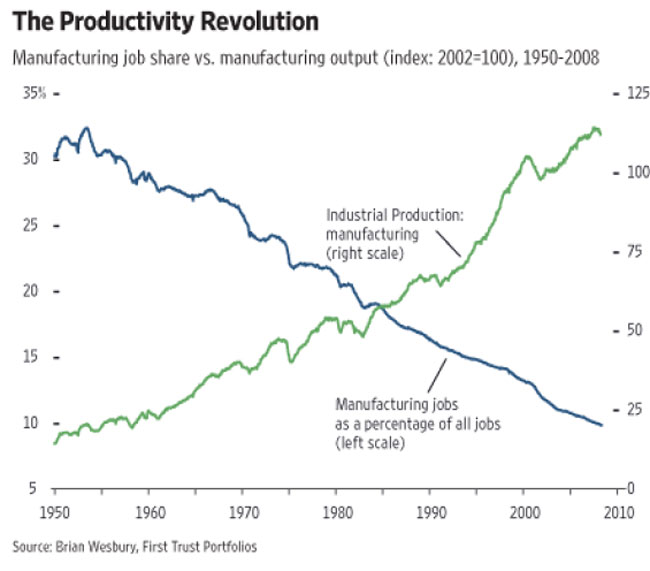

I don't consider the posts at those links to be much of a 'dressing down' but I suppose that is in the eyes of the beholder. If you enjoyed them, I am sorry that ol' Zalatix (may he rest in PPR peace) is not around to post them anymore.

brentspeak
(18,290 posts)that even a banned troll was able to see right through them.
pampango
(24,692 posts) Armstead
(47,803 posts)"It certainly seems that he believed that domestic policies were more important than trade in improving living standards. Empowering unions, raising taxes on the rich, making the safety net better, tighter corporate regulation government spending to boost employment - all liberal domestic policies that made life better for American workers. This is the same combination of liberal domestic policies and trade that progressive countries follow today."
What do you think these current "free trade" agreements are intended to do?
PREVENT nations from doing trhose wonderful progressive things you describe. They are intended to remove the sovereign ability of nations to determine their own laws and policies. They are designed to make progressive values subservient to the dictates of Big Capital throughout the world.
pampango
(24,692 posts)That seems logical but you can't argue with reality. The countries with 'these wonderful progressive things' are exactly the same countries that trade much more than the US trades and they have more 'free trade', too. That may seem 'illogical' but republicans think the same about their belief that raising the minimum wage 'must' increase unemployment. "Logic" and reality sometimes conflict with each other.
FDR was big on multilateral institutions to govern international politics, trade, finance, labor, etc. I think he would agree with you that one point of that is to limit the 'sovereignty' of nations. He might disagree with you, though, that that is a bad thing.
There is no 'invisible hand' in international relations. If each country pursues its own narrow national interest, there is no magic 'hand' that causes that to result in the most peace and prosperity for everyone on the globe. FDR had seen that both domestically and internationally. He wanted the UN, GATT, the IMF and World Bank, the ILO and a host of other international organizations to tie countries together and, yes, limit their sovereignty in the interests of the greater good. In a sense he applied the same philosophy internationally that he applied to domestic policy - that there is no 'magic hand' that creates a great outcome for everyone when each person (or each country) pursues its own narrow self-interest.
Armstead
(47,803 posts)The concept, for example, of a domestic law is totally neutral. It all depends on the content of the law, who is pushing it and why, and who it benefits or hurts...So a law can be good, bad, or somewhere in between.
Same with governments in a larger sense. There are governments that are good, bad or -- as is most often the case -- a mixed bag.
It's the same on the global level. A multilateral agreement or organization can be good (such as, in its bumbling way, the UN). Or it can be bad. It all depends on the content, who's behind it and how it is negotiated.
Many of these so-called "free trade" agreements are bad. They are pushed by global economic interests to remove the restraints of national civil society and governments. Their purpose is to push rigid free-market uber capitalism on nations. It says, if you want to trade internationally, you have to accept OUR rules.
If these agreements were so wonderful, why are they negotiated in secret and why do their proponents want to cram them through Congress (fast track) with no chance for thorough debate, public scrutiny or alteration?
Egalitarian Thug
(12,448 posts)bearing on today's? I know you make your living by stealing from American workers and always support this scam, but this is beyond even your usual corporate litany.
pampango
(24,692 posts)The article I posted that when there were high tariffs the working class hated them. If you think that history of working class attitudes during times of high tariffs is irrelevant you are entitled to your opinion.
If you think that whatever FDR thought with respect to the global economy in the 1930's is irrelevant today, you are entitled to your opinion.
I believe that history is relevant.
Egalitarian Thug
(12,448 posts)I just like people to know whose opinion it is that they are reading.
"Distract and divert, watch and listen to anything as long as it has nothing to do with what is being done to you. Blame the Mexicans, blame the Indians, blame the Chinese, just don't look at who is making a fortune by stealing from you."
pampango
(24,692 posts)bearing on today's?"
Allow me to interpret my response of "I believe that history is relevant." YES.
The reason why: Republicans in the 1920's wanted to reverse Woodrow Wilson's low tariffs and impose high tariffs to protect American producers from foreign competition. (Guess what the rationale for higher tariffs today is? Sound familiar?) The big similarity is that it has always been easy to say "Let's solve our economic problems by sticking it to the foreigners. Some good ol' high tariffs will be good 'us' and bad for 'them'. Who can argue with that? Aren't you a patriotic American?"
Another similarity is that FDR saw through that false "us (Americans) vs them (foreigners)" mindset in favor "it's the working man vs the rich man" and 'we're all in this together' (in terms of people of all countries cooperating rather than unrestricted competition between countries with some hope for an 'invisible hand' that would produce a common good) mindset.
Some things never change. Today you will see that the "us (Americans) vs them (foreigners)" mindset is still around even if the 1920's republicans who spawned it are not. Fortunately, no one ever asked FDR if he was a 'patriotic American' despite his support of GATT, the ITO, the IMF and World Bank and the ILO. He had a different definition of 'patriotic'.
Which is why history is relevant. Some things never change.
Egalitarian Thug
(12,448 posts)You're completely wrong and are ignoring too many facts to even begin to list, but thank you for the effort.
Some things are seemingly persistent and importing labor or exporting jobs (two sides of one coin) are one of them.
B Calm
(28,762 posts)Spider Jerusalem
(21,786 posts)when the USA isn't self-sufficient in raw materials or energy.
B Calm
(28,762 posts)Spider Jerusalem
(21,786 posts)B Calm
(28,762 posts)minutes to provide all of the energy needs of the world for one year.
Spider Jerusalem
(21,786 posts)And when the entire fleet of gasoline and diesel vehicles is replaced with electrics.
B Calm
(28,762 posts)get the gumption to do something.
Spider Jerusalem
(21,786 posts)And they're a fantastically stupid idea for a country that's import-dependent.
B Calm
(28,762 posts)Spider Jerusalem
(21,786 posts)Why should goods produced in a country with a substantially lower cost of living and therefore lower wages and production costs than the USA have import duties that raise the price to the level of an equivalent US-made product? Free trade is good because it leverages comparative advantage. The USA is at a comparative disadvantage in producing some consumer goods, because of lower production costs elsewhere; protecting jobs where the US is at a comparative disadvantage doesn't erase that disadvantage.
http://web.mit.edu/krugman/www/ricardo.htm
http://web.mit.edu/krugman/www/smokey.html
B Calm
(28,762 posts)Spider Jerusalem
(21,786 posts)"fair" means "American consumers get to keep screwing developing countries out of their resources and using protectionism to beat them into submission if they start to develop competitive industries", then?
Armstead
(47,803 posts)You shouldn't replace one evil with a worser one.
brentspeak
(18,290 posts)As well as being a major exporter of oil to foreign markets, I'd say you some reading up to do.

mathematic
(1,618 posts)Perhaps you're thinking of our refined product exports. We import oil, turn it into refined products, and export a portion of those refined products.
It's like importing sugar and exporting rum. Nobody would confuse the sugar with the rum or the effects of rum tariffs with sugar tariffs.
Spider Jerusalem
(21,786 posts)The US IMPORTS oil.
http://www.eia.gov/dnav/pet/pet_move_impcus_a2_nus_ep00_im0_mbblpd_m.htm
See that? US oil imports. Nine point three MILLION barrels per day.
Production, 7.7 million barrels per day: http://www.eia.gov/dnav/pet/pet_crd_crpdn_adc_mbblpd_m.htm
Product supplied per week, around twenty million barrels a day: http://www.eia.gov/dnav/pet/pet_cons_wpsup_k_w.htm (this number is larger because of refinery gains and the counting of natural gas liquids and ethanol).
And here, US petroleum product EXPORTS:
http://www.eia.gov/dnav/pet/pet_move_wkly_dc_NUS-Z00_mbblpd_w.htm
Sixty-one thousand barrels per day of crude oil, and 3.6 million barrels per day of finished product of which a third is diesel fuel.
And the raw materials the US exports to China? Copper, aluminium, and coal. The raw materials that the US imports from China? Rare-earth metals. The Chinese can get their copper and aluminium from other sources. The US can't get rare-earth metals anywhere else.
I'm not the one who has some reading up to do.
brentspeak
(18,290 posts)Refining our own crude for sale overseas as petroleum products, and importing crude for sale on the domestic market and for petroleum refinement. We produce sufficient crude to satisfy domestic demand, but too much of it gets exported.
http://www.eia.gov/tools/faqs/faq.cfm?id=268&t=6
How much of the oil produced in the United States is consumed in the United States?
EIA cannot determine exactly the amount of crude oil produced in the United States (U.S.) that is consumed, as refined products, in the U.S. However, the majority of the crude oil produced in the U.S. is refined in U.S. refineries. The U.S. also produces other liquids that are used in the refining process that are added or blended with the refined products. In December 2012, the U.S. produced about 7.03 million barrels of crude oil per day and imported about 7.58 million barrels per day.
EIA is not able to track how much domestically produced crude oil and other liquids are exported in the form of refined products. The small quantity of crude oil produced in the U.S. that is exported, nearly all to Canada, may actually be returned to the U.S. as refined products.
The U.S. became a (slight) net exporter (exported more than we imported) of refined petroleum products in 2008. Refined petroleum products produced in the U.S. from both domestic and imported crude oil are exported to other countries. The volume of net exports of refined products in December 2012 was equivalent to about 8.5% of the total volume of U.S. petroleum consumption in December 2012.
Spider Jerusalem
(21,786 posts)The US has refinery capacity that places in the Caribbean and Latin America do not. Therefore it makes economic sense for oil companies to import crude oil for processing and export refined product for sale. Especially considering that much of the refined product consists of diesel fuel (which is not widely used as a passenger fuel in the USA, but is elsewhere).
brentspeak
(18,290 posts)for its own use. The US gov. site says we are at least capable of 7 million barrels/day. And the 9 million barrels is your own estimate of how much crude we need/day, not anyone else's estimate. If we need to import oil to make up the difference, we import more than enough for our domestic needs from Canada, with whom we will always have good trade relations no matter what and with whom no tariffs are needed -- that applies only to nations such as China and India. So I would say that you don't know what you're talking about either about our energy needs/capabilities or trade policy.
Spider Jerusalem
(21,786 posts)And US oil CONSUMPTION? Try 18.4 million barrels a day. Not nine million. That 9.3 million is PRODUCTION, not CONSUMPTION.
https://www.cia.gov/library/publications/the-world-factbook/rankorder/2246rank.html
Again, I'm clearly not the one who has some reading to do.
brentspeak
(18,290 posts)Question, from B.Calm: "Want to be more specific on raw materials and energy we need?"[/i
Answer, from Spider Jerusalem: "Nine million barrels of oil a day, for a start"
Spider Jerusalem
(21,786 posts)US production: 7.7 million barrels a day. US consumption: 18.4 million barrels a day. 18.4-7.7=?
brentspeak
(18,290 posts)What you really meant to say was that we need to produce 18.4 million barrels/day?
Again, I'm referring to your own earlier post.
Spider Jerusalem
(21,786 posts)Since the US is NOT self-sufficient in oil production. Since this was in reference to raw materials imports, I should have thought the meaning would be clear from the context.
brentspeak
(18,290 posts)is why you believe assessing tariffs on say, China, would in any way, shape, or form adversely affect our energy self-sufficiency and raw materials needs.
How much oil do we import from China? How many raw materials do we import from China? Did you know we have the capacity to produce most of the rare earth metals that we currently import from China?
Spider Jerusalem
(21,786 posts)The OP to which I was responding said "tariffs", full stop.
Armstead
(47,803 posts)The OP was discussing the basic concept of tariffs. That does not automatically mean uniform tariffs against everything. It is not all or nothing.
China has proven to be a rather shitty trading partner that has sucked jobs out of the US. That is a different situation than, say, a country that we have to import a raw material or energy source that we do not have enough of. It is also a different situaiton than, say a country with roughly equivalent salaries and standards as us.
If tariffs are applied judiciously, to allow for trade without opening our doors to dumping of goods or massive outsourcing of US jobs, then they can be a useful tool to protect -- yes protect -- our domestic economy and standards for such things as environmental protection. The net result can also be beneficial for trading partners if they realize they have to pay their workers decently and not totally screw up the planet in order to export to the US market.
Spider Jerusalem
(21,786 posts)Look up "comparative advantage" and get back to me.
frwrfpos
(517 posts)Or better yet,abolish Capitalism and humanity would be much better off.
Greed kills
Egalitarian Thug
(12,448 posts)I am still concerned that more of them haven't come to spam this thread, though. We can usually count on at least four or five of them to show up with their cut & paste arguments.