General Discussion
Related: Editorials & Other Articles, Issue Forums, Alliance Forums, Region Forums
We're Running Out of Antibiotics
By Nicole Allan
The Atlantic
Feb 19, 2014
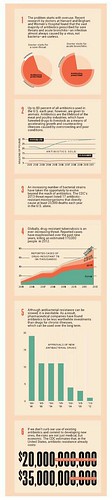
It’s difficult to imagine a world without antibiotics. They cure diseases that killed our forebears in droves, and enable any number of medical procedures and treatments that we now take for granted. Yet in 1945, while accepting a Nobel Prize for discovering penicillin, Alexander Fleming warned of a future in which antibiotics had been used with abandon and bacteria had grown resistant to them. Today, this future is imminent. Speaking to reporters last fall, Tom Frieden, the director of the Centers for Disease Control and Prevention, sounded a similar alarm: “If we’re not careful, we will soon be in a post-antibiotic era. In fact, for some patients and some microbes, we are already there.”
More: http://www.theatlantic.com/magazine/archive/2014/03/were-running-out-of-antibiotics/357573/
 = new reply since forum marked as read
Highlight:
NoneDon't highlight anything
5 newestHighlight 5 most recent replies
= new reply since forum marked as read
Highlight:
NoneDon't highlight anything
5 newestHighlight 5 most recent replies

Democracyinkind
(4,015 posts)Although the point at which we can decide between the two is long gone.
Thank you for this interesting article.

Ms. Toad
(38,887 posts)in the process of dispelling one set of myths (sore throats and congestion should be treated with antibiotics), walks right into another (people become antibiotic resistant).
It is bacteria which becomes antibiotic resistant - not people. And if you harbor one antibiotic resistant bug (VRE - vancomycin resistant enterococci, for example), that doesn't mean that you cannot use vancomycin to treat different bacteria - for example c. diff.
/rant
Not that I have any strong feelings about this...
magical thyme
(14,881 posts)He said that some patients are already in a post-antibiotic era. IOW, some *patients* are already infected with multi-drug and even completely resistant pathogens.
There are today some species of carbapenem-resistant enterobacteriaciae that are completely resistant to all antibiotics. If you are infected with one of those pathogens, the only treatment is supportive and the mortality rate is up to 50%.
CRE bacteria -- a family of germs called carbapenem-resistant Enterobacteriaceae, which includes E. Coli. Some CRE bacteria are resistant to all existing antibiotics. The CDC reports more than 9,000 infections are contracted in hospitals and other health care settings from these bacteria. As many as 50% of the patients who are infected with CRE end up dying because there is nothing to help them fight the infections.
http://www.cnn.com/2013/09/16/health/antibiotic-resistant-infections-cdc/
Studies have shown 3% of C diff isolates with intermediate resistance to vanco. Also note the precautions mentioned about treating C diff with vanco: "Metronidazole is currently the first choice agent due to its lower potential for selecting vancomycin-resistant enterococci..."
http://www.ncbi.nlm.nih.gov/pmc/articles/PMC1472208/
IOW, if you treat with vanco, then vanco-resistant enterococci gain flourish and can overwhelm other bacteria that are wiped out by it.
LiberalEsto
(22,845 posts)and that this method was fairly successful.
magical thyme
(14,881 posts)Because it recently proved very successful with C diff in randomized trials.
It is obviously totally irrelevent to non-bowel infections.

BrotherIvan
(9,126 posts)But doctors are not prescribing it because not that many places do the procedure. We spent over $10k on antibiotics (insurance doesn't cover most of the cost) for my mother because she was wary of the procedure and her doctor did not support it. Almost killed her. Thankfully none of her caregivers got it. One of the worst things I have ever experienced.
Ms. Toad
(38,887 posts)He said patients are in a post antibiotic age, and microbes are. If the microbes are, then the infections created by those microbes are (both fall into the category of microbes being in a post antibiotic age). Yes, patients who are infected by a microbe which is resistant may well die - because the microbe is post antibiotic. Yes - everyone should be extremely cautious using antibiotics, particularly vancomycin. I am not one to push careless or unnecessary use of antibiotics. I recently insisted my doctor use a cephalosporin during surgery when he had ordered vancomycin. I am allergic to penicillin, and there is some cross-reaction with cephalosporins - so it was appropriate for him to be cautious. But not every patient has the cross reaction, and I am one who does not - so vancomycin was not the appropriate medication for me to be using.
So - I am well aware of the concerns of antibiotic resistance, and more insistent than most on appropriate and limited use of antibiotics. But, on the flip side, I am equally critical of the careless use of the suggestion that patients become resistant. It is only microbes (and the specific infections they cause) which are in a post antibiotic age not patients as a whole. This is a critical distinction. A patient who is infected with a non-resistant microbe can still be treated with the most appropriate antibiotic - even if they have previously been infected or colonized with a microbe which is resistant to that same antibiotic.
My daughter has a disease for which this distinction matters, because the myth of patients becoming resistant (making the antibiotic unavailable to treat them for any condition - even those not caused by resistant strains) is currently playing a significant role in discouraging patients from enrolling patients in clinical trials. Vancomycin has been shown in initial small trials (fewer than 100 individuals) to be correlated with disease remission in a statistically significant number of patients (100% of children & around 30% of adults) - even when the disease has progressed enough for patients to have been listed for transplant. Remission has been maintained, in the earliest patients in the trials, for as much as 16 years - unheard of in this disease for which there is currently no medical treatment and a median time from diagnosis to death or transplant of around 18 years. And, while not risk free, the protocol is designed to minimize the risk of creating vancomycin resistance.
But resistance to these trials among patient advocates and some doctors is strong, in part because of the myth that the patients might become resistant, and then vancomycin could not be used to treat other infections which are common with this disease (infections not typically caused by vancomycin resistant microbes)
magical thyme
(14,881 posts)I'm very sorry for what your daughter is experiencing, but the quote does not imply that patients are resistant. It states that in their particular situations, antibiotics are irrelevent.
Personally, I've never heard of a doctor or other medical professional confusing the patient with the microbe regarding antibiotic resistance. When my lab sends sensitivity results, as far as I can determine everybody understands that the bacteria that was cultured is the one that is sensitive or resistant to the listed antibiotics.
In any event, the exact quote was in direct reference to living in a post-antibiotic world. It was in specific reference to living in a world where anti-biotics are irrelevent.:
"In fact, for some patients and some microbes, we are already there.”
Where are we? In a post-antibiotic world
IOW, some microbes are already resistant to all antibiotics, and patients infected with those microbes, along with the microbes that infect them, are already experiencing a 'post-antibiotic' world.
Or, some patients and microbes are already living in a post-antibiotic world.
Nothing in that statement implies patient resistance to antibiotics. It is about living in a world where antibiotics are no longer effective.
Ms. Toad
(38,887 posts)I have had several doctors say that to me, including some from at least two of the top medical institutions in the US (as well as a number which do not have national standing). I have not had any who persisted in that statement when I challenged them on it - but as often as not, the phrase patient resistance - or "you may develop a resistance" (rather than microbe resistance) is the first thing out of their mouths.
I know enough to challenge phsyicians when they make statements like that - but unfortunately not everyone living with this disease does. That means that it is reported in the support groups dealing with my daughter's disease - as attributed to top doctors in the country (and I know from my own experience a fair amount of it, if not all, is an accurate attribution). That makes it harder to make the case for the studies which need to be done. It robs patients who want to participate in the formal trials (or in off-label use of the medication outside the trial) of the opportunity to participate in the trials and of the tools to communicate with their doctors about it.
As far as your reading of the article - we'll just have to disagree. No amount of rationalization is going to convince me that using the phrase post-antibiotic in the same sentence with microbes and patients, in a parallel construiction, has a different meaning applied to some microbes (antibiotics are irrelevant in total) than it does to some patients (antibiotics are irrelevant only as it pertains to certain infections caused by certain microbes, but still very relevant to treating infections in those patients which are caused by non-resistant microbes)

Avalux
(35,015 posts)We are not "running out" - this has nothing to do with quantity. Antibiotics are becoming useless. Big difference there.
The coming antibiotic crisis is an issue I've been studying for a very long time. Until governments and pharma cos. take serious steps and pour lots of $$$ into developing NOVEL new antibiotics (not just cousins), as well as restricting access to protect the ones we have that still work (big ones like daptomycin) we are screwed.
Pharma cos don't care about new antibiotic development because there's no profit in it; why should they do that when getting a drug approved for a chronic disease is like hitting the jackpot. Often they are able to expand the indication for such a drug, which is the best way to make money. Don't have to start from square one and the return on investment is enormous. Cymbalta is a perfect example - developed for depression; it is now also being marketed for older people to relieve arthritis pain. Brilliant! 
I don't even need to address government funding in this country - can you imagine the GOP passing a bill to invest a substantial amount of money in new antibiotic development?
There are many contributing factors to antibiotic resistant. Greed and irresponsibility by humans and the natural evolution of bacteria are at the core.

PDittie
(8,322 posts)capable of reducing Earth to one remaining species (antibiotic-resistant bacteria).
Well, that and cockroaches.
The way I look at it is: maybe we'll kill ourselves off soon enough that some other species are able to outlast us.
