General Discussion
Related: Editorials & Other Articles, Issue Forums, Alliance Forums, Region ForumsHelp me debunk this argument against raising the minimum wage....
The argument goes like this:
A business employs some people at $10 an hour (which is the minimum wage in this scenario) and other workers at $12 an hour. These are the two lowest pay levels at said business.
Now, the minimum wage gets raised from $10/hour to $12/hour; what happens to the employees who were paid $12/hour before the minimum wage is increased? Their wages won't be increased (or so the argument goes) any time soon, and wage increases for them will actually be delayed, yet they have seniority and experience over the minimum wage employees.
Is this a valid argument? What are the best ways to debunk this one? Maybe I am missing something obvious...
 = new reply since forum marked as read
Highlight:
NoneDon't highlight anything
5 newestHighlight 5 most recent replies
= new reply since forum marked as read
Highlight:
NoneDon't highlight anything
5 newestHighlight 5 most recent replies

elleng
(141,926 posts)What happens? Their wages won't be increased, unless the employer decides to do so. Who knows if or when their wages might have been increased?
No harm to anyone. 
YoungDemCA
(5,714 posts)It's not my argument; however, I think the point was that those employees on the second-lowest rung may resent the minimum wage increase.
elleng
(141,926 posts)that's life. Now, at least, more will have a better wage.


freshwest
(53,661 posts)There is no zero sum game here, that is Rush's mantra since the 1990s. WA state tied the minimum wage to the cost of living in 1998. That wage is now $9.32 and the jump to $10.00 a hour would have occured soon enough anyway.
The greater buying power of workers helped the economy, kept unemployment down; funded the state despite some deficits; allowed more social infrastructure that benefit all ages and levels of pay.
Here are some facts to use:
Highest Minimum-Wage State Washington Beats U.S. in Job Creation
When Washington residents voted in 1998 to raise the state’s minimum wage and link it to the cost of living, opponents warned the measure would be a job-killer. The prediction hasn’t been borne out.
In the 15 years that followed, the state’s minimum wage climbed to $9.32 -- the highest in the country. Meanwhile job growth continued at an average 0.8 percent annual pace, 0.3 percentage point above the national rate. Payrolls at Washington’s restaurants and bars, portrayed as particularly vulnerable to higher wage costs, expanded by 21 percent. Poverty has trailed the U.S. level for at least seven years.
The debate is replaying on a national scale as Democrats led by President Barack Obama push for an increase in the $7.25-an-hour federal minimum, while opponents argue a raise would hurt those it’s intended to help by axing jobs for the lowest-skilled. Even if that proves true, Washington’s example shows that any such effects aren’t big enough to throw its economy and labor market off the tracks...
“It’s hard to see that the state of Washington has paid a heavy penalty for having a higher minimum wage than the rest of the country,” said Gary Burtless, an economist at Brookings Institution who formerly was at the U.S. Labor Department.
http://www.bloomberg.com/news/2014-03-05/washington-shows-highest-minimum-wage-state-beats-u-s-with-jobs.html
Use this graphic and article:
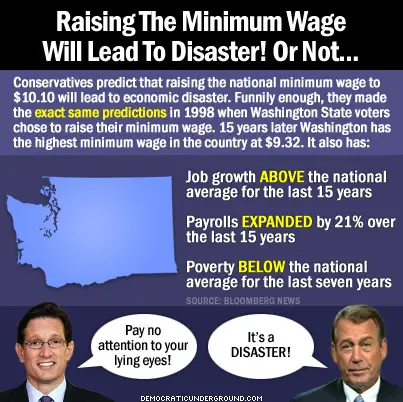
What CBO Report? The State With The Highest Minimum Wage Is Adding Jobs.
If you thought that the hotly contested Congressional Budget Office report, suggesting that a higher minimum wage would reduce the number of jobs, would squelch any chance of raising it, think again.
President Obama ratcheted up the pressure today, speaking out in favor of a $10.10 federal minimum wage at a Connecticut rally with four New England Democratic governors who are pledging to push for the same in their respective states.
And he now has a silver bullet to debunk those conservatives using the report, which only offered an estimated range of possibilities, as proof that raising the minimum wage is a certain job-killer.
Washington State.
The home of the Super Bowl champions is also America’s minimum wage champion, with the highest state minimum wage of $9.32. The minimum is also indexed to inflation, so it will never lose purchasing power.
Today Bloomberg checked in on how the Evergreen State’s wage policy has impacted job growth … and found that Washington State job growth beats the national average:
…job growth continued at an average 0.8 percent annual pace, 0.3 percentage point above the national rate. Payrolls at Washington’s restaurants and bars, portrayed as particularly vulnerable to higher wage costs, expanded by 21 percent. Poverty has trailed the U.S. level for at least seven years.
Bloomberg noted that even if conservatives have a point that higher minimum wages have some negative impact on job growth, “Washington’s example shows that any such effects aren’t big enough to throw its economy and labor market off the tracks.”
While the CBO did project a slight reduction in jobs, it also projected that 16.5 million Americans would have higher incomes with a $10.10 minimum wage, including and beyond those directly earning the minimum. (With a $9 minimum, 7.6 million would earn more.)
Considering the Washington State banked those bigger payrolls without experiencing any net job loss, it seems pretty short-sighted to pass on raising the minimum just because of a flimsy projection of minor job losses that isn’t backed up by real world experience.
Republicans who think they can resist the drive for a higher minimum wage by waving the CBO report haven’t noticed that a higher minimum still polls phenomenally even after the report’s release.
Common sense and real-world experience will beat an academic paper.
http://ourfuture.org/20140305/what-cbo-report-the-state-with-the-highest-minimum-wage-is-adding-jobs
One more story:

Re: low-paying WalMart:
Walmart’s Greed Exposed: They Could Pay Employees $25,000/Year Without Raising Prices
A new Demos study has revealed that the only thing stopping Walmart from paying their employees $25,000 a year without raising prices is their ridiculous level of greed.
According to Demos, here is how Walmart could afford to pay their workers $25,000 a year without raising prices:
Now as another holiday season approaches, this research brief considers one way Walmart could meet the wage target its employees are calling for— without raising prices. We find that if Walmart redirected the $7.6 billion it spends annually on repurchases of its own company stock, these funds could be used to give Walmart’s low-paid workers a raise of $5.83 an hour, more than enough to ensure that all Walmart workers are paid a wage equivalent to at least $25,000 a year for full-time work.
Curtailing share buybacks would not harm the company’s retail competitiveness or raise prices for consumers. In fact, some retail analysts have argued that by providing a substantial investment in the company’s front-line workforce, higher pay could be expected to improve employee productivity and morale while reducing Walmart’s expenses related to employee turnover.
With more money in their wallets, Walmart employees would likely spend a portion of the cash at Walmart itself, boosting the company’s sales. Sales might also increase as customers benefit from an improved shopping environment.
Walmart’s business model reflects the narrow minded economic views of the Republican Party. By choosing to only share profits at the top, Walmart is calling the stockholders makers and their employees takers.
The Republican idea that a business has to raise prices if wages are raised is false. Companies like Walmart can afford to raise wages without raising prices if they choose to do so. Costco has proven both Republicans and Walmart wrong by paying a living wage and watching their profits soar. Customers have abandoned Walmart for Costco in 2013, because unlike Walmart, Costco supports raising the minimum wage.
http://www.politicususa.com/2013/11/19/walmarts-greed-exposed-pay-employees-25000year-raising-prices.html
Perhaps a little of that you can use in your discussion. Never submit to Republican theology about wages and business. Their economic theories are faith based, not scientifc and do not meet the smell test for good goverance. They support the politics of robber barons. They are wrong now and have always been.
Pretzel_Warrior
(8,361 posts)Depending on health of business profits and management/motivation style,
A small business owner may react by bumping pay for those making more to avoid resentment or may explain things are too tight for such a move. Others may determine they've got to reduce staff by one person per shift until revenue catches up with increased period costs (possibly by raising prices).
YoungDemCA
(5,714 posts)nt

thelordofhell
(4,569 posts)The other wages will increase as well........A rising tide lifts all boats
Boom Sound 416
(4,185 posts)jberryhill
(62,444 posts)There's your argument right there.

TreasonousBastard
(43,049 posts)on how much the employer spends on payroll overall, among other things, and there seems to be an assumption that there's less for everyone else if the bottom tier is raised. This is not necessarily true.
If other efficiencies are made, prices are raised, or sales go up, everyone could have a raise. Granted that's not so easy, but it would work out well for everyone.

stopbush
(24,808 posts)The argument attempts to portray the people earning $12-an-hour as being victims of the people earning $10-an-hour getting a raise to $12. That's a straw man argument as it 1. sets up parameters that may or may not exist, and 2. assumes an injury to the $12 people when none exists. The person might as well argue that the people already earning $12 get one of their eyes poked out when the $10-an-hour employees get their raise.
A better question would be: just how valuable to the employer are workers with seniority and experience if he can't see his way clear to paying them more than $2-an-hour over a minimum wage entry-level employee?

Jamaal510
(10,893 posts)point the person to Australia, which has a minimum wage of over $16 per hour. Theirs is much higher than ours, but they don't appear to have any issues with it, from what I've heard so far.

MADem
(135,425 posts)will have more disposable income. His profits will increase.
He can afford to give the twelve buckers a bit of a raise.

safeinOhio
(37,651 posts)Results, better workers, less turn-over and they all bought his product. He made a fortune by doing it.
FACT

quaker bill
(8,264 posts)Part of the reason a minimum wage increase works well is that employers will seek to reduce this sort of wage scale compression. In short, they will generally act in some manner, usually smaller raises up the scale, to prevent the experienced folks from earning at entry (minimum wage) levels. It would be normal in this situation to see the experienced staff go to $13 when the entry level is raised to $12. (and likely the folks making $13 going to $13.50 or $14....).
The action stays pretty close to the bottom, but usually everyone near it sees something.
I saw 3 minimum wage increases at different companies during the time when I worked at near the minimum. This was how it worked in every case. It is not required, but employers generally do it to keep experienced staff.
Hoyt
(54,770 posts)The pettiness among people is disconcerting sometimes.
Of course, 12 buckers could be given a raise, or a new title, designated parking space, or some other worthless perk.
Token Republican
(242 posts)For people earning minimum wage or a few dollars close to it, two dollars an hour is not petty.
Hoyt
(54,770 posts)Billy got a needed raise, now I want one to maintain my position/rank. Frankly, it's greedy too.
And, such pettiness is used by right wingers as an argument against raising the minimum wage.
Token Republican
(242 posts)its only part of the equation.
Raising the minimum wage to 12 in your example results in the 12 dollar employees now becoming minimum wage workers. In theory, they were receiving an extra two dollars an hour due to experience, seniority, or whatever, as an incentive to stay with that company.
Since they could now work for any company for the same pay, they could very well have an incentive to leave, especially if their current duties are more work than an entry level position that pays minimum wage.
Depending on the health of the company, it might be able to give a raise to the senior workers to retain them. These raises will be an added expenses which will either reduce profits or more likely, result in higher prices. If the health of the company is poor, and there are no surplus profits and raising prices is not an option, the company will be forced to cut expenses somewhere.
The Ford example in this thread is a great example of the success of paying decent wages. Contrast that with the current wage structure at blockbuster video.
There is a cost to raising minimum wage. There's also a benefit. The answer I would give is the benefit outweighs the cost. Or vice versa, depending on which side you are arguing.

libtodeath
(2,892 posts)so that gives them leverage to ask for an increase if the business wants to be staffed with good employees.
stevenleser
(32,886 posts)The second is that yes, minimum wage increases usually result in higher wages for all workers at the lower end of the spectrum. And as we can see from the Washington state example, it makes the economy and job creation better, not worse.