General Discussion
Related: Editorials & Other Articles, Issue Forums, Alliance Forums, Region ForumsObama's SEC and CTFC bribed by Wall St, will reverse key parts of Dodd-Frank
It's a certainty that Obama's handlers on the campaign trail will make sure he doesn't have to answer any questions on this topic. So how will he differentiate himself from Romney?
http://money.cnn.com/2012/04/18/news/economy/swaps-rules/?google_editors_picks=true
Big Business gets a break on financial reform
By Jennifer Liberto @CNNMoney April 18, 2012: 3:55 PM ET
WASHINGTON (CNNMoney) -- Big business scored a major win Wednesday when two regulatory boards agreed to limit the impact of tough rules to regulate the complex trades that helped spur the 2008 financial crisis.
(snip)
But over the past two years, big business, ranging from Wall Street to energy and agricultural companies, have spent millions of dollars lobbying regulators. They wanted the regulators to back off on tougher rules that would require disclosure of the price of a swap as well as capital to back up those bets.
(snip)
On Wednesday, the CFTC and SEC voted to sharply narrow the pool of companies that must abide by tougher rules. The rule narrowed the definition of who qualifies as a swaps dealer by raising the threshold from a suggested $100 million to $8 billion in swaps traded each year
(snip)
Several veterans of the financial crisis cried foul, calling the new rules far too narrow to have much of an impact. One former CFTC official called the move one of the largest erosions of the Wall Street reforms passed as part of the 2010 Dodd-Frank Act. "It's just breathtaking. How did they get from $100 million to $8 billion? And there are so many exemptions written in there," said Michael Greenberger, a professor at the University of Maryland School of Law who worked at the CFTC during the administration of President Bill Clinton. "It's an administrative veto of Dodd-Frank."
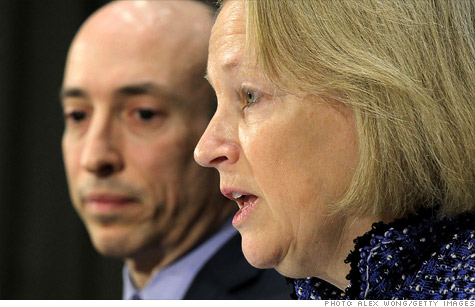
Mary Schapiro, head of the Securities and Exchange Commission, and Gary Gensler, head of the Commodity Futures Trading Commission, agree to limit the impact of swaps rules.
 = new reply since forum marked as read
Highlight:
NoneDon't highlight anything
5 newestHighlight 5 most recent replies
= new reply since forum marked as read
Highlight:
NoneDon't highlight anything
5 newestHighlight 5 most recent replies

msongs
(73,754 posts)banned from Kos
(4,017 posts)$8 billion of swaps per year is in Who Cares? catergory.

Leopolds Ghost
(12,875 posts)About all this money being traded by the 1% while the Main Street economy is bought out and sold to Wal-Mart.

brentspeak
(18,290 posts)http://4closurefraud.org/2010/07/07/the-role-of-derivatives-in-the-financial-crisis-credit-default-swaps-and-the-economic-meltdown/
The Role of Derivatives in the Financial Crisis – Credit Default Swaps and the Economic Meltdown
Testimony
of
Michael Greenberger
Law School Professor
University of Maryland School of Law
~
Financial Crisis Inquiry Commission Hearing
Dirksen Senate Office Building, Room 538
Washington DC
Wednesday, June 30, 2010, 9am EDT
By removing the multi-trillion dollar swaps market from the traditional norms of market regulation, a highly speculative derivative bubble was created that was opaque to federal regulators and market observers alike. By removing all forms of ensuring the normal capital adequacy protections of market regulation, the swaps market permitted trillions of dollars of financial commitments to be made with no assurance that those commitments could be fulfilled beyond the highly illusory AAA ratings of the counterparties in question.
Had the norms of market regulation been applicable, these swaps transactions would have been adequately capitalized by traditional clearing norms; and the dangers building up in these markets would otherwise have been observable by the transparency and price discipline that accompanies exchange trading.
While the poorly capitalized underwriting of CDS and naked CDS triggered the meltdown, the crisis was further aggravated by the opaque interconnectedness of large financial institutions emanating from interest rate, currency, foreign exchange and energy swaps.
Because there was no road map outlining interdependency of those financial transactions, the worst was feared in the wake of the Bear Stearns, Lehman, AIG, and Merrill dysfunctions. Institutions became too big to fail because of these uncharted and feared interdependencies; and the fear that unwinding of these institutions (as proven in the Lehman bankruptcy) would be hampered by the lack of reliable pricing of the instruments in question.
The darkness of this huge multi-trillion dollar unregulated market not only caused, but substantially aggravated, the financial crisis. And, the American taxpayer funded the bailouts and rescued the economy from Depression. The banks are now stronger than ever. The taxpayer, however, is burdened by high unemployment, job insecurity, depleted pensions, and little access to credit. We are depending on this Commission to identify correctly the malpractices to ensure that a fiasco of this nature never happens again.
http://www.reuters.com/article/2012/04/18/financial-regulation-swaps-idUSL2E8FG0BZ20120418
After heavy lobbying from energy companies and big commodity traders, the final version bumps the threshold up to $8 billion for most asset classes as an initial phase-in.
The CFTC also added a more explicit exemption for swaps that are done to hedge market risks, such as reducing exposure to interest-rate fluctuations or oil price moves. Those trades will not count toward the threshold that triggers the swap dealer designation.

dixiegrrrrl
(60,161 posts)banned from Kos
(4,017 posts)But CDS should be open and on an exchange like Dodd-Frank says.
People here don't understand derivatives.
Someone doing $100 million in currency swaps can be a two-man fund.
brentspeak
(18,290 posts)But only bullets have.
Nice try, though.
banned from Kos
(4,017 posts)when there is not a shred of evidence for such.
Its a Taibbi type lie.
A billion in swaps can occur in a minute. They want to monitor the TBTFs and not the guy in a basement.
brentspeak
(18,290 posts)Every one of your posts proves Kos was right.

Ikonoklast
(23,973 posts)
Lasher
(29,577 posts)When regulators first proposed the rules in late 2010, they set the exemption at $100 million. At that level, only 30 percent of the players would have been excused from the oversight, which was mandated by the Dodd-Frank financial overhaul law.
<snip>
Some watchdog groups, however, fear that regulators are carving out a significant loophole that will open the door to problems. The exemption, the culmination of wrangling among the regulators and a yearlong lobbying blitz, would excuse firms from having to post additional capital and file reports.
<snip>
But the regulatory fine print could allow many firms to whittle down the size of their activity to under $8 billion.
Under the rule, companies can exclude the swaps they use to hedge their business against risk like, say, interest rate fluctuations. And the rule would apply only to a company’s swaps transactions, so firms would not need to count their other varieties of derivatives, like forwards and options. The Commodity Futures Trading Commission also scrapped a strict provision that would have prevented companies that are exempt from the rules from arranging more than 20 swap contracts in one year, regardless of the dollar amount.
http://dealbook.nytimes.com/2012/04/17/regulators-to-ease-a-rule-on-derivatives-dealers/

kenny blankenship
(15,689 posts)Moderates can't be bothered to enforce the watered down, weak ass laws they wrote themselves.

ProSense
(116,464 posts)By BEN PROTESS
Regulators approved a rule on Wednesday that spells out the type of derivatives dealers that will soon face federal oversight, a crucial piece of the broader regulation for the market that played a major role in the financial crisis.
The rule, which defines the universe of so-called swaps dealers, has been one of the more contentious rules stemming from the Dodd-Frank regulatory overhaul law. Dodd-Frank, passed in response to the crisis, sought to create new oversight and capital requirements on the firms that arrange swaps.
<...>
He then directed a statement at critics of the rule. “For those who question the level of the de minimis, we considered the threshold in the context of an overall $300 trillion notional swaps market,” noting that $8 billion in hardly significant amid this massive market.
The $8 billion threshold, he said, represents $32 million in notional value of derivatives trading per day. “Putting this in perspective, the interest rate swap market, transacts, on average, over $500 billion notional per day,” Mr. Gensler said. “As further reference, this year the futures markets for crude oil traded, on average, $65 billion of notional per day.”
Under the rule, the C.F.T.C and S.E.C. must study whether the $8 billion figure is appropriate. The agencies could change the figure if it proved too high or low.
- more -
http://dealbook.nytimes.com/2012/04/18/regulators-defend-derivatives-rule/
What's interesting here is Mary Schapiro, who was critical of the recent adjustment to Sarbanes-Oxley, specifically related to increasing the threhold, is doing the same here with this rule.
Another thing, if they need to study whether the $8 billion is "appropriate," how did they come up with that number?
Still, it's fascinating to watch the regulatory rule-making process unfolding and the implementation of the law.
Robert Reich: The Significance of Citigroup’s Shareholder Revolt
http://www.democraticunderground.com/1002579118
Major Hogwash
(17,656 posts)
Honest to gawd, where are the balloons?

bvar22
(39,909 posts)...will get taken off "The LIST"?
You will know them by their WORKS,
not by their excuses.
[font size=5 color=green]Solidarity99![/font][font size=2 color=green]
--------------------------------------------------------------------------------------------------------------------------------[/center]

woo me with science
(32,139 posts)Lasher
(29,577 posts)KABUL, Afghanistan — After months of negotiations, the United States and Afghanistan completed drafts of a strategic partnership agreement on Sunday that pledges American support for Afghanistan for 10 years after the withdrawal of combat troops at the end of 2014.
The agreement, whose text was not released, represents an important moment when the United States begins the transition from being the predominant foreign force in Afghanistan to serving a more traditional role of supportive ally.
By broadly redefining the relationship between Afghanistan and the United States, the deal builds on hard-won new understandings the two countries reached in recent weeks on the thorny issues of detainees and Special Operations raids. It covers social and economic development, institution building, regional cooperation and security.
http://www.nytimes.com/2012/04/23/world/asia/us-and-afghanistan-reach-partnership-agreement.html?_r=3&pagewanted=all
brentspeak
(18,290 posts)http://www.allgov.com/Top_Stories/ViewNews/Obama_Administration_Exempts_85_Percent_of_Energy_Derivatives_Traders_from_Regulation_120419
Obama Administration Exempts 85% of Energy Derivatives Traders from Regulation
On Wednesday, the Obama administration dramatically scaled back its oversight of financial institutions that deal in the $700 trillion derivatives market.
Following the passage of the Dodd-Frank reform law, the Securities and Exchange Commission (SEC) and the Commodity Futures Trading Commission (CFTC) proposed new regulations for any firm trading $100 million or more each year in derivatives tied to interest rates and commodities, including oil and gas.
At this level, only 30% of institutions would have been exempted from oversight, according to Ben Protess of The New York Times’ DealBook.
Now, though, regulators have set the oversight exemption ceiling at $8 billion worth of swaps each year—which could mean as many as 85% of derivatives traders, such as energy companies, hedge funds and banks, would avoid regulation. It just so happens that $8 billion was the exact threshold first suggested by a group of energy companies to the SEC and the CFTC in February 2011. The energy industry engaged in massive lobbying that included an estimated 100 meetings with regulators.