General Discussion
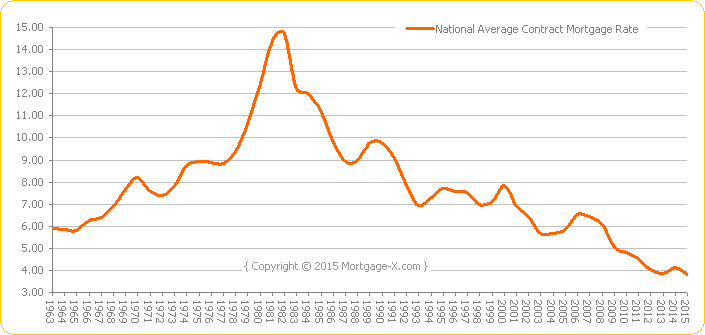
Related: Editorials & Other Articles, Issue Forums, Alliance Forums, Region ForumsFind Reagan on this chart

Were working people making more relative gains on the left side of this mountain, or on the right side?
What, if anything, does this say about the position of labor in an inflationary environment versus a deflationary environment?
In every economic chart it is easy to spot the deflection point of 1978-1982. The global economy changed at that point. Was it for the better or for the worse? And why?
zeemike
(18,998 posts)I don't even understand what a contract mortgage rate is...
But what I do know that before Reagan one working person could support a family and now it takes two or more....so the conclusion for working people is obvious.
Course this does not apply to income that is not earned because their prosperity is based on how much they can take from others...with things like contract mortgage rates...
On the Road
(20,783 posts)Reagan had less to do with it than Carter, who appointed Paul Volcker to the Fed.
Double-digit inflation preceded Carter, of course, but it was Volcker who allowed interest rates to spike by controlling monetary growth and letting interest rates fluctuate. Once they peaked in 1981 and inflation began to subside due to less demand and lower oil prices, interest rates began to fall as well.
Reagan, of course, reappointed Volcker after he accomplished what many people thought was impossible -- namely, killing inflation while restoring economic growth. But that was a good reappointment.
I doubt labor or wages are key factors in this chart. The spike in interest rates in the late 70s was due to previous inflation caused by a long-term boom and the two oil shocks caused by OPEC and (in the second case) Iran. Fortunately, it led to a long period of sustained growth.