General Discussion
Related: Editorials & Other Articles, Issue Forums, Alliance Forums, Region Forumsmutant daisies growing near Fukushima power plant
https://mobile.twitter.com/san_kaido/status/603513371934130176
 = new reply since forum marked as read
Highlight:
NoneDon't highlight anything
5 newestHighlight 5 most recent replies
= new reply since forum marked as read
Highlight:
NoneDon't highlight anything
5 newestHighlight 5 most recent replies

hobbit709
(41,694 posts)This is quite common among daisies and has nothing to do with Fukushima.

Kip Humphrey
(4,753 posts)
NightWatcher
(39,386 posts)

SidDithers
(44,333 posts)
Suich
(10,642 posts)in my back yard.


Octafish
(55,745 posts)Fukushima has three of them.
hobbit709
(41,694 posts)Octafish
(55,745 posts)Do you know of any published information documenting radiation levels in Japan or in the United States?
I'd like to know, especially considering how bad nuclear news seldom gets reported by Corporate Owned News.
I'm not one of those "Oh well, let's move on" types. Maybe some of the mutant flowers around the USA were affected by Fukushima radiation, or more likely, U.S. nuclear power plants. For instance:
[font color="green"][font size="4"]Radioactive leaks found at 75% of US nuke sites[/font size][/font color]
AP June 21, 2011, 9:07 AM
BRACEVILLE, Ill. - Radioactive tritium has leaked from three-quarters of U.S. commercial nuclear power sites, often into groundwater from corroded, buried piping, an Associated Press investigation shows.
The number and severity of the leaks has been escalating, even as federal regulators extend the licenses of more and more reactors across the nation.
Tritium, which is a radioactive form of hydrogen, has leaked from at least 48 of 65 sites, according to U.S. Nuclear Regulatory Commission records reviewed as part of the AP's yearlong examination of safety issues at aging nuclear power plants. Leaks from at least 37 of those facilities contained concentrations exceeding the federal drinking water standard -- sometimes at hundreds of times the limit.
While most leaks have been found within plant boundaries, some have migrated offsite. But none is known to have reached public water supplies.
At three sites -- two in Illinois and one in Minnesota -- leaks have contaminated drinking wells of nearby homes, the records show, but not at levels violating the drinking water standard. At a fourth site, in New Jersey, tritium has leaked into an aquifer and a discharge canal feeding picturesque Barnegat Bay off the Atlantic Ocean.
Previously, the AP reported that regulators and industry have weakened safety standards for decades to keep the nation's commercial nuclear reactors operating within the rules. While NRC officials and plant operators argue that safety margins can be eased without peril, critics say these accommodations are inching the reactors closer to an accident.
Any exposure to radioactivity, no matter how slight, boosts cancer risk, according to the National Academy of Sciences. Federal regulators set a limit for how much tritium is allowed in drinking water. So far, federal and industry officials say, the tritium leaks pose no health threat.
CONTINUED...
http://www.cbsnews.com/news/radioactive-leaks-found-at-75-of-us-nuke-sites/
That was from June 2011, a few months after Fukushima. I don't recall hearing much about it at the time and nothing as far as follow-up reporting. I certainly don't recall hearing any radiation level warnings around the local nuclear plants here in Michigan.
hobbit709
(41,694 posts)Daisies have this quite commonly and it's been written up LONG before there ever were nuclear reactors.
There are more than enough real problems with nuclear reactors and the waste thereof without attributing everything to that cause.
Read up on fasciation
http://news.gardentoolbox.co.uk/plants-2/fasciation-flowers-need-know
Octafish
(55,745 posts)Unlike what you implied:
I wanted to make clear that radiation should not be ruled out.
hobbit709
(41,694 posts)Anyone that automatically blames everything on one source without determining that it is a common occurrence that the odds are highly in favor of it NOT being from that cause doesn't get much support from me.

AikidoSoul
(2,150 posts)You are all being unfair and unscientific.
Many things can cause mutations.
radiation, toxicants, heavy metals.
Look it up and stop picking on Octafish!!!!!
hobbit709
(41,694 posts)As the Who song says "Go to the mirror , boy"
AikidoSoul
(2,150 posts)You said "radiation should not be ruled out" but DID NOT SAY IT'S THE ONLY CAUSE which is what the DUer detractors implied.
I like the analysis from National Geographic which says:
"It’s possible the flower deformity could have been induced by radiation, says Jeffrey J. Doyle, a professor of plant biology at Cornell University. However, “this is a pretty common mutation in daisies that I’ve seen sporadically in various places not associated with radioactivity,” he says.
There are many factors that can cause the oddity, Doyle says, from chemicals to diseases, a hormone imbalance, or random mutations to inherited genes. This particular malformation has been seen in numerous species of the world’s 20,000 members of the daisy family, from Holland to Idaho.
He's not ruling out a role for Fukushima: “It wouldn’t surprise me to find mutations of all types, including this one, in places that have higher than average levels of mutagenic agents, such as a radioactive site or toxic waste dump.”
See what National Graphic has to say:
http://news.nationalgeographic.com/2015/07/150723-fukushima-mutated-daisies-flowers-radiation-science/
So if DUers are experiencing the mutated daisies in their backyard they might suspect toxic chemicals, endocrine disrupters like ROUNDUP READY HERBICIDE, or toxic fertilizers with hazardous waste. But probably most DUers haven't a clue that toxic waste is routinely put into fertilizers.
I respect friend Duff Wilson who was nomiated for a Pulitzer Prize for his courageous series of articles at the Seattle Times on highly toxic fertilizer containing recycled hazardous wastes:
http://archives.seattletimes.nwsource.com/cgi-bin/texis.cgi/web/vortex/display?slug=2547772&date=19970703&query=Fear+in+the+Fields
Octafish
(55,745 posts)
For instance:
Fukushima radiation still poisoning insects
By Dennis Normile
Sciencemag.org, AAAS, 22 September 2014 11:00 pm 62 Comments
Eating food contaminated with radioactive particles may be more perilous than thought—at least for insects. Butterfly larvae fed even slightly tainted leaves collected near the Fukushima Daiichi Nuclear Power Station were more likely to suffer physical abnormalities and low survival rates than those fed uncontaminated foliage, a new study finds. The research suggests that the environment in the Fukushima region, particularly in areas off-limits to humans because of safety concerns, will remain dangerous for wildlife for some time.
The 2011 Fukushima Daiichi Nuclear Power Station disaster released massive amounts of radiation, much of which drifted out to sea. Humans were evacuated to safety and their exposure to radiation was minimal. But local wildlife were exposed both externally to radiation in the environment and internally from contaminated food sources. Joji Otaki, a biologist at University of the Ryukyus in Nishihara, Japan, and his colleagues have been conducting field studies and lab experiments on how such radiation affected the pale grass blue butterfly (Zizeeria maha), a species found throughout most of Japan.
In a previous experiment, Otaki’s group fed butterfly larvae leaves of the creeping woodsorrel (Oxalis corniculata) with radiation in the thousands of becquerels per kilogram (Bq/kg) gathered near the power plant within a few months after the accident. (For comparison, the Japanese government set a limit of 100 Bq/kg for human consumption of rice, meat, and fish, and 50 Bq/kg for milk and infant formula.) Larvae that dined on the radiation-drenched leaves had low survival rates and high incidences of physical abnormalities such as unusually small forewings. These results corroborated field surveys by others that turned up fewer butterflies in contaminated areas than would normally be expected.
The new study shows that radiation can damage larvae even at much lower concentrations. Otaki and colleagues collected leaves 16 to 20 months after the accident, after short-lived radioactive contamination had decayed, but this time from locations ranging from 59 to 1760 kilometers from the power plant; contamination levels ranged from 161 to 0.2 Bq/kg. They found that as contamination increased, mortality rates and incidences of abnormalities increased. "These results suggest that low-dose ingestion of approximately 100 Bq/kg may be seriously toxic to certain organisms," the team writes in a paper published today in BMC Evolutionary Biology.
In another experiment, the researchers divided offspring of the butterflies into two groups, feeding larvae either the same contaminated leaves their parents had eaten or uncontaminated leaves. Larvae fed the contaminated leaves had even lower survival rates and more abnormalities than their parents, whereas those feeding on clean leaves largely reverted to near-normal in both mortality rates and frequency of abnormalities.
The findings from Otaki’s group are “groundbreaking,” says Timothy Mousseau, a biologist at the University of South Carolina, Columbia, who also studies the effects of radiation on wildlife near Fukushima and Chernobyl. He notes that there have been “almost no studies” on how ingestion of radiation-tainted foods affect wildlife. Still, Mousseau cautions that the results should not be directly extrapolated to humans. “I think butterflies as a group are likely to be much more sensitive than humans to radiocontaminants,” he says. He adds that Otaki's findings suggest that insects that survive after eating contaminated leaves might evolve tolerance to the low levels of radiation likely to persist in the Fukushima region for decades.
SOURCE: http://news.sciencemag.org/asiapacific/2014/09/fukushima-radiation-still-poisoning-insects
PS: Thank you for standing up with me, AikidoSoul. Cyberbullies who work to shut down discussion act in a most unscientific and undemocratic manner.
Logical
(22,457 posts)
FBaggins
(28,774 posts)It's over four years running now.
Octafish
(55,745 posts)Here are a few links you might want to go through and actually show where I actually exaggerated. Going from the responses on them, the people who are exaggerating are the posters promoting the safety of nuclear power.

A Public Service Announcement about Plutonium
TEPCO - Plutonium is not dangerous. Where is the Boss?
Fukushima, Plutonium, CIA, and the BFEE: Deep Doo-Doo Four Ways to Doomsday
Before and After photo show significant tsunami damage...
On the Poet's Trail
Helicopter pictures show devastation inside Fukushima reactor towers
Governments Covering Up Nuclear Meltdowns for 50 Years to Protect the Nuclear Power Industry
Surviving Chernobyl Cleaner: 'Tell The People Of Japan To Run!'
What part of what he said wasn't true?
First thing I'd do if I were fighting this nuclear disaster is get the Team the best gear.
The Return of Nukespeak
TEPCO - Plutonium is not dangerous. Where's the Boss?
Toxic plutonium seeping from Japan's nuclear plant
Japan's Nuclear Rescuers: 'Inevitable Some of Them May Die Within Weeks'
Fukushima from Space
Absolutely. A real shame - man's hubris.
Japan Nuclear Power Plants
A more-recent satellite image of Fukushima Daiichi reactors 1-4...
The SCALE of the devastation is incredible.
Jimmy Carter, USN - Nuclear Hero
Utility Engineer Warned of Tsunami Threat at Japanese Nuclear Plant
Voyage to Fukushima Daiichi
TEPCO was warned and took the cheapskate's way out.
Fukushima owners failed to follow emergency manual - report
The people's ancestors left monuments to remind them of the dangers...
Fukushima tsunami plan a single page
Doubts deepen over TEPCO truthfulness after president's sightseeing trip uncovered
Atomic Samurai -IAEA Humbled By Worker Courage at Fukushima Daiichi
Fukushima Radiation Data Quarantined by Governments of Japan and the United States. Why?
Absolutely. And some, if not most, cancer deaths can be avoided with forewarning and knowledge.
''We never meant to conceal the information, but it never occurred to us to make it public.''
Fukushima Daiichi Mystery Man Steps Forward
The Fukushima Crisis Demonstrates how Lowly the Global Elites Hold the Common People
Plutonium detected 40km from Fukushima plant
Trivializing Fukushima
''We never meant to conceal the information, but it never occurred to us to make it public.''
In regards to Fukushima, the only thing TEPCO has successfully buried is the Truth.
TEPCO was warned and took the cheapskate's way out.
Trivializing Fukushima
Citizen Testing Finds 20 Radioactive Hot Spots Around Tokyo
Japan Fukushima plant dismantling needs over 30 yrs
Fukushima Typhoon raising radioactive water levels in contaminated buildings.
Fukushima owners failed to follow emergency manual - report
Fukushima and the Nuclear Establishment - The Big Lies Fly High
I've tried to make up for lack of news coverage, using DU as a news medium. Show me where I claim, even once, to be an expert or "exaggerate" or sensationalize what I have found. Better yet, show where the experts or my post is wrong. I'll be happy to admit the mistake and correct the record, unlike my devoted critics on DU.

herding cats
(20,056 posts)Last edited Tue Aug 18, 2015, 09:21 PM - Edit history (1)
I can't say if these specific mutations in the daisies are due to radiation, or not. Biologist Dr. Mousseau has done extensive studies on the wildlife left to fend for itself around Chernobyl. He has documented many mutations, but also an odd sort of unnatural selection process where 25 years after the disaster, some of the wildlife is apparently evolving to appear to adapt to the elevated, yet not deadly, levels of radiation in the surrounding forest. Some of his research is here and here if anyone is interested in reading about his it.
I did read this today, though. It's food for thought on the reality of the fate of the Fukushima contaminants.
Date:
August 18, 2015
Source:
Woods Hole Oceanographic Institution
Summary:
An international research team reports results of a three-year study of sediment samples collected offshore from the Fukushima Daiichi Nuclear Power Plant. The research aids in understanding what happens to Fukushima contaminants after they are buried on the seafloor off coastal Japan. Scientists found that a small fraction of contaminated seafloor sediments off Fukushima are moved offshore by typhoons that resuspend radioactive particles in the water.
<>.
Led by Ken Buesseler, a senior scientist and marine chemist at the Woods Hole Oceanographic Institution (WHOI), the team found that a small fraction of contaminated seafloor sediments off Fukushima are moved offshore by typhoons that resuspend radioactive particles in the water, which then travel laterally with southeasterly currents into the Pacific Ocean.
"Cesium is one of the dominant radionuclides that was released in unprecedented amounts with contaminated water from Japan's Fukushima Daiichi nuclear power plant following the March 11, 2011, earthquake and tsunami," says Buesseler. "A little over 99 percent of it moved with the water offshore, but a very small fraction--less than one percent--ended up on the sea floor as buried sediment."
"We've been looking at the fate of that buried sediment on the continental shelf and tracking how much of that contaminated sediment gets offshore through re-suspension from the ocean bottom," he adds.
<>
"This was a bit of a surprise because when we think of sediment in the ocean, we think of it as sinking vertically, originating from someplace above. But what this study clearly shows is that the only place that the material in our sediment traps could have come from was the continental shelf and slope buried nearshore. We know this because the coastal sediments from the shelf have a unique Fukushima radioactive and mineral signal," says Buesseler.
<>
"The total transport is small, though it is readily detectable. One percent or less of the contaminated sediment that's moving offshore every year means things aren't going to change very fast," Buesseler says. "What's buried is going to stay buried for decades to come. And that's what may be contributing to elevated levels of cesium in fish--particularly bottom-dwelling fish off Japan."
http://www.sciencedaily.com/releases/2015/08/150818112431.htm
If people are curious about this, they need to read the full article to get a better understanding of what they're saying. I can't link to enough to actually explain in full. The gist is, it's moving out. However, the movement is small amounts and it's slow, very slow to be exact. Which is good news, yet still it's moving in ways it wasn't fully realized it would move via the sediment before the climatic factors were fully considered. It's interesting if you're into how the oceans are impacted by climate, and that sort of stuff, which I realize not everyone finds to be titillating.

tammywammy
(26,582 posts)Here: http://www.democraticunderground.com/10027005086
Also, here's the Snopes link http://m.snopes.com/nuclear-mutant-daisies/
Logical
(22,457 posts)Quit spreading made up shit......
http://www.huffingtonpost.com/entry/mutant-daisies-fukushima_55b13010e4b0a9b94853fb7b
 :large
Liberal_in_LA
(44,397 posts)
Octafish
(55,745 posts)Here's what Fukushima is all about.

Dr. Timothy Mousseau, professor of Biological Sciences at the University of South Carolina and researcher for the Chernobyl and Fukushima Research Initiative, presented new findings to the International Ornithological Congress in Tokyo last week that suggest radiation contamination around Fukushima Daiichi, even at low levels, is negatively impacting biodiversity and wildlife populations.
Mousseau and his collaborators have been monitoring radiation levels at 1,500 sites and bird populations at 400 points across Fukushima over the last 3 years. The lay of the land and dispersal patterns of radioactive matter have created a very heterogenous situation in the Fukushima exclusion zone, meaning areas of high radiation lie right alongside areas of low radiation. By controlling for other environmental factors, the scientists can apply a rigorous statistical analysis to predict what the population in a particular area should be.
Using this method, Mousseau et al have found both the number of birds and the variety of species drop off as radiation levels rise, and more importantly, that there is no threshold under which the effect isn’t seen.
This is counter to what both the Japanese government and the United Nations Scientific Committee on the Effects of Atomic Radiation have said regarding low-level radiation. In a report on the situation in Fukushima released in April, UNSCEAR said, “Exposures of both marine and terrestrial non-human biota following the accident were, in general, too low for acute effects to be observed,” although the report goes on to hedge that “changes in biomarkers cannot be ruled out.” Indeed, Mousseau and the Wild Bird Society of Japan report seeing partial albinism in Fukushima birds, a condition rarely seen outside of Chernobyl (see photo above).
Citing years of research in Chernobyl and meta-analysis of studies on areas with naturally occurring radiation, Mouseau says, “Contrary to government reports, there is now an abundance of information demonstrating consequences, in other words, injury, to individuals, populations, species, and ecosystem function stemming from low-dose radiation.”
-- Jessica @ RocketNews24.com
http://en.rocketnews24.com/2014/08/27/new-research-suggests-even-low-level-radiation-in-fukushima-negatively-impacting-wildlife/
More on Dr. Timothy Mousseau: http://www.beyondnuclear.org/home/2014/9/17/dr-timothy-mousseau-fukushima-impacts-on-wildlife.html
You should try reading more, Logical, rather than cry "bullshit" when someone reports negatively on the precious and delicate nuclear power scam.

Jamastiene
(38,206 posts)window air conditioners. I have always wondered why things look deformed when they grow that way under window air conditioners. Not sure there is anything radioactive under window air conditioners though.
Triffids?

mia
(8,481 posts)If you’ve ever taken a walk around your garden and noticed some flowers looking a bit different to others, there’s a good chance that’s due to fasciation. Whilst fasciation can cause plants to look considerably uglier than other flowers, it can also make them look beautiful. It’s a very strange condition....
What Causes Fasciation?
There is no one single cause for fasciation as some people are led to believe. Instead, there are a variety of factors that can cause a plant to become fasciated and these have been listed below:
•Hormonal imbalance – Having a hormonal imbalance can have an impact on certain cells in the plant where growth mainly occurs. Because of the imbalance these cells do not grow or develop properly like they would in a regular plant.
•Infections – Plants can be fouled by viral or bacterial infections which go on to take over the plant and cause mutilations. Certain bacterium has been linked with plants which have fasciation, but by no means is it exclusive to every plant that has the problem.
•Genetics – Just like in humans, genetics play a huge role in the structure of the body and a plant is no different. Whilst there are no specific causes for genetics to be altered or predisposed to certain plants, it is simply considered to be a random mutation in the genetics of a plant.
•Environment – The environment that the plant grows in can also play a huge role in the things that come into contact with it. Insects and animals attacking the plant and causing damage can both lead to fasciation; same as fungi or mites. Harsh chemicals used to get rid of pests may also cause problems, as well as exposure to harsh weather conditions in winter like frost. Many of these can be a factor in causing fasciation....
http://news.gardentoolbox.co.uk/plants-2/fasciation-flowers-need-know
ericson00
(2,707 posts)in their campaign ads, calling this some kind of super flower
Orrex
(67,472 posts)Clearly Fukushima has contaminated eastern Pennsylvania in 1982.
Octafish
(55,745 posts)You might have noticed the power company did a good job containing coverage of the fallout.
THE CONTINUING CENSORSHIP Of THE NUCLEAR ISSUE
Project Censored, July 18, 2015
Three Mile Island, the worst accident in the history of the atomic energy program in the United States, has proven to be a blessing for pro-nuclear propagandists.
Using the phrase “no one died at TMI,” the nuclear power industry has embarked on a nationwide campaign to resell nuclear power to the American public. Slick television commercials and full page ads in magazines and newspapers solicit public and press support for nuclear power.
America’s Electric Energy Companies directed its campaign right at the media with an advertisement in Columbia Journalism Review (March/April 1981) headlined “Three Mile Island has made nuclear power even safer.”
The campaign appears to be working. More than a half dozen nuclear-oriented stories were nominated for “best censored” of 1980. Following are the highlights of some of these stories.
CONTINUED...
http://www.projectcensored.org/3-the-continuing-censorship-of-the-nuclear-issue/
So, yeah. It wasn't Fukushima.
Orrex
(67,472 posts)Granted, the 1979 incident did provide an origin story for the superhero I created in 2nd grade, who went on to be a major and entirely unprofitable hit among my peers, but we weren't in TMI's line of fire.
Octafish
(55,745 posts)Details:
Startling Revelations About Three Mile Island (Nuclear) Disaster
Raise doubts over nuclear plant safety
bySue Sturgis
CommonDreams, Friday, April 03, 2009
by Facing South
It was April Fool's Day, 1979 -- 30 years ago this week -- when Randall Thompson first set foot inside the Three Mile Island nuclear power plant near Middletown, Pa. Just four days earlier, in the early morning hours of March 28, a relatively minor problem in the plant's Unit 2 reactor sparked a series of mishaps that led to the meltdown of almost half the uranium fuel and uncontrolled releases of radiation into the air and surrounding Susquehanna River.
It was the single worst disaster ever to befall the U.S. nuclear power industry, and Thompson was hired as a health physics technician to go inside the plant and find out how dangerous the situation was. He spent 28 days monitoring radiation releases.
Today, his story about what he witnessed at Three Mile Island is being brought to the public in detail for the first time -- and his version of what happened during that time, supported by a growing body of other scientific evidence, contradicts the official U.S. government story that the Three Mile Island accident posed no threat to the public.
"What happened at TMI was a whole lot worse than what has been reported," Randall Thompson told Facing South. "Hundreds of times worse."
CONTINUED...
http://www.commondreams.org/views/2009/04/03/startling-revelations-about-three-mile-island-nuclear-disaster
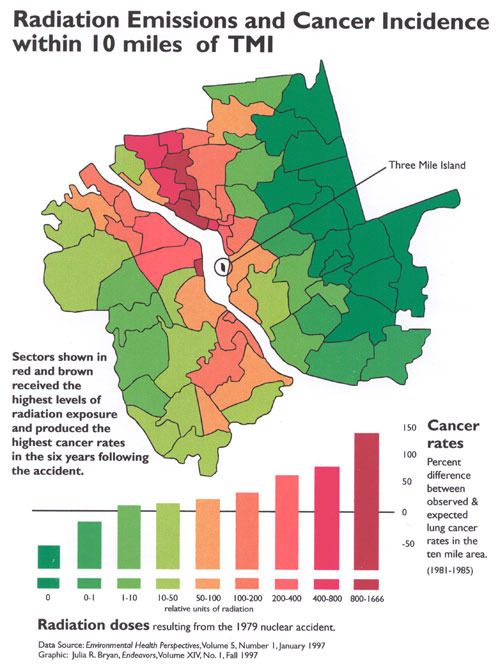
For those interested, lots more info n links here: http://agreenroad.blogspot.com/2012/03/three-mile-island-coverups-exposed.html