General Discussion
Related: Editorials & Other Articles, Issue Forums, Alliance Forums, Region ForumsDo you enjoy beef? You're directly contributing to climate change. Beef is the new SUV.
An excerpt:
Don't blame me alone for bearing the bad news. In a Facebook poll, thousands of you overwhelmingly voted for me to report on meat's contribution to climate change as part of CNN's Two° series. You commissioned this highly personal topic over more widely feared climate change bad guys such as coal, deforestation and car pollution.
But eating beef, as I'll explain, has come to be seen, rightly, in certain enviro circles, as the new SUV -- a hopelessly selfish, American indulgence; a middle finger to the planet. It's not the main driver of global warming -- that's burning fossil fuels for electricity, heat and transportation -- but it does contribute significantly.
Globally, 14.5% of all greenhouse gas pollution can be attributed to livestock, according to the U.N. Food and Agriculture Organization, the most reputable authority on this topic. And a huge hunk of the livestock industry's role -- 65% -- comes from raising beef and dairy cattle.
http://www.cnn.com/2015/09/29/opinions/sutter-beef-suv-cliamte-two-degrees/index.html
 = new reply since forum marked as read
Highlight:
NoneDon't highlight anything
5 newestHighlight 5 most recent replies
= new reply since forum marked as read
Highlight:
NoneDon't highlight anything
5 newestHighlight 5 most recent replies
Travis_0004
(5,417 posts)yeoman6987
(14,449 posts)
hlthe2b
(115,155 posts)I could almost literally live off of cheese & yogurt.  But, I do eat very little meat.

mainer
(12,636 posts)We can't eat pork because pigs are polluting.
Is chicken allowed?

hobbit709
(41,694 posts)philosslayer
(3,076 posts)There are too many of us on the planet, and we're slowly (and lately at a more rapid rate) killing it.

get the red out
(14,081 posts)No one dares to broach that major reality.
The constant demonization of every bite anyone puts in their mouths has gotten so old with me that when I read a food commandment it just tells me what is for dinner.
If we all switch to soy we are destroying the rain forests, eat nuts and we are destroying California. Eat chicken and get bird flu. Eat kale and destroy your thyroid. Eat fruit and get too much sugar. If we drink water and just not eat we will still either be consuming fluoride, or destroying the oceans with plastic waste.
smirkymonkey
(63,221 posts)That topic is like the Third rail around here, but it's something that seriously needs to be discussed.

NightWatcher
(39,389 posts)I realize it wouldn't make a huge dent in saving resources, but maybe the rest of us could enjoy our remaining time in peace and quiet.
Do I need to add the Snarkasm thingee to prevent being barbecued and crucified?
pintobean
(18,101 posts)I vote for crucifixion only. 

daleanime
(17,796 posts)
drm604
(16,230 posts)

jwirr
(39,215 posts)Marr
(20,317 posts)agricultural advancements that could greatly increase our food output.
GMOs? RoundUp2.0?
MindfulOne
(227 posts)The "agricultural advances" argument can never withstand close scrutiny because, in the end, externalized consequences aren't considered in original models.
There's too little water, just for starters, to support the numbers we he have now in Southern California, which imports practically all of their water and food. So there's an example of a no-fix population condition.
If you're advocating for growing the food on one continent to send to other continents, then you have to factor in fossil fuels to ship the food there.
It can't be fixed with technology.

LuvNewcastle
(17,983 posts)You can use the flesh, hide, and wool of a sheep, so at least none of it goes to waste. And goats will eat just about anything. I just don't think going vegan is acceptable for most people.

TexasProgresive
(12,830 posts)daleanime
(17,796 posts)to simply eat smaller portions and skip it for a couple of meals? More locally grown fresh fruits and veggies, good for you and the planet.
GliderGuider
(21,088 posts)The issue is one of scale. This kind of scale:
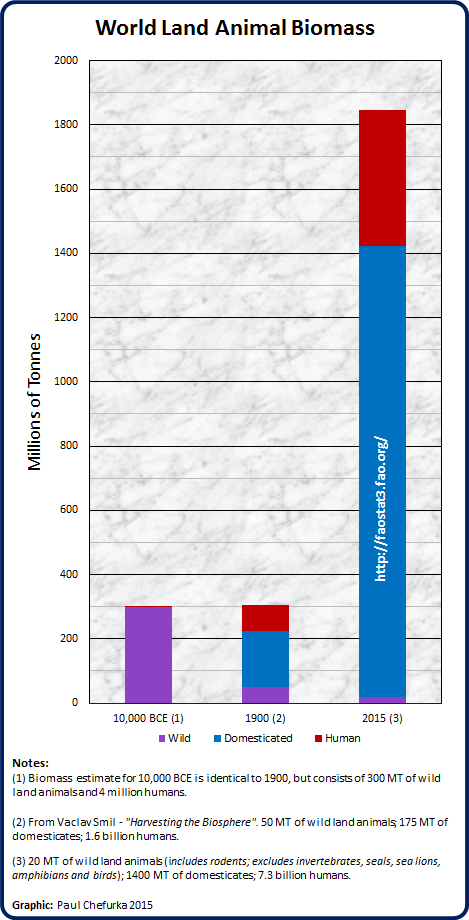
But you already know that.
Adrahil
(13,340 posts)
quickesst
(6,309 posts)

NaturalHigh
(12,778 posts)I guess I won't be getting any holiday greetings from this guy.

ileus
(15,396 posts)pintobean
(18,101 posts)it's to John D. Sutter.
TexasProgresive
(12,830 posts)I had to read nearly the whole piece to find out the source of the greenhouse gasses. It is part of the NATURAL cycle that consists of vegetation absorbing carbon from the atmosphere and when it decomposes either decaying at death or in the after fermenting in the rumen of a ruminant (cows, sheep, goats, deer) it returns back to the air. Get rid of cattle and the deer population will grow to take their place continuing to emit greenhouse gasses as nature intended. There would be a plus as it might cut into the real carbon foot print of meat production; fossil fuel burning for transport, processing and preserving.
I seldom eat beef and if beef production went away it wouldn't affect me much. But this particula argument is false logic that gets people who are against meat eating to lose focus of the real cause of climate change-burning fossil fuels.
hobbit709
(41,694 posts)TexasProgresive
(12,830 posts)I've never seen a comparison. My guess is that the food industry would fight its publication to the death.
IT'S FOSSIL FUEL BURNING, PEOPLE!!!!
newfie11
(8,159 posts)drm604
(16,230 posts)As you say, that's part of the natural cycle. The problem is with the methane they emit, which is a much more potent greenhouse gas than CO2.
My understanding is that it wouldn't be so much of a problem if they were fed grass (their natural diet) rather than corn.
TexasProgresive
(12,830 posts)There are about 150 species of ruminants, some domestic and others wild. All produce and emit methane gas in the process of breaking down fibrous plant matter in the rumen. I think that if we got rid of all domestic livestock; cattle, buffalo, sheep, goats, reindeer and yaks that the empty grass lands would be filled with wild ruminants such as the various type of deer, antelope etc. I don't like that much of the beef in this country is fed high concentrations of corn, but I believe the higher production of methane is coming from grass (high in fiber) that must be fermented in the rumen for the animal to utilize it as food.
Off topic: Feed lot practices are what has lead to e.coli that is resistant to our stomach acids. Heavy feeding of grain concentrates causes the rumen to be in a chronic state of lactic acidosis. Over crowding in feed lots causes the cattle to ingest fecal matter which will contain e.coli. The e.coli evolves to survive in an acid environment and the result is an e.coli that can survive the stomach acids to end up in the small gut where it can pour toxins directly into the blood stream. That is bad, but I think feeding high concentrations of grain generates less CH4 than grass. The production of grain for feed will have a higher carbon foot print from fossil fuel use than grain in the form of CO2 and CO.
Cattle and methane: More complicated than first meets the (rib) eye
http://www.shapingtomorrowsworld.org/wahlquistMethane.html
By Asa Wahlquist
Posted on 17 August 2012
Filed under Agriculture, Food
A lot of people, amongst them Britain's Lord Stern and Sir Paul McCartney, argue that eating less meat could help save the planet. But there is a growing body of evidence that it is not simply a case of less meat means less heat.
Most of the world's farmland is grassland. For reasons of rainfall, soil type or topography it can't be ploughed and it should never be irrigated. The only way to produce food from grasslands is to graze ruminants—animals like cows, sheep and goats—on it. Most mammals, and that includes humans, cannot digest grass. But ruminants possess several compartments in their stomachs. One, the rumen, houses microbes that can digest grass. The problem is that this microbial digestive process also produces the greenhouse gas methane as a by-product.
Methane is a potent, if short-lived greenhouse gas. It is given a global warming potential rating of 25 times that of carbon dioxide, though it has a lifetime of 9 to 12 years in the atmosphere, compared with carbon dioxide which can last more than 100.
Some sectors of the community have leapt on this information, arguing that eating less beef, or not eating it at all, would be better for the environment. But this raises several questions: what happens to the grasslands that are no longer grazed?
mainer
(12,636 posts)Deer and wild boar sounds like a diet for a small planet.
ileus
(15,396 posts)My son is in the woods with his bow now trying to put a deer in the freezer. When he comes in I'll tell him what a bad human he's being.
ileus
(15,396 posts)although scientific facts are not...
http://www.hsi.org/assets/pdfs/hsi-fa-white-papers/HSI_The_Impact_of_Animal_Agriculture_on_Global_Warming_and_Climate_Change.pdf
http://www.scientificamerican.com/article/the-greenhouse-hamburger/
http://science.time.com/2013/12/16/the-triple-whopper-environmental-impact-of-global-meat-production/
http://www.researchgate.net/profile/Jules_Pretty/publication/49791211_Global_food_supply._Linking_policy_on_climate_and_food/links/02e7e536be24b3e2f8000000.pdf
https://www.asas.org/membership-services/public-policy/asas-grand-challenges/grand-challenge-agricultural-animals-and-climate-change
http://ajcn.nutrition.org/content/89/5/1704S.short
http://www.cabdirect.org/abstracts/20073024897.html;jsessionid=5A58A143FB9398882EB5BE88D95D777D
http://www.ciwf.org.uk/factory-farming/environmental-damage/climate-change-in-detail/?gclid=Cj0KEQjwnMOwBRCAhp-ysqCwypkBEiQAeSy1-Un66C8dP20umGgXGgKnYc7GEK5qChRHfbj3pVpsdO0aAjKK8P8HAQ
...............................
ileus
(15,396 posts)
restorefreedom
(12,655 posts)more water, more land, and creates more greenhouse gases than most other industries and is one of the biggest polluters of water and land.... that is just fact. not to mention the various flu illnesses and antibiotic resistant diseases, which usually have their roots in animal ag. add in food borne illness and human health, and you have a strong case for no longer consuming meat.
but even sticking to climate change alone, we can ignore reality, or we can accept it and start making the changes we need to make to save our earth.
people denying the reality of animal ag destruction so they can keep eating meat is no different than oil fanatics denying climate change so they can keep drilling.
it is killing the planet. we can either accept it or not, do something about it or not. to all the people telling the 1% to do their share....are we all willing to do our share as well?

aikoaiko
(34,214 posts)Even allowing for the metaphor that it is alive (really it is not) the pet that can be said is that It will change.
daleanime
(17,796 posts)us and most of the other species living right now, yes.
restorefreedom
(12,655 posts)that we may not be able to control. we know what has to be done. the only question is if the will is there.

spinbaby
(15,408 posts)Supermarket feedlot beef is very wasteful; locally-raised, grass-fed beef is a good use of resources. It's also a good idea to pay attention to how you use beef--a bit of beef in vegetable soup is not the same as a slab of beef on a plate.
msanthrope
(37,549 posts)Travis_0004
(5,417 posts)Thats a double whammy.
msanthrope
(37,549 posts)steak, and eggs made with the leftover lobster.
I made my signature Old Bay Bloody Mary......
And I am done eating for the day...
newfie11
(8,159 posts)So guess I'm contributing to climate change.
darkangel218
(13,985 posts)pipoman
(16,038 posts)roody
(10,849 posts)Seeing the feedlots reminded me of the cruelty of beef.
geek tragedy
(68,868 posts)
handmade34
(24,117 posts)
GummyBearz
(2,931 posts)The problem would be even worse with them around. Now lets do the same to cows. Then work our way through everything that farts until there is nothing left but trees

Shoulders of Giants
(370 posts)I fully admit I have many bad habits. I have tried to go vegetarian, but I just can't make myself do it. I couldn't even imagine going vegan. However, at the very least, I can at least say I'm not as damaging to the environment as a vegetarian/vegan who has children.

Major Nikon
(36,927 posts)We should all either get sterilized or stop having sex, or both just to be sure.
Shoulders of Giants
(370 posts)However, the world's population has gone from about 1 to 7 billion in about 200 years. Overpopulation is without question the biggest threat to the environment by human made causes. Every single other human made environmental problem is exponential worsened by overpopulation.
However, the media never talks about it. I will fully admit I am wasteful in my life. I use plastic bags (I try not to, but I sometimes forget to bring the reusable bags to the store) I don't have the ability to make myself stop eating meat (actually I do, but I have little willpower). I don't drive a hybrid because they are too expensive. I sometimes drive to places I could sometimes walk. I many times choose convenience over environmental friendliness.
However, I realize the most environmentally conscience thing I did in my entire life was having a vasectomy and not having children. That makes my impact on the environment much much lessor than anyone who does everything perfectly (and even doesn't eat meat) but has children, because when I die, my impact stops. When other people (even environmentally conscience vegans) have kids, they do much more to destroy the planet than me. They could teach their kids to be vegan and environmentally friendly, but will they teach their grand kids, great grandkids... etc? Eventually they will stop being environmentally friendly somewhere down the line and they have done significant harm to the environment (and animals when their meat eating great-great grand children eat them) that will last millenniums just by having kids.
I'm not saying I'm perfect. Ultimately, humans are pests on the planet, and I am part of the problem. And someone who is vegan and environmentally conscience, while not having kids is doing even less harm than me. They are people we should try to live up to. However, I know articles like the CNN article in the original post are meant to make meat eaters feel terrible, by calling it the new SUV. I'm just trying to put everything in its proper perspective.
Obviously far fewer people need to be having children. Obvious as well is that the humanity will die off as well if every single person stops having children. However, extinction is not a treat. An individual can assume that the population will continue to grow and the best choice an individual can make is to not have children, because that best solves the current problems (which do not include threat of extinction).
Major Nikon
(36,927 posts)Shoulders of Giants
(370 posts)Major Nikon
(36,927 posts)Adrahil
(13,340 posts)get off your high horse. I agree that overpopulation is a problem. But ya knwo where it is NOT a problem? In the West. The West currently maintains perfectly sustainable population trend figures. The problem lies elsewhere. Self-righteous "no kids" people in the West are having about ZERO impact on arresting population growth.
You deciding to not have kids to be "environmentally conscious" is basically meaningless. If everyone stops having kids, who pays for social security? Seriously. Everyone in the USA could commit suicide tomorrow, and our numbers would be replaced, and then some, within about 6 years.
Shoulders of Giants
(370 posts)I stand by everything I said. The world in whole is increasing in population, regardless of regional trends. The world is already signfigantly overpopulated. Therefore, people should think about world population trends (not regional trends) when deciding to have kids. I have fully aware that many western countries are currently having no population growth (or even negative population growth in some European countries). That is completely irrelevant to me, because ultimately we are citizens of the world, not individual countries.
And about social security, that's an economic country. The environment is more important than the economy. If the environment goes to hell, what's the point of the economy? We will just have to work longer (or make massive life changes) to make up the difference.

PasadenaTrudy
(3,998 posts)I didn't have kids, my brother didn't have kids, my deceased sister didn't have kids 

REP
(21,691 posts)My house is hydro-solar heated, all LED-lighting, energy- and water-efficient everything, and the very spoiled chickens in the yard provide eggs and eat any leftover food, but the most important thing I've done for the environment is to not produce any Western-consuming humans.
Adrahil
(13,340 posts)Shoulders of Giants
(370 posts)See my replies above.
restorefreedom
(12,655 posts)and i don't have kids, although if i had, i would have raised them vegan. but i do live in a first world country, use modern technology and drive a non hybrid car.
hopefully we all help in our own way and since none of us live in caves (i hope) and subsist on grubs, i guess none of us will get it 100%.
nice that many are trying, though
Shoulders of Giants
(370 posts)You are doing far better than me. Good job.
The point I was making about kids, is yes you can raise them vegan. However, you have no control of them after they are 18, and they could become meat eaters. And if they have kids, then grand kids, great grand kids, etc, the chain of vegans will almost certainly end at some point, and a vegan could be responsible for many meat eaters being on the planet for thousands of years. Thats why if someone could do only one thing for the environment (and animals), it would be to not have kids. However, you are doing that, on top of being a vegan, so you are pretty much ahead of everyone else.
I have little willpower, and that's why I'm not a vegan. I honestly wouldn't even know how to make it. However, I took my little willpower and used it for good in another area by getting a vasectomy, because I don't have the will power to raise kids.
restorefreedom
(12,655 posts)The car I drive (22mpg), no solar panels on the house due to cost and possible hoa bullshit, etc.
that's a good point though. I hadn't even thought of the generational cascade of people and how eventually the vegan chain could be broken and could lead to a lot of non-vegans being on the planet. It was a coming together of several factors that led to not having kids, although I was concerned about being able to keep them vegan until at least they were 18 due to nosy teachers, possible other kids etc.
and as far as willpower goes, I don't need any because anything that even resembles meat disgusts me. Cheese is a little bit of a challenge, especially because restaurants put it on yearly everything, and I do like it except that it's hard for me to get past where it came from. friend of mine is vegan for ethical reasons but really misses meat. That has to be hard. i've basically despised meat even since I was a kid, so in that sense I guess I had it pretty easy.
muriel_volestrangler
(106,822 posts)and between the animal types (and for milk and egg production too): http://www.fao.org/docrep/018/i3437e/i3437e.pdf
Their estimates of CO2 per kg of product (carcass weight - add about 30% to get to the 'cut of meat' value) vary a lot around the world - for beef, 30kg in North America, 15kg in Eastern Europe, and over 70kg in Latin America (that includes a figure for pasture expansion - without that, it would be about 48kg).
For North America, it's about 1.8kg per kg (ie liter) of milk; 4.7kg per (carcass) kg of pork; 4.5kg per (carcass) kg of chicken; and 2.9kg per kg of eggs (including shell, presumably). Other sources reckon that it takes perhaps 9kg of milk to make 1kg of cheese, which means that cheese production emits more CO2 than pork or chicken, but not beef.
cherokeeprogressive
(24,853 posts)It's the law (someday?).

Meldread
(4,213 posts)Just taking a look through the responses to this thread, and it doesn't shock me one bit. People are always happy to oppose things external to themselves, such as the Keystone Pipeline, or to criticize Coal and Oil Companies. That way the moral burden of climate change is shifted and placed on the shoulders of someone else.
However, when you start talking about consumer habits the story changes. When you start talking about how individuals are collectively contributing to climate change, and the actions each individual can take to reduce emissions--well... suddenly, it's a whole new ball game. The moment you start talking about the need of people to start making some "sacrifices" because their lifestyles are literally unsustainable, they become all, 'Well fuck that shit. I guess we'll just keep heating this old bitch up. Sorry future generations of humanity! My steak is important!'
If this is the type of reaction you get from liberals who actually believe in climate change, imagine the type of reaction you'll get from conservatives who don't. If you can't convince liberals to change their lifestyles, then there is zero hope of convincing conservatives.
This is why I've basically shifted my tactics on this whole issue. For me, it's no longer about convincing other people. It's about trying to imagine what the future looks like in a world that has had its climate radically altered. Then it's about finding other like minded people, preparing, and basically telling the rest of the human species to go fuck itself. Save only those worth saving, and just let the rest fend for themselves or die off. Let nature run its course, and cease intervening to save those that were too stupid to save themselves. Sometimes, as a liberal, you have to realize that your efforts to help other people are futile, and your energy is better spent elsewhere. This is one of those situations. There is zero hope of preventing or slowing climate change, and so the only thing that a reasonable person can do is work with other reasonable people to prepare for the worst case scenarios--at least we're saving our own people.
pintobean
(18,101 posts)
I especially like this part:
I'm not a prepper. I am not talking about storing food or some other stupid shit like that. I am talking about a consorted social effort to build climate controlled industrial sized green houses, massive water generation (whether from desalination or other techniques), massive investments in renewable. ...and instead of trying to do it on a nation wide scale, which doesn't look likely, focus it on a local scale. Get people of like mind to relocate, invest locally, build the infrastructure needed to endure climate change, and then give everyone else the finger.
TransitJohn
(6,937 posts)People always blame the awful oil companies, but I don't see many people in my neighborhood doing the backbreaking labor of gardening and canning. No one's got the time or inclination to do that kind of physical labor.
Meldread
(4,213 posts)...it is even the smallest suggestion that people need to modify their lifestyles is met with huge resistance. All that was said was maybe we should cut down on our beef consumption--it's not even a call to go vegan! Just to cut back. Obviously, other countries do just fine without consuming as much beef and dairy products. Yet, you see the reaction.
It's such a small thing to ask. Look at the reaction.
You literally have a situation where we have people who believe that climate change is real, and you tell them something they can do--a small change--and they decide it is worthy of ridicule or even grow resentful. This is how you know we've lost. We can't even get the people who agree that climate change is real to make changes to their lifestyles. If we can't do that for the people who actually believe climate change is real and a problem, how and the hell are we going to do it for those who don't believe it is real?
It is easy for them to attack coal and oil companies, but what they refuse to acknowledge is that they are the ones who are generating the demand for what they are supplying--they are the consumers. We, as individuals, lack the power to change the government, and the only power we have as individuals is to modify our own behavior. As we see here, people are unwilling to even consider that.
OldHippieChick
(2,434 posts)You make several good points. I have to admit my initial reaction to the OP was to drool over a hamburger, but you appealed to my better nature. Though I won't go vegan - just can't - I will continue to eat little beef. Every now and again I get a hankering for some prime rib, but mostly stay vegetarian or fish and chicken. I will make more of a concerted effort to eat more vegetarian meals.
Thanks for posting.
GliderGuider
(21,088 posts)Historian Ronald Wright has called it a "progress trap":
A progress trap is the condition human societies experience when, in pursuing progress through human ingenuity, they inadvertently introduce problems they do not have the resources or political will to solve, for fear of short-term losses in status, stability or quality of life. This prevents further progress and sometimes leads to collapse.
The term gained attention following the historian and novelist Ronald Wright's 2004 book and Massey Lecture series A Short History of Progress, in which he sketches world history so far as a succession of progress traps.
According to him, the error is often to extrapolate from what appears to work well on a small scale to a larger scale, which depletes natural resources and causes environmental degradation. Large-scale implementation also tends to be subject to diminishing returns. As overpopulation, erosion, greenhouse gas emissions or other consequences become apparent, society is destabilized.
In a progress trap, those in positions of authority are unwilling to make changes necessary for future survival. To do so they would need to sacrifice their current status and political power at the top of a hierarchy. They may also be unable to raise public support and the necessary economic resources, even if they try.
Meldread
(4,213 posts)...and I more or less agree. That is the situation we find ourselves in exactly.
It is the reason I now advocate the position that I do. We can't save those who aren't willing to save themselves. So, we need to look for alternative means to save what we can. I no longer believe that massive climate change is avoidable, and thus we have to do what we can to prepare for it. I believe there are enough of us who recognize the problem, and are willing to do whatever is necessary.
GliderGuider
(21,088 posts)The window of opportunity to avoid it closed long ago - maybe as much as 100 years or more ago, before we even knew there was a problem. People who believe otherwise tend not to understand the scale of the problem set we face.
Meldread
(4,213 posts)You are right that we fucked ourselves the moment we started walking down this path and now we're trapped.
I honestly don't think people truly realize the scale of the problem, nor the consequences of what will eventually unfold. We are really talking about the global collapse of civilization. To think of things comparable in the history of the Western World it will be on par with the fall of the Roman Empire and the Black Death all rolled into one and multiplied by roughly ten all of which unfolds over the space of roughly 200-250 years.
In fact temperatures may rise by up to 12C (21.6F) within just three centuries making many countries into deserts.
The study, published in the prestigious journal Proceedings of the National Academy of Sciences, said humans will not be able to adapt or survive in such conditions.
Professor Tony McMichael, one of the authors, said if the world continues to pump out greenhouse gases at the current rate it will cause catastrophic warming.
"Under realistic scenarios out to 2300, we may be faced with temperature increases of 12 degrees or even more," he said. "If this happens, our current worries about sea level rise, occasional heatwaves and bushfires, biodiversity loss and agricultural difficulties will pale into insignificance beside a major threat - as much as half the currently inhabited globe may simply become too hot for people to live there."
Article from the Telegraph.
That's what we're facing in the long term.
restorefreedom
(12,655 posts)i don't disagree with a word of it, just sad is all.

TBF
(37,603 posts)especially those in the US, China, and "Other" (mainly tropical deforestation globally) and blame one small sector.
Emissions by Country
In 2008, the top carbon dioxide (CO2) emitters were China, the United States, the European Union, India, the Russian Federation, Japan, and Canada. These data include CO2 emissions from fossil fuel combustion, as well as cement manufacturing and gas flaring. Together, these sources represent a large proportion of total global CO2 emissions.
Emissions and sinks related to changes in land use are not included in these estimates. However, changes in land use can be important - global estimates indicate that deforestation can account for 5 billion metric tons of CO2 emissions, or about 16% of emissions from fossil fuel sources. Tropical deforestation in Africa, Asia, and South America are thought to be the largest contributors to emissions from land-use change globally. [3] In areas such as the United States and Europe, changes in land use associated with human activities have the net effect of absorbing CO2, partially offsetting the emissions from deforestation in other regions.
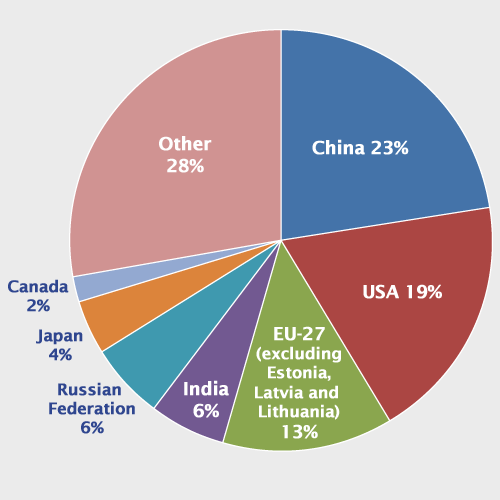
http://www3.epa.gov/climatechange/ghgemissions/global.html
GliderGuider
(21,088 posts)[center]
[/center]
The Situation Today
After 1900 fossil fuels began to change the face of agriculture, with major consequences for the expansion of the human population and our domesticated animals.
Today, late in 2015, there are approximately 7.3 billion people on the planet, with an estimated average weight of 58 kg each. The resulting human biomass of about 425 MT is one-third greater than the biomass of all the land animals that existed just 12,000 years ago. It is also over five times the human biomass in 1900.
But as enormous as that number is, it pales in comparison to the biomass of our domesticated animals.
In order to get a reliable estimate for the biomass of domestic animals, I consulted the United Nations Food and Agriculture Organization (FAO).
The total biomass of domestic animals comes out to 1400 MT, which is eight times greater than it was in 1900. It should come as no surprise that the majority of this enormous mass consists of cows. Almost 900 MT, or 63% of the total weight of all livestock on Earth is cattle. That is also more than twice the weight of all human beings alive today.
You can read the whole article at the link, including the reasons I claim that the total biomass of wild animals on the planet today is only 20 million tonnes, compared to 300 million tonnes before humans began to farm the world.

librechik
(30,957 posts)They are not allowed to kill and consume the millions of cattle that wander the country.
So there's a little more nuance to the issue. Large herds of cattle, no matter their ultimate use, are raising global methane levels.

frogmarch
(12,258 posts)Mr. froggy and I don't eat animals, but for several years we breathed in cow poop fumes, so I know what you're talking about. We lived in Torrington WY and never once opened our windows. That’s because the cattle sale barn was smack dab in the middle of town (the sale barn was there first, and the town grew around it) and there was no fresh air to breathe. Whenever we went to Cheyenne (about 85 miles south), on our way back we could see the huge cloud of green haze hanging over Torrington from many miles away. We never had to fertilize our lawn, so there was that, but between the eye- & nose- & throat-burning cow poop/urine smell and the caustic smell of the sugar beet factory, the town had nothing good going for it as far as we were concerned. We moved to Nebraska 10 years ago and have never regretted it.
Reter
(2,188 posts)Article wasn't specific.
muriel_volestrangler
(106,822 posts)about 35% of the beef figure is the methane they produce internally; another 15% from the methane and nitrous oxide produced from their manure as it is broken down; about 10% from the production of feed for the cattle; 10% in post-farm handling (refrigeration etc.), and miscellaneous others.
cherokeeprogressive
(24,853 posts)Do you ever experience flatulence?

IVoteDFL
(417 posts)The environmental consequences were one of the biggest reasons why I went veg. I think it also takes a shitload of water to produce a pound of hamburger.
Thanks for the article, I admit I've had whoppers on my mind recently. It's good to be reminded.

MineralMan
(152,011 posts)gas pollution. From the massive amounts of CO2 we contribute to the atmosphere, just by breathing, to the methane we release every time we pass gas. And that doesn't even mention the energy we use that involves fossil fuels.
It's interesting that nobody seems to quantify that, but are eager to blame livestock. And then, there are all those other oxygen-breathing/CO2-producing/methane-producing lifeforms on the planet.
It's important to view the whole picture, not just one aspect that makes up less than 15% of the greenhouse gas production. Show me the numbers for human beings, and we'll talk.
workinclasszero
(28,270 posts)By Kris Gunnars, BSc | May, 2013 | 280,583 views
http://authoritynutrition.com/6-ways-wheat-can-destroy-your-health/
GliderGuider
(21,088 posts)For the last two years my diet has been almost 100% meat. I'm healthy again, for the first time in over 30 years.
Fuck wheat. Fuck all grains. Fuck starch. Fuck sugar. Gimme that old-time steak with a side of bacon, baby. 
workinclasszero
(28,270 posts)Beef or any other kind of meat is not driving the type 2 epidemic raging across America, that's for damn sure!
opiate69
(10,129 posts)
GliderGuider
(21,088 posts)You'd be much better off ditching the bun and eating only the healthy parts of that meal. Or try this one...

EX500rider
(12,852 posts)Hardly just a American "indulgence"


DonCoquixote
(13,990 posts)they cannot have their Kosher and Halal meat.

derby378
(30,262 posts)
Polly Hennessey
(9,048 posts)I'm thinking of having a steak tonight and after dinner I think I'll get in my Escalade and drive around Las Vegas.

Agnosticsherbet
(11,619 posts)Buy any kind of consumer goods?
brooklynite
(96,882 posts)...they won't give up beef. But they can eat it moderately and responsibly.

LostOne4Ever
(9,768 posts)
CentralMass
(16,997 posts)Rex
(65,616 posts)The day I feel bad about individual choices over corporate/government choices...never happen.

one_voice
(20,043 posts)for one thing it's so damn expensive. It's really not that good for you. Every now and again I will cook a very lean piece of beef. My husband enjoys a nice steak or a good roast beef.
I will use it in beef stew or make pepper steak; something like that. But again not that often. It's ridiculous how much it cost.
Iggo
(50,124 posts)So yeah, it's on me.
oberliner
(58,724 posts)Which should at least be worth noting.