General Discussion
Related: Editorials & Other Articles, Issue Forums, Alliance Forums, Region ForumsFight Nights: The Brief Candle of an American Artist
Last edited Sat Oct 22, 2016, 10:03 AM - Edit history (1)
“I don’t know anything about boxing. I was painting two men trying to kill each other.”
---George Bellows
[IMG] [/IMG]
“ Stag at Sharkey’s” 1909. Cleveland Art Museum.
Just last month I was in the coolly tasteful, white walled National Gallery of Art in Washington D.C. and confronted by the lesser known of Bellows’ painted nightmares of stag fights, “Both Members of This Club,” seen here
[IMG] [/IMG]
It so jolted me away from the rest of the paintings in the American Collection room -- as gritty as the Ashcan School works could be with its Bellows and Sloans mixed in ...that I circled around and took a second...and then a third look at this remarkable painting. What were its smells, smoke, noise and downright insane crowd faces doing in this genteel place?
Quite frankly, this confrontation of racial outrage and fury by a white artist of its time shocked me. Now I was not looking at the fight of two white men but of one black and one white. The brush stroke that I had admired in the fighters legs in “Sharkey’s” was brushed deeply in this painting’s meaning. The complex motions of the legs and the arms of the fighters, the blood smears, the crowd’s menacing force, were all subject to the political significance of the art at that moment.
I now knew the answer to this question: when does art hurt?
For the whole meaning of a social situation that would produce such a brutal assemblage in the first place had its rightful, stunned moment of recognition...we have met the enemy and he is us...or was us at that time...but the racial statement here precluded so much that we think we have learned -- and accomplished -- yet really have not...
George Bellows was an Ohio kid who loved sports and played semi pro baseball. He was as middle American as you could get in those days. And he moved to New York in his third year at Ohio State because he wanted to get closer to social realism and to portray it, as so many of his fellow social realists did.
There he met others of the then-burgeoning days of the Ash Can school of American art. Ash Can was a social movement as well as an art destination for the nation’s artists who flocked to New York to find their own niche as artists in such a roiling time. Its teacher of the day was Robert Henri, who famously told his students to go out into the streets and seek out the ordinary people at their daily work and play, including its dangers and crumbling living conditions. Paint that, he said.
When Bellows concentrated on his boxing series he was doing something important for the socially and politically aware. He was presenting men in the boxing ring beating each other to a pulp for the entertainment of the crowd, who could bypass the law against boxing matches by going to a “private” club, such as Sharkey’s.
Bellows captures the riotous sense of “being there” to watch unconstrained combat between two men willing to be bloodied for a very small purse -- a dead end way of earning money through howling pain. New Yorker critic Peter Schjeldahl writes on a Bellows 2012 retrospective:
Their livid flesh, radiating agony, is a marvel of colors blended in wet strokes on the canvas. The picture is at once a snapshot of Hell and an apotheosis of painting.
Joyce Carol Oates in her Bellows monograph writes that these two paintings, while “realistic in conception, are dreamlike in execution; poetic rather than naturalistic.”
The aspiring Ash Can artists practically moved in with the social realists of their day to capture the zeitgeist they were experiencing around them... and boxing was but one theme of their heady movement.
A wonderful outcome here was the ascent of socially aware portraiture. One of the most poignant and powerful portraits, Paddy Flanagan, by Bellows sums it up
[IMG] [/IMG]
Paddy Flanagan. 1908. National Gallery. Washington, D.C.
Look at this kid and you see the face of impudence and survival, an act defying the odds with a kind of courage that is hard to fathom. I wonder how old he could be. His spine is already bent over, his fingers knobby and reddened, as if he had been caught right after a fist fight, and he is abnormally skinny from malnutrition. He is unkempt, ragged and shirtless. The early 20th century child labor laws had not yet been passed at the time this was painted, but perhaps it in some way encouraged them. Nothing bespeaks the poverty of children in his day like we see on this canvas.
Bellows joined the Group of Eight, the artists of the day that were dedicated to this movement and its goals. But in 1913 the history of art had a sudden world shaking event. American artists witnessed the new revelations in European modern art at the 1913 Park Avenue Armory Show (in which Bellows was a participant). I think he just didn’t see it coming. All the isms...Cubism, Futurism, Fauvism...as the avant-garde took the center of attention of the art world...would of course change the world of art as he knew it.
Bellows was not a fan of Cubism and said so. It “ merely laid bare a principle of construction which is contained with in the great works that have gone before.” Adept as he was with his impressive city/riverscapes (and particularly one in which could flaunt his treatment of snow) and his seascapes in Maine, they were suddenly “the past” and art had moved on from them.
Poor Bellows. He went through a period where he seemed to catch anti-German hysteria at the eve of World War One, painting that hysteria shown in his sad, artistically diminished depictions of atrocities (perhaps with Goya-like justification in his mind?) that may or may not have been accurate. His art would never be the same. He died of peritonitis in January 1925 at the age of 42, having ignored the pain of a ruptured appendix.
Looking back on the course of art in Bellows day, we have to wonder how he would have evolved in his career. In his absence there rose other “stars" such as Edward Hopper, and then, Jackson Pollock, to address and shape the American manner.
Had Bellows lived as long as his fellow student Edward Hopper did, would Hopper’s fame have been eclipsed at some point, as some critics like to retroactively imagine? Or was Hopper able to develop his theme even further because of Bellows’ absence?
I immediately think: if Bellows had lived would we have Hopper’s sunlight on the El tracks, ever there for our delight? Would we still see Jo awash in Sunday morning light on her bed in that reflective pose?
I like to think that we would.
 = new reply since forum marked as read
Highlight:
NoneDon't highlight anything
5 newestHighlight 5 most recent replies
= new reply since forum marked as read
Highlight:
NoneDon't highlight anything
5 newestHighlight 5 most recent replies

H2O Man
(79,252 posts)I'd never seen the third one.
I've often said -- to the dismay of some of the more squeamish here -- that all of life imitates the Great Sport of Boxing. While perhaps mildly "tongue-in-cheek," I actually mean it. And, of course, I am 100% correct.
On edit: forgot to say "recommended"!

CTyankee
(68,476 posts)which one is the "third one" you are referring to? Is it Dempsey-Firpo?

This one is also famous but doesn't come near to the artistically wonderful other two.
H2O Man
(79,252 posts)third one in the OP ....of a individual boxer.
Yes, that's Firpo knocking Dempsey out of the ropes, onto the type-writers of the ringside journalists! Painted from a famous photograph of the event.
CTyankee
(68,476 posts)approach and sense of the boxing ring was so correct and true. What the hell happened with this thing?
H2O Man
(79,252 posts)I admittedly know very little about art. My lady friend, who should get to my house within the hour, is an art teacher/historian. I'll be sure to show her your OP, and ask her opinion.
Very good OP/thread! Thank you for it!
CTyankee
(68,476 posts)She couldn't stay long, but she'll be back Sunday evening. But, even for the brief moment she read through the OP, she was excited to show me that style going back into the 1600s, etc. I apologize for not being able to repeat the numerous points she was making. Way over my head! But I told her that I wanted to continue with this OP/thread when she is back.
This is turning out to be so cool!

edhopper
(37,521 posts)CTyankee
(68,476 posts)
Generic Other
(29,082 posts)Fought in Madison Square Garden, Coney Island, Atlantic City. He had some fights lasted 1 minute. Once he chased the other guy around the ring. I asked him why such short bouts. He said, he didn't like getting hit. He sparred with Dempsey back in the day. His last fight was with Jersey Joe Alcott who went on to become the world champion. Dad lost. He really had an amazing career. It ended when he joined the Army during WW2.
These paintings remind me of him.
CTyankee
(68,476 posts)I've never been to a prizefight but these paintings kinda look like what I thought they would. And of course, perfect for the cinema which portrays them so realistically as well.
H2O Man
(79,252 posts)(his real name was Arnold Raymond Cream) worked for my grandfather's construction company for many years, before he could afford to concentrate full-time on boxing. He was a good man, and an extremely talented fighter. He is among the most under-rated of the heavyweight champions -- hardly surprising, as he and Ezzard Charles held the title between the reigns of Joe Louis and Rocky Marciano!
Charles is likewise grossly under-rated. He was likely the greatest light heavyweight ever, though due to the war, he was never able to fight for that title. Walcott was about ten pounds larger than Charles, but in today's divisions, he could have competed at either light heavyweight or cruiserweight.
"The Greatest" would learn from Walcott ....much of his amazing footwork copied Jersey Joe's!
Generic Other
(29,082 posts)They got beaten to a pulp for very little money. A rough life. Very cool story about your grandfather. I wonder if he hired my dad too. I think Newark was a tough place to live during the Depression. My dad did anything he could back then to survive and make an honest living.
H2O Man
(79,252 posts)My grandfather came to the US as a boy, in the 1870s. He loved baseball; one of his brothers, who he was very close to, was a boxer. Uncle Pat was born in New Jersey in the 1890s, and not only fought a long, tough career, but was a sparring partner for heavyweight champions, a trainer, manager, and promoter. His pro career ended in the 1940s. (He also worked on the railroads. He would find a tough, street-fighting kid in upstate NY, teach him to box, and promote all of the kid's early fights. That kid was Carmen Basilio, who went on to win the welterweight and middleweight titles. Carmen remained a family friend; he worked my brother's corner in his pro debut. I was honored to be able to introduce him to my children!)
The list of boxers the brothers knew and associated is vast -- a real "who's who" from that era. As you note, it was a brutal lifestyle. Much worse than today.And, for every one fighter who was successful, there were literally hundreds who absorbed terrible punishment for the money needed to support their families.
There was a good movie a while back, "Cinderella Man." It's based upon the career of James Braddock (also nicknamed, "The Bulldog of Bergen" . It shows the terrible conditions that even talented fighters competed under, when he turned pro in the late 1920s. A funny thing: for his first defense of the heavyweight title, he lived part-time at my great uncle's home. Uncle Pat helped train him. (Unfortunately for Braddock, though Uncle Pat had been a perfect sparring partner for those preparing to face the great Jack Dempsey, he wasn't able to be of much help to anyone preparing to fight a prime Joe Louis!)
edhopper
(37,521 posts)I saw the Bellows show at the Met a few years back. He was a spectacular artist and died way to soon.
As for the other Ed Hopper, I would like to think that a living Bellows would only have made him better, that they would grow off each others work. Like Picasso and Matisse.
Though their sensibilities were different Bellow looked for the chaos in urban settings and hopper pursed the quiet times. Bellows' paintings are full of noise and action, Hopper's are still and silent.
CTyankee
(68,476 posts)I think Hopper was by nature introspective and Bellows the opposite. Interesting, tho, isn't it that they were both students of Henri at the same time!
but you can see his influence in their techniques.
CTyankee
(68,476 posts)you can see it in their style.
Looking at what you posted, does this style look familiar?
[IMG]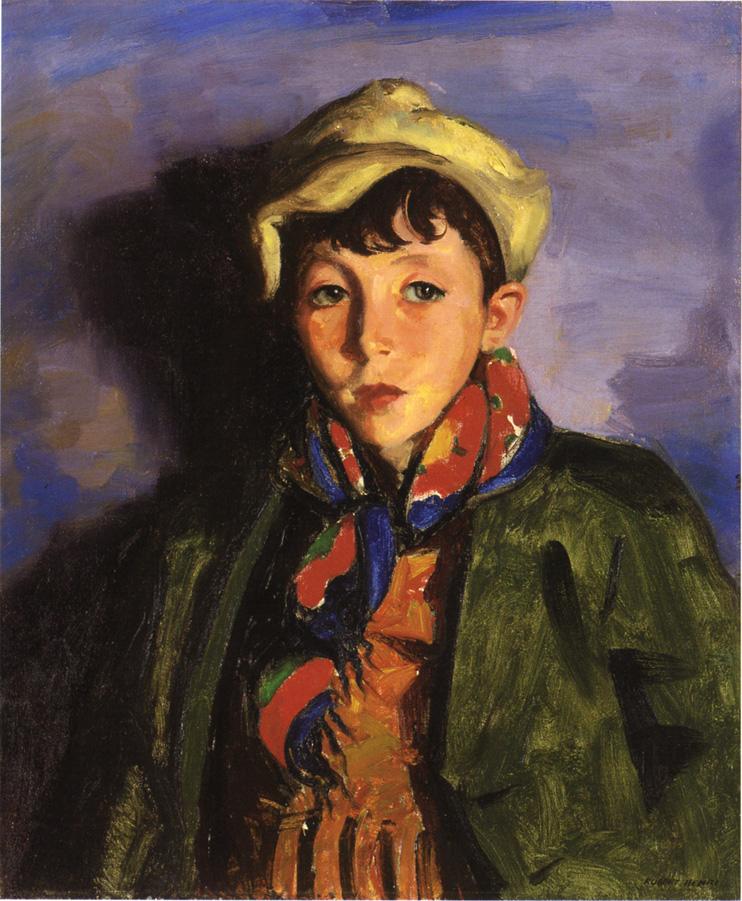 [/IMG]
CTyankee
(68,476 posts)I don't see a kid suffering from loss of all kinds of social supports in this kid. Physically, he is not suffering from the real health issues of Paddy. This kid is clothed and looks comfortable. I don't "feel" that Paddy is at all comfortable...even his ordonture (sp?) looks painful...
edhopper
(37,521 posts)look at the technique. the way he handles paint and brushwork. That is what is taught. What an artist does with it is up to him.
Why Bellows and Hopper could use similar training to paint different subjects with different emotion.
CTyankee
(68,476 posts)of that poor kid, is his choice but the technique is what remains from the training.
I guess that is why Bellows loved to paint snow...too bad it is so hard to see here online...in person a loaded brush can deliver so much to the viewer...
edhopper
(37,521 posts)I love his snow scenes as well
CTyankee
(68,476 posts)so very good for us to have this...
edhopper
(37,521 posts)and be thankful for the ones that had full lives.
Especially Hopper, who didn't gain success until his 40s.
CTyankee
(68,476 posts)I mean the part about not gaining recognition in their lives or late in their lives?
edhopper
(37,521 posts)Michelangelo, Raphael, Rubens, Rembrandt, Velasquez, Goya, David, Ingres, Picasso, Matisse all had great recognition during their lives. Even Van Gogh would have been renowned in his lifetime had he lived.
Sorry I misread. later in their lives for many.
CTyankee
(68,476 posts)a few we love did not but later got their renown...Van Gogh would certainly have, but as you point out, he was so unstable mentally...

femmocrat
(28,394 posts)Just wonderful! Thank you!
Armstead
(47,803 posts)Someday maybe I'll post my opus on George Inness
CTyankee
(68,476 posts)
panader0
(25,816 posts)I like the portrait of Paddy Flanagan best though.
CTyankee
(68,476 posts)A really great artist can catch them being them and this has been true through the centuries of art history.
This kid catches the moment of the time...shameful tho it is, it has a life and a sense of hope and daring even tho your heart grieves for that kid...
It's interesting -- friend Generic Other mentions the great Jersey Joe Walcott (we both have a "family connection" there!) .....he is an example of a kid who was fighting professionally in his teens. Walcott's "official" record lists his pro debut as being when he was 16. His opponent was an older fellow, Eddie Wallace, who was in his 16th recorded bout.
Actually -- even considering how young Walcott was -- both no doubt had much more experience. But professional boxing had been outlawed for an extended period in the early 1900s, so they would have competed in "bootleg" bouts.
Walcott (or, Arnold Raymond Cream) was typical of a number of young guys back then. Lacking the formal education that could have opened other opportunities, they found employment in construction and other related hard labors. Often, those fields were run by people who were involved in sports. My grandfather, for example, who owned the construction company Joe worked at for much of his early career, owned what was known as a semi-pro baseball team (Grandpa once played against the Yankees). Grandpa's brother was a boxer, though much of his career was spent in the bootleg era.
Walcott, a black young man, and my great uncle, of an Irish immigrant family, began their careers at the approximate age of the young fellow in that painting. It was not an uncommon experience for those in their socio-economic class. Tough way to make a living, that's for sure.
CTyankee
(68,476 posts)loved him.
Such a brutal time in this country for the poor trying to make it out of poverty. We have to be aware of what went on in those days...and hope they never come back to us again...

lovemydog
(11,833 posts)I will re-read and savor your post a few more times. I love your posts about art.
In the case of George Bellows and the other Ash Can school of artists, their depictions of simple realities long outlive their lives. They inform and entertain us to this day and well beyond.
I've had the pleasure of seeing some of them in person, in museums, and they completely draw me in to the action. I love learning more about them. Hope you enjoy a wonderful weekend.
CTyankee
(68,476 posts)
Kick in to the DU tip jar?
This week we're running a special pop-up mini fund drive. From Monday through Friday we're going ad-free for all registered members, and we're asking you to kick in to the DU tip jar to support the site and keep us financially healthy.
As a bonus, making a contribution will allow you to leave kudos for another DU member, and at the end of the week we'll recognize the DUers who you think make this community great.