General Discussion
Related: Editorials & Other Articles, Issue Forums, Alliance Forums, Region ForumsWhy do people say we need more immigrants? Robots are the future.
With respect to unskilled labor, we simply don't need any more. These guys are going to take most if not all manual labor/service jobs.
http://www.cnbc.com/2016/02/24/google-robot-is-the-end-of-manual-labor-vc.html
Boston Dynamics' new "Atlas" robot is a game changer, not just for companies, but for society, Insider.com CEO Jason Calacanis said Wednesday.
"This is really the end of manual labor. When you watch this video, he's walking through the snow; he's wobbly, but he gets back up," the tech investor told CNBC's "Squawk Alley."
"Manual labor is going to end in our lifetime, and in this video you can see how close we really are. It's a huge societal issue with jobs, but it's going to be a huge lift in terms of efficiency of companies that nobody expected."
Yet I still see people saying "we need more immigrants due to aging population." We really don't. They won't contribute unless they're highly skilled workers. When robots do finally take service jobs, what will unskilled labor add to our country besides more unemployed?
 = new reply since forum marked as read
Highlight:
NoneDon't highlight anything
5 newestHighlight 5 most recent replies
= new reply since forum marked as read
Highlight:
NoneDon't highlight anything
5 newestHighlight 5 most recent replies

phantom power
(25,966 posts)We basically have no moral or ethical framework for a world where the majority of humans are effectively unemployable.

NowSam
(1,252 posts)is about to be upon us where work as we know it will be a very small part.
Time for a new model for society.
LittleBlue
(10,362 posts)Our laws are way behind at this point. We are literally taking in millions of people who will never, ever be able to find work. We're training our own citizens for jobs they won't have in 10 years, jobs that won't even exist.

Baobab
(4,667 posts)Immigrants are people who want to stay here permanently, many were originally H1B visa workers. they make a lot more money and likely are relatively high skill. In theory the L1 workers are also supposed to be high skilled but its hard to know how far it will go because the financial incentive will be high and it will be strange for high skill workers to be making less than many low skill workers. he services liiberalisation will basically be an intra company transfer. Due to liberalisation, countries can no longer keep jobs to themselves when they spend money - so, the kind of New Deal programs that existed in the 1930s will never be possible again. Instead they will be put up for international competitive bidding and the lowest bidder wins. What's illegal is for countries to reserve these contracts to their own companies only. Companies get to bid on jobs around the world. Whoever is the low bidder wins. Sure, it will drive a lot of automation in developed countries because with jobs like construction, even here, the only way we will win that contract without using subcontractors from low wage countries exclusively, is by automating it. On the other hand, business will be more profitable for the owners because of lower wage costs. I think this is a huge mistake but they have been working on it for 20 years. And its almost ready to go.

Warpy
(114,614 posts)The rich don't share resources with anyone who isn't of use to them and share few resources with anyone who is.

shrike
(3,817 posts)People work to have money to live. If there's no work, there's no money. Have to be significant changes.
Old Union Guy
(738 posts)Just program the robots to buy stuff too, and that takes care of the whole economy without all those messy humans and their drama.
Right?
Baobab
(4,667 posts)reproduce. So kind of like advertising looks at older humans, they will be crappy consumers. Its likely they will just work all day every day 24/7 without any breaks of any kind for many years. Eventually some robots will likely become intelligent like us, (but not for at least 20-30 years I think.) Already its common for robots to self diagnose and instruct humans in the replacement of their parts. When a part is about to wear out they will send off for the replacement and a human will just follow their instructions in replacing it, put the broken part in a prepaid envelope and send it back. Humans will likely spend a lot of time learning because the challenges of getting a job will be substantial, basically people will have to be extremely good at whatever they do. maybe the best in the world at that thing, or close.
Baobab
(4,667 posts)n/t

FSogol
(47,623 posts)
LittleBlue
(10,362 posts)Scenario: You are an unskilled laborer. You want to come to the United States. Robots have automated most service jobs.
What are you going to do? Knowing that most people do not have the ability to program AIs. Please explain this to me.
FSogol
(47,623 posts)in technology is pretty transparent.
Low skill workers will still do the landscaping, construction, home cleaning, home repairs, transportation, and healthcare jobs. They'll continue to be needed to cook, wash dishes, and care for the aging population. The children of immigrants will go on to skilled work, and a new group is needed for continue the low skill jobs. One day, those low skill workers will be patching up the robots. Need an example? Check out any US History book.

FSogol (proud 2nd generation immigrant)
LittleBlue
(10,362 posts)That robot is doing exactly what millions of laborers already do. The guy who builds them says it's the end of manual labor. He's not just blowing smoke, his robot actually proves it in a video. When people from those sectors retrain for others, they will compete with more people for fewer positions, with each job becoming obsolete. Eventually you'll have 10 laborers for every job. What then?
You can't just stick your head in the sand and pretend the future will never come.
FSogol
(47,623 posts)robots and the infrastructure necessary to run them? When I break the muffler bracket off my motorcycle, I can get a local welder to fix it for about $20 while I wait. Think it will ever be cost effective to program a welding robot what to do? Sure Amazon and a bunch of other libertarian companies will invest in robots, but there will still be plenty of low skill jobs for the next few generations. Immigration keeps countries from becoming stagnant and we will always need them.
LittleBlue
(10,362 posts)$50,000 might sound like a lot, but it's really not. Those fixed assets are amortized over time. Assume the life of this robot is 5 years. That's only $10,000 per year. Assuming a normal employee works 40 hours a week x 52 weeks = $16640 per year. Plus the robot can work nights and weekends. The only time it has to stop is to get repairs and maintenence. $8 per hour x 22 hours per day x 365 days a year = $64k of work per year. The robot has already paid for itself in the first year.
No medical, no workers comp, no unions, no sick pay. Try competing with that.
FSogol
(47,623 posts)to justify the cost. Think the weld shop in my example needs to weld 24/7?
LittleBlue
(10,362 posts)They will be leased. Even if they don't work all day, their life will be longer. They're like cars. The years don't matter so much, it's the wear and tear of working hours. Work them 11 hours a day and they'll run for 10 years instead of 5.
Point is, no matter how much work you need done, these droids are going to be much cheaper. Robots don't need food or breaks, recovery time, living wages or pretty much anything we need.
FSogol
(47,623 posts)Baobab
(4,667 posts)Thats all they do. I MHz CPU = 1 million clock cycles (which can be thought of as decisions) a second..(in a single thread/process)
Millions or these days, often many billions of times a second.
>Many unskilled jobs require decision making skills. Robots are far from that
Its the creative jobs that are not so clearly defined that are more difficult. Any job which follows a script is likely to be automated soon.
FSogol
(47,623 posts)While robots are awesome at welding on an assembly line, look at the piece I wanted welded. How would the robot know what to weld on my muffler bracket, would it be able to determine that the bracket should be removed from the bike first before welding. How could it be programmed for a one-off repair task involving unknown parts, materials, etc? The Korean welder who fixed it didn't speak my language, yet could easily determine what was needed and how to proceed making his labor more valuable for his shop than the robot.
In the original OP, they disrupted the robot by moving box. What if you covered the scan code with black paint, would the robot be able to pick it up? Highly unlikely.
Matt_R
(456 posts)It is not unskilled labor. Most welding is not unskilled.
Baobab
(4,667 posts)manufacturing, production and fulfillment. All office work will be handled by companies that just do office work with screen pop. You know what screen pop is? When you automate something the goal is to automate 90% and pass the exceptions to humans, at least at the start (gradually you likely ca get rid of the remaining exceptions by fine tuning the application) the economics of scale means that you want a company to handle your back office chores and typically you might have a company that specializes in that. Customer service. their workers likely work at home, they may be on the other side of the world, manning their computers. When a customer calls, they get a screen that is the result of the database query which encapsulates the entire application and all the customers personal details so you can get high ratings for your service, and not be surly or rude.
They see the details maybe half a second before they even answer the call. They may be in some other English speaking country and perfect English speakers. Even things as simple as ordering a hamburger from a drive in window are done like this. That way employers can focus on their core competencies which likely are in the product's design.
FSogol
(47,623 posts)this country. There is a whole range of jobs that do not involve factory, repetitive, or warehouse work. Robots will not replace these workers quickly. As I said before, sure Amazon can replace a lot of workers with robots. Most companies don't have a hatred of workers.
Baobab
(4,667 posts)the jobs are high skill jobs.
Here is a comparison to the 1995 GATS. Note though that GATS never gained traction so TiSA includes all services sector and modes of supply by default, and they would have to be excluded, to not apply, so for example, if I wanted to exclude public education I would need to say so, same thing with health care and banking, although its clear banking is being included.
TiSA may effect as many as many millions of jobs depending on winning going to the lowest qualified bidders.. winning low bids.
http://www.cartel-ge.ch/data/doc/150603-TiSA--An_UY_comparison_between_TiSA__core_text_and_GATS-english-2.pdf
FSogol
(47,623 posts)clue what you are going on about with your condescending posts. Pat yourself on the back and have fun.

Baobab
(4,667 posts)and the proposed Trade Facilitation Agreement on Services.
India recently gave up their right to higher education in a very controversial decision.. they did it in no small part for jobs, under Mode Four, *which is a balancing factor*.
What is GATS? Its the 1995 WTO General Agreement on Trade in Services.
It allows services, the *four modes of supply* of services to be traded between countries
Will the GATS close on higher education? - The Hindu
http://www.thehindu.com/opinion/columns/will-the-gats-close-on-higher-education/article8042337.ece
Conflicts between US immigration law and GATS MFN obligation
http://www.tilj.org/content/journal/42/num1/Worster55.pdf
FSogol
(47,623 posts)You are discussing something different than everyone else, but don't seem to realize it. Using a bunch of nickel-plated economic terms and proposed trade treaty explanations won't change that.
Baobab
(4,667 posts)Emergency Motion on TiSA
Paris, 2 October 2015
Emergency Motion – Trade in Services Agreement (TiSA)
Adopted at the ETUC 13th Congress on 2 October 2015
Since 2013, the EU has been negotiating the Trade in Services Agreement (TiSA) plurilaterally with 23 other WTO members with the aim of further liberalising trade in services by the means of reaching an international agreement that goes far beyond the existing provisions of the General Agreement on Trade in Services (GATS). By the goals set out in the EU negotiating mandate, this agreement should be “comprehensive and ambitious”, “apply in principal to all sectors and modes of supply" and “bind the autonomous level of liberalisation”. Yet, negotiations are conducted in total secrecy, behind closed doors.
In the beginning of June and July 2015, however, Wikileaks published the most comprehensive compendium of secret documents from the TiSA negotiations ever, revealing the full extent of the planned agreement for the first time. The leaked documents included the draft core text of this new agreement as well as several annexes including on domestic regulation, movement of workers and specific sectors such as maritime and aviation transport. First analyses of these documents make it apparent that TiSA might have significant detrimental implications on the working and living conditions of large parts of the population, including those of workers in Europe.
It appears that so-called ratchet and standstill clauses are to be incorporated into TiSA with the effect of locking-in a certain degree of liberalisation and confining the public policy space to that of ever increasing liberalisation. In sectors affected by such clauses, TiSA would make it impossible to return to a decreased level of liberalisation. The re-municipalisation of services of general interest that has occurred in recent years would no longer be possible choices of democratically elected governments. A possible incorporation of a so-called Most-favoured-nation (MFN) clause into the core text could bear the risk of bringing an investor-state-dispute-settlement (ISDS) mechanism into TiSA via the back door of other free trade agreements such as CETA or TTIP. More recent information sources confirm even a possible annex on the facilitation of patient mobility being currently under discussion by TiSA negotiators, despite Trade Commissioner’s Malmström reassurance in February 2015 as reaction to a first leaked concept paper by the Turkish party that “under no circumstances, I would ever propose a trade agreement that contained provisions on portability of health insurance”.
One of the key issues of the TISA negotiations are the so-called rules on domestic regulation, which directly relate to important regulations for safeguarding standards. The newly leaked negotiation documents reveal that regulations must be in line with TiSA provisions even if they are non-discriminatory and serve to guarantee fundamental cultural, social or ecological rights. By the same token, regulations must stand a so-called necessity test of being “no more burdensome than necessary”. The objective here is to restrict a government’s room for manoeuvre as far as regulations are concerned, thus potentially putting a downward pressure on labour, social, environmental and consumer standards. This, for instance, would also impact financial services where, in the aftermath of the global financial crisis, it is especially important for more stringent standards to be enforced. Yet, the negotiation documents reveal that even greater liberalisation of the financial markets is envisaged under TiSA. The most recent official withdrawal of Uruguay and Paraguay from the TiSA negotiations in early September can be judged as another indication that states start to see these risks and react to the increasing public pressure.
In light of these alarming recent publications and against the background of the European Parliament currently drafting its recommendations on TiSA, the ETUC Congress urgently calls for the following aspects to be guaranteed in the TISA negotiations:
Negotiations must not take place in secret. Negotiation documents must be published in order to allow the general public and civil society to be informed in good time. We demand the highest level of transparency and involvement of the European Parliament, national parliaments, social partners and civil society organizations.
Every effort must be undertaken to protect public services and in particular no pressure must be brought to bear either in favour of liberalising or privatising public services, nor should a return to the provision of greater – or even wholly – public services be blocked by any ratchet or standstill clause. Public services e.g. health care and social services, education, water and waste services must therefore be excluded from the scope of any trade agreement; this exclusion should apply irrespective of how the services are provided and funded. In this light we ask the European Commission to openly reject the use of negative or hybrid listing in any trade agreement.
Under no circumstances should possible means of regulation be restricted where this leads to a lowering of national labour, social, environmental and consumer standards. The member states’ right to regulate and to introduce new regulations must not be compromised. Between two services that meet the same use, member states must be allowed to favour the one furnished in respect of labour standards.
Limits on the introduction of new prudential regulation and further liberalisation of financial markets cannot be accepted. Governments must maintain the right to fully intervene in times of financial crisis, and to limit international financial flows in order to prevent currency crises. The financial crisis demonstrated that instead of further liberalisation and deregulation, governments must bring back the rules and regulation on the financial markets.
European data protection standards, as provided for in the envisaged EU General Data Protection Regulation, must not be compromised. Data collected by foreign businesses must therefore be processed in situ and in line with local data protection laws.
Any establishment of temporary free movement of workers must under no circumstances make it possible to undermine labour and social law and collective agreement provisions of the host country and respect the obligation to proceed with a preliminary analysis of the labour market. Possible negotiations on mode IV must be bound to functioning cross-border cooperation in administration and justice in labour and employment law issues as a precondition to guarantee the full application of collective agreement wages and working conditions. It must be possible to make any lack of enforcement by the contractual parties subject to dispute settlement including sanctions.
Any dispute settlement mechanisms foreseen in TiSA – may it only be temporary before a possible multilateralization of the agreement under the WTO – must take into account the current critics on ISDS, and more especially must not offer private investors the privilege to challenge democratically chosen policies without strong social clauses allowing to effectively sanctioning violations of international labour standards at the same time.
If TiSA doesn't meet all these demands, the ETUC calls for its rejection.
FSogol
(47,623 posts)Baobab
(4,667 posts)response to it. Trying to max out on profits as jobs vansh by sparking a race to the bottom on wages. Long before the need to not have people work.. They claim its to share the wealth and lots of other gobbledegook but the fact remains like Obama's past history, they want everybody else to give up everything so that they can have more and more.
that is the cost of global corruption.
Baobab
(4,667 posts)or the myth of the seven cities of gold?
the Western countries have been taking advantages, promising the same things to two groups of people at the same time.
FSogol
(47,623 posts)tastier waffles?

Baobab
(4,667 posts)so I think the cost of a full on computer worker is stll higher than $8. Figure maybe $75 for a decent web server. Amortize that over maybe ten years, max. It doesnt take much in the way of hardware to run an online store if you don't have a lot of graphics.
So you can be open 24/7/365 unless you observe some kinds of holidays.
there are ARM chips that cost under a quarter in quantity that are fully capable 32 bit PCs now.

Shankapotomus
(4,840 posts)as a way to compete with and undermine existing companies. Plus if I am one of the individuals who can afford one of these robots, I can rent it out to do work I would have had to rent myself out to do previously.
ghostsinthemachine
(3,569 posts)Bots are cheaper, need no OSHA oversite, no unemployment insurance, no insurance, no retirement.....
Corporations are required ONLY to do one thing, make money. And bots will be cheaper than employees and that will be very very very soon.
Bradical79
(4,490 posts)Retail is well on its way along with the fast food industry. Also, it's more about reducing workforce rather than eliminating it. Yes, you need humans, but just less of them.
Kelvin Mace
(17,469 posts)it shows a robot performing specific tasks in a controlled environment. The walking outdoor test was impressive, but we don't know whether he was being remotely controlled or had been simply told "Leave this building and go to location x."
Show me a robot that can mow a lawn, ANY lawn, and we'll talk.
We use robots in my company, and while they are useful, they have a long way to go before we would trust them working around expensive machinery and people.
Humanist_Activist
(7,670 posts)Kelvin Mace
(17,469 posts)Also, how comfortable are you leaving a machine that can reduce a pet, child, or passed out frat boy into ground round in seconds, running around your property? At $2,300 how many times does it have to mow the yard until it pays for itself? When I didn't mow my own lawn, it cost me about $50 bucks to get it mowed twice a month from May to the end of September. So, $250 a year, means it would take almost ten years to pay for itself.
Here are some deal killers for me:
Can it detect objects such as clothes or toys lying on lawn?
No. It is up to you to keep the lawn surface object free. Any object that is small enough for Automower® to pass over may be damaged, as well as cause damage to the mower’s blades. Make sure your lawn is clear of small objects before operating the mower.
Can children play on the lawn when Automower® is working?
Even though Automower® operates on low power, you can still cut your fingers or toes if they come into contact with the cutting blade. A built-in safety feature means the blade will automatically stop if the mower is lifted up or turned over. The distance between the outer body and the blade tip is also extra-long to avoid feet or hands from accidentally reaching the blades. For safety reasons, we recommend turning off mower when small children are playing on the lawn.
Sorry, not ready for prime time.
LittleBlue
(10,362 posts)Bye bye all chef/cook jobs. Automatic checkout at grocery stores are already replacing checkers. The one above can stock store shelves and warehouses.
“These machines are different,” the bank’s chief economist Andy Haldane said. “Unlike in the past, they have the potential to substitute for human brains as well as hands.”
According to the bank, administrative, clerical and production workers might be the first to be replaced by robots in the coming years. That’s not to say unemployment will suddenly rise. Humans will “adapt their skills to the tasks where they continue to have a comparative advantage over machines.”
A recent Oxford University study quoted by Yahoo says that the jobs at risk of being replaced by robots include loan officers, receptionists, paralegals, salespeople, drivers, security guards, fast food cooks, bartenders.
http://bgr.com/2015/11/16/robots-replacing-human-jobs/
Kelvin Mace
(17,469 posts)and actually being on sale in 2017 are two different things.
Also, it will be interesting to see how much the robot will cost, including the cost of building your kitchen so that the robot can find everything.
Here are some questions I have:
1) How does the robot tell if food is spoiled?
2) What happens when a programming error serves a highly allergic customer a dish cooked in peanut oil?
3) What happens when someone gets in the way of the robot and is sliced/stabbed/burned/crushed?
4) What happens when food is contaminated in some manner, for example, a knife chips and leaves a piece of steel in the food?
5) What happens if someone tampers with the setup? For example, switches containers (accidentally or maliciously) of ketchup and salsa?
6) What are the liability issues involving robots making food? Who will be the first company to make itself a guinea pig and underwrite a policy covering a restaurant.
7) What are the health regulations going to look like? You are not going to be able to plop one of these down in a kitchen unless a health inspector signs off on it.
Also, reading the Time article I find some interesting caveats and qualifiers:
crab bisque is the only dish the robot is currently able to make. However, the company plans to build a digital library of 2,000 recipes before the kitchen is available to the wider public. Moley ambitiously aims to scale the robot chef for mass production and begin selling them as early as 2017.
So, as of last Spring, the robot could make one dish.
They PLAN on 2000, which is interesting, since code will have to be written for each recipe. That is a LOT of coding and debugging. Yes, some of it can be cut and pasted, but that also means you cut and paste bugs as well.
They hope to sell them AS EARLY as 2017, but that seem extraordinarily optimistic to me.
The robotic chef, complete with a purpose-built kitchen, including an oven, hob, dishwasher and sink, will cost £10,000 (around $15,000). Yet that price point will depend on a relatively high demand for the kitchen and it’s still unclear how large the market is for such a product at the moment
Yeah, $15K sounds awfully damn cheap for this kind of tech. I have seen welding robots that do way less and they cost many times that price.
Having a large demand for a product means having a lot of people willing to bet tens of thousands (more realistically hundreds of thousands) of dollars on unproven tech which will blaze brand new ground in regulation and litigation. Restaurants are chancey enough business propositions as it is, and all it takes to ruin a good one is a single bad incident.
And finally there is this, which makes my point:
But there is still work to be done on Moley’s kitchen before it would be an even remotely practical, albeit pricey, purchase. As the robot doesn’t have any way to see, it’s unable to locate an ingredient or utensil that might be moved or knocked out of place. It also can’t chop or prep food yet, so it must use prepared ingredients that are meticulously laid out.
Humans adapt to changing environments easily, robots DO NOT.

Oneironaut
(6,299 posts)In the future it might, but not now. Think of everything laborer or delivery man does. This robot can't do any of those things yet (except finding a package and bringing it to someone right next to them). To work, this thing would need both better AI and infrastructure to support it. This is at best a tech demo of what can be in the future.
Robots like this won't be useful until at least 10-20 years from now. It might even take longer. People always expect technology to progress faster than it actually does.
LittleBlue
(10,362 posts)One human for four to eight checkout lanes. These robots aren't humanoid, so it doesn't scare people as much, but they do the job of humans. One human can easily direct and maintain 4 robots to compensate for errors. That reduces labor costs by 3/4 to 7/8.
Where did those people go? Into other service jobs, mostly. Until those jobs get partially automated. Then the next, then the next. Until tens of millions are out of work.
Baobab
(4,667 posts)The goal of all technology since before recorded history has been to free humanity from drudge work.
LittleBlue
(10,362 posts)aid human beings. A tractor, car, or ship still needed a human to drive. They allowed us to exploit land and resources that weren't already being exploited.
But now they can think and act independently. Our population is so high and widespread that robots won't help us expand into new frontiers and become wealthier, at least not until we can exploit resources in space. Which is a long way off.
Baobab
(4,667 posts)But network bandwidth kept getting cheaper and cheaper. Cost approaches zero to hook up anybody on the globe to anythere else, with lots of bandwidth and low latency.
So then everything that they still cant do with AI becomes possible now without it.
Just pay somebody whatever is appropriate where they live, and use their services everywhere, to operate the dumb machines, over the network.
Even driving trucks, tractors, flying drones, operating on patients..
You name it!
Oneironaut
(6,299 posts)It involves a scanner (which already existed) and a food product database. Of course, that's a simplification, but there's no AI, geospatial navigation, or complex decision-making required. This robot requires near-perfection at all three.
Those jobs will absolutely be automated, but probably not any time soon. It will be a slow cut-over.
Bradical79
(4,490 posts)The company I work for has customer service robots in the testing stage working the sales floor. It's pretty early, but already could be used to reduce staffing.
Baobab
(4,667 posts)Some countries are fighting for their right to education, but here in the US nobody did anything in 1995 to stop it.
The2ndWheel
(7,947 posts)every institution we've built up to now has required more people. Whether governments or businesses, they've always needed more taxpayers or customers.
Same with an aging population. We don't really have experience with that. Our systems aren't set up for it. More older people than younger people, it's really never been an issue.
Like with anything else, it'll have its positives and negatives. Some will do great, others will get screwed, and most will muddle through in various ways somehow. It'll free everyone to pursue their own dreams and desires! It could also lead to a loss of purpose. With 7, 8, however many billion people, I'm sure, just like today, basically anything and everything that can happen, will happen. Both good and bad, right and wrong.
Baobab
(4,667 posts)Countries like Japan are reverting to forest as large parts of the country are depopulated. People simply don't have children.
The US may continue to change but the change will likely be churning more than growth. Were trying to become the place where rich people come.

Cassiopeia
(2,603 posts)The proponents to bring more immigrant labor to the US are doing so in order to drive wages for everyone down which increases profits for their friends at the top.
Baobab
(4,667 posts)They are temporary.
Do you know what "National Treatment" and "Most Favored Nation" are?
Tierra_y_Libertad
(50,414 posts)The workers? The capitalists?
Kelvin Mace
(17,469 posts)This is kind of like trotting out a biplane and saying it is ready to dogfight an F-16.
There are a HUGE number of obstacles that must be overcome before C3PO starts packing boxes at Amazon, slinging fries at Mickey Ds, or tucking in Grandma at the nursing home.
You are looking at a robot pick up a very well defined object, weighing a specific weight, moving it a specific known distance. When you start throwing in different shapes, weights, and distances, things get complicated fast. There is also a dwarfstar density of laws and regulations that must be worked out before such robots can be deployed.
Add to this the cultural and societal changes that must be made to accept robots in the workplace. This may not seem a big deal, but ponder these scenarios:
Imagine what will happen when you mix a robot staff at the local fast food chain with a college campus. Imagine Animal House meets West World.
How will a dementia patient react to getting their medication from a T-1000 without the skin?
What will be the reaction to factory robot going ED-209 with some machine tools?
Look at the pandemonium drones are causing right now to get an idea of just a fraction of the problems with robots.
Humanist_Activist
(7,670 posts)While I'm sure deployment will be slow, please bear in mind the robot in the video didn't move the object a specific distance, but was programmed to adapt to changing conditions. Its a few years off, but a robot able to lift objects of irregular shape and sizes and with a variance in weight equal to the range for an average human, if not greater, isn't far off.
This robot in the video had the object taken away, it chased after it to pick it up again. Its biggest limitation was that they didn't bother giving it fully articulated hands, which do exist, by the way, and possibly the servos in the arms may not be strong enough to lift more than 20 pounds, though they were strong enough for it to right itself from a prone position.
Don't underestimate the technology present today, these aren't robots like those present in auto factories the world over, they are generalized, adaptable, and able to learn.
Kelvin Mace
(17,469 posts)and work for a manufacturing company. I don't underestimate tech change. But again, a robot that can work in a controlled environment is one thing, one that can work in a dynamic environment something else entirely.
Show me a robot that I can drop into ANY kitchen without having to rewrite reams of code and adjuting the layout, and I will be impressed.
Also, even if the tech were mature enough, there are massive legal, regulatory and social issues to overcome.
Humanist_Activist
(7,670 posts)Many of Amazon's warehouses are largely autonomous, after all.
Same thing for a kitchen, installed, the robot will be able to prepare any meal it is programmed to recreate. Its not difficult to prepare such a space for such specialized robots. Kinda the point of manufacturing such robots, which is being done now.
Kelvin Mace
(17,469 posts)they CAN be a controlled environment, but I have yet to walk into one. All it takes to screw things up is a misplaced pallet. Specialized robots doing specific tasks in a controlled and CLOSED environment are, as you say, already out there. Robots wandering around by themselves fetching things and packing them, or cooking meals are not, and will not be for some time. We have a few robots we run in our shop, sometimes we let them run all weekend unattended (nobody else in the building). But they sit in one place and are not prone to go walk-about.
The kind of robots that will cook food, do gardening, take care of granny, walk the dog, etc, are a LONG way off due to legal, regulatory, safety and social obstacles.
Humanist_Activist
(7,670 posts)Granted, they can't do everything yet, but you seem to grossly underestimate what's being used now.
You keep reiterating that its going to take a LONG time for these robots to be ready for prime time, as it were. What time frame are you talking about? Years, decades, centuries?
Kelvin Mace
(17,469 posts)Robots performing very, specific easy to define tasks, in a rigidly controlled environment. Basically they are moving around big stacks of stuff, loaded up by humans, taking them to humans for packaging. The intricate work requiring discretion is performed by humans, the simple muscle work by machines.
I am not underestimating anything, grossly or otherwise. I am not making these comments just to be contrary, I have been working with computers (software and hardware) for about three decades and we have industrial robots in our company and are certainly looking at how we can automate, given the type of work we do (light/heavy machining). A manufacturing environment is not a warehouse environment. We move around bulk HEAVY sheet/coil/rod metals weighing tons, and it goes into a variety of machines and it involves lots of of unique motions and decisions trees. We have robots executing tasks which are within their capability and we follow the changes in automation very closely (not because we don't like people, but because we want people doing more sophisticated tasks that are less dangerous and CANNOT be automated).
Humans REALLY underestimate what a complex, flexible and amazing machine the human brain/body is. I have an appreciation for this from another context in that my wife has MS, and I see first hand what happens to humans when that amazing machine is damaged. The robots in the Amazon warehouse roll on wheels on a perfectly flat surface. Change that surface, add obstacles or stairs and robots cannot functions. My wife, with her wobbly gait and dodgy balance can run circles around those robots.
Also, we do these tasks while consuming the amount of energy needed to run a vacuum cleaner for about two and a half hours.
What time frame am I postulating? Another generation at least before robots get to be sophisticated enough to handle many of the more pedestrian tasks that human children can pull of without working up a sweat. Then another generation to work out the legal/regulatory issues, and several generations to overcome the social dislocation. At that point you will start to see widespread adoption.
Am I anti-robot? Nope, I am very pro-tech AND pro-human. I want robots doing dangerous tasks such as mining, construction, firefighting, etc, freeing up humans to do more important things, you know, like thinking and creating. But, evolving into such a society requires us to DRAMATICALLY rethink people's worth and their view of self-worth. We live in a world where one's usefulness and status are largely dictated by what our job is, and the compensation for our jobs is completely divorced from the importance/danger associated with that job. Why is putting on a jacket, wrapping a strip of cloth around your neck and calling yourself a CEO, worth thousands, even tens of thousands per hour, but taking care of the elderly is worth $7.50 an hour? Why is stuffing a basketball into a hoop worth millions a year, but running into a burning building is on worth $70K.
Tech is amazing, but lets not forget who imagines and creates it. Let's not give it credit for more than it can accomplish.
Humanist_Activist
(7,670 posts)for example, the Boston Dynamics robot displayed is nearly as sophisticated, mechanically, as a bipedal human, enough so to navigate a human environment that isn't always neat and laid out like the Amazon robots require. This isn't even new, what is new is the advancement in portable energy storage, before these robots were mostly tethered to power wires, but now, as shown with this robot, this isn't necessary, though I doubt it can function for long between recharges. But there have been some huge recent advances in battery technology lately that seem promising. Which is good considering battery tech has been barely progressing for what, 20 years now?
You are talking on the order of 20 to 40 years before these robots become mainstream. I would say its more like 10, perhaps 20 before they become ubiquitous. Optimistically I would say we will see more autonomous systems in stores and restaurants within the next 5 years or so, along with driverless cars and other automation.
Kelvin Mace
(17,469 posts)except for a small period when I was serving five to life in fast food management. In computers, the hardware was undergoing generational shifts every 18-24 months. I have been playing on the bleeding edge of computer hardware for a good 25 years. I rebuild my PC about once every year and a half to stay current and automated my house for fun. I have a solar array and an electric car and am immersed every day in tech sites or dead tree editions of tech journals. This is what I do to relax.
Now, you mention battery tech, and drop right into an area I have been following closely since the days of NiCad.
"But there have been some huge recent advances in battery technology lately that seem promising."
I have been reading that sentence, or some variation of it every year since at least 1990. And every year the really cool battery tech that will double capacity and/or power never materializes. Works great in the lab, but fails in the field or in production. A perfect battery must have a huge density, recharge/discharge quickly, and have a long duty cycle. Pretty much all of the batteries have to compromise on one of these three.
Despite ALL of these promising new chemistries, designs and materials, energy density has poked along at the same rate. You just put your finger on one of the main issues for robots, they have to have power. If you give them a battery light enough to lug around, they will have to recharge every hour. If you give them enough power to work an 8 hour shift, they need an extension chord.
The human body uses 2500-3000 calories a day to operate. That's 2.8-3.4 kWhs worth of electricity. That is enough power to move my 3200 lb Leaf 9-12 miles. As I have to go further than that, I have a 24kWh battery, which gives me 60-80 miles depending on weather, speed and road conditions. That battery weighs 650 lbs. A single gallon of gasoline weighs 6.3 lbs, and has the equivalent energy of 34 kWhs. That fact alone explains why internal combustion engines still dominate the world.
New cars are on the horizon, using newer batteries, but energy density is still progressing slowly and has a long way to go before it can power a human sized robot for and eight hour shift and still be affordable and of a manageable weight. You would not like a 200 lb robot to step on your foot. You would like it even less when the 200 lb robot is also carrying 300 lbs of battery.
Energy density is a tough nut to crack, and despite repeated claims of a breakthrough that will revolutionize the industry as soon as it gets out of the lab, those revolutions haven't occurred.
Power tech is an evolutionary process, and evolution takes time. Robots must overcome this, and about four or five other equally complex obstacles. Just arguing the legal and regulatory issues regarding robots and how they are used will take a few decades. Five or six if the GOP stays in charge.
Logical
(22,457 posts)Baobab
(4,667 posts)The web is the driver of business automation, not humanoid robots.
Pressure sensitivity is basically done with haptics, they have elastomeric sustances that incorporate means of sensing pressure based on capacitance or the change in the speed of light through a fiber optic cable when its bent.
Kelvin Mace
(17,469 posts)we are a long way off from humanaform robots taking our jobs.
Humanist_Activist
(7,670 posts)displacing quite a few white collar jobs, look at a picture of Wall Street on a trading day today versus 20 or 30 years ago. You have computers trading stocks, even making decisions and predictions about stock behavior with little to no human input.
File clerks are becoming a thing of the past, for example in law firms, including paralegals and such, can be easily replaced by agents designed specifically to sift through legal documents and prepare summaries and legal documents on their own. They would do it much more quickly and more accurately than any human.
This also applies to people employed to prepare press releases, articles, etc. They are replaceable by computers, and chances are, you have already read articles that were not prepared by humans at all, and more importantly, you didn't notice.
Does your job involve creating schedules for others and/or preparing spreadsheets, collating data, presentations, etc.? Also replaceable.
Hell, Watson is busy supplementing the work of doctors in diagnosis and treatment of cancer, in the future, AI may replace many of the jobs a physician has, with more accuracy and less mistakes.
Even in creative fields, computers may end up replacing humans, for example, in the case of product design, there are already algorithms that use artificial selection criteria and concepts related to evolution to design products more efficiently than humans can.
Even in computer coding, many things are automated, and low level computer programmers aren't necessary and can be replaced by scripts and bots easily enough, and are, by the way. Its only a matter of time before computer programs can program other, better computer programs.
Not to mention, and this is important, many of these programs will able to learn and grow from past data and "experiences", and so are able to adapt to changing conditions.

mwrguy
(3,245 posts)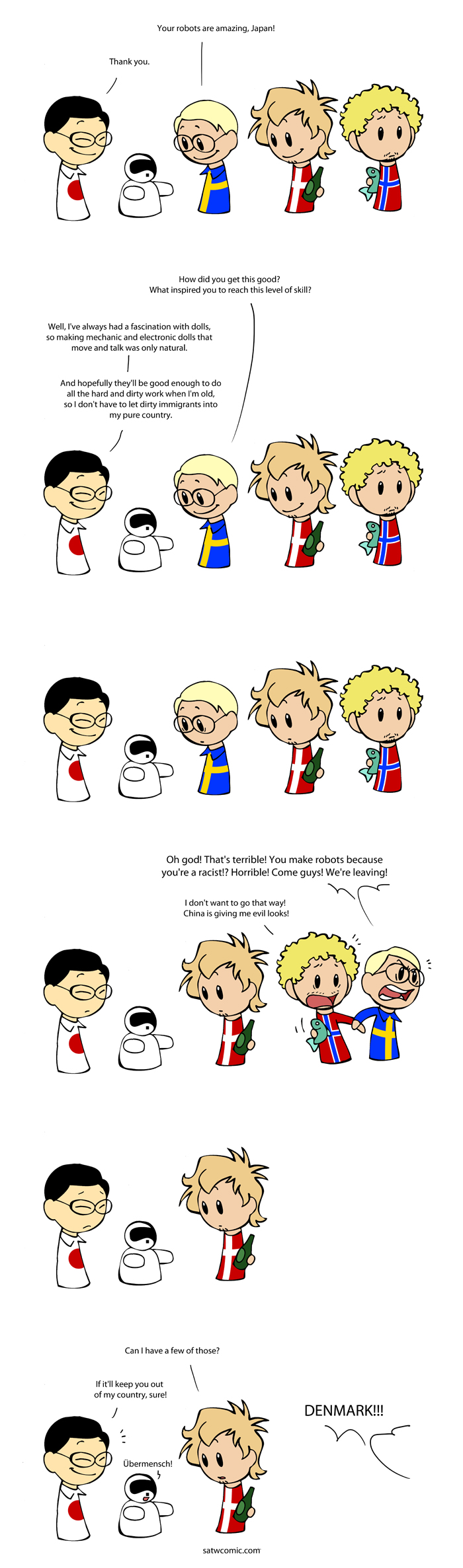
LittleBlue
(10,362 posts)It's going to be a truly awful next 10-20 years for people believe like you do. Weren't you the guy who was gung ho to letting in refugees to Europe before the gang rape scandals? I think you were. Now that you were proven wrong and Europeans are turning against this insanity (the borders are almost closed now after the outcry against your beliefs), why should I take this accusation seriously from you?
Also, that cartoon is really, really ignorant. Japan's economy is in bad shape, nobody is going there, and they don't let in people anyway.
mwrguy
(3,245 posts)Proven wrong? We should push them into the sea instead?
LOL
You can't stop them. Your world is going to be a lot less white in the near future. Try clinging to guns and religion, or voting for Trump. I hear that's cathartic.
LittleBlue
(10,362 posts)Hungary did already. Macedonia did. Britain says they won't take any. They're massing in Greece because they can't shut their borders due to all the islands and shoreline. They're staying in Greece because the Balkans and V4 are saying "no more" and closing their borders. Your ideas are basically deemed suicidal and being abandoned lol.

pampango
(24,692 posts)Europe want nothing to do with refugees. Many countries governed by the far-right in Europe (Hungary, Poland, etc.) are refusing to accept any refugees. Sweden, Germany, the Netherlands and other liberal countries are carrying the load.
Conservatives may be willing to wall off the refugees, maybe even sink their boats as they travel from Turkey to Greece. Liberals realize that refugees are vulnerable people who need protection. Conservatives could care less about vulnerable people.
Baobab
(4,667 posts)L1 workers are not refugees. Refugees have nothing to do with this.
Basically, its trading jobs for markets. Some countries have markets but few jobs, we want access to those markets, also want to begin the race to the bottom which in theory should be able to lower wages to almost nothing eventually, But they mistakenly think we'll have a decade or two of growth elsewhere, so they are trading jobs for national treatment, MFN, etc. .
Both parties leadership are doing it. Liberals except for the armies of fake liberal fake bloggers and the leadership generally don't know. Right wingers seem much more clued in, they know not to hire anybody because they will be able to get three or four workers for what they are paying one person in a few years. So they act accordingly. And pretend to hate Obama,.
pampango
(24,692 posts)My post had nothing to do with L1 workers.
Baobab
(4,667 posts)There are more important things than stupid prejuidices.
Baobab
(4,667 posts)the human race may have greeded itself to extinction.

JustABozoOnThisBus
(24,681 posts)Baobab
(4,667 posts)Once the software is written it can replace a whole job category

Erich Bloodaxe BSN
(14,733 posts)The only real job creator is demand.

chade
(103 posts)However, there are way more compelling things that will hopefully happen soon with more automation. Replacing manual labor is complicated, but more and more physical things are being retrofitted with inputs that will start making their own decisions. The big consumer example of this is the Nest thermostat, which models temperature regulation based on behaviors, but the Internet of Things will also have huge impact on industry. Machines can now be outfitted with more input sources. Computers and their AI can churn through the repetitive data collected by those sensors easily, and quickly pinpoint issues, rather than having someone required to inspect the machine. That's just one example.
A lot of things make me world-weary, so I try to think of the positive things technology can bring. Diagnosing machines means there's less risk of accidents, for example. I hope that more energy is put toward automation and systems that will mitigate risk in dangerous jobs, such as in the mining, chemical, nuclear, or oil industries, as well as in putting automation in place to keep watch over conditions to keep workers safe. That is the kind of stuff that can happen right now or is just out of reach.

valerief
(53,235 posts)
HughBeaumont
(24,461 posts)"Hey, let's move into this awesome future where robots do all the work and humans can be free to live life!!"
Er, how will that be possible when they're kicked out of their homes and starving because they have no ability to purchase big OR small ticket items?
"Don't worry, Guaranteed Minimum Income will take care of THAT problem!!"
Guaranteed minimum income isn't going to save us. That's a fucked pipe dream.
For one, if there's no revenue coming in, it cannot be funded amidst the already enormous bills our MIC and corporations demand from the public largesse.
Secondly, today's conservatives are George Bush on steroids. Toss any microscopic notion you might have about them softening up to the idea that one person (let alone millions) isn't going to be able to exchange work for a paycheck. They're never going to stand for that; you know this as well as I do.
Oh, and if you think the millions upon millions of unemployed in retail, manufacturing, medical, warehouses, industry, automotive, etc, etc, etc doesn't affect YOU, white collar worker, THINK AGAIN.
If no one has a paycheck coming in, guess what: they aren't buying your services or your funds or seeing you for loans/mortgages . . . forget about them buying stocks, doing taxes, forget about the investments in R & D, forget about all of that. You might as well take a goddamned lighter to that MBA or PhD, because it's a-gonna be worthless.
But hey, just ignore me. LAUGH AWAY. "Ha ha ha ha, Luddite! Because America has invented everything they need already, right? HA HA HA HA HA!"
What, you think Joe Sixpack's going to invent his way out of this mess? It doesn't work that way anymore - most invention is performed in corporate laboratories with mean-ass patent attorneys in 2015. You know, unless Joe Sixpack is somehow rich with lots of 3-D printers at his disposal. Oh wait, who's going to buy his product?
Any light bulbs going off in your heads yet?
Laugh gleefully while some of you think that this is the event that's going to finally lead to the Democratic Socialism we all want. Y'all couldn't be more incorrect on this. This is going to lead to a dystopia that will make the Great Depression seem like a two-car accident. It's going to be horrific, there's going to be a shit-ton of pain, there's going to be starvation, there's going to be unneeded deaths and it's going to be biblical.
Bluenorthwest
(45,319 posts)Just a thought.