Biden administration unveils new crypto tax reporting rules
Source: Reuters
Aug 25 (Reuters) - Cryptocurrency brokers, including exchanges and payment processors, would have to report new information on users' sales and exchanges of digital assets to the Internal Revenue Service (IRS) under a proposed U.S. Treasury Department rule published on Friday.
The rule is part of a broader push by Congress and regulatory authorities to crack down on crypto users who may be failing to pay their taxes. A proposed new tax reporting form called Form 1099-DA is meant to help taxpayers determine if they owe taxes, and would help crypto users avoid having to make complicated calculations to determine their gains, the Treasury Department said. It would also subject digital asset brokers to the same information reporting rules as brokers for other financial instruments, such as bonds and stocks, Treasury said.
Under the proposal, the definition of a "broker" would include both centralized and decentralized digital asset trading platforms, crypto payment processors and certain online wallets where users store digital assets. The rule would cover cryptocurrencies, like bitcoin and ether, as well as non-fungible tokens. Brokers would need to send the forms to both the IRS and digital asset holders to assist with their tax preparation.
The new requirements stem from the $1 trillion 2021 Infrastructure Investment and Jobs Act, which included a provision that aimed to increase tax reporting requirements for digital asset brokers. It instructed the IRS to define what firms qualified as crypto brokers and provide forms and instructions for reporting. It also extended reporting requirements for certain cash transactions of more than $10,000 to digital assets.
Read more: https://www.reuters.com/markets/us/biden-administration-unveils-new-crypto-tax-reporting-rules-2023-08-25/
Link to IRS Rule news release - https://www.irs.gov/newsroom/treasury-and-irs-issue-proposed-regulations-on-reporting-by-brokers-for-sales-or-exchanges-of-digital-assets-new-steps-designed-to-end-confusion-help-taxpayers-aid-high-income-compliance-work
Link to Federal Register filing notice page - https://www.federalregister.gov/public-inspection/2023-17565/gross-proceeds-and-basis-reporting-by-brokers-and-determination-of-amount-realized-and-basis-for
 = new reply since forum marked as read
Highlight:
NoneDon't highlight anything
5 newestHighlight 5 most recent replies
= new reply since forum marked as read
Highlight:
NoneDon't highlight anything
5 newestHighlight 5 most recent replies
brooklynite
(96,882 posts)
BumRushDaShow
(172,224 posts)

GregariousGroundhog
(7,593 posts)Centralized brokers would have little difficulty enforcing Know Your Customer and Anti-Money Laundering regulations. The very nature of decentralized brokers makes that much more difficult though. It would be like Craigslist trying to identify everyone who posts "Want to currency swap, meet me at the corner of Main St. and First Ave" and then perform KYC and AML procedures against them.
BumRushDaShow
(172,224 posts)but at least it might be a start to capture those participating in the legit, above-board trading market. The incentive might be that if they do find shenanigans going on (including sting ops), then they have the reporting regs codified to charge them with violating.

ancianita
(43,356 posts)This set of 'rules' sounds like a crypto currency capture mechanism that comes out of dismissing crypto as a viable world currency, just so fiat currency can maintain world reserve status.
How can the Treasury, which has international jurisdiction over preserving a world reserve currency -- along with imposing sanctions on other countries' currency/trade -- have jurisdiction over a non-jurisdictional currency.
The SEC recently lost a case against Ripple (that creates the XRP digital token) over the SEC's claim that XRP was a security. The SEC tried to use the lack of legislative clarity around securities, commodities and asset classes so 3 letter agencies and folks 'in commerce' could profit from insider trading -- a kind of racketeering that can't be called a racket about what a "security," "asset" or "commodity" is. So that people can enrich themselves in the legal cloud where Ripple exists.
The minute the SEC made this partial ruling, JPMorgan Chase rolled out crypto related products to their investors, not through legislative clarity, but through judicial clarity. Banks across the world are hedging their bets that crypto will eventually replace fiat.
I'm new to the issues, but am reading more about why BRICS is challenging the West's US dollar as a world reserve currency. BRICS will offer a 'basket' of commodities (including agricultural, precious metals, gold, energy commodities) that back its currencies. The whole BRICS system will not be a debt based economic system.
This whole setup lacks context that Americans need to learn more about. I'm just recently learning more about BRICS' moves and cryptocurrency issues, so I'm no expert, but am just passing along what I've been learning.
BumRushDaShow
(172,224 posts)so this initial thing isn't necessarily "going after" anyone but actually "defining" who should be covered and for what, in order to begin to implement some additional regulations since that whole sector is still pretty confusing when it comes to how transactions are looked at by the IRS.
Treasury has to have dominion over entities that are U.S.-based that utilize that currency (see FTX and Silvergate) because these types of banks expose traditional-currency banks to certain risks. Those risks effectively hit some of the Regional banks in combo with interest rate hikes, that weakened some of the other Regionals.
One of the "demands" has always been that people pay "their fair share" of taxes and that "we" (editorial "we" ) do more to claw back some revenue by "enforcing" existing laws, and those laws need clear regulations.
IOW, if you need piles of articles like this to tell people "how to do it" -
When you make money on crypto, Uncle Sam's going to want a piece.
By Lyle Daly – Updated Nov 4, 2022 at 2:23PM
It's not the most exciting part of crypto investing, but if you do invest in a digital currency, you need to know how taxes on crypto work. Although cryptocurrencies are still new, the IRS is working hard to enforce crypto tax compliance. There are quite a few ways that you can end up owing taxes on crypto, and even trading one cryptocurrency for another can be a taxable event. You also need to pay taxes if you realize a gain on other digital assets, such as non-fungible tokens (NFTs). If you don't keep accurate records, it can be hard to piece together your gains and losses at tax time. And, if you don't pay your crypto taxes -- even if it's an honest mistake -- you could end up paying costly penalties.
This guide will explain everything you need to know about taxes on crypto trading and income. You'll learn about how to file crypto taxes, crypto tax rates, and other important details about this complex subject.
Do you pay taxes on crypto in the USA?
You're required to pay taxes on crypto. The IRS classifies cryptocurrency as property, and cryptocurrency transactions are taxable by law just like transactions related to any other property. Taxes are due when you sell, trade, or dispose of cryptocurrency in any way and recognize a gain. For example, if you buy $1,000 of crypto and sell it later for $1,500, you would need to report and pay taxes on the profit of $500. If you dispose of cryptocurrency and recognize a loss, you can deduct that on your taxes.
Buying crypto on its own isn't a taxable event. You can buy and hold cryptocurrency without any taxes, even if the value increases. There needs to be a taxable event first, such as selling the cryptocurrency. The IRS has been taking steps to ensure that crypto investors pay their taxes. Tax filers must answer a question on Form 1040 asking if they had any type of transaction related to a digital asset during the year. Crypto exchanges are required to file a 1099-K for clients who have more than 200 transactions and more than $20,000 in trading during the year.
(snip)
https://www.fool.com/investing/stock-market/market-sectors/financials/cryptocurrency-stocks/crypto-taxes/
then the IRS needs to work on ways to clarify and simplify the process!
And I have seen calls to change from (petro) dollars (and consider that a century ago, the Franc used to be "the world currency", during a period when the British Pound ruled the roost).
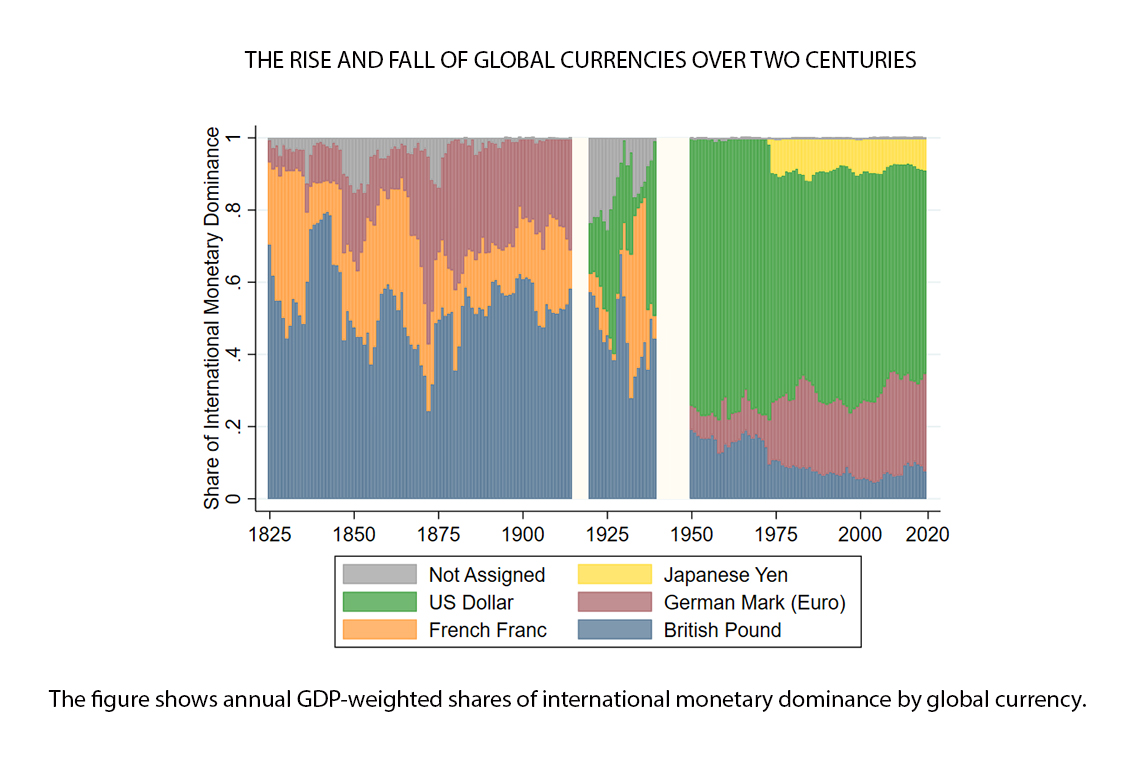
You can see in the above timing that it is obvious what WWII did in terms of "balance of currency power", and post-WWII is when the U.S. achieved that dominance. Even with the implementation of the Euro (not used by all EU countries but most including the one with the largest GDP there - Germany), it is coming in at about #2.
This is a good historical article about currency dominance (above chart from this too)- https://publications.banque-france.fr/en/rise-and-fall-global-currencies-over-two-centuries
ancianita
(43,356 posts)least damaged country after WWII. We then projected our vision across oceans that resulted in the modernizing of other nations through our military-stabilized trade routes and deals.
Now, however, we're moving into a digital future. And along with that, a gray zone of currency use exists. Those who benefit from debt based currency like to claim that we're in the "wild wild West," but that's a ruse.
Because our world reserve currency use has been predicated on getting other countries' wealth in exchange, including "lending' them our currency for whatever benefit we derive.
However, the one big, important difference between current economic systems and the BRICS new currency systems is DEBT. Current world reserve currencies are debt based (with all the "mort" gaged rentier class 'products' that keep humans trapped into the trappings of economics that Americans have had no say in and have had to live with). These guys benefit from debt based economies.
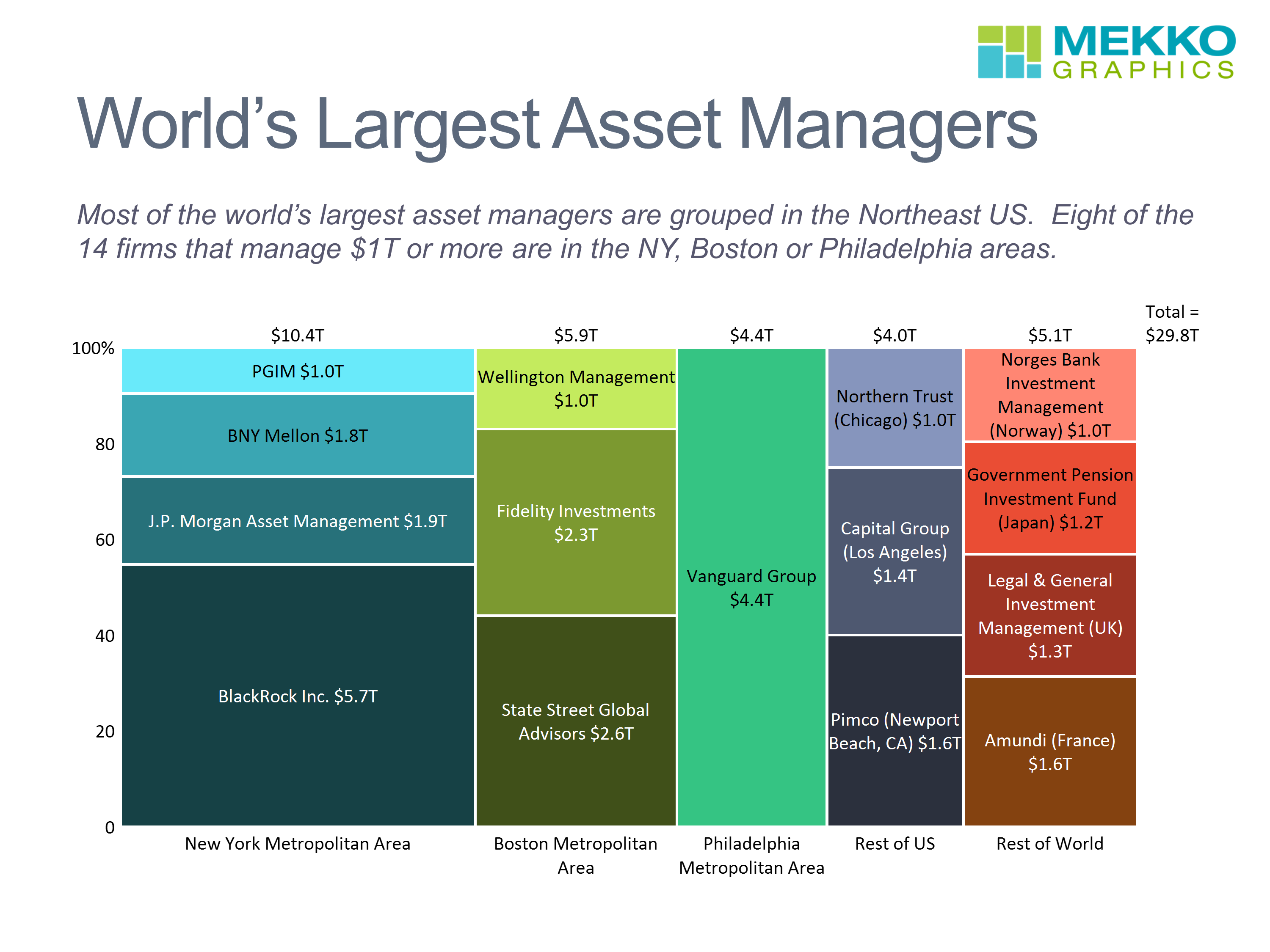
BRICS is none of that. And none of those above have any interest in what BRICS is doing, nor do they want the public to see what BRICS is all about.
Debt based currency allows for all manner of interest hiking (defining of even humans as commodities whose labor is 'bet' on), along with all the 'inflation' and 'deflation' shenanigans that debt bankers and their finance networks engage in. Biden has been more than aware of the 'odious debt' that has saddled other countries. That Biden has aggressively forged ways to forgive college debt points us in a productive economic direction.
What I'm pointing to is a the need for Americans to examine the basis of "national debts," which we have worked to pay off since the founding of the country, when we were sold out to foreign banks that 'lent' us our operating budget -- mostly because we thought we had no choice but to join that world.
Digital currency's increasing strengths lie with the elimination of debt based currency in favor of commodity based currencies.
Our "Treasury" doesn't necessarily have American interests at heart; only those of debt based nations' economies, imo. Congress needs to get out in front of this emerging situation to help define what kind of country we'll become among civilized nations.
BumRushDaShow
(172,224 posts)You gotta look at who is holding our debt first and what is happening with the dollar value compared to other currencies. 
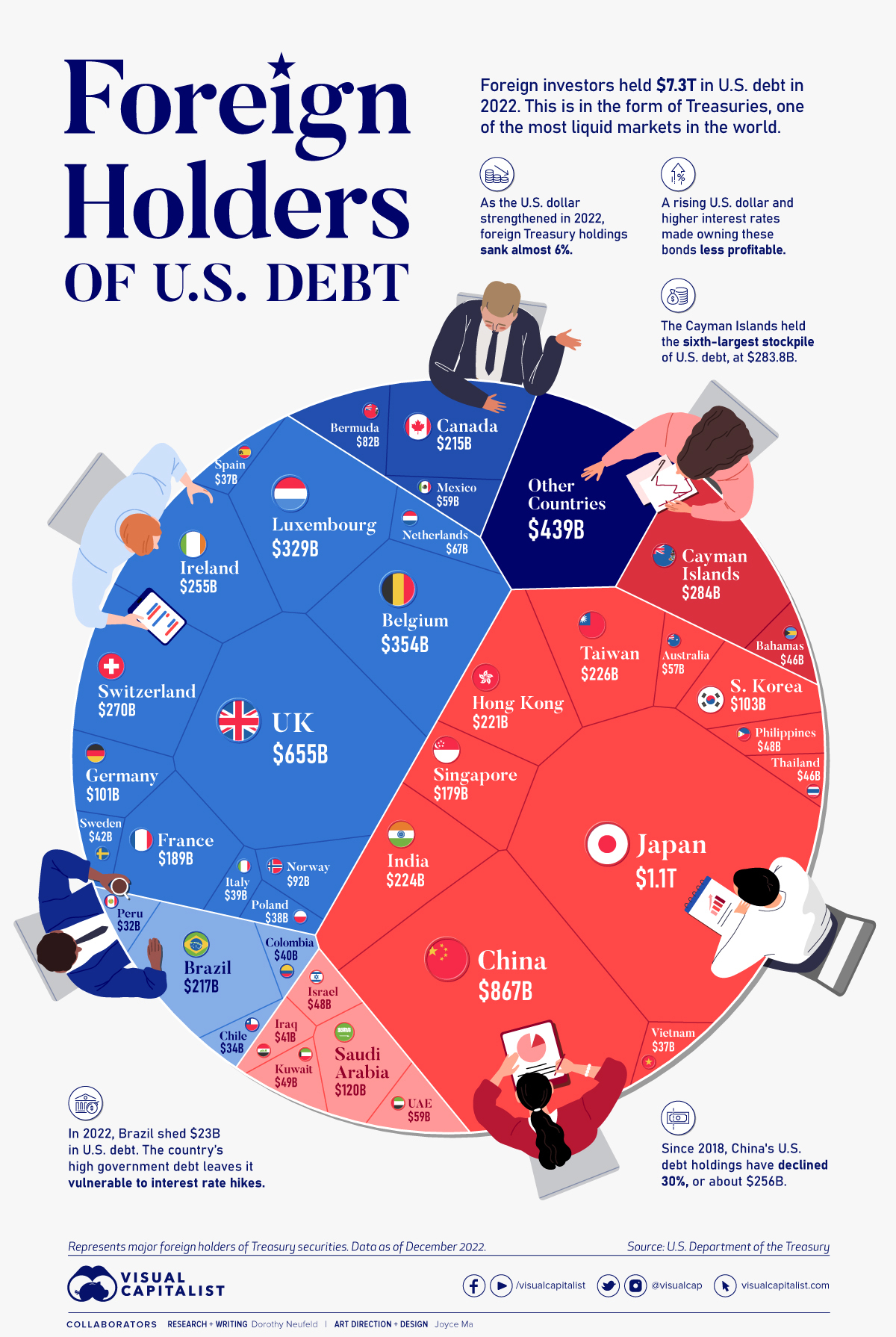
https://www.visualcapitalist.com/which-countries-hold-the-most-us-debt/
One of the problems with looking to "commodities" (at least outside of metals and minerals) is that climate change is making that an almost no-go (particularly any agricultural commodities).
We used to be on the gold standard but the idea of bits and bytes, which is something "non-tangible" as a basis for "value", is going to be a non-starter as well. The IMF has been sounding the alarm about what has happened with crypto and some things that need to be dealt with before going "all in" -
https://www.imf.org/en/Blogs/Articles/2023/07/18/crypto-needs-comprehensive-policies-to-protect-economies-and-investors
https://www.imf.org/en/Blogs/Articles/2023/07/05/crypto-poses-significant-tax-problems-and-they-could-get-worse
Basically an issue is that you'll have the same people who abuse the dollar, abusing any type of currency (including crypto). Sam Bankman-Fried is a case in point.
I do agree that it is probably past time to shift out of the "WWII" legacy world. The G7 AND things like the U.N. Security Council, are long-decayed artifacts of WWII hegemonies. But that will be difficult to achieve when you have a whole continent that has been and continues to be exploited and devastated, and is still being picked apart by other regions like Europe and even by some members of that very same BRICS organization.
It made one wonder whether Nigeria was even invited and how South Africa was even considered representative and I found this - https://www.theafricareport.com/320023/the-brics-expands-and-nigeria-is-not-on-the-list/

Note that Nigeria has the largest population of all the countries on that continent AND has a desired commodity - oil (and sweet oil at that). Yet it was excluded. So BRICS is no different in behavior compared to the G7, other than the name and membership. Everyone has their own "interests".
One of your main arguments is anti-capitalist, which is fine. But one of the best pieces of advice that my mom would always tell us was a truism - that "this is a capitalist country and 'capital' = 'money'. You just have to deal with it" (unless you go for a Russian Revolution/Cuban Revolution-style overthrow of it... although the aftermath entities have been around long enough, and that includes post-Mao China too) to see which way the ultimately shifted (as "human nature" ).
I.e., no matter what "economic system", there will always be a "hierarchy".
republianmushroom
(22,697 posts)
Kick in to the DU tip jar?
This week we're running a special pop-up mini fund drive. From Monday through Friday we're going ad-free for all registered members, and we're asking you to kick in to the DU tip jar to support the site and keep us financially healthy.
As a bonus, making a contribution will allow you to leave kudos for another DU member, and at the end of the week we'll recognize the DUers who you think make this community great.