Observers invited by Venezuela condemn election
Source: BBC
A renowned NGO that was invited by Venezuelan officials to monitor Sunday's presidential poll has said the election "cannot be considered democratic".
The US-based Carter Center deployed 17 experts and observers to Venezuela after being asked to monitor the election by the National Electoral Council (CNE).
On Monday, the CNE - which is dominated by government allies - declared President Nicolás Maduro the winner, but the result has been disputed by the opposition which says voting tallies show its candidate, Edmundo González, has won by a wide margin.
In a statement released on Wednesday, the Carter Center said that it could not "verify or corroborate the results of the election declared by CNE".
The Carter Center also said that the CNE's failure to announce the detailed results by polling station "constitutes a serious breach of electoral principles".
It added that the CNE had "demonstrated a clear bias in favor of the incumbent [President Nicolás Maduro]" and accused the CNE of a "complete lack of transparency in announcing the results".
With its statement, the Carter Center has joined a long list of countries and organizations pressuring the CNE to release detailed voting data at the polling station level, among them the US, Brazil and the EU.
Read more: https://www.bbc.com/news/articles/cxx28wex0w6o
 = new reply since forum marked as read
Highlight:
NoneDon't highlight anything
5 newestHighlight 5 most recent replies
= new reply since forum marked as read
Highlight:
NoneDon't highlight anything
5 newestHighlight 5 most recent replies

hlthe2b
(114,376 posts)
EX500rider
(12,663 posts)Or they will avoid this thread like the plague
yardwork
(69,513 posts)Marcus IM
(3,001 posts)High standards for them, low standard for us.
I wonder if American election totals for every precinct could even be produced in several weeks.
So it makes sense to demand it of others. 
Carter center also said it can't verify US elections due to the wildly varying standards and systems from state to state, even county to county within states. Different tabulation systems. Different voting systems. Etc etc.
There is no way for the US to comply with it's own demands.

Naked, blatant hypocrisy. It's weird.
EX500rider
(12,663 posts)Panamanian President José Raúl Mulino said on social media that Venezuela had denied the plane permission to take off as long as the former leaders were aboard. The Venezuelan government has rejected the allegations.
Among those on the plane were the ex-presidents of Mexico, Panama, Costa Rica and Bolivia
Venezuelan President Nicolás Maduro, who is seeking a third consecutive term, has said he will win "by hook or by crook".
And Colombian officials, Spanish MPs and Chilean senators all reported being denied entry at Caracas Airport.
Spanish People's Party president Alberto Núñez Feijóo said the Venezuelan government "does not want the international community to have eyes and ears in Venezuela this weekend".
https://www.bbc.com/news/articles/cn4v963pzm2o
I guess the darn right wing BBC is in on the plot against Maduro too, right?!
Response to EX500rider (Reply #4)
Post removed
EX500rider
(12,663 posts)Response to EX500rider (Reply #10)
Post removed

Torchlight
(6,981 posts)Happy Hoosier
(9,582 posts)WTF dude? Why are you tankin' for Maduro, an obviously corrupt toerag?

Judi Lynn
(164,156 posts)
GreenWave
(12,725 posts)EX500rider
(12,663 posts)
nvme
(872 posts)?
osteopath6
(195 posts)To see that some supposed liberals have fallen for the old tricks of dictators. They pretend to be on your side so you'll overlook their atrocities, sadly they usually find a sizeable segment of the population more than willing to look the other way when its benefiting them or what they wanted benefited.
No dictators. Period.
Happy Hoosier
(9,582 posts)Plenty still think highly of the Castros and Cuba.
Tankies gonna tank.
yardwork
(69,513 posts)They said:
The Carter Center also said that the CNE's failure to announce the detailed results by polling station "constitutes a serious breach of electoral principles".
In the U.S., we announce detailed results by polling station.
Torchlight
(6,981 posts)and that the electoral system was hacked, "but he didn’t give any specifics or present any evidence."
I'm guessing Mr. maduro studied the same playbook Mr. trump did: yell, assert, blame, and yell some more, but always kick the ball of presenting evidence to support the assertion down the road.
osteopath6
(195 posts)The siren call when people are caught doing or saying something they aren't supposed to do. Of course they weren't "hacked."
"Hackers" focus on maintaining hard won access, not throwing it all away to post a few zingers on social media.
GreenWave
(12,725 posts)
StClone
(11,869 posts)I am not convinced that the portrait of Maduro as Trump is accurate. I see the long history of U.S. intervention in Central, and South American politics—economic distress caused by sanctions on Venezuela.
EX500rider
(12,663 posts)Government seizing of farms/factories and foreign owned oil assets ruined the agricultural economy and their oil economy on top of ridiculous currency controls and wild inflation due to printing money excessively
GreenWave
(12,725 posts)Adecos and Copeyanos notoriously looted their own country. Carlos Andrés Pérez became one of the wealthiest men in the world while President. COPEI fired everyone on a government salary to replace with incompetents,
Perhaps you are paying too much attention to the super-vivísimos who know how to get to people.
EX500rider
(12,663 posts)Doesn't sound like you know your recent history on Venezuela's economy
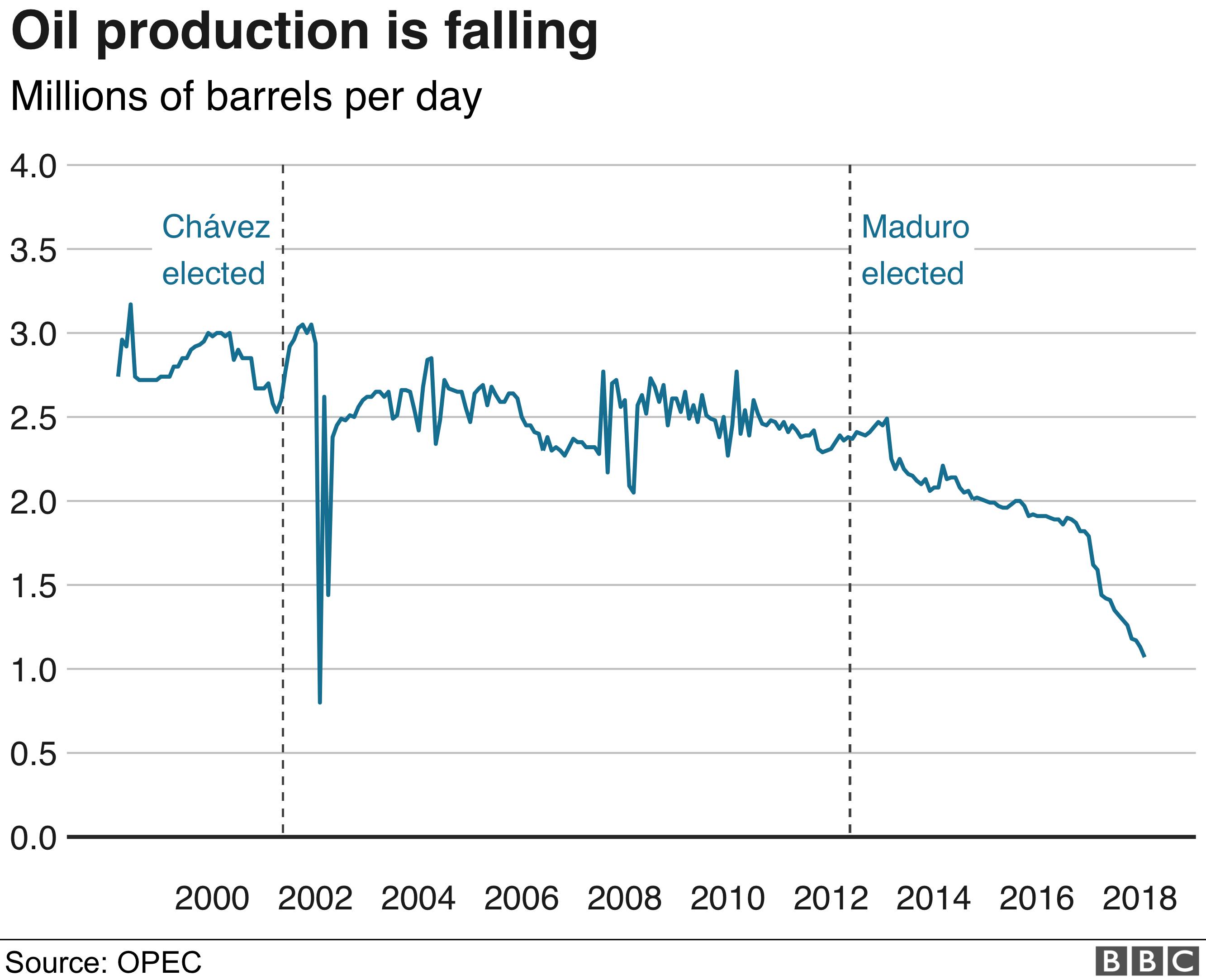
They seized foreign oil facilities without compensation driving off much needed expertise, Chavez fired all the knowledgeable oil employees and staffed it with toadies, since then the oil production has constantly dropped in output, they made a multi-tier currency exchange making dollars almost impossible to get so you can't import anything since no one will take their worthless money, They seized the large farm operations and ran them into the ground, went from a food exporter to a food importer, none of those had anything to do with sanctions which are all fairly recent
EX500rider
(12,663 posts)He was worth over 2 billion at the time of his death and his daughter's worth twice that the richest woman in Venezuela
GreenWave
(12,725 posts)EX500rider
(12,663 posts)The opulent lives of Venezuela’s so-called “daughters of chavismo” continue to be flaunted while the country is crippled by constant power blackouts and hyperinflation.
Among the spoiled socialist elite is Maria Gabriela, the oldest daughter of the late President Hugo Chavez, who he affectionately called “the heroine”, and is said to be Venezuela’s wealthiest woman.
According to a Forbes article in 2015, the leader was worth an “estimated $2 billion ($A2.76bn) at the time of his death [in 2013].
“Today, his daughter Maria Gabriela is the wealthiest woman in Venezuela, worth double that.”
The Chavezes’ love of flaunting their wealth has been copied by the likes of socialist President Nicolas Maduro.
He famously puffed on a cigar while tucking into a large banquet in Istanbul, hosted by celebrity chef Salt Bae, in 2018.
And Maduro’s stepsons, Yoswal and Walter Gavidia Flores spent a whopping $45,000 ($A62,000) on accommodation at the Ritz in Paris — the equivalent of the monthly wages of 2,000 Venezuelans.
The rich kids have also been seen splashing out on jewellery and clothes in Madrid — despite the suffering of people back home.
I know, it wasn't in the Daily Worker or Pravda or DemocracyNow so you won't believe it.
Judi Lynn
(164,156 posts)I saw that years ago, as he was dying and they stayed right with him throughout. Some wingers will stoop to anything.
It was only after he died the oligarchy and its "news" sources (it controlled all of them) started attacking his daughters, then took off with their claims the daughters were stealing Venezuela's money.
Also, while Chavez was still on his death bed, the Venezuelan "news" media started making sure to inform everyone every day that when Maduro was a young man, he drove a bus to make a living. That cracked their nasty pampered asses up, having a chance to look down on someone who had had to work for a living and actually drive a bus.
Sane people would say that's scraping the bottom of the barrel.
The corporate media running the garbage "news" in the US, as in Rupert Murdoch-owned publications once started claiming Fidel Castro was one of the wealthiest men because he owned all of Cuba's money.
A gullible, ignorant, lazy "readership" that doesn't really want to read too much is a gift to greedy predators operating their bogus journalistic imitation news sources. I suspect there are a whole lot of hard drinkers in the readership. There can't be that many idiots.
EX500rider
(12,663 posts)My "source" was Forbes.
I suppose you think she eats beans & rice only and works 12 hours a day on a collective farm?
EX500rider
(12,663 posts)Venezuela's highest-ever oil production occurred in 1998 at 3.5 million barrels per day (BPD). That also happened to be the year that Hugo Chávez was elected president of Venezuela. During the Venezuelan general strike of 2002–2003, Chávez fired 19,000 employees of the state oil company Petróleos de Venezuela, S.A. (PDVSA) and replaced them with employees loyal to his government.
So there are primarily two related causes that have resulted in the steep decline of Venezuela's oil production, despite the sharp increase in the country's proved reserves. The first is the removal of expertise required to develop the country's heavy oil. This started with the firing of PDVSA employees in 2003 and continued with pushing international expertise out of the country in 2007.
https://www.forbes.com/sites/rrapier/2017/05/07/how-venezuela-ruined-its-oil-industry/
GreenWave
(12,725 posts)Unlike some I lived there for an extensive period of time. Unlike many, I speak that language to the extent I was called el reencauchado.
So I witnessed first hand the great sacrifice of workers for an invisible government. We are talking even postal carriers.
Later on after I departed, our news networks talked about the oil workers. They failed to mention a few things.
So many were from Texas and Oklahoma and were treated like babies. Even the urban legend phrase panadería comes from a misunderstanding of the Texas drawl.
To wit to woo:
They got special schools for their kids.
11.5 months pay.
3 months vacation pay (for a few weeks off- to enjoy yourselves)
4 months aguinaldo pay.(to enjoy Holidays)
Production bonus pay
and lots of little tidbits
and upon retirement:
severance pay 1 month x yrs worked
antigüedad pay 1 month x yrs. worked
Above two were doubled if you were a "clave".
So when these poor helpless workers caused trouble, they were not even criollos nor poor.
Or when "cruel" Carlos Andrés Pérez (AD) nationalized the oil companies, how the USA saber rattled back then. The "nationalization" was basically a name change of the company. How cruel.
EX500rider
(12,663 posts)Somehow I doubt a large % of the 19,000 fire oil workers were from the US.
But the fact is they shot their oil production, their main export, in the foot between that and the expropriating of ExxonMobil and ConocoPhillips assets which drove off needed expertise and investment and oil production has still not recovered .
 .webp
.webp
EX500rider
(12,663 posts)And which of the economy ruining practices I noted are you saying didn't happen?
They didn't fire a19,000 experienced oil workers from PDVSA?
They didn't seize foreign oil assets driving off technical expertise and investment?
They didn't make a multi-level currency exchange rate (with good rates for cronies) making dollars for imports hard/impossible to get?
They didn't expropriate large farms and divide them up into small parcels of basically subsistence farmers or poorly run State farms?
They didn't by the above turn Venz from a food exporter to a food importer?
Judi Lynn
(164,156 posts)Venezuela Land Reform Looks to Seize Idle Farmland
By Juan Forero
Jan. 30, 2005
EL CHARCOTE, Venezuela - There may be no more explosive issue in Latin American politics than land reform, or how to address the problem of too much land in the hands of so few people.
. . .
So far, disputes over the distribution of public land have been relatively rare, with farmers making complaints in about 5 percent of the cases that land they held title to was taken away. But violence is not unheard of, and about 80 peasant land invaders have been killed by landowners, most of them during Mr. Chávez's six years in office.
. . .
Mr. Chávez and peasant farmers across Venezuela say such steps are needed because a small minority of landowners control a vast majority of arable lands, leaving most of the peasantry landless and impoverished and Venezuela importing most of its food.
"Any self-respecting revolution cannot permit such a situation," Mr. Chávez said earlier this month as he signed a decree forming a national commission that will evaluate farms' productivity and the legitimacy of their ownership.
Mr. Chávez's government says its priority is not to expropriate, but rather to tax farms into productivity, by levying stiff penalties against land that is not being put to use. The plan gives farmers with idle fields two years to make them productive.
"We are trying to make a country where agriculture was abandoned into one where it is revived," said Marisol Plaza, Venezuela's solicitor general.
The only lands to be seized, the government says, are those that were illegally obtained. Other, unproductive lands will be expropriated with compensation.
https://www.nytimes.com/2005/01/30/world/americas/venezuela-land-reform-looks-to-seize-idle-farmland.html
More:
www.nytimes.com/2005/01/30/world/americas/venezuela-land-reform-looks-to-seize-idle-farmland.html
or:
https://web.archive.org/web/20240725030211/https://www.nytimes.com/2005/01/30/world/americas/venezuela-land-reform-looks-to-seize-idle-farmland.html
~ ~ ~
From the Guardian, during Chavez:
This article is more than 19 years old
Venezuela moves to seize thousands of hectares of 'idle' land from British peer
Associated Press in Caracas
Mon 14 Mar 2005 05.34 EST
The Venezuelan government is to press ahead with plans to expropriate land from a British-owned farm this week, sparking fears of large-scale land grab under the leftist government.
The national lands institute ruled at the weekend that the landowner - Agroflora, an affiliate of the Vestey Group, owned by the tycoon Lord Vestey - did not have a legitimate claim to the land.
. . .
The takeover is part of moves to hand 96,440 hectares (238,620 acres) of Venezuelan land to the poor.
The state will take a large part of Lord Vestey's 13,600-hectare El Charcote cattle ranch in Cojedes state east of Caracas, and most of the 80,000-hectare Pinero Ranch animal reserve, the land agency said. It will also take large chunks of two other ranches. None of the owners could be reached for comment.
National land institute director Eliezer Otaiza told Reuters it would take the land to develop state-sponsored agriculture projects. "The land is going to pass over to us now," he said. "Tomorrow starts the rescue process."
Mr Otaiza said the farms had failed to prove ownership, but had 60 days to appeal to the courts.
The decision follows weeks of land inspections as part of President Hugo Chávez's 2001 land reform law, which allows the state to expropriate farmland if it is "idle", or if rightful ownership is not proved as far back as 1830.
More:
https://www.theguardian.com/world/2005/mar/14/venezuela


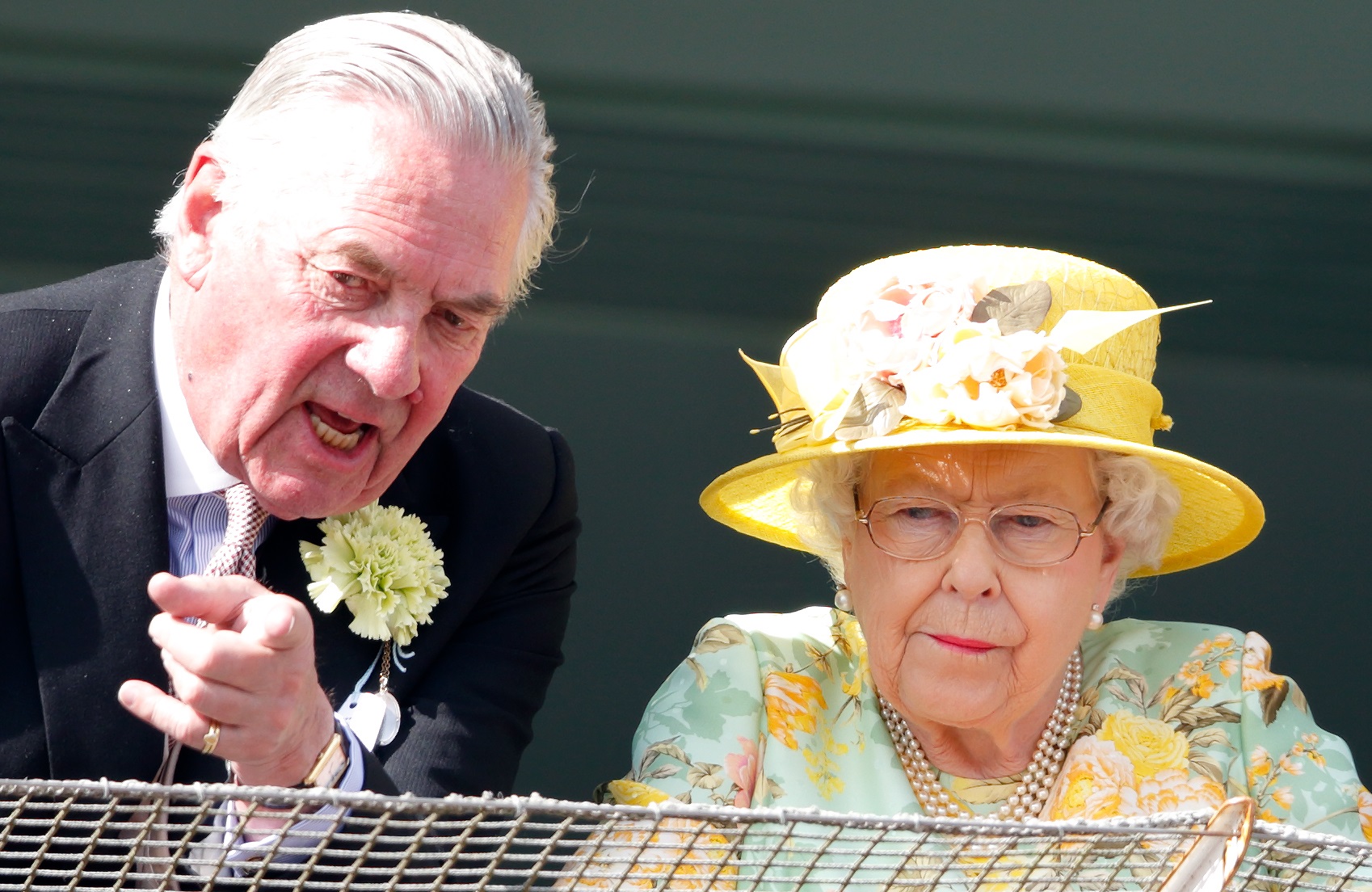

Samuel Vestey, 3rd Baron Vestey, one of England's wealthiest peeps and personal friend of Queen Elizabeth
Also owner of many latifundios (huge estates) in Venezuela
EX500rider
(12,663 posts)The government has confiscated and expropriated much of the industry, state intervention has seriously damaged the agricultural sector, and Venezuela imports most of its food. There are persistent shortages of common foodstuffs.
Due to internal economic and political problems, sugar cane production dropped from 7.3 million tons in 2012 to 3.6 million in 2016. Corn production dropped from 2.3 million tons in 2014 to 1, 2 million in 2017. Rice fell from 1.15 million tons in 2014 to 498 thousand tons in 2016.
https://en.wikipedia.org/wiki/Agriculture_in_Venezuela
Judi Lynn
(164,156 posts)You could use some time boning up on Venezuela's history concerning what happened to Venezuela after oil was discovered and eventually US-based multinationals came streaking down here to take advantage of all the "sweetheart deals" made available to them by the oligarchs (right-wing) of the ruling class which always controlled Venezuela until Hugo Chavez, generally.
The oligarchy threw the country wide open to them, superficially taxed them, allowed them a free hand and didn't ask anything in return but special privileges benefiting bribees who wanted to be supported in style by US mega businesses.
From the beginning of your Wikipedia article:
The massive, suffering illiterate, lower class was invited to #### itself, and to stay out of the way.
EX500rider
(12,663 posts).....which since gone has devastated Venz oil production. Their #1 export.....good job!
.webp
And yes I am well aware who Simón Bolívar is having spent over 5 years in public school in Latin America and how Chavez/Maduro have tried to hitch their horse to his name.
EX500rider
(12,663 posts)Not sure what that has to do with the Carter Center saying the Venz, elections "cannot be considered democratic"
Did you write that or did some AI bot hack your account?
Judi Lynn
(164,156 posts)to do their worst reviling and mocking every progressive Latin American leader they can remember to hate, and to express as much contempt for anti-bully posters as they can muster.
Time to butt out of Latin America, over a hundred years too late, as it is.
Whoever taught the odd ones among us that it's OK to run right over others, anyway? Time to grow the #### up.
Hands off ALL the Americas.
EX500rider
(12,663 posts)Hardly a progressive leader by any metric unless you think political suppression, torture Etc are progressive which case you need to change your dial settings.
Happy Hoosier
(9,582 posts)It is possible to acknowledge US wrong-doing in the past without embracing obviously corrupt authoritarians like Chavez and Maduro.

Hermit-The-Prog
(36,631 posts)osteopath6
(195 posts)His time is running out. Yet another fraudulent election where the will of the people, the vote, is ignored and discarded to fit the whims of dictators. Can't wait until the whole of Chavismo is in the bargain bin of history along with all the other failed dictators.
Judi Lynn
(164,156 posts)Why bother to read or look for information when you can simply buy what the totally anal, aggressive right-wing has used to drive US foreign policy all these looooooong years.
Easy grab from Wikipedia, for anyone who doesn't mind reading, for a change:
United States involvement in regime change in Latin America
In what The New York Times described as "Washington’s most overt attempts in decades to carry out regime change in Latin America", the administration of President Donald Trump made an attempt of regime change in an effort to remove President Nicolás Maduro from office during the Venezuelan presidential crisis.[62][63][64][65][66][67][68][69][70][71][72][73] The Congressional Research Service of the United States Congress wrote: "Although the Trump Administration initially discussed the possibility of using military force in Venezuela, it ultimately sought to compel Maduro to leave office through diplomatic, economic, and legal pressure."[74] According to Marc Becker, a Latin American history professor of Truman State University, the claim of the presidency by Juan Guaidó "was part of a U.S.-backed maximum-pressure campaign for regime change that empowered an extremist faction of the country's opposition while simultaneously destroying the economy with sanctions."[64] Economist Agathe Demarais made similar statements in her book Backfire: How Sanctions Reshape the World Against U.S. Interests, saying that the United States held the belief that regime change was attainable and that sanctions were implemented against Venezuela to hasten the establishment of Guaidó.[65] Jacobin wrote that the corporate-friendly Guaidó movement was meant to take power after a coup supported by the United States removed President Maduro from office.[75] Ahumada Beltrán said that the Trump administration participated in an "open campaign" to overthrow Maduro with a goal to establish American control over oil and to re-establish Venezuela's traditional elite class.[68]
US officials met with members of the National Bolivarian Armed Forces of Venezuela from 2017 to 2018 to discuss coup plans, though discussions ceased after information leaked and some of the plotters were arrested prior to their anticipated actions during the 2018 Venezuelan presidential election.[76] May 2018 presidential elections in Venezuela were boycotted by the opposition and Maduro won amid low turnout; the United States and other nations refused to recognize the elections, saying they were fraudulent.[77] National Security Advisor John Bolton said in a 1 November 2018 speech prior to the 2018 United States elections that the Trump administration would confront a "Troika of tyranny" and remove leftist governments in Cuba, Nicaragua and Venezuela;[78][66] Trump officials spoke to the media about an existing plan to overthrow Maduro, limiting oil exports to Cuba to create economic distress which would prompt its government's removal and then to finally target Nicaragua.[66][79]
In January 2019, Leopoldo López's Popular Will party attained the leadership of the National Assembly of Venezuela according to a rotation agreement made by opposition parties, naming Juan Guaidó as president of the legislative body.[80] Days after Guaidó was sworn in, he and López reached out to the United States Department of State and presented the idea that Guaidó would be named interim president and that the United States could lead other nations to support Guaidó in an effort to remove Maduro; former Director of the Central Intelligence Agency and Secretary of State Mike Pompeo approved of the idea.[81] Though the National Assembly sought to assume executive power from Maduro itself, López and Guaidó continued to work with the State Department without the knowledge of other opposition groups since they believed their objectives would be blocked.[81] State Department official Keith Mines wrote on 20 January that Guaidó declaring himself president "could have the impact of causing the regime to crumble in the face of widespread and overwhelming public support" and on 22 January, Vice President Mike Pence called Guaidó personally and told him that the United States would support his declaration.[81] Neuman wrote that "it's likely that more people in Washington than in Venezuela knew what was going to happen."[81] Guaidó, declared himself the acting President of the country, disputing Maduro's presidency and sparking a presidential crisis. Minutes after the declaration, the United States announced that it recognized Guaidó as president of Venezuela while presidents Iván Duque of Colombia and Jair Bolsonaro of Brazil, beside Canadian Foreign Affairs Minister Chrystia Freeland, made an abrupt announcement at the World Economic Forum that they too recognized Guaidó.[81][82]
Becker said that the United States attempted to remove the Maduro government threatening military action and inflicting desperation on ordinary Venezuelans, planning that distraught citizens or members of the military would remove Maduro in a coup.[64] The United States then increase sanctions on Venezuela[68] and economic conditions drastically deteriorated due to the sanctions.[83] NPR, following a February 2019 statement by President Trump suggesting that members of the Venezuelan armed forces join Guaidó, described such comments as "the latest push for regime change in Venezuela."[84] US Vice President Mike Pence stated in April 2019 that the US was set on Maduro's removal, whether through diplomatic or other means, and that "all options" were on the table.[85] Financial Times wrote following the failed 2019 Venezuelan uprising attempt on 30 April 2019 that regime change in Venezuela was one of Trump's main foreign policy goals and that it was not going as planned.[86] The New York Times wrote following April's failed attempt to remove Maduro that President Trump's aides promoted regime change through social media, with Bolton tweeting hundreds of times about the effort to remove Maduro and going on news networks daily to discuss the situation.[87] Secretary of State Pompeo said that the US would take military action "if required" at the time.[88] In August 2019, President Donald Trump's administration imposed additional sanctions on Venezuela as part of their efforts to remove Maduro from office, ordering a freeze on all Venezuelan government assets in the United States and barring transactions with US citizens and companies.[89][90] In March 2020, the Trump administration deployed naval units in the Caribbean to pressure the Maduro government and later offered a $15 million reward for the capture of Maduro.[68]
More:
United_States_involvement_in_regime_change_in_Latin_America
Judi Lynn
(164,156 posts)BY THE ASSOCIATED PRESS
Published 10:31 AM CDT, January 25, 2019
Venezuelan President Nicolas Maduro accuses the United States of trying to orchestrate a coup against him, and that allegation has resonance among many in a region where Washington has a long history of interventions — military and otherwise.
Ever since President James Monroe announced a sort of protectorate over the hemisphere in the early 19th century known as the Monroe Doctrine, the United States has involved itself in the daily affairs of nations across Latin America, often on behalf of North American commercial interests or to support right-leaning forces against leftist leaders.
That military involvement petered out after the end of the Cold War, although the U.S. has been accused of granting at least tacit backing to coups in Venezuela in 2002 and Honduras in 2009.
The Trump’s administration leading role in recognizing Juan Guaido as the interim president of Venezuela returns the U.S. to a more assertive role in Latin America than it has had for years.
. . .Some of the most notable U.S. interventions in Latin America:
1846: The United States invades Mexico and captures Mexico City in 1847. A peace treaty the following year gives the U.S. more than half of Mexico’s territory — what is now most of the western United States.
More:
https://apnews.com/article/2ded14659982426c9b2552827734be83
Judi Lynn
(164,156 posts)Shauna N. Gillooly and Sofia-Alexa Porres
Oct 12 2023
In 2023 alone, President Biden has met with four Latin American countries led by left-wing governments, including Argentina, Mexico, Bolivia, and Colombia. Considering the historic tendency of the US to support the right in Latin America, what could these meetings signal towards the future of Latin American-US relations? Relationships between the United States and its southern neighbors have been historically marked by U.S. interventionism in the region, particularly during the Cold War. The Cold War (1947-91) was a moment in history that was marked by simultaneous increase in panic over left-wing ideologies like communism and socialism along with new trends toward globalization in the United States. Truman argued that it was no longer safe to simply depend on the security of US territory for national safety, but rather it now depended on stopping the expansion of Soviet totalitarianism and defending those states that could be corrupted. This vision of interventionism led to the Truman Doctrine. As a result, U.S. interference in Latin American countries increased, with the primary aim of combatting the possible involvement with the Soviet Union in the region as well as the spread of leftist ideologies in respective Latin American governments. This US perspective toward Latin America is one that has been slow to change.
During the ‘banana republic’ era, this intervention took on a more capitalistic approach. US interventions sought to replace democratically elected left-wing governments with those that were more sympathetic to U.S. interests, particularly U.S. business interests abroad. In Guatemala, for example, the U.S. government backed a military coup aimed at overthrowing the democratically elected President Jacobo Arbenz. In 1951, Guatemala held their first democratic presidential election in which Colonel Jacobo Arbenz was elected. However, some of Arbenz’s policies directly threatened U.S. business interests and profit in the country. The Arbenz Administration had introduced Decree 900, which outlined a progressive stance on wages and land reform, which threatened the profit structure of the United Fruit Company, a privately-owned, U.S.-based company. The U.S., seeing this as a threat, involved the CIA in a covert operation during which they armed, trained, and funded the Guatemalan military. The military then overthrew the Arbenz administration. Following the coup, Guatemala remained under a military dictatorship for multiple decades, during which time resulted in the genocide of Indigenous Mayan people in Guatemala in the 1980s. The search for the disappeared is still ongoing in Guatemala today.
Following U.S. intervention in Guatemala, the National Security Council wrote a report in which they outlined the objectives and focus of U.S. policy toward Latin America. In particular, they outline the important role that Latin American had in the Communist expansion era. It reads: “A defection by any significant number of Latin American countries over their governments, would seriously impair the ability of the United States to exercise effective leadership of the Free World […] and constitute a blow to U.S. prestige.” The National Security Council explicitly outlined the need for respect, partnership, and cordiality with other countries in the Americas. However, the report includes a clause which states that they shall recognize Latin American governments “unless a substantial question should arise with respect to Communist control.” This report and subjective quote created leeway and a policy justification for the U.S. to continue to implement policies of interventionism in their ‘own backyard.’
From here on, the U.S. continued to intervene in various Latin American countries and contexts. In Colombia, the U.S. assisted the Colombian government with the threat that leftist guerrilla groups like the Revolutionary Armed Forces of Colombia (FARC) posed through Plan Colombia and Plan Patriota. In Argentina, they turned a blind eye to the “Dirty War” that happened in the late 1970’s through the early 1980’s. In Bolivia, various U.S. administrations participated in covert operations throughout the 1960’s. In Chile, they used covert actions to fund electoral candidates, “run anti-Allende propaganda campaigns and had discussed the merits of supporting a military coup,” in the 1960’s and 70’s. We can look to Cuba, where the U.S. participated in both covert and overt operations in the 1960’s and 1970’s. Last but not least in El Salvador, the U.S. funded and trained paramilitary groups that caused unrest and violence in the 1960’s. Most countries in the region had their trajectories of governance altered by U.S. intervention, which continues to have implications for today’s foreign policy discourses and decisions.
With this troubled context of U.S. interventionism in mind, we asked U.S. policymakers how they felt about the progressive wave of administrations recently elected in Latin America. Based on our results, it seems that bureaucrats and technocrats within the U.S. government are no longer particularly concerned over a perceived “leftist threat” in the region. However, that change in attitude is not necessarily shared by many officials in Congress.
More:
https://www.e-ir.info/2023/10/12/a-tale-of-two-attitudes-toward-leftist-governments-in-latin-america/
Judi Lynn
(164,156 posts)Since at least the Spanish-American War, the United States has helped develop Latin American militaries and police forces, providing training, up-to-date technologies, and technical assistance. While we might conventionally consider questions about security and questions of political economy as separate spheres of analysis, a close look at how economic shifts affect security concerns, and how security assistance shapes political and economic transformations, indicates the persistence of a strong relationship between security objectives and political economy. Outlining these links reveals trends of change within continuity. Even as Washington’s effort to endow Latin American states with powerful security apparatuses has reconfigured the possibilities for US capital to reap easy rewards from its alliances with elites in Latin American and the Caribbean, the purposes and forms of US security assistance have both shifted and remained, in important ways, unchanged.
In fact, an examination of the historical record demonstrates that the security assistance of each period helped to create the security challenges of the next one, which new rounds of assistance would in turn confront. In the current period, reverberations are being felt throughout the hemisphere—including here in the United States—because of the “War on Drugs,” fought from the Andean highlands to the US-Mexico border and beyond. But what I call, drawing on Greg Grandin, the “long counterrevolution” started in the nineteenth century, as the United States increasingly exerted its influence throughout the Americas.1
Gunboat diplomacy and occupation as security cooperation
As the Spanish Empire collapsed at the turn of the twentieth century, the United States saw an opportunity for regional self-aggrandizement at a key moment of global uncertainty. The Spanish Empire’s decline had already been occurring for over a century when the United States occupied Cuba and Puerto Rico in 1898, but recent economic crises provided new opportunities.2 Thanks to the Monroe Doctrine, the independent republics across Latin America maintained strong, if not always willing, ties to the United States. Economic upheavals in the region from the 1870s through the 1890s created a new purpose for the United States, which was to bend local economies to the desires of US elites. Theodore Roosevelt’s 1904 Corollary to the Monroe Doctrine further entrenched this orientation, by commanding the United States to exercise “international police power” to maintain political and economic stability.
Direct invasion or overt occupation was the occasional form of US intervention in Latin America (17 in the century after 1898), and the construction of security forces afterward, with or without occupation, ensured Roosevelt’s corollary would remain in effect.3 These early US occupations saw the creation of new security forces—for example, the US Marines’ assistance to Nicaragua’s Guardia Nacional—designed to foster the most basic forms of economic development while also repressing revolutionary movements that might rebel against the prevailing socioeconomic order.
More:
https://items.ssrc.org/from-our-fellows/the-long-counterrevolution-united-states-latin-america-security-cooperation/
EX500rider
(12,663 posts)Judi Lynn
(164,156 posts)That's doubtful.
The CEO of the Carter Center worked for years with the U.S.A.I.D., which is viewed with varied levels of concern, and has been, for years. Her Name is Paige Alexander:
PAIGE ALEXANDER
Paige Alexander joined The Carter Center as chief executive officer in June 2020. Ms. Alexander has had a distinguished global development career, with over two decades of experience spanning the government and nonprofit sectors. She has held senior leadership positions at two regional bureaus of the United States Agency for International Development (USAID). Between 1993 and 2001, Ms. Alexander held several roles in USAID’s Bureau for Europe and the Newly Independent States Task Force, including deputy assistant administrator, chief of staff, director for the Democracy and Governance Office, deputy director of the Bosnia Task Force, and country desk officer.
After leaving for 10 years to work in a leadership role in the nonprofit sector, Ms. Alexander returned to USAID in 2011 in the Senate-confirmed position of assistant administrator for Europe and Eurasia; in 2015, she was again confirmed to lead the Middle East and North Africa (MENA) Bureau, overseeing 1,000 employees, programs in 12 countries, and more than $1.4 billion in annual funding. From 2017 until her appointment to The Carter Center, she served as executive director of the European Cooperative for Rural Development (EUCORD) in Brussels and Amsterdam, working to bring market-led solutions to marginalized farmers in Africa to sustainably improve the livelihoods of families and communities. Ms. Alexander serves on the boards of the Romanian-American Foundation, Free Russia Foundation, the World Affairs Council of Atlanta, the ADL Southeast Region, and as a member of several human rights organizations. Follow Alexander on X at @P_AlexanderCEO.
https://www.fp4america.org/paige-alexander/
~ ~ ~
USAID skills:
US secretly created 'Cuban Twitter' to stir unrest and undermine government
USAid started ZunZuneo, a social network built on texts, in hope it could be used to organize 'smart mobs' to trigger Cuban spring
Associated Press in Washington
Thu 3 Apr 2014 08.34 EDT
In July 2010, Joe McSpedon, a US government official, flew to Barcelona to put the final touches on a secret plan to build a social media project aimed at undermining Cuba's communist government.
McSpedon and his team of high-tech contractors had come in from Costa Rica and Nicaragua, Washington and Denver. Their mission: to launch a messaging network that could reach hundreds of thousands of Cubans. To hide the network from the Cuban government, they would set up a byzantine system of front companies using a Cayman Islands bank account, and recruit unsuspecting executives who would not be told of the company's ties to the US government.
McSpedon didn't work for the CIA. This was a program paid for and run by the US Agency for International Development, best known for overseeing billions of dollars in US humanitarian aid.
According to documents obtained by the Associated Press and multiple interviews with people involved in the project, the plan was to develop a bare-bones "Cuban Twitter," using cellphone text messaging to evade Cuba's strict control of information and its stranglehold restrictions over the internet. In a play on Twitter, it was called ZunZuneo — slang for a Cuban hummingbird's tweet.
Documents show the US government planned to build a subscriber base through "non-controversial content": news messages on soccer, music, and hurricane updates. Later when the network reached a critical mass of subscribers, perhaps hundreds of thousands, operators would introduce political content aimed at inspiring Cubans to organize "smart mobs" — mass gatherings called at a moment's notice that might trigger a Cuban spring, or, as one USAid document put it, "renegotiate the balance of power between the state and society."
More:
https://www.theguardian.com/world/2014/apr/03/us-cuban-twitter-zunzuneo-stir-unrest
By the way, former President Jimmy Carter's diplomat in Havana, Wayne S. Smith, the man he appointed as the head of the United States Interests Section always, until his death a couple of weeks ago, believed the US should drop the embargo and establish decent relations with Cuba:
JULY 15, 2024
Wayne Smith Devoted His Career to Dialogue and Diplomacy
The former Foreign Service officer liked to say "Cuba seems to have the same effect on American administrations as the full moon has on werewolves.”
PETER KORNBLUH and WILLIAM M. LEOGRANDE
SHARE
“Cuba,” as former Foreign Service officer Wayne S. Smith was fond of observing, “seems to have the same effect on American administrations as the full moon has on werewolves.” Smith devoted his career—in and out of government—to advancing the cause of dialogue, diplomacy, and normal relations between Washington and Havana. He lived to see his tireless efforts come to fruition when President Barack Obama began normalizing relations in 2014, only to have President Donald Trump reverse course, returning to the failed policy of hostility and regime change.
At the time of Smith’s death at age 91 on June 28, 2024, the cause he championed— rapprochement between Washington and Havana—remains as critical, and as elusive, as ever.
As a young diplomat, Wayne Smith was posted to Havana just months before the triumph of Fidel Castro’s revolution in 1959. When the Eisenhower administration broke relations in January 1961, he was one of the last US officials to leave, carrying with him the American flag that had flown over the Embassy. Eighteen years later, he returned as “principal officer” of the reopened US “Interests Section”—part of the Carter administration’s incremental and halting efforts to improve relations.
Options memo on normalizing relations, part of Smith’s early efforts to get the embargo lifted.
In a comprehensive, and witty, options memorandum, “Possible Steps to Improve Relations with Cuba,” he recommended a wide range of economic, cultural, military, and diplomatic steps to move US policy toward normal relations. He proposed lifting the embargo on food and medicine, calling it “unconscionable.” He advocated opening the door to selected Cuban exports, including Cuba’s renowned tobacco products (of which Smith was a connoisseur). He suggested an exhibition baseball game in Havana. Given Cubans’ fanatical love of the sport, he argued, baseball diplomacy would “emphasize the affinities between our two countries.” The Soviet Union, he noted, “does not play baseball.”
Smith was also one of the first officials to identify advantages for US security interests in counternarcotics collaboration with Cuba. “This strikes me as an initiative to which only the Mafia could object strongly,” he wrote.
More:
https://www.thenation.com/article/world/cuba-diplomacy-tensions-peace-latin-america/
Judi Lynn
(164,156 posts)President Carter's Cuba Trip Report
May 20, 2002
By Jimmy Carter
Thanks to the generosity of J.B. Fuqua and the Ford Foundation, Rosalynn, John Hardman, Jennifer McCoy, Bob Pastor, and Chip and Becky Carter were able to fly to Cuba.
Having received several verbal invitations from President Fidel Castro to visit Cuba, I accepted an official one in January, and we made arrangements for the trip through the Cuban Interest Section in Washington. Our key request was for me to speak directly to the Cuban people, preferably in the evening and with live television coverage, and this was granted.
Prior to the trip, we had a number of briefings from interested groups, including the conservative Cuban American National Foundation, moderate and relatively unbiased experts, international agencies, and the U.S. State Department and intelligence agencies. One key question that we asked American officials was if there was any indication that Cuba had been involved with any foreign government in promoting terrorist activities, directly or indirectly. We were assured that no such evidence existed.
Our goals were to establish a dialog with Castro, to reach out to the Cuban people, and to pursue ways to improve U.S.-Cuban relations. I wanted to explore with the president and other Cuban leaders any indication of flexibility in economic or political policy that might help to ease tensions between our two countries. For instance, having been quite familiar with Deng Xiaoping's transformation of China's economy by gradually permitting small family businesses to expand, I thought this might be one possibility. Also, foreign investors would be more inclined toward Cuba if they could hire and pay their own employees directly instead of through state agencies.
The Varela Project was a subject of great publicity, and a petition from more than 11,000 citizens was presented to the National Assembly a few days before our arrival. As apparently permitted under Cuba's constitution, the petition called for a referendum on: a) freedom of ex-pression and association; b) amnesty for political prisoners not accused of attempted murder; c) rights of private enterprise; d) direct election of public officials; and e) elections to be held within one year. In my speech to the nation, I called for some of these rights, for the establishment of a blue-ribbon commission to resolve property claims, an extensive exchange of university students, and for the utilization of responsible Cuban Americans as a possible bridge between Cuba and the United States.
We were received at the Havana airport by the president with full honors and a warm welcoming address. We considered it significant that he wore a business suit rather than his normal military uniform, and this was his custom throughout our visit until he said goodbye at the airport the day we left. I responded in Spanish, giving the time and place of my major speech and expressing hope that it could be broadcast both through television and radio. I wanted to be sure that there would be some public awareness of the university address. Subsequently it was advertised in advance in the government newspaper Granma.
During our ride in to the hotel, President Castro and I had a friendly chat about growing peanuts, the total freedom we would have while in Cuba, and his hope that I would attend the All-Star baseball game and perhaps throw out the first ball. He was thoroughly familiar with our plans for the visit, and assured me that there would be no restraints, that all my activities and statements would be covered by the large media contingent, and that my Tuesday speech would be on TV and radio and rebroadcast at later times.
More:
https://www.cartercenter.org/news/documents/doc528.html
~ ~ ~
Report by Jimmy Carter on his and Rosalind's second trip to Cuba, to meet Raul Castro, in 2011:
https://www.cartercenter.org/news/trip_reports/cuba-march2011.html
EX500rider
(12,663 posts)Last edited Fri Aug 2, 2024, 10:24 AM - Edit history (1)
USAID is the principal U.S. agency to extend assistance to countries recovering from disaster, trying to escape poverty, and engaging in democratic reforms.
The horror!
And giving the repressed Cuban people a way to speak freely among each other, how dare they!
Judi Lynn
(164,156 posts)It used to be generally frowned upon to openly call for military coups and U.S. intervention in Latin America. Not anymore. At least not when it comes to Venezuela, a country where—according to the prevailing narrative—a brutal dictator is starving the population and quashing all opposition.
Last August, President Trump casually mentioned a “military option” for Venezuela from his golf course in New Jersey, provoking an uproar in Latin America but barely a peep in Washington. Similarly, Rex Tillerson, then-Secretary of State, spoke favorably about a possible military ouster of Venezuelan president Nicolás Maduro.
In recent months, opinion pieces suggesting that a coup or a foreign military intervention in Venezuela might be a good thing have dotted the U.S. media landscape: from the Washington Post to Project Syndicate to The New York Times. Occasionally a pundit argues that a coup d’état could have undesirable consequences, for instance if a hypothetical coup regime should decide to deepen relations with Russia or China.
Rarely does anyone point out that this is an insane debate to be having in the first place, particularly regarding a country where elections occur frequently and are, with few exceptions, considered to be competitive and transparent. On Sunday, May 20th, Maduro will be up for reelection. Polls suggest that, if turnout is high, he could be voted out of office.
The fact that coups, not elections, are the hot topic is a sad reflection of the warped direction that the mainstream discussion on Venezuela has taken. For many years now, much of the analysis and reporting on the oil-rich but economically-floundering nation have offered a black-and-white, sensationalized depiction of a complex and nuanced internal situation. In addition, there has been little serious discussion of the Trump administration’s policies toward Venezuela even as they wreak further damage to the country’s economy, worsen shortages of life-saving medicines and food, and undermine peace and democracy.
More:
https://nacla.org/news/2018/05/18/united-states%E2%80%99-hand-undermining-democracy-venezuela

Jose Garcia
(3,531 posts)Judi Lynn
(164,156 posts)DECEMBER 3, 2021
RICARDO VAZ
Corporate media’s coverage of Venezuela has been constantly biased over the past 20 years, but especially when reporting on elections (FAIR.org, 11/27/08, 5/23/18, 1/27/21).
Corporate media’s coverage of Venezuela has been constantly biased over the past 20 years, but especially when reporting on elections (FAIR.org, 11/27/08, 5/23/18, 1/27/21).
The latest flurry of dishonesty and faithful stenography came as Venezuelans voted for new regional and local authorities on November 21. The ruling United Socialist Party of Venezuela (PSUV) won resoundingly, securing 19 of 23 governorships and 212 of 335 mayoralties. Pundits who are happy to equate “democracy” with elections are not so keen on people voting when Washington’s enemies are poised to win (Washington Post, 11/22/21).
The hardline Venezuelan opposition made life easy for the media establishment in recent years by boycotting elections altogether. Outlets could then just echo the ever baseless “fraud” allegations from US officials and move on (NPR, 5/21/18; BBC, 5/21/18; Reuters, 5/20/18; Bloomberg, 5/7/18; New York Times, 5/17/18).
However, this time around, these right-wing actors returned to the ballot. Corporate journalists, having paid little attention to Venezuela in recent months as US-backed regime change efforts floundered, had to scramble to explain and discredit the events. Unable to reheat the “fraudulent” label, there was a return of classics such as “rigged” (CNN, 11/24/21) or “flawed” (New York Times, 11/23/21), which happened to be the State Department’s choice too.
‘Flawed’ reporting
There was already a sense that the US-favored parties would not do so well on their return to the electoral path. Reports talked of a “skeptical” opposition (Al Jazeera, 11/19/21; AFP, 11/19/21) to dampen expectations, after building the myth that anti-government parties had overwhelming support in the country.
More:
https://fair.org/home/western-media-venezuelan-elections-must-be-undemocratic-because-chavismo-won/
EX500rider
(12,663 posts)...and the OAS and the leaders of most Latin American countries +the EU?
According to El Espectador, the fact that the CNE's official vote counts of 29 July[14] correspond to percentages that have zeros in the second to fifth decimal places is a coincidence indicating fraud. Kiki Llaneras, writing in El País, estimated the chance of the coincidence as one in 100 million.[15] Infobae also saw the percentages as having values that were unlikely to occur by chance, which it said raised the suspicion of the CNE statement of the results.[16] Anne Applebaum wrote in The Atlantic on 31 July that "the election had been stolen".[316]
Opposition leaders, world leaders and observers have forcefully urged Maduro to make the vote tallies at the table level public. Rather than having the election authority (CNE) release the table-level results (as the opposition has), Maduro approached the Supreme Tribunal of Justice (TSJ – overwhelmingly government loyalists) on 1 August, and according to the BBC, "took the unusual step" of asking the court to audit and approve the results; this process is "likely to be conducted behind closed doors" where only the TSJ members will see them. The Carter Center, anticipating this move, stated that "the TSJ is another government institution, appointed by the government ... not an independent assessment".[143] This move always delays the process while giving the appearance of compliance
Condemnation from some countries, including Costa Rica, El Salvador, Peru and Uruguay described the CNE result in terms of fraud or corruption
The three leftist presidents of Brazil, Colombia and Mexico[316][331][332] were quick in demanding that all votes be counted, along with full transparency of all ballot records from each precinct
Here's the fine people who believed the results:
The Washington Post reported that "Russia, China, Iran and Cuba were among those to congratulate Maduro"
https://en.wikipedia.org/wiki/2024_Venezuelan_presidential_election#International
EX500rider
(12,663 posts)There were the huge queues at polling stations, but only tiny amounts of people being let in at one time.
This led to accusations of deliberate delays, perhaps in the hope some people would give up and go home.
When our BBC team arrived at one polling station, the organizer of the station took a call saying the international media were there. 150 people were then suddenly allowed to be admitted.
There were some poll stations that didn’t open at all, leading to protests and clashes with the authorities.
There were allegations that some of those who work for the state, including police students, were told how to vote.
There was the fact President Maduro’s face remained emblazoned above some poll stations even on voting day.
His face lines almost every street in Caracas, with his governing party paying for incentives for people to support him - buses put on for people to attend his rallies, and free food parcels handed out.
Even prior to allegations of explicit fraud the question was asked: Is this contest fair?
Opposition candidates were banned from running, opposition aides detained, many Venezuelans overseas struggled to register to vote and many international election observers were disinvited.
https://www.bbc.com/news/articles/c1dmv9jlvj1o
EX500rider
(12,663 posts)Last edited Fri Aug 2, 2024, 07:17 PM - Edit history (1)
Sure, nothing says fair elections like blocking foreign dignitary observers from landing:
Panama has accused the Venezuelan government of blocking a flight carrying former Latin American leaders who were due to observe presidential elections on Sunday.
Panamanian President José Raúl Mulino said on social media that Venezuela had denied the plane permission to take off as long as the former leaders were aboard. The Venezuelan government has rejected the allegations.
Among those on the plane were the ex-presidents of Mexico, Panama, Costa Rica and Bolivia
Venezuelan President Nicolás Maduro, who is seeking a third consecutive term, has said he will win "by hook or by crook".
And Colombian officials, Spanish MPs and Chilean senators all reported being denied entry at Caracas Airport.
Spanish People's Party president Alberto Núñez Feijóo said the Venezuelan government "does not want the international community to have eyes and ears in Venezuela this weekend".
https://www.bbc.com/news/articles/cn4v963pzm2o