Earliest known evidence of human fire-making dating back 400,000 years is discovered in the UK
Source: Independent
Groundbreaking research has revealed the earliest known evidence of human fire-making in the UK, dating back over 400,000 years.
This discovery, at a disused clay pit near Barnham, Suffolk, pushes the timeline back 350,000 years from the previous record of 50,000 years ago in northern France.
The Barnham site, between Thetford and Bury St Edmunds, yielded fire-cracked flint hand axes and heated sediments.
Crucially, two fragments of iron pyrite – a spark-striking mineral – were also found.
-snip-
Read more: https://www.independent.co.uk/news/science/human-fire-making-earliest-evidence-suffolk-b2881949.html
 = new reply since forum marked as read
Highlight:
NoneDon't highlight anything
5 newestHighlight 5 most recent replies
= new reply since forum marked as read
Highlight:
NoneDon't highlight anything
5 newestHighlight 5 most recent replies

RedWhiteBlueIsRacist
(2,368 posts)
wolfie001
(8,103 posts)Potatoes are Post-Colombian. 

RedWhiteBlueIsRacist
(2,368 posts)I've studied North American Indians (sic) for many decades, as well as the European invasion. That's why I haven't celebrated Thanksgiving in over 30 years. Oh, studied World religions even longer, that's why I'm not religious, so no Christmas for me!
wolfie001
(8,103 posts)I'm such a "quick learner"  Cheers
ps- Have you heard the Yale Courses and Dr. Freeman's Middle Ages/Post Rome lectures on YT? I put them on when I get on my bike. He's so great. 
RedWhiteBlueIsRacist
(2,368 posts)
eppur_se_muova
(42,752 posts)What Americans call "corn" is called "maize" or "Indian corn" in Europe, although the "Indian corn" thing is a tad archaic. It was a new grain from "the Indes", so they called it "Indian corn".
(Not to be confused with Korn from the Indies)

dedl67
(269 posts)The book "Vestal Fire" by Stephen Pyne is a fascinating account of humans' use of fire, and defense against fire, through European history. Nearly every aspect of our lives is connected in some way with fire and Pyne covers everything. So this discovery is very important in understanding the evolution of the genus Homo.

roscoeroscoe
(1,830 posts)It's freaking cold in the UK!

twodogsbarking
(19,575 posts)
JustABozoOnThisBus
(24,753 posts)Smart, warm, well-fed Neanderthals.
highplainsdem
(63,435 posts)erronis
(24,719 posts)LudwigPastorius
(15,157 posts)...and became Millwall F.C. fans.
wolfie001
(8,103 posts)I mean, what a "4head"
cstanleytech
(28,648 posts)
Warpy
(114,743 posts)who is iin Africa looking for the same things, concentrating on places where natural fire was least likely to occur. She's trying to push it back millionds of years, all the way back to Australopithecus. I don't know if she'll find traces from that deep in time, but I think it highly likely that A. Afarensis most likely used harvested fire and knew how to keep it going, at the very least.
I'mnot a bit surprised they found this in the UK, there have been several waves of hominid occupation between severe climate shifts that buried the islands in ice. H. Heidelbergensis and the later Neanderthals were well known to use fire and to cook their food.
Love these deep time discoveries.

Martin68
(28,149 posts)current scientific consensus. We also reached the New World far earlier than the 10,000 to 20,00 year timeline that is currently accepted, by a variety of different routes and transportation means.
wolfie001
(8,103 posts)He's a clown and a fraud. 
Martin68
(28,149 posts)wolfie001
(8,103 posts)I was kinda expecting a short jab on the chin. Cheers! 
eppur_se_muova
(42,752 posts)Pyrite is well known as "fool's gold" because the brassy-gold, shiny color of unweathered pyrite has fooled many people into imagining a "rich strike" that wasn't. Under optimum conditions it forms large, well-formed crystals which are popular with collectors, and found in any rock shop or rock/mineral/gem collectors' convention. In all my years of being an amateur rock collector starting in grade school, I never heard (or more oddly, never read) of pyrite's spark-making ability. It's not even mentioned in the Boy Scout Manual, or in anything I've ever read on camping ! It seems to have once been common knowledge, but once iron and/or steel became commonly available, pyrite fell into disuse and its abilities were largely forgotten, at least in common discourse. We even overlook the name "pyrite" being derived from Greek "πῦρ", or fire, which gives us all those words starting with 'pyro-' having to do with fire or heat -- as well as "pyre", the poet's favorite synonym for fire !

Pyrite has been made into jewelry since prehistoric times (still is), and flint (and its somewhat softer relative, chert) have been used since prehistoric times to make sharp tools and weapons. So it was probably pretty early in human existence, once humans began using and making tools and collecting shiny baubles, that someone -- maybe the very earliest of "someones" -- happened to strike flint and pyrite together and observed a hot spark*. All this has led me to realize that humans quite likely learned to make their own fire a very long time ago, and did not spend eons relying on "found fire" from lightning strikes and other natural sources of ignition, as has often been assumed. So the recent discovery has me thinking, to some extent, "of course", and wondering how many early human fire-starting nodules of pyrite have been overlooked due to weathering to rusty brown rocks or even breaking up altogether.
Weathered pyrite can be transformed completely into dark brown or reddish-brown iron oxide/hydroxide minerals, which are much less eye-catching:
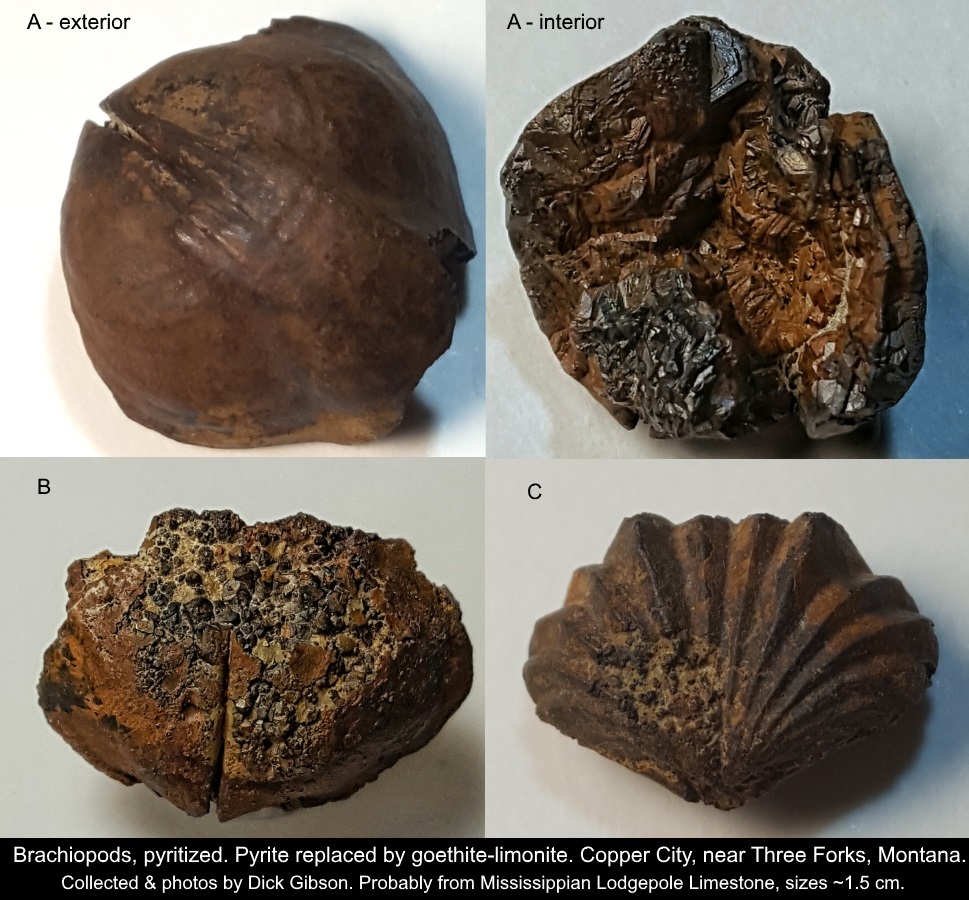
*"Sometimes the hardest thing about making a discovery is recognizing that you have made a discovery." Although I have seen this attributed to Enrico Fermi, I cannot find a source.
Kid Berwyn
(25,287 posts)

11 Bravo
(24,347 posts)Trump's earliest known ancestor initiated the first ever fart-lighting contest.

FakeNoose
(42,749 posts)