
NYT Editorial Board: The Fighter Jet That's Too Pricey to Fail
Source: New York Times
The Fighter Jet That’s Too Pricey to Fail
The F-35 is a boondoggle. Yet we’re stuck with it.
By The Editorial Board
The editorial board is a group of opinion journalists whose views are informed by expertise, research, debate and certain longstanding values. It is separate from the newsroom.
March 12, 2021
Last week, the new head of the House Armed Services Committee, Representative Adam Smith, said in an interview that the F-35 fighter jet was a “rathole” draining money. He said the Pentagon should consider whether to “cut its losses.” That promptly set off another round of groaning about the most expensive weapon system ever built, and questions about whether it should — or could — be scrapped.
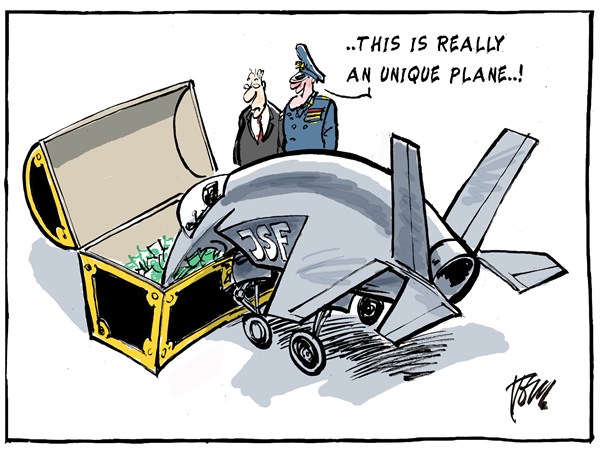
Conceived in the 1990s as a sort of Swiss army knife of fighter jets, the F-35 Joint Strike Fighter was meant to come as a conventional fighter for the Air Force, as a carrier-based fighter for the Navy and as a vertical-landing version for the Marines. The problems, and there were lots of them, set in early. All three versions of the plane ended up at least three years behind schedule, and sharing less than a quarter of their parts instead of the anticipated 70 percent. Many of those already built need updates; hundreds of defects are still being corrected; the jet is so expensive to maintain that it costs around $36,000 per hour to fly (compared to $22,000 for an older F-16). At the current rate, it will cost taxpayers more than $1 trillion over its 60-year life span.
So, kill the monster and start looking for alternatives? Or declare it too big to fail and make the best of it?
Last month, the Air Force chief of staff, Gen. Charles Brown Jr., gave his answer when he said that the F-35 should become the Ferrari of the fleet: “You only drive it on Sundays.” For other days, Air Force officials recently said they were exploring less expensive options, including new F-16s, low-cost tactical drones or building another fighter from scratch. But the F-35 was here to stay, General Brown insisted: “The F-35 is the cornerstone of what we’re pursuing. Now we’re going to have the F-35, we’re getting it out, and we’re going to have it for the future.”
Representative Smith — a Democrat whose Washington constituency includes Boeing, which was beat out for the F-35 contract by Lockheed Martin — acknowledged in an interview that there was no easy way to get rid of the F-35.
-snip-
Read more: https://www.nytimes.com/2021/03/12/opinion/f-35-fighter-jet-cost.html
 = new reply since forum marked as read
Highlight:
NoneDon't highlight anything
5 newestHighlight 5 most recent replies
= new reply since forum marked as read
Highlight:
NoneDon't highlight anything
5 newestHighlight 5 most recent replies
VarryOn
(2,343 posts)
The Wizard
(13,859 posts)F4 phantoms with modern weapons. Pilots loved the F4.

kairos12
(13,707 posts)
keithbvadu2
(40,915 posts)The planning for the manufacture of the F-35 was ingenious.
They spread the jobs around many, many Congressional districts.

Kid Berwyn
(25,109 posts)...look at the features!

Even by Pentagon terms, this was a dud: The disastrous saga of the F-35
The military-industrial complex spent $2 trillion building a "flying Swiss Army knife." Now it's been shelved
By LUCIAN K. TRUSCOTT IV
Salon.com, FEBRUARY 27, 2021
Excerpt...
The F-35, on the other hand, can't fly at twice the speed of sound. In fact, it comes with what amounts to a warning label on its control panel marking supersonic flight as "for emergency use only." So it's OK to fly the thing like a 737, but if you want to go really fast, you have to ask permission, which promises to work really, really well in a dogfight. What are pilots going to do if they're being pursued by a supersonic enemy jet?
The F-35 will carry four different air-to-air missiles, six air-to-ground missiles and one anti-ship missile, but the problem is, all of them have to be fired from the air, and right now, the F-35 isn't yet "operational," which means, essentially, that it's so unsafe to fly the damn things, they spend most of their time parked.
Take the problem they have with switches. The developers of the F-35 decided to go with touchscreen switches rather than the physical ones used in other fighters, like toggles or rocker switches. That would be nice if they worked, but pilots report that the touchscreen switches don't function 20 percent of the time. So you're flying along, and you want to drop your landing gear to land, but your touchscreen decides "not this time, pal" and refuses to work. How would you like to be driving your car and have your brakes decide not to work 20 percent of the time, like, say, when you're approaching a red light at a major intersection?
But it gets worse. The heat coating on the engine's rotor blades is failing at a rate that leaves 5 to 6 percent of the F-35 fleet parked on the tarmac at any given time, awaiting not just engine repairs, but total replacement. Then there's the canopy. You know what a canopy is, don't you? It's the clear bubble pilots look through so they can see to take off and land, not to mention see other aircraft, such as enemy aircraft. Well, it seems F-35 canopies have decided to "delaminate" at inappropriate times, making flying the things dangerous if not impossible. So many of them have failed that the Pentagon has had to fund an entirely new canopy manufacturer to make replacements.
Continues...
https://www.salon.com/2021/02/27/even-by-pentagon-terms-this-was-a-dud-the-disastrous-saga-of-the-f-35/

modrepub
(4,194 posts)So when was the last war the US fought where the opposition was anywhere close to our level of air sophistication? Vietnam maybe? I wouldn't consider Iraq much competition.
Truth is, the odds of a conventional all out war are pretty remote. So we're left competing with ourselves in our own minds. That means a bunch of people are thrown together to brainstorm what the next generation combat jet needs to be. The result is that we try and come up with an all dimensions combat system that tries to do everything well instead of doing what it will need to do in the future under some unknown scenario. This becomes and expensive ghost chase.
Better to develop the capacity to quickly adjust to circumstances and be able to produce something quickly on the fly. Put something up in the air that plays to our pilot's strengths and figure we'll need to make tweaks later. There's no guarantee that some new system will make fighter jets obsolete in the future anyway.

Kick in to the DU tip jar?
This week we're running a special pop-up mini fund drive. From Monday through Friday we're going ad-free for all registered members, and we're asking you to kick in to the DU tip jar to support the site and keep us financially healthy.
As a bonus, making a contribution will allow you to leave kudos for another DU member, and at the end of the week we'll recognize the DUers who you think make this community great.