Alito Says Abortion Has Nothing To Do With Gender Equality--But History Says Otherwise
Alito Says Abortion Has Nothing To Do With Gender Equality—But History Says Otherwise
7/22/2022 by Shoshanna Ehrlich
In Dobbs v. Jackson, Alito claims preventing abortion does not evince a “discriminatory ‘animus’ against women.” History makes clear: He’s wrong.
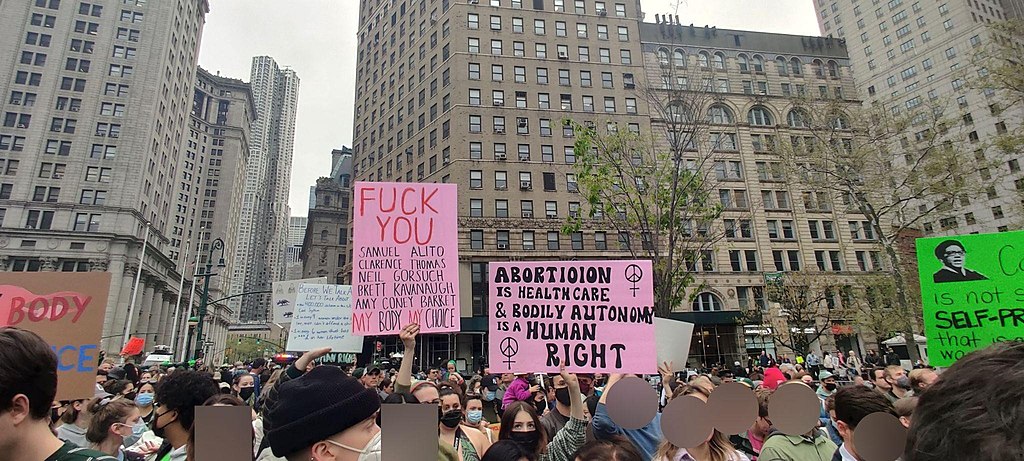 Pro-abortion protesters gather in New York City’s Foley Square on May 3, 2022, following the leak of a draft Supreme Court opinion that would overturn Roe v. Wade. (Legoktm / Wikimedia Commons)
In one fell swoop, Justice Alito’s majority opinion in Dobbs v. Jackson Women’s Health Organization eviscerated Roe’s privacy anchoring of the right to abortion. It also trashed the Court’s subsequent recognition in Planned Parenthood v. Casey that control over one’s reproduction is inextricably linked to gender equality. “Roe’s concept of liberty in defining the capacity of women to act in society, and to make reproductive decisions,” according to Alito, has liberated them “to participate equally in the social and economic life of the Nation.” Without so much as a nod to Casey, Alito blithely disconnects the dots. In support of this decoupling, he relies upon the Court’s 1993 conclusion in Bray v. Alexandria Women’s Health Clinic that clinic protests by Operation Rescue did not deprive those seeking abortion services of their civil rights because opposition to abortion does not evince a “discriminatory animus against women.’” In doing so, Alito ignores the deeply gendered origins of the nation’s criminal abortion laws. A considerable irony is at work in this omission given his pointed criticism that the Roe Court’s survey of abortion history ranged from the “constitutionally irrelevant to the plainly incorrect.”
The nation’s criminal abortion laws that were deemed unconstitutional in Roe were the product of a 19th-century campaign by elite physicians who sought to replace the common law ‘quickening’ rule, which permitted abortion up until the time of fetal movement, with a strict prohibitory regime subject to a narrow life-saving exception. According to historian James Mohr in his classic monograph on the subject, their efforts proved “to be the single most important factor in altering the legal policies towards abortion in this country.” As a result, by the turn of the century, the quickening rule had been consigned to the historic dustbin, in favor of a near absolute ban on abortion. Animated by a pervasive fear that the mid-19th-century woman’s rights movement was encouraging the “better sort” of wife to abandon her “divinely-inscribed” duty to bear children, the physicians’ campaign was saturated with a deep gendered paternalism.
Sounding the alarm, Dr. Horatio Storer, the Boston-born and educated leader of the crusade, urgently warned that those who “become unmindful of the course marked out for her by Providence” by giving into desire while avoiding the “pains and responsibilities of maternity” would no longer “merit the respect of a virtuous husband,” and could expect to “sink into old age like a withered tree stripped of its foliage, with the stain of blood upon her soul.” The physicians’ crusade can be understood as a masculinist project aimed at repairing the damage they believed had been wrought by feminist agitators who foolishly believed that “woman was born for higher and nobler purposes than the propagation of the species.” To this end, Storer exhorted his colleagues to engage in a “bold and manly” effort against the crime of abortion which he claimed “interfered with all elements of domestic happiness.”
. . . . . .
This history upends Alito’s claim in Dobbs that “the goal of preventing abortion” does not evince a “discriminatory ‘animus’ against women.” It also makes a mockery of his assertion that the Roe Court was guilty of a “plainly incorrect” reading of history.
https://msmagazine.com/2022/07/22/alito-abortion-bans-history-discrimination-women-gender/
 = new reply since forum marked as read
Highlight:
NoneDon't highlight anything
5 newestHighlight 5 most recent replies
= new reply since forum marked as read
Highlight:
NoneDon't highlight anything
5 newestHighlight 5 most recent replies



niyad
(135,781 posts)
Docreed2003
(18,714 posts)niyad
(135,781 posts)Docreed2003
(18,714 posts)

LetMyPeopleVote
(184,679 posts)Alito's only support for his position was a witch hunter who believed in marital rape. The professor cited a number of real historians who disagreed with Alito. I did not copy the cites on the zoom CLE and now wish that I had
niyad
(135,781 posts)it is out there.
alito is one nasty piece of work.
LetMyPeopleVote
(184,679 posts)In case this link does not work, go to Harris County Democratic Lawyers Association and look at events
Here is the link
https://www.facebook.com/events/565149841674183/?acontext=%7B%22event_action_history%22%3A[%7B%22surface%22%3A%22group%22%7D]%7D

niyad
(135,781 posts)LetMyPeopleVote
(184,679 posts)Alito's only support for his opinion was a witch hunter who believed in/advocated for marital rape. Here is some authority that Alito was too stupid to find or use
Link to tweet
https://www.washingtonpost.com/made-by-history/2022/07/19/1792-case-reveals-that-key-founders-saw-abortion-private-matter/?pwapi_token=eyJ0eXAiOiJKV1QiLCJhbGciOiJIUzI1NiJ9.eyJzdWJpZCI6IjM4MjMyODIzIiwicmVhc29uIjoiZ2lmdCIsIm5iZiI6MTY1ODU2MjA5NSwiaXNzIjoic3Vic2NyaXB0aW9ucyIsImV4cCI6MTY1OTc3MTY5NSwiaWF0IjoxNjU4NTYyMDk1LCJqdGkiOiI0MDZjNjg4ZC1hODI2LTQ0ZWMtOGQ2Zi0zNDAwMjI3NDhiNDAiLCJ1cmwiOiJodHRwczovL3d3dy53YXNoaW5ndG9ucG9zdC5jb20vbWFkZS1ieS1oaXN0b3J5LzIwMjIvMDcvMTkvMTc5Mi1jYXNlLXJldmVhbHMtdGhhdC1rZXktZm91bmRlcnMtc2F3LWFib3J0aW9uLXByaXZhdGUtbWF0dGVyLyJ9.3Oz4ziKkJBN2tEYVnpVZn6nAAc14004UAhTbvAbyhAM
Alito’s evidence that abortion was always considered a criminal act, and thus something the Constitution should not protect, consisted of a single criminal case that was prosecuted in 1652 in the (Catholic) colony of Maryland. He then jumped ahead to laws that states enacted, mostly in the mid-to-late-19th century, to criminalize abortion. This cursory survey of abortion in early America was hardly complete, especially because it ignored the history of abortion in the years in which the Constitution was drafted and ratified.....
Therefore, the more historically accurate conclusion is Justice Harry A. Blackmun’s majority opinion in Roe v. Wade (1973), that “at the time of the adoption of our Constitution, and throughout the majority of the 19th century, abortion was viewed with less disfavor than under most American statutes currently in effect. Phrasing it another way, a woman enjoyed a substantially broader right to terminate a pregnancy than she does in most States today. ”
Though Marshall’s notes on Commonwealth v. Randolph are extensive, this episode is poorly documented in the county court records, and, thus, no formal case law was generated. Regardless, the episode begs examination as it involved key Founders who occupied vastly different positions on the political spectrum, both nationally and in Virginia. The Federalist Marshall believed in a strong national government. Jefferson mostly supported a decentralized system. Henry was a populist. Yet all three tacitly agreed that abortion in this case was a private matter, not a criminal act worthy of further investigation and prosecution. In a remarkable coda, Nancy went on to marry Gouverneur Morris of New York, an influential signer of the Constitution, who was well aware of her backstory.
If anything, the saga demonstrates that the concept of abortion as a private matter was “deeply rooted” in the minds of our nation’s Founders. As Americans consider their next move on the abortion issue at the state level, they should be mindful of the precedents followed by these early giants of our republic.
niyad
(135,781 posts)posting this as its own OP for greater visibility and so we can rec it?
LetMyPeopleVote
(184,679 posts)Again, Alito is a partisan hack who does not know history. Alito cited a witch hunter who was an advocate for marital rape as his authority to overturn Roe. Alito is both a partisan hack/bad lawyer and a bad historian
Link to tweet
https://www.washingtonpost.com/outlook/2022/06/24/dobbs-decision-looks-history-rescind-roe/
Writing for the majority in Dobbs, Justice Samuel A. Alito Jr. argues that Roe disrupted “an unbroken tradition of prohibiting abortion on pain of criminal punishment” that had “persisted from the earliest days of the common law until 1973.” But the real picture is far blurrier — and even once states began passing stricter abortion laws between the 1820s and 1880s, public sentiment did not follow. Few abortion providers were convicted under the new laws, indicating that most Americans didn’t see abortion as a crime.
Anglo-American common law initially guided the U.S. on abortion. Under common law, abortion was only punishable after “quickening,” defined as the moment the mother first felt fetal movement — typically between 16 to 22 weeks of gestation.
Alito contends, however, that pre-quickened abortions were always strongly condemned, as shown by the wave of statutes that states passed in the 19th century criminalizing abortion for the entire pregnancy. Yet, over a third of the states actually retained the imprint of quickening in these laws, assigning a distinctly lesser penalty for abortions that took place before quickening.
Even more importantly, there is scant evidence of public concern about fetal “personhood” or moral opprobrium prompting those new state laws in the 19th century, as Alito claims in Dobbs. In fact, there appears to have been no public pressure at all for tougher laws before 1845. All the statutes passed before 1845 were added during routine revisions of state criminal codes, probably meaning that most were enacted without actual debate.