Welcome to DU!
The truly grassroots left-of-center political community where regular people, not algorithms, drive the discussions and set the standards.
Join the community:
Create a free account
Support DU (and get rid of ads!):
Become a Star Member
Latest Breaking News
Editorials & Other Articles
General Discussion
The DU Lounge
All Forums
Issue Forums
Culture Forums
Alliance Forums
Region Forums
Support Forums
Help & Search

Wittgenstein in the classroom

The philosopher understood that learning – of a concept, of ourselves, of each other – is the undertaking of a whole life
https://aeon.co/essays/learning-for-wittgenstein-is-a-whole-life-undertaking

When I first read Ludwig Wittgenstein’s Philosophical Investigations, I was a student struggling to make sense of it. Now as I read it on the 70th anniversary of its posthumous publication, I am a teacher struggling to make sense of it. In my job, I teach adults who speak English – or at least have a good grasp of it as a spoken language – how to read and write. And not how to read and write ‘professionally’, but rather how to connect sounds to shapes on a page and vice versa, how to spell the language’s most common words, and how to write a complete sentence. There is a member of my class who, although he can say and use the words we study, and has a good grasp of consonants, will not include vowels when he spells. I will ask him to spell the word ‘went’, for example, and he will spell out ‘wnt’. If I correct him once, this currently makes no difference – the next time, he will spell without vowels just the same. As you may imagine, I can find this very frustrating. Wittgenstein writes of a similar case in one of the central sections of the Investigations. He describes teaching a pupil the series 0, n, 2n, 3n, etc, where n = 2. Only, when the pupil gets to 1000, he writes 1000, 1004, 1008, 1012:

Wittgenstein then compares this to a case of someone who does not react naturally to a gesture of pointing: someone who looks in the direction from fingertip to wrist instead of following the line beyond the fingertip. We might also think of a cat, staring blankly at a pointing finger. He goes on to suggest that the rules we take for granted as governing all manner of human activity, from mathematics to the grammar of propositions, cannot be explicated by the Platonic tradition of reference to ineffable objects, nor by a subjective ‘interpretation’ at the moment of each instantiation of the rule. Rather, they in a sense rely on shared agreement in natural inclination, or in common practices. Our understandings are just what we do. They are our form of life. (This is, it strikes me, a very teacherly attitude. Every teacher knows that it is no use just having a learner say they understand: we have to watch them do it.)

But if you were to read the Investigations expecting to find this conception of meaning and understanding presented as a thesis, logically derived from explicit premises, you would be sorely disappointed. The book is instead composed of a series of remarks, each spinning off from the anxiety of the last. They are not remarks made by a single speaker – rather, Wittgenstein engages a series of imaginary interlocutors in a back-and-forth in response to philosophical stimuli. In so far as there is a single voice of ‘Wittgenstein’ to lead the discussion, it is a voice of questioning, of doubt, of self-correction, and of self-criticism (the interjections come without quotation marks as often as they come with them). Its form is not so much dialogical as polyphonic. In this sense, the Investigations presents almost as a dramatic work. And the drama that takes place is one with which every teacher will be familiar: it is the drama of the classroom.
What does it mean to say that the Investigations dramatises the pedagogical moment? What does it mean to say that the Investigations is controlled by a concern about the method, and indeed the possibility, of teaching? One angle of entry would be Wittgenstein’s idea that the meaning – the ‘essence’ – of a word is to be found not by searching for the object or referent ‘behind’ it, but by looking at its use in the language games in which it is deployed. Wittgenstein says again and again that one of the best language games to study for this is the one in which the word is taught:
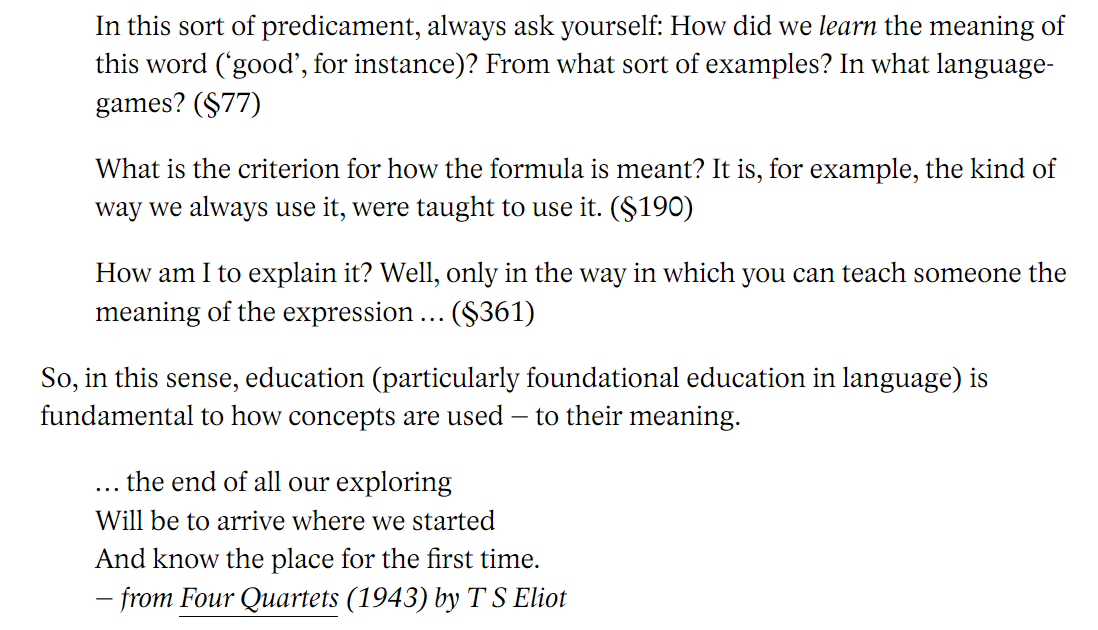
snip
1 replies
 = new reply since forum marked as read
Highlight:
NoneDon't highlight anything
5 newestHighlight 5 most recent replies
= new reply since forum marked as read
Highlight:
NoneDon't highlight anything
5 newestHighlight 5 most recent replies
= new reply since forum marked as read
Highlight:
NoneDon't highlight anything
5 newestHighlight 5 most recent replies
Wittgenstein in the classroom (Original Post)
Celerity
Aug 2023
OP

jmbar2
(7,990 posts)1. I taught Spec Ed young adults last spring - can relate!
I enjoyed the challenge of trying to figure out different ways to get the training across.
Tried reading Wittgenstein in college - tough going!