Why quantum mechanics needs phenomenology

Breaking the chain
The role of the conscious observer has posed a stubborn problem for quantum measurement. Phenomenology offers a solution
https://aeon.co/essays/why-quantum-mechanics-needs-phenomenology

Photo by Herbert List/Magnum Photos. View from Max Scheler's apartment, 1953. Trastevere, Rome
In the early 1960s, quantum physics was regarded as one of the most successful theories of all time. It explained a wide range of phenomena to an unprecedented level of accuracy, from the structure of atoms and the formation of chemical bonds, to how lasers and superconductors worked. For some, it was more than just a theory, providing an all-encompassing framework for understanding the micro-world of elementary particles. However, it turned out that the very foundations of that entire framework were built on shaky ground – and the person who noticed wasn’t a physicist but an up-and-coming philosopher.
The debate that resulted not only opened the door to new ways of thinking about those foundations, but also had tucked away within it, overlooked by all the participants at the time, an entirely different philosophical perspective on quantum physics – one that can be traced back to the phenomenological philosopher Edmund Husserl. The impact of that shift in perspective is only now being fully appreciated, offering an entirely novel understanding of quantum mechanics, one that prompts a complete re-evaluation of the relationship between philosophy and science as a whole.
The philosopher who kick-started that debate was Hilary Putnam, who went on to make groundbreaking advances in philosophy of language and philosophy of mind, as well as in computer science, logic and mathematics. In 1961, he responded to a paper offering a resolution of the so-called Einstein-Podolsky-Rosen (EPR) paradox, which appeared to show that the description of reality offered by quantum mechanics could not be complete. In the course of his argument, Putnam pointed out that there was an even more profound problem that lay at the very heart of the theory, as it was standardly understood, and which had to do with one of the most basic of all scientific procedures: measurement.
That problem can be set out as follows. A crucial element in the formalism of quantum mechanics is a mathematical device known as the ‘wave function’. This is typically taken to represent the state of a given system – such as an atom or an electron – as a superposition of all its possible states. So, consider an electron and the property known as ‘spin’. (This is not really the same as the spin put on a ball in a game of baseball or cricket, but the name has stuck.) Spin comes in two forms, labelled ‘up’ and ‘down’, and so when we use the wave function to represent the spin state of our electron as it travels towards our detector, it is as a non-classical superposition of spin ‘up’ and spin ‘down’. However, when we come to measure that spin, the outcome is always one or the other, either ‘up’ or ‘down’, never a superposition of both. How can we account for the transition from that superposition to a definite outcome when we perform a measurement?
snip
 = new reply since forum marked as read
Highlight:
NoneDon't highlight anything
5 newestHighlight 5 most recent replies
= new reply since forum marked as read
Highlight:
NoneDon't highlight anything
5 newestHighlight 5 most recent replies

cachukis
(4,083 posts)Interesting explanation of observation and reality.

LearnedHand
(5,604 posts)So this was a very challenging read. I likely misread the main point, but I still don’t understand how the act of observing the quantum state doesn’t produce the outcome if you view the experiment through the lens of phenomenology.

Celerity
(54,884 posts)London and Bauer radically depart from von Neumann’s argument at a crucial juncture. In setting out the chain of correlations, from detector + system to observer’s body + detector + system, they do not stop at the consciousness of the observer but also include this in the overall quantum superposition. It is this move that expresses in physical terms the phenomenological idea of the ‘mutually dependent context of being’, so that not just the body of the observer but their consciousness is also correlated, quantum mechanically, with the system under investigation.
How do we go from that correlation, manifested through the quantum superposition, to having a definite belief corresponding to our observation of a certain measurement outcome? Here, London and Bauer insist that
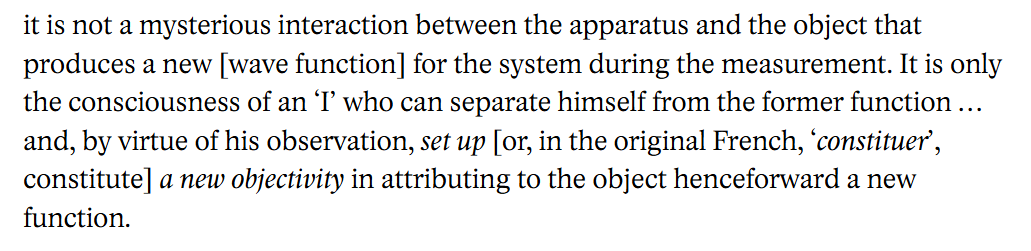
In other words, the transition from a superposition to a definite state is not triggered in some mysterious fashion by the consciousness of the observer and, as a result, Putnam and Shimony’s concern regarding how consciousness can cause a definite state to be produced is simply sidestepped. Instead, what we have is a separation of consciousness from the superposition, leading to a ‘new objectivity’, that is, a definite belief on the part of the observer and a definite state attributed to the system.
This separation is effected, as London and Bauer explain, via

And, in a typed note inserted by London in his own copy of the manuscript, he wrote:

It is this characteristic and familiar act of reflection that cuts the chain of statistical correlations expressed by quantum theory as a set of nested superpositions, and keeps the twin phenomenological poles of those correlations – namely consciousness and the world – mutually separate. And so, on the one hand, the system is objectified, or ‘made objective’, in the sense of having a definite state attributed to it, and, on the other, the observer acquires a definite belief state through this objectifying act of reflection.
LearnedHand
(5,604 posts)What I mean is I thought quantum observations *always* included the observer’s consciousness as an inextricable part of the observation. IOW, I kept trying to understand what *new* element this essay was introducing. Again, I am likely misreading it. I had only a survey course in philosophy and only a passing introduction to phenomenology.
EDIT: Thank you for this challenge gong article!

Uncle Joe
(65,535 posts)Thanks for the thread Celerity.

Kick in to the DU tip jar?
This week we're running a special pop-up mini fund drive. From Monday through Friday we're going ad-free for all registered members, and we're asking you to kick in to the DU tip jar to support the site and keep us financially healthy.
As a bonus, making a contribution will allow you to leave kudos for another DU member, and at the end of the week we'll recognize the DUers who you think make this community great.