The DU Lounge
Related: Culture Forums, Support Forums
No, there is (almost certainly) not a second Sphinx buried under a pile of sand on the Giza Plateau
You may have heard that last year, an engineer named Filippo Biondi announced that he had developed a new underground scanning method, and that he had found all sorts of amazing stuff below the pyramids on the Giza Plateau: many large wells with circular stairways that went down over a kilometer to some 80 meter square chambers:
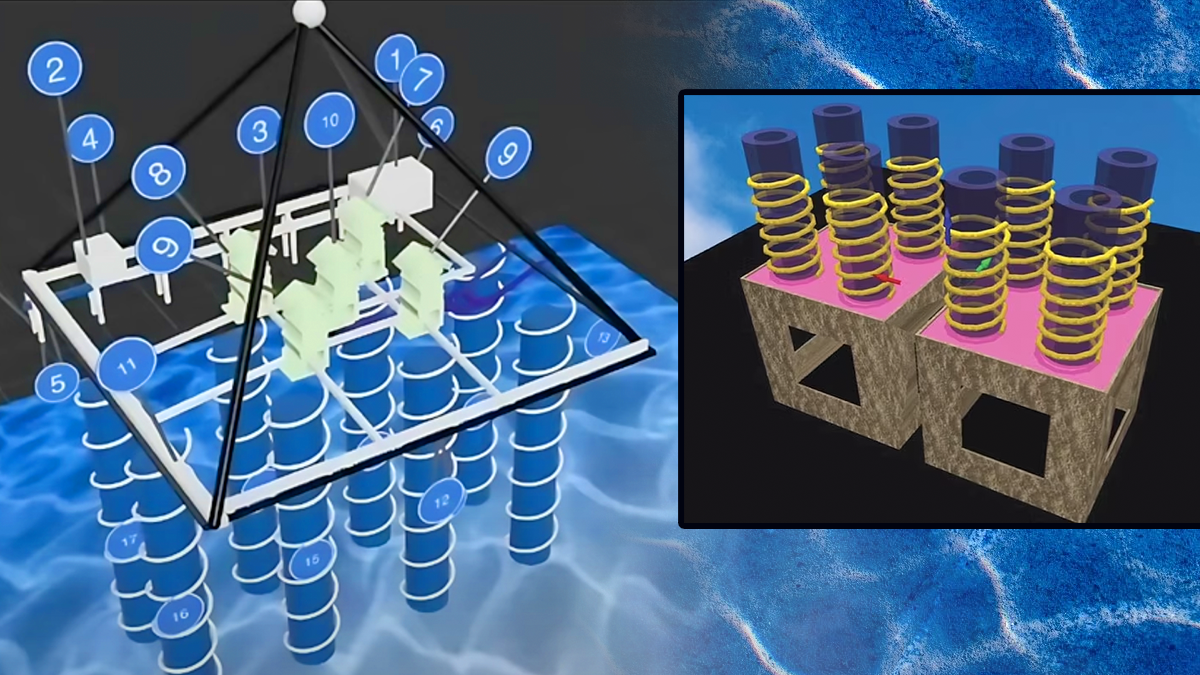
That's the 3D model he constructed from this scan result:
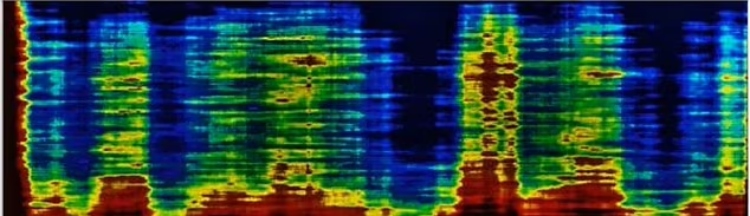
I first heard of Biondi in 2022 when he published a supposed scan of the Great Pyramid itself. This was shortly after another project called Scan Pyramid used muon detectors to identify an unknown "void" above the known structures, and they found a small entrance passageway above the known entrance, which has since been confirmed by cameras inserted in a crack, but it's only a few meters long now. I was very interested, but his results weren't really very convincing. There were a couple colored blobs that he identified as known structure like the Queen's Chamber, but he didn't have a good explanation for why it didn't show all the known structure, or why he assumed that all the other colored blobs were unknown tunnels and chambers. But the technique sounded fairly credible at first glance, and I hoped that he could improve the process and get better results -- specifically, I wanted to see scans of more known underground structures, but the two or three examples where he claims to do that are as unconvincing as the pyramid scan. Another problem is that he is keeping key details about the process secret, so nobody can reproduce his results. Instead of working on that — as any serious and professional researcher would have done before publishing such extraordinary claims — he was working on the deeper scan shown above.
In the year since that announcement, he still hasn't been working toward actually validating his results, but instead has been working on scanning a pile of sand to the west of the pyramids that happens to be somewhat Sphinx shaped, and now he claims that there is a second Sphinx under there.
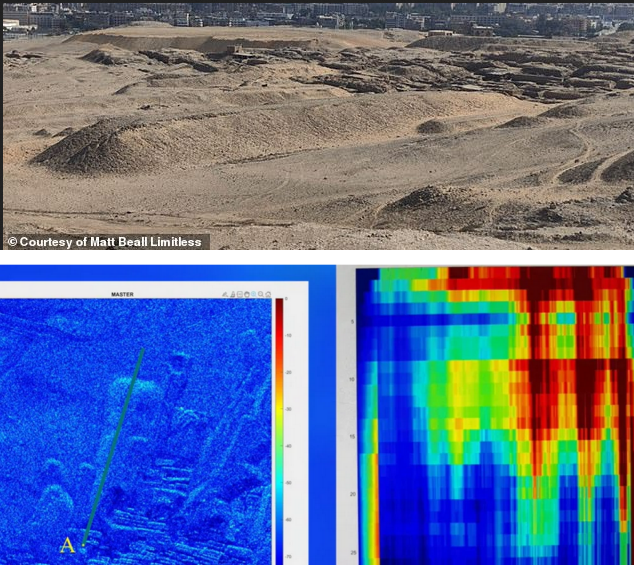
Within a few days, however, a photo of that area taken in 1929 was found, and the sand pile wasn't there at all. But then it appears in a 1930 photo — apparently, it's sand dumped there from another excavation site. That hasn't deterred the "alternative archaeology" corners of YouTube, however, so there are many breathless clickbait videos about it, with new ones popping up every day. Since the photos surfaced, however, advocates have claimed that the Sphinx must be below ground under the pile. That implies that either it was an incredible coincidence that the sand was dumped over it, or that whoever dumped it knew the Sphinx was there but decided to bury it even further. That fits in with the standard pseudo-archaeology theory that mainstream archaeology is intentionally hiding information, supposedly because it doesn't fit with their established beliefs and would be professionally embarrassing, or that there's some secret "they don't want you to know." I personally find it hard to believe that Egyptian authorities would not want another tourist attraction.
As for the scanning method, there is a lot of confusion about how it's supposed to work — some accounts confuse it with ground-penetrating radar and some say it's taken directly from satellite images, neither of which is correct. The radar frequency used by SAR satellites cannot penetrate more than a few feet underground. But after learning more about how he claims it works, I am extremely doubtful that these scans are showing anything other than artifacts of the processing.
He claims to be using Synthetic Aperture Radar (SAR) satellite images (which show more detail than visible light images) to detect vibrations on the surface, and then doing something similar to seismic tomography from those waves to detect underground structures. It is actually possible to detect vibrations from a series of SAR images using a Doppler effect, but I haven't found any claims to detect vibrations less than about a millimeter. Biondi claims to be working with very small vibrations caused by things like Cairo traffic and wind. The thing is, all forms of tomography (deducing internal structure from surface waves) require "penetrating" waves, because waves detected on the surface cannot possibly tell you anything about internal structure unless those waves passed through, around, or bounced off that structure. That's why seismic tomography is conventionally done with earthquake waves and explosive blasts, whereas Biondi is using very low-power waves, and he is also using relatively high frequency waves that attenuate very quickly in rock, compared to earthquakes and explosive blasts. To me, without independent corroboration, I have trouble believing Biondi is detecting such small vibrations from SAR images, and even if he is, it is virtually impossible that such waves can really penetrate over a kilometer down and bounce back to tell you anything about underground structures. One thought I had was, if Biondi could really do tomography with those waves, then he'd get much, much better data by putting an array of sensors directly on the ground, and forget about trying to detect such small vibrations with SAR images.
There's nothing wrong with keeping an open mind, but it's not very encouraging that Biondi isn't putting in the effort to validate his results or to make it possible for independent researchers to duplicate them. Until that happens, Biondi is hard to take seriously. He dismisses any criticism as coming from "debunkers" (intended as an insult) that he doesn't care to be bothered with, which is the common dismissal used by all pseudo-scientists.