Music Appreciation
Related: About this forum
John Coltrane Draws a Picture Illustrating the Mathematics of Music
I've got to check out this site some more but I've seen two very interesting articles on it so far
http://www.openculture.com/2017/04/the-tone-circle-john-coltrane-drew-to-illustrate-the-theory-behind-his-most-famous-compositions-1967.html
Physicist and saxophonist Stephon Alexander has argued in his many public lectures and his book The Jazz of Physics that Albert Einstein and John Coltrane had quite a lot in common. Alexander in particular draws our attention to the so-called “Coltrane circle,” which resembles what any musician will recognize as the “Circle of Fifths,” but incorporates Coltrane’s own innovations. Coltrane gave the drawing to saxophonist and professor Yusef Lateef in 1967, who included it in his seminal text, Repository of Scales and Melodic Patterns. Where Lateef, as he writes in his autobiography, sees Coltrane's music as a "spiritual journey" that "embraced the concerns of a rich tradition of autophysiopsychic music," Alexander sees “the same geometric principle that motivated Einstein’s" quantum theory.
Neither description seems out of place. Musician and blogger Roel Hollander notes, “Thelonious Monk once said ‘All musicans are subconsciously mathematicians.’ Musicians like John Coltrane though have been very much aware of the mathematics of music and consciously applied it to his works.”
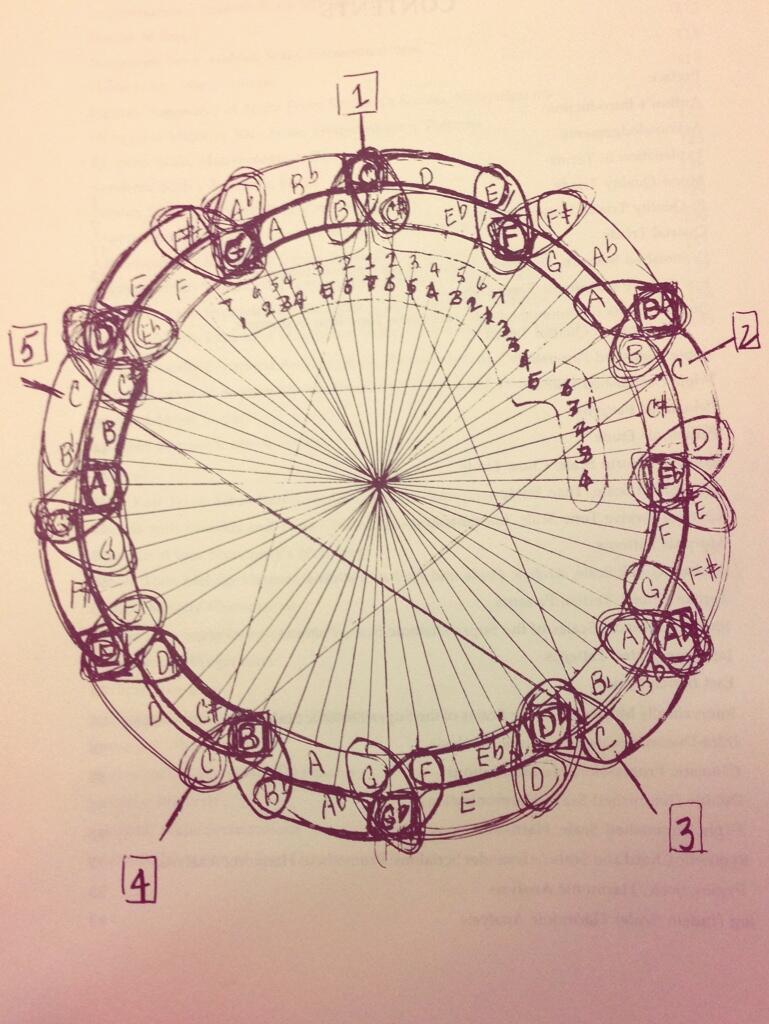
Coltrane was also very much aware of Einstein’s work and liked to talk about it frequently. Musican David Amram remembers the Giant Steps genius telling him he “was trying to do something like that in music.”
Hollander carefully dissects Coltrane's mathematics in two theory-heavy essays, one generally on Coltrane’s “Music & Geometry” and one specifically on his “Tone Circle.” Coltrane himself had little to say publically about the intensive theoretical work behind his most famous compositions, probably because he’d rather they speak for themselves. He preferred to express himself philosophically and mystically, drawing equally on his fascination with science and with spiritual traditions of all kinds. Coltrane’s poetic way of speaking has left his musical interpreters with a wide variety of ways to look at his Circle, as jazz musician Corey Mwamba discovered when he informally polled several other players on Facebook. Clarinetist Arun Ghosh, for example, saw in Coltrane's "mathematical principles" a "musical system that connected with The Divine." It's a system, he opined, that "feels quite Islamic to me."
 = new reply since forum marked as read
Highlight:
NoneDon't highlight anything
5 newestHighlight 5 most recent replies
= new reply since forum marked as read
Highlight:
NoneDon't highlight anything
5 newestHighlight 5 most recent replies
brush
(61,033 posts)
Harker
(17,785 posts)had some very profound understandings of many of life's great mysteries.