Photography
Related: About this forumSome Recent Bird Shots
nothing very interesting....i really need to get out more and practice and get some compelling shots


 = new reply since forum marked as read
Highlight:
NoneDon't highlight anything
5 newestHighlight 5 most recent replies
= new reply since forum marked as read
Highlight:
NoneDon't highlight anything
5 newestHighlight 5 most recent replies

Diamond_Dog
(40,461 posts)These are fabulous!

Gato Moteado
(10,170 posts)...and nothing i've produced lately has met that bar.
the hummer in flight is pretty cool....the rest are meh. i think the last two are over processed.....i might re-process that acorn woodpecker to see if i can get it looking better.
Gato Moteado
(10,170 posts)...with my unsteady hands, using the nikkor 500mm PF prime, this one was pretty sharp even when inspecting it closer. the eye looks good...things should be better when i use my tripod (which i didn't have with me that day).
one "interesting" thing with these acorn woodpeckers: it seems no matter how diffused or gentle the light is, if you want to have some detail in the black feathers, you're going to blow out the white forehead. it's just so reflective.


elleng
(141,926 posts)
Walleye
(44,655 posts)
Gato Moteado
(10,170 posts)....i'm not feeling it. but i posted them because it's all i have at the moment.

twodogsbarking
(18,626 posts)Gato Moteado
(10,170 posts)....i'll keep working it.

MuseRider
(35,176 posts)I have so many birds, such a cool assortment of them on my farm and in the pond and, of course other animals and I cannot take good pictures. It is a shame!
Gato Moteado
(10,170 posts)do you have a camera? if so, what camera and lenses do you have?
MuseRider
(35,176 posts)I did have a nice camera but it was borrowed and I do not have it back, but whatever, I know NOTHING about this.
I am experimenting with my camera on my phone, I bought this phone just for that camera so slowly I am learning it. I am slow with this kind of stuff, numbers are not my friend and whatever.
I have always found camera working difficult. I have a Samsung S21 Uktra 5G whatever that means. Anyway, that is what I mean.  I am certainly not trying to do anything like you are doing.
Gato Moteado
(10,170 posts)...but other types of photos can easily be made with phone cameras. i've seen amazing images made with phones.
elleng
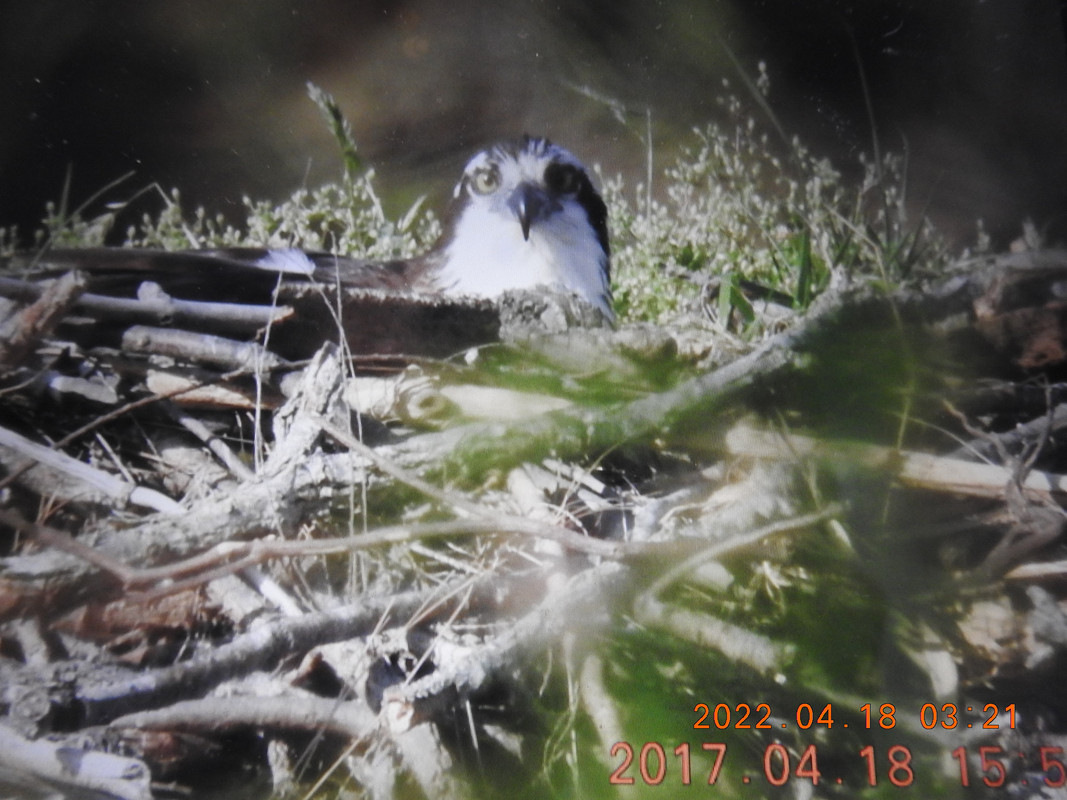
(141,926 posts)I wish I could 'get out more,' but geese have taken over 'my' osprey nest, so posting 'oldies' now, this from 2017 spring:
Gato Moteado
(10,170 posts)...what camera and lens were you using and how far away was the nest?
elleng
(141,926 posts)Nest is not sure how many yards away; I was on level ground, nest on roof of small boathouse adjacent to my house, so 10+? yards maybe.
Gato Moteado
(10,170 posts)...no problem for the P900, really.
elleng
(141,926 posts)Got some great pics of parents with chicks, which I'll post as they pop up in my 'memories.'

sprinkleeninow
(22,321 posts)usonian
(25,056 posts)I am a non-birder, except when one lands on the dead tree some distance from my front window. And these are a treat for me.
Thanks for posting.
George McGovern
(11,812 posts)Your lens has an outstanding depth of field. Hope you get your mojo back.
Gato Moteado
(10,170 posts)...unless the subject of your photo is a different part of the body, of course.
you probably know all of this, but i'll type it out just in case it can help someone:
if you're using the default autofocus area mode of your camera, you're letting the camera decide where your focal point is going to be...and the camera never gets it right. for snapshots, especially when using wider-angle kit lenses with small maximum apertures yielding a lot of DoF, this isn't a big issue. but if you're doing serious portraiture or wildlife work and using wide open apertures to blur out your backgrounds, limiting your DoF, you need to have your focal plane dead on. on some newer mirrorless cameras (i'm not sure which olympus models you have) there's an autofocus area mode for detecting animals' eyes and focusing on them...this is an invaluable feature as it allows for worry-free composition. on DSLRs and older mirrorless bodies, the best solution (and it's what i do) is to use single point autofocus area mode, where there is just one point in the VF that the camera will focus, and you put that point in the frame where you want your subject's nearest eye to be (it's an extra step but well worth the effort). then, looking thru the VF, you lay that little square over your subject's eye, acquire focus and snap. obviously, this is more challenging with moving targets, like birds in flight, and there are more suitable AF area modes for that. also, i set up my camera to use back button focus instead of doing the half-shutter-press...i find this to be more helpful in acquiring and locking focus. when shooting animals or people, i'm looking to get this kind of focus on the eye(s)...of course, i don't always get it:


worth noting: even the older mirrorless cameras have eye detection AF for people and it is an invaluable tool for shooting portraits or people in the streets...it allows you to compose as you wish and the camera will find the eyes of your subject and lock in focus on them no matter where they are in the frame. i shot this with my lumix G9 using eye detection AF area mode:

finally, you mentioned the DoF of my lenses. it's true that when you use prime lenses with larger maximum apertures, you're going to have more control with image separation, but even if you're using consumer grade or kit zooms, you can still turn your backgrounds to butter by positioning yourself correctly in relation to your subject and the background. first of all, when shooting something like birds, shoot wide open whenever possible...this is good not only for image separation but will accommodate faster shutter speeds and/or lower ISO. when shooting at longer focal lengths, you'll automatically be decreasing your DoF, helping to make your subject pop out, but also you want to position yourself as close to your subject as you can get and try to shoot at an angle where you have no nearby distractions in the frame and the background (foliage, landscape, water, whatever) is as far back in the distance as possible...and if you're really close to your subject, the background doesn't even have to be that far back to get creamed out. all these shots were made at f/6.3 or smaller, and most kit zooms can open up at least to that aperture even when fully extended (the toucans were shot at f/8 with the zoom extended between 440mm and 500mm):


George McGovern
(11,812 posts)Gato Moteado
(10,170 posts)...and let me know how it worked out for you. if you have AF also set to continuous, it should track the face/eyes as the person moves around.
looks like single point AF area mode is called single target in the OM manual.....try that out for all non-human subjects and see what you think about pin point AF.
lastly, if you feel like stepping things up a notch...try out back button focus:
George McGovern
(11,812 posts)Gato Moteado
(10,170 posts)...i'm always gonna hook you up.