Welcome to DU!
The truly grassroots left-of-center political community where regular people, not algorithms, drive the discussions and set the standards.
Join the community:
Create a free account
Support DU (and get rid of ads!):
Become a Star Member
Latest Breaking News
Editorials & Other Articles
General Discussion
The DU Lounge
All Forums
Issue Forums
Culture Forums
Alliance Forums
Region Forums
Support Forums
Help & Search
Photography
Related: About this forum
How Dorothea Lange Taught Us To See Hunger And Humanity
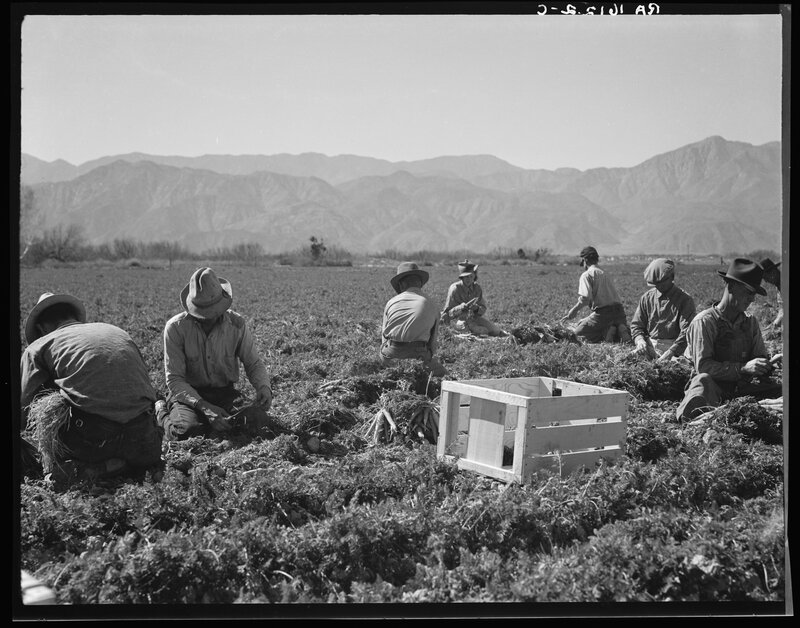
Carrot pullers from Texas, Oklahoma, Missouri, Arkansas and Mexico. "We come from all states and we can't make a dollar in this field noways. [sic] Working from seven in the morning until twelve noon, we earn an average of thirty-five cents." California, February 1937
Documentary photographer Dorothea Lange had a favorite saying: "A camera is a tool for learning how to see without a camera."
And perhaps no one did more to reveal the human toll of the Great Depression than Lange, who was born on this day in 1895. Her photographs gave us an unflinching — but also deeply humanizing — look at the struggles of displaced farmers, migrant laborers, sharecroppers and others at the bottom of the American farm economy as it reeled through the 1930s.
Lange worked for the Farm Security Administration in the 1930s, chronicling rural poverty across America and the agency's efforts to provide relief.
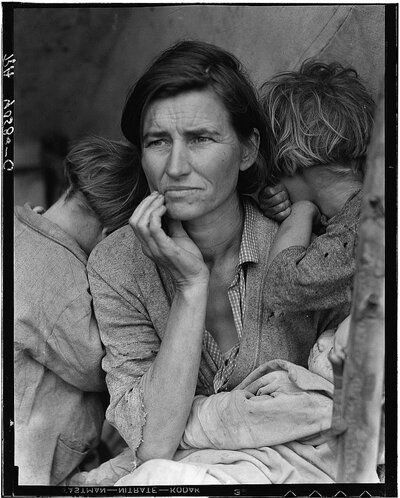
Her most famous photo is often referred to as "Migrant Mother." Shot in 1936 at a campsite full of unemployed pea pickers in Nipomo, Calif., the image features Florence Owen Thompson, a poor farmworker flanked by two of her seven children, while a third, a baby wrapped in burlap, rests on her lap.
And perhaps no one did more to reveal the human toll of the Great Depression than Lange, who was born on this day in 1895. Her photographs gave us an unflinching — but also deeply humanizing — look at the struggles of displaced farmers, migrant laborers, sharecroppers and others at the bottom of the American farm economy as it reeled through the 1930s.
Lange worked for the Farm Security Administration in the 1930s, chronicling rural poverty across America and the agency's efforts to provide relief.
Her most famous photo is often referred to as "Migrant Mother." Shot in 1936 at a campsite full of unemployed pea pickers in Nipomo, Calif., the image features Florence Owen Thompson, a poor farmworker flanked by two of her seven children, while a third, a baby wrapped in burlap, rests on her lap.
 .
.
Lange's iconic photograph of Florence Owens Thompson, often referred to as "Migrant Mother." It was taken at a camp full of destitute pea pickers in Nipomo, Calif., in 1936.
the rest from npr
2 replies
 = new reply since forum marked as read
Highlight:
NoneDon't highlight anything
5 newestHighlight 5 most recent replies
= new reply since forum marked as read
Highlight:
NoneDon't highlight anything
5 newestHighlight 5 most recent replies
= new reply since forum marked as read
Highlight:
NoneDon't highlight anything
5 newestHighlight 5 most recent replies
How Dorothea Lange Taught Us To See Hunger And Humanity (Original Post)
fizzgig
May 2015
OP

Curmudgeoness
(18,219 posts)1. She had an eye to envy.
Incredible photos to document the pain and suffering of the poor. I never knew that there was a baby on the migrant mother's lap.
I can agree with her favorite saying, because I realize how much more I notice when I have a camera in my hand, or when I am thinking of photos. "A camera is a tool for learning how to see without a camera."
juxtaposed
(2,778 posts)2. I love her work