Welcome to DU!
The truly grassroots left-of-center political community where regular people, not algorithms, drive the discussions and set the standards.
Join the community:
Create a free account
Support DU (and get rid of ads!):
Become a Star Member
Latest Breaking News
Editorials & Other Articles
General Discussion
The DU Lounge
All Forums
Issue Forums
Culture Forums
Alliance Forums
Region Forums
Support Forums
Help & Search
Latin America
Related: About this forumIs Caral, Peru the Oldest City in the Americas?
These pyramids in Peru are older than the ones in Egypt, and predate the Incan Empire by roughly 4,000 years.
By Eric Betz
December 23, 2020 2:00 PM
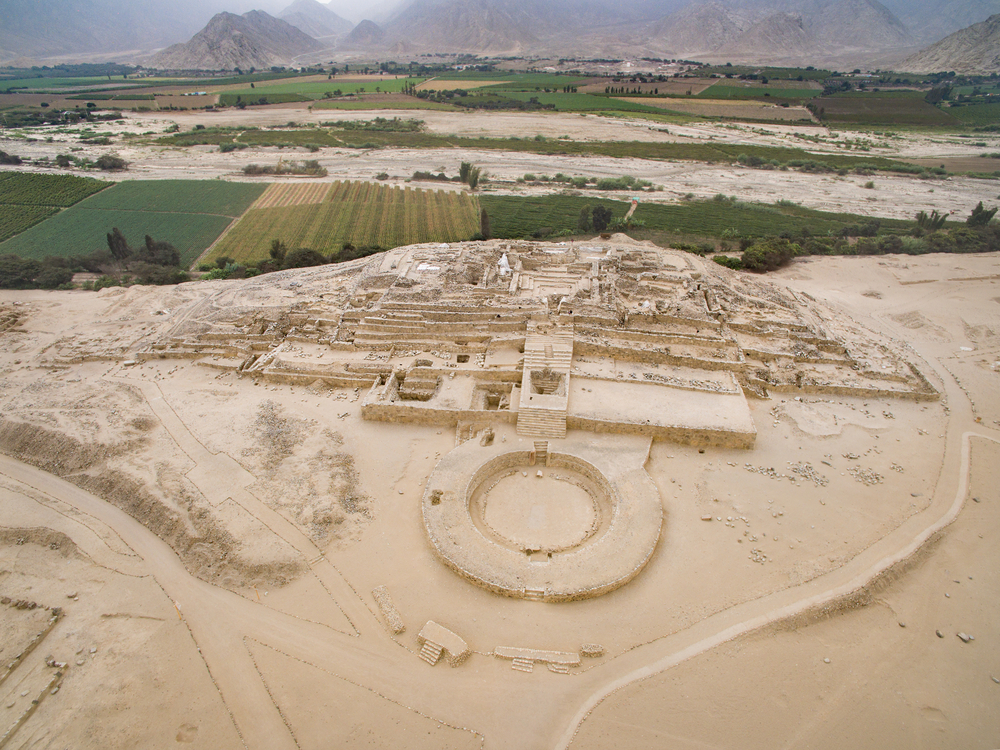
(Credit: Christian Vinces/Shutterstock)
On a high, dry terrace overlooking a green river valley in the Andes Mountains of Peru, sits a complex of American pyramids that may be older than the pyramids of Egypt. These structures are remnants of the ancient city of Caral, which some have called the oldest society in the Americas.
Caral was built around 5,000 years ago, give or take a few centuries, according to groundbreaking research published in Science back in 2001. That origin date places it before the Egyptian pyramids in Africa and roughly 4,000 years before the Incan Empire rose to power on the South American continent. That history, and the shear scope of the site, prompted UNESCO, the United Nations Educational, Scientific and Cultural Organization, to dub it a World Heritage Site in 2009.
Caral sits in the Supe Valley, a region of Peru’s high desert nestled between the rainforest, mountains and the Pacific coast. The valley is brimming with ancient monumental architecture. And in the decades since Caral first made headlines, archaeologists working in the region have turned up about 18 nearby cities, some of which may be even older.
Taken together, these ancient people represent a complex culture now called Norte Chico. These people lived at a time when cities were on Earth, and perhaps non-existent elsewhere in the so-called New World. Even more incredible is that the civilization pre-dated the invention of ceramic pottery by some six centuries, yet they could master the technological prowess required to build monumental pyramids.
Much remains a mystery about this culture, but if archaeologists can unlock the secrets of Caral and its ancient neighbors, they may be able to understand the origins of Andean civilizations — and the emergence of the first American cities.
More:
https://www.discovermagazine.com/the-sciences/is-caral-peru-the-oldest-city-in-the-americas
Also posted in Anthropology:
https://www.democraticunderground.com/12296480
Far more images of the Caral structures in this google images page of thumbnails, completely fascinating for some:
https://tinyurl.com/y8z3q38m

6 replies
 = new reply since forum marked as read
Highlight:
NoneDon't highlight anything
5 newestHighlight 5 most recent replies
= new reply since forum marked as read
Highlight:
NoneDon't highlight anything
5 newestHighlight 5 most recent replies
= new reply since forum marked as read
Highlight:
NoneDon't highlight anything
5 newestHighlight 5 most recent replies
Is Caral, Peru the Oldest City in the Americas? (Original Post)
Judi Lynn
Dec 2020
OP

Arne
(3,609 posts)1. Hope they find the King and Queen tombs.
 (Your enter key may be sticky Judi.)
Judi Lynn
(164,079 posts)4. There has been an astonishing disregard toward the very thought the Americas were civilized.
That might lead people to believe the savages were the Europeans who felt inspired to enslave so many, murder the rest, and ignore the ones who succumbed to ferocious diseases which came with the white big deals from Europe.
There is a vast field of information waiting to be grasped about the Americas, since it has been ignored so long. It seems they are really just getting started, but with important technology by now.
Thanks for the enter key tip, Arne. Was preoccupied and didn't take time to notice. I'll check it out.
Judi Lynn
(164,079 posts)2. Older article, from the Smithsonian Magazine:

The amphitheater served as the ceremonial heart of a thriving city 4,600 years ago. (George Steinmetz)
First City in the New World?
Peru’s Caral suggests civilization emerged in the Americas 1,000 years earlier than experts believed
By Smithsonian magazine
AUGUST 2002
Six earth-and-rock mounds rise out of the windswept desert of the SupeValley near the coast of Peru. Dunelike and immense, they appear to be nature’s handiwork, forlorn outposts in an arid region squeezed between the Pacific Ocean and the folds of the Andean Cordillera. But looks deceive. These are human-made pyramids, and compelling new evidence indicates they are the remains of a city that flourished nearly 5,000 years ago. If true, it would be the oldest urban center in the Americas and among the most ancient in all the world.
Research developed by Peruvian archaeologist Ruth Shady Solís of San Marcos University suggests that Caral, as the 150-acre complex of pyramids, plazas and residential buildings is known, was a thriving metropolis as Egypt’s great pyramids were being built. The energetic archaeologist believes that Caral may also answer nagging questions about the long-mysterious origins of the Inca, the civilization that once stretched from modern-day Ecuador to central Chile and gave rise to such cities as Cuzco and Machu Picchu. Caral may even hold a key to the origins of civilizations everywhere.
Though discovered in 1905, Caral first drew little attention, largely because archaeologists believed the complex structures were fairly recent. But the monumental scale of the pyramids had long tantalized Shady. “When I first arrived in the valley in 1994, I was overwhelmed,” she says. “This place is somewhere between the seat of the gods and the home of man.” She began excavations two years later, braving primitive conditions on a tight budget. Fourteen miles from the coast and 120 miles north of Peru’s capital city of Lima, Caral lies in a desert region that lacks paved roads, electricity and public water. Shady, who enlisted 25 Peruvian soldiers to help with the excavations, often used her own money to advance the work.
For two months she and her crew searched for the broken remains of pots and containers, called potsherds, that most such sites contain. Not finding any only made her more excited; it meant Caral could be what archaeologists term pre-ceramic, or existing before the advent of pot-firing technology in the area. Shady eventually concluded that Caral predated Olmec settlements to the north by 1,000 years. But colleagues remained skeptical. She needed proof.
In 1996, Shady’s team began the mammoth task of excavating Pirámide Mayor, the largest of the pyramids. After carefully clearing away several millennia’s worth of rubble and sand, they unearthed staircases, circular walls covered with remnants of colored plaster, and squared brickwork. Finally, in the foundation, they found the preserved remains of reeds woven into bags, known as shicras. The original workers, she surmised, must have filled these bags with stones from a hillside quarry a mile away and laid them atop one another inside retaining walls, gradually giving rise to the city of Caral’s immense structures.
More:
https://www.smithsonianmag.com/history/first-city-in-the-new-world-66643778/

tblue37
(68,362 posts)3. K&R & thanks. nt
Judi Lynn
(164,079 posts)5. Thank you, tblue37.


abqtommy
(14,118 posts)6. Thanks for my DU education of the day!