Latin America
Related: About this forumPeru's Castillo closes in on victory in presidential election
By Marcelo Rochabrun and Marco Aquino
Posted on June 10, 2021
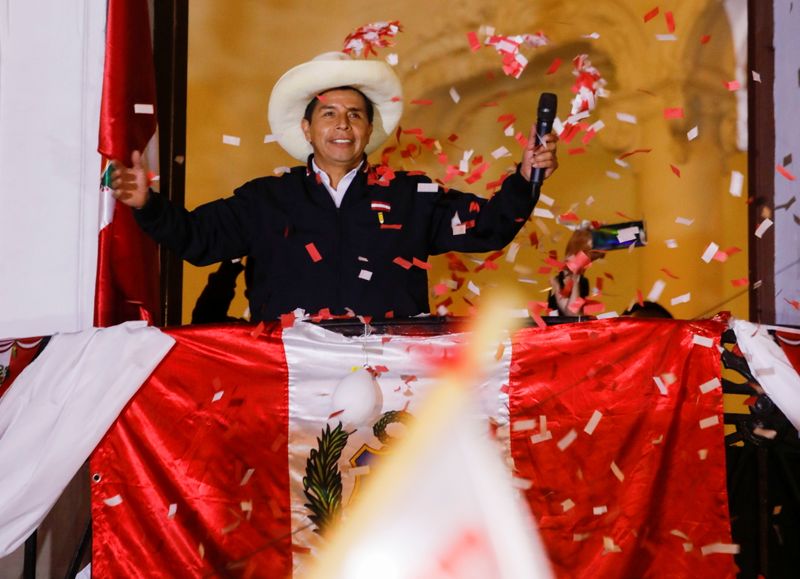
FILE PHOTO: Peruvians await presidential election results
LIMA (Reuters) – Pedro Castillo maintained a slim lead over rival Keiko Fujimori in Peru’s presidential election on Thursday, with almost all votes counted, but with a chunk of contested votes yet to be scrutinized by electoral authorities.
Castillo, an elementary school teacher and political novice who won widespread grassroots backing for pledges to rewrite the constitution and redistribute wealth, had 50.2% of the vote, maintaining a 0.4 percentage point lead over right-wing Fujimori, or 71,254 votes.
Some 300,000 contested votes are being scrutinized by an electoral jury, a process that will take several days to complete and could delay the announcement of who will be the next president to take over from interim leader Francisco Sagasti at the end of July.
However, analysts said that was unlikely to be enough to change the outcome, and many in the region were already celebrating Castillo’s victory.
More:
https://www.metro.us/perus-castillo-closes-in/
 = new reply since forum marked as read
Highlight:
NoneDon't highlight anything
5 newestHighlight 5 most recent replies
= new reply since forum marked as read
Highlight:
NoneDon't highlight anything
5 newestHighlight 5 most recent replies

Downtown Hound
(12,618 posts)And he deserves to rot in jail until the day he dies. Glad his daughter won't be able to set him free and continue in his murderous legacy.
I have always considered Bill Clinton's support of Fujimori to to be one of the great failings of his presidency. The U.S. needs to stop coddling dictators like him.

Judi Lynn
(164,122 posts)Judi Lynn
(164,122 posts)Electoral Observation Mission of the Organization of American States says vote was a ‘positive electoral process’ and no ‘serious irregularities’ were detected
12 Jun 2021
Peru’s presidential election frontrunner Pedro Castillo was poised for victory, despite legal wrangles over the ultra-close vote count that had ignited tensions in the Andean nation.
“We call on the Peruvian people to stay alert,” Castillo told supporters on Friday night in the middle of last-minute legal disputes over the tight vote count.
According to local media, electoral authorities had considered changing rules to allow right-wing rival Keiko Fujimori to challenge the validity of some 200,000 votes, but ultimately declined to make the changes in the afternoon, following intense pressure from Castillo’s camp.
In a boost for Castillo and a blow to Fujimori, the Electoral Observation Mission of the Organization of American States said the vote was a “positive electoral process” in which “serious irregularities” were not detected.
More:
https://www.aljazeera.com/news/2021/6/12/perus-castillo-on-verge-of-winning-presidency-after-tight-race
Judi Lynn
(164,122 posts)Tony Wood
The socialist candidate Pedro Castillo is on the verge of victory, but a hostile elite could stymie his agenda
Sat 12 Jun 2021 07.00 EDT
. . .
The electoral drama in Peru was in that sense a generational reckoning, comparable to the recent upheavals in Chile and Colombia. But it was also the product of the specific political crises Peru has endured in recent years. Since 2018, the country has had two presidents impeached and removed on charges of corruption and one hounded from office by a surge of protests. The sleaze and dysfunction of the established parties was one of the factors that enabled Castillo’s shock breakthrough in the first round of voting in April.
Until then he was known mainly for leading a protracted teacher’s strike in 2017, and his party, the avowedly Marxist-Leninist Perú Libre, had no seats in Congress. With only 19% of the vote, he finished first in a crowded field of 18 candidates. Combining redistributive economic policies with socially conservative views, for instance on same-sex marriage, Castillo looks, dresses and talks like the population of Peru’s long-marginalised interior provinces. Fujimori, by contrast, is the arch-insider, having been one of the most powerful players in Peruvian politics for more than a decade. She has run unsuccessfully for president twice before, in 2011 and 2016, and heads the Fuerza Popular party, which held the majority in Congress from 2016 to 2020. The 13% she scored in April, though a remarkable drop from the 40% she secured in the first round in 2016, was still enough for her to scrape through to the run-off.
The second-round campaign at once dramatised and deepened Peru’s stark socioeconomic, political and cultural divides. First, it drew attention to the gulf separating the more prosperous coast from poorer highland regions, which have a larger indigenous population. Castillo, who is from the northern mining region of Cajamarca, drew his support overwhelmingly from the highlands, which saw few of the benefits of the boom years of the 2000s and early 2010s. The Lima-based elite’s attitude to such disparities is perhaps best captured by a phrase Fujimori let slip during a presidential debate held in rural Cajamarca in early May, when she complained of having “had to come all the way here”. (She said afterwards this was a reference to the difficulty of the journey.)
A second crucial fault-line separated Keiko Fujimori’s supporters from those determined to reject the authoritarian legacy of her family’s dynasty. Alberto Fujimori, in power from 1990 to 2000 and currently serving a 25-year sentence for corruption, claims credit for defeating the Maoist Shining Path insurgency and imposing macroeconomic discipline on the country. However, these measures were implemented through harsh anti-democratic means: in 1992, Fujimori suspended the constitution, and the following year wrote a new one granting himself even greater powers. His decade in office was marked by abuses that scar the country to this day, including extrajudicial killings, the forced sterilisation of as many as 270,000 women and colossal corruption.
More:
https://www.theguardian.com/commentisfree/2021/jun/12/perus-knife-edge-election-could-be-good-news-for-latin-americas-left