Economy
Related: About this forumSTOCK MARKET WATCH -- Wednesday, 18 April 2012
[font size=3]STOCK MARKET WATCH, Wednesday, 18 April 2012[font color=black][/font]
SMW for 17 April 2012
AT THE CLOSING BELL ON 17 April 2012
[center][font color=green]
Dow Jones 13,115.54 +194.13 (1.50%)
S&P 500 1,390.78 +21.21 (1.55%)
Nasdaq 3,042.82 +54.42 (1.82%)
[font color=green]10 Year 1.99% -0.01 (-0.50%)
30 Year 3.14% -0.01 (-0.32%) [font color=black]
[center][/font]
[HR width=85%]
[font size=2]Market Conditions During Trading Hours[/font]
[center]


[/center]
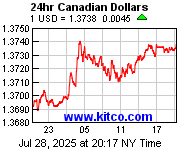
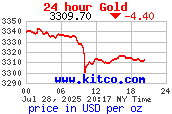
[font size=2]Euro, Yen, Loonie, Silver and Gold[center]


[/center]

[/center]
[HR width=95%]
[font color=black][font size=2]Handy Links - Market Data and News:[/font][/font]
[center]
Economic Calendar
Marketwatch Data
Bloomberg Economic News
Yahoo Finance
Google Finance
Bank Tracker
Credit Union Tracker
Daily Job Cuts
[/center]
[font color=black][font size=2]Handy Links - Economic Blogs:[/font][/font]
[center]
The Big Picture
Financial Sense
Calculated Risk
Naked Capitalism
Credit Writedowns
Brad DeLong
Bonddad
Atrios
goldmansachs666
The Stand-Up Economist
The Automatic Earth
[/center]
[font color=black][font size=2]Handy Links - Government Issues:[/font][/font]
[center]
LegitGov
Open Government
Earmark Database
USA spending.gov
[/center][font color=black][font size=2]Handy Links - Videos:[/font][/font]
[center]
Charlie Rose talks with Roubini
Charlie Rose talks with Krugman
William Black: This Economic Disaster
Bill Moyers with Kevin Drum and David Corn
[/center]
[div]
Financial Sector Officials Convicted since 1/20/09 = [/font][font color=red]12[/font]
2/2/12 David Higgs and Salmaan Siddiqui, Credit Suisse, plead guilty to conspiracy involving valuation of MBS
3/6/12 Allen Stanford, former Caribbean billionaire and general schmuck, convicted on 13 of 14 counts in $2.2B Ponzi scheme, faces 20+ years in prison
[HR width=95%]
[center]

[HR width=95%]
[font size=3][font color=red]This thread contains opinions and observations. Individuals may post their experiences, inferences and opinions on this thread. However, it should not be construed as advice. It is unethical (and probably illegal) for financial recommendations to be given here.[/font][/font][/font color=red][font color=black]
 = new reply since forum marked as read
Highlight:
NoneDon't highlight anything
5 newestHighlight 5 most recent replies
= new reply since forum marked as read
Highlight:
NoneDon't highlight anything
5 newestHighlight 5 most recent replies

Tansy_Gold
(18,167 posts)Son, DiL, grandson coming in from Seattle and we're goin' to a baseball game tomorrow. I have no idea when I'll get home, so you folks can either wait up for me (ha ha ha) or someone who's so inclined can start it off. But I will be back before midnight. . . . .

Po_d Mainiac
(4,183 posts)Demeter
(85,373 posts)So it won't be me starting anything on Wednesday...

Roland99
(53,345 posts)
Demeter
(85,373 posts)Which means that next Thursday we reconvene and try to get the other half done.


All this Sturm und Drang because the house rules and bylaws, which I have tried THREE TIMES (3, count them, 3) in the past 5 years to get straightened out...are biting us every time we turn around.
I had no support. The FIRST time, the self-dealing bitches went and undid all the work in the dead of night, and we found out 5 minutes before the conversion vote, and since everybody wanted to convert, they were accepted in spite of their unlegal and awfulness.
The SECOND time, they took it away from me...that was a vendetta. I'm going to fix that little red wagon next time we elect board members....and it will be my pleasure.
the THIRD time, the present, we have had exactly ONE meeting, 3 weeks ago. A major rewrite is going to take two years, I figure, since we are volunteers and all. I've learned so much since the first attempt, but the problem is so much bigger than it was because so much more has happened since then, and I'm a lot more knowledgeable about the enormity of the problem. Still, winners never quit...and whining is par for the course. (I will try to keep it out of the thread).
But I could really use a drink, now.
And that doesn't even count the whole buy-the-mortgage from the bank and save a lot of money issue....which may finally...FINALLY...be getting off the ground.
I have a corkscrew around here somewhere....
Well, what the hell. We got until April 30th.....
Demeter
(85,373 posts)I resemble that remark. 
Roland99
(53,345 posts)Tansy_Gold
(18,167 posts). . . how outraged I am, every single day, at the crap that goes on. Most of it comes from the right, but teh DEAFENING SILENCE from too many on the left is just as terrifying.
When did I and those like me become second class human beings? When did we, because of our physiology, become unworthy of respect and compassion and some attempt at fairness?
Yes, women can get pregnant. Yes, pregnancy may raise the cost of medical care over her life for a woman who bears children. What about sports injuries for men? I can't even begin to tell you how many over-60 men I know right now who are dealing with major medical issues due to years of playing sports when they weren't fit enough for it or due to years of body-punishing employment or just plain stupid shit like dropping a trailer hitch on their finger instead of the ball. NONE OF THEIR OVER-60 WIVES ARE DEALING WITH SIMILAR ISSUES.
Sorry. I could rant about this for hours. . . .
Demeter
(85,373 posts)I was listening to Bloomberg surveillance this morning and they were discussing the problem of skyrocketing rents mixed with tight credit for mortgages and increasing foreclosures. One of the hosts said that “everyone was waiting for the 49 state mortgage settlement” as a go signal to start foreclosures again. That’s what the mortgage settlement really is, a cultural, legal, and political signal of “all clear”. How exactly a new wave of foreclosures is supposed to help the housing market is still something of a puzzle, but it does show that the administration and most settlement pushers really do believe that the market needs to clear via foreclosures before it can reset. I guess we’ll see.
Meanwhile, here’s more evidence that the settlement is really just meant to kick off a new round of injury to homeowners. The monitor of the settlement, court-appointed North Carolina official Joe Smith, clearly doesn’t know how to do his job.
“I don’t have a quick and easy answer to that right now,” Smith said when I asked him how he’s going to avoid the same conflicts of interest we’re seeing in the foreclosure reviews when he hires his own “primary professional firm.”
Finding the “appropriate balance between independence and capacity,” as Smith describes it, is not easy when sufficient independence may mean too little experience and sufficient experience may mean conflicts of interest. Conflicts of interest tempt consultants to bend the rules on behalf of current and future bank clients.
Smith has already invited about 40 handpicked professional services firms to express interest in the “primary professional firm” role. Depending on the response he gets, some will be invited to respond to a request for proposals and then subjected a highly personal final selection process.
“I’ll meet personally with the firm I’m going to depend on,” he promises. The banks, according to Smith, want to deal with one firm for settlement compliance reporting. That’s not surprising. Better the devil you know…
He’ll meet personally with highly conflicted firms before depending on them? Like a meeting, in person? Wow! That’s a devastating accountability mechanism. Then there’s this embarrassing nugget.
“If litigation against the banks continues and plaintiffs’ claims continue to contradict what I’m hearing from bank leadership,” Smith says. “I’ve got to pay attention to it.”
So Smith is saying that if bank leaders continue to lie to him, he might have to pay attention to the fact that they are lying to him?
Joe Smith seems up for the task he’s agreed to. “I’ve got a lot of stuff I have to enforce. I’m hoping all the time and money the banks are spending on the foreclosure reviews will show up as we do our work.”
I really hope Smith is not as stupid as he sounds.
Demeter
(85,373 posts)Wells Fargo and U.S. Bank have let foreclosed homes in black and Latino neighborhoods lapse into disrepair, while bank-owned homes in mainly white neighborhoods are better cared-for, according to housing advocates.
The National Fair Housing Alliance, a non-profit group, brought a formal complaint to the Department of Housing and Urban Development last week alleging that Wells Fargo violated the Fair Housing Act by failing to keep up homes in minority neighborhoods. Today, the group announced they are also filing a second complaint, against U.S. Bank.
Earlier this month, the group released a survey, which was funded in part by HUD, of more than 1,000 unoccupied, foreclosed homes across the country owned by unspecified banks. When a house is foreclosed upon, the bank that takes it over is responsible for maintaining it. The report cites evidence — photos and interviews with neighbors — showing houses becoming dilapidated under banks' watch.
The complaint against Wells Fargo claims that among more than 200 homes surveyed, those in black and Latino neighborhoods were much more likely to have yards filled with trash, broken doors, damaged windows, and other signs of neglect. Fewer homes in those neighborhoods had "for sale" signs visible. For example, 68 out of 149 homes in black and Latino neighborhoods had damaged roofs, compared to only nine out of 69 properties in white neighborhoods. The study looked at homes owned by Wells Fargo in Washington D.C., Baltimore, Philadelphia, Dallas, Miami, Atlanta, Oakland, Calif., and Dayton, Ohio....
Demeter
(85,373 posts)The company President Obama called a "model for America" is squeezing its workers, cutting pensions, wages and benefits--but workers are organizing to fight back...If the war against unions has reached a tipping point, Wilma Smith is among those determined to rebalance the scales. The 58-year-old assembler at the General Electric plant in West Burlington, Iowa, was called back to work in September. She had been on layoff since 2007 from the non-union factory, which makes electrical switch gears for municipalities and energy-hungry factories, hospitals, and call centers. “You know how you have a fuse box in your house?” she asks. “These are like fuse boxes for a city,” the size of a refrigerator.
But the job came with new terms: a 50 percent pay cut—she’d now make $12 an hour. No health care coverage when she retired. And no chance she’d get the $5,000 bonus GE’s union workers won in last year’s national contract.
“You know what the deal is, so I don’t want to hear any complaining,” the manager at the 150-worker plant told her at orientation.
Six months later Smith is a leader in the Electrical Workers (IUE-CWA) organizing committee that’s expecting a Labor Board election in April. The campaign was buoyed by a successful January vote at a GE factory that refurbishes locomotive motors in Kansas City, Missouri, the first GE plant to go union in a decade. Success breeds success, and organizing is now under way in several other locations. “As soon as they heard the workers in Kansas City won, another group called us up immediately,” said Mike Knox, an Electrical Workers (IBEW) organizer involved in the Missouri win...
SCUMBAGS BEWARE! WE ARE THE 99%, AND WE ARE PISSED! (OR i WOULD BE, IF i GOT UP AND FOUND THE CORKSCREW...)
Demeter
(85,373 posts)ROMNEY WANTS TO HIRE LARRY, TIM AND BENNY?
http://www.nakedcapitalism.com/2012/04/romneys-lead-economist-urges-policies-that-will-cause-the-next-financial-crisis.html?utm_source=feedburner&utm_medium=email&utm_campaign=Feed%3A+NakedCapitalism+%28naked+capitalism%29
Presidential nominees of either U.S. party can secure economic advice from any economist in the world. This makes it all the more amazing and sad that they choose economists with track records of disastrous policy advice. Bill Clinton chose Robert Rubin, George W. Bush chose Gregory Mankiw, Obama chose Lawrence Summers, and Mitt Romney chose Mankiw. Rubin and Summers led the Clinton administration’s efforts to gut financial regulation. Mankiw led the efforts under Bush. Collectively, these efforts created the criminogenic environment that produced endemic financial fraud (“green slime”).
Mankiw Morality
I have often emphasized the importance of George Akerlof and Paul Romer’s 1993 article (“Looting: the Economic Underworld of Bankruptcy for Profit”) to understand the economics of why we suffer epidemics of accounting control fraud and recurrent, intensifying financial crises. Mankiw was the “discussant” when they formally presented their paper. I was also present at their invitation. Mankiw was unconcerned about looting. It was my first introduction to Mankiw morality: “it would be irrational for savings and loans [CEOs] not to loot.” I was appalled, but my outrage at Mankiw paled when I observed that the members of the audience, professional economists, were not even made visibly uncomfortable by such a depraved response to elite fraud. CEOs owe fiduciary duties to the shareholders. Mankiw’s response to the findings that CEOs were looting their shareholders was to praise the rationality of the fraudulent CEOs (if you don’t loot you aren’t moral – you’re insane). One cannot compete with theoclassical economists’ unintentional self-parody.
Mankiw Still Loves the Regulatory Race to the Bottom that Breeds Endemic Green Slime
Mankiw wrote a column in the New York Times praising competition among governments.
I start with a historical note that falsifies Mankiw’s claim that competition among governments is desirable. Mankiw makes an historical argument for his claim that competition among governments is desirable and notes that the “founding fathers were no fools.” In an odd way, we can thank our immensely successful Constitution to the demonstrated disaster produced by governmental competition engendered by the Articles of Confederation. The States competed vigorously – to aid their merchants at the expense of “foreign” States (their neighboring States). They competed to impose more destructive internal tariffs (and other trade barriers) so aggressively that they crippled commerce. This is one of the principal defects that led the committee appointed to reform the Articles to instead junk them and adopt our Constitution. The Constitution created a nation instead of a confederation. The interstate commerce and supremacy clauses were key provisions of the new Constitution because the framers knew that competition among the States and the new federal government could threaten our nation’s survival.
In the context of public finance and financial regulation Mankiw’s praise for such competition demonstrates that he has learned nothing useful from our recurrent crises. This column discusses why competition among governments in financial regulation leads to the criminogenic financial deregulation that produces the epidemics of green slime that drive our financial crises. I have recently explained, in the context of opposing the JOBS Act, why the “regulatory race to the bottom” is an oxymoron designed by regular morons...
AND BILL GOES ON...DELIGHTFULLY
Demeter
(85,373 posts)Warren Buffett, the billionaire founder of Berkshire Hathaway, said on Tuesday that he had been diagnosed with stage-one prostate cancer, the earliest diagnosed level.
The 81-year-old business magnate told shareholders in a letter that his condition was “not remotely life-threatening or even debilitating in any meaningful way”, adding: “I feel great – as if I were in my normal excellent health – and my energy level is 100 per cent.”
Read more >>
http://link.ft.com/r/YIQXNN/L9VCIN/MJTKN/B5SIOU/QN52XU/E4/t?a1=2012&a2=4&a3=17
Demeter
(85,373 posts)The wealthiest Americans believe they've earned their money through hard work and innovation, and that they're the most productive members of society. For the most part they're wrong. As the facts below will show, they're not nearly as productive as middle-class workers. Yet they've taken almost all the new income over the past 30 years.
Any one of these five reasons should reinforce the belief that the rich should be paying a LOT more in taxes.
1. They've Taken All the Middle Class Wage Increases
2. They've Mismanaged Key American Industries
3. They've Benefited from 50 Years of Public Research
The very rich have made their fortunes in good part because of taxpayer-funded research at the Defense Advanced Research Projects Agency (the Internet), the National Institute of Health, the National Science Foundation, and numerous other government agencies.
Consider just a simple communications device. Computer chips and audio/video/voice technologies grew out of decades of funding at the Department of Defense, the Air Force, NASA, and public universities. The pieces of the device were put together by a procession of chemists, physicists, chip designers, programmers, engineers, production-line workers, market analysts, testers, troubleshooters, etc., etc. They, in turn, couldn't have succeeded without another layer of people providing sustenance and medical support and security and administrative assistance and transportation and office maintenance for the technologists. ALL of them contributed to the final product.
But over the years private businesses have received government contracts to produce and market the results, and "entrepreneurs" have rearranged the pieces into products that seem to appear out of the magical world of a single individual.
4. They've Increased Their Incomes By Not Paying Taxes
5. They've Contributed Little to Society
MORE DETAILS (OR INDICTMENTS) AT LINK
Demeter
(85,373 posts)that knits up the raveled sleeve of care...or at least, anesthetizes it.

Fuddnik
(8,846 posts)The stepson came down from Cleveland on Thursday, and he's here until next Tuesday. Had guests over for a cook-out tonight. I did all the prep and cooking. Now I can relax, read SMW and have cocktails.
Demeter
(85,373 posts)Bank’s ‘value at risk’ measure falls to lowest level since before the financial crisis, indicating it is preparing for onset of tough new rules
Read more >>
http://link.ft.com/r/5F39HH/FKGGCS/FDFZE/30XZQO/5VNSCB/XL/t?a1=2012&a2=4&a3=18
Demeter
(85,373 posts)The vote may reflect a deeper change in shareholder behaviour, which Dodd-Frank reforms were designed to achieve
Read more >>
http://link.ft.com/r/5F39HH/FKGGCS/FDFZE/30XZQO/NJZCSM/XL/t?a1=2012&a2=4&a3=18
SO CRYPTIC! IS THIS A CONTINUATION OF THE "ASPENS ARE TURNING" THEME?
Demeter
(85,373 posts)Explosion at German chemical maker Evonik Industries has taken out one of the industry’s biggest producers of cyclododecatriene, used in a nylon found in coatings and connector applications
Read more >>
http://link.ft.com/r/5F39HH/FKGGCS/FDFZE/30XZQO/NJZCSX/XL/t?a1=2012&a2=4&a3=18
hEARD ABOUT THIS ON THE RADIO...EXCEPT THEY COULDN'T EVEN BE BOTHERED TO SAY WHICH CONTINENT THE EXPLOSION WAS ON....JUST THAT CAR MANUFACTURERS WOULD HAVE A TIME TRYING TO GET "RESIN" TO MAKE GAS TANKS AND STUFF....AND THAT THERE WERE ONLY THREE SUCH FACTORIES IN THE WORLD...
IF THE FACTORIES ARE GOING TO EXPLODE SPECTACULARLY, MAYBE THE WHOLE USE OF THIS STUFF SHOULD BE RETHOUGHT....
Demeter
(85,373 posts)http://www.bloomberg.com/news/2012-04-17/spain-sells-more-bills-than-planned-as-yields-increase.html
Spain borrowing costs rose at a sale of one-year and 18-month bills for the first time since November as Prime Minister Mariano Rajoy battles to convince investors the country won’t need a bailout. Spain sold 12-month bills at 2.623 percent, up from 1.418 percent at the last auction on March 20, the Bank of Spain said in Madrid today. The Treasury also sold 18-month bills at 3.11 percent, compared with 1.711 percent last month. The total amount sold was more than the 3 billion-euro ($3.9 billion) maximum target set for the auction. Spanish bonds extended gains after the auction with the yield the 10-year benchmark bond falling 16 basis points to 5.91 percent. That yield rose as high as 6.156 percent yesterday, the most since Dec. 1. Spain faces another test of market sentiment on April 19 when it seeks to sell 2.5 billion euros of two-year bonds and its 10-year benchmark security.
“As far as this auction goes, not so bad but not good enough, in my opinion, to provide the market with a sense of optimism going into the bond auction on Thursday,” said Luca Jellinek, head of European interest-rate strategy at Credit Agricole Corporate & Investment Bank in London.
ECB Help
Demand for the 12-month bills was 2.9 times the amount sold, compared with 2.14 times last month. Demand for the longer maturity notes rose to 3.77 times from 2.93. Demand for Spanish debt has been underpinned by the European Central Bank’s emergency three-year lending to banks at tenders in December and February. Spanish banks’ average net borrowings from the ECB surged almost 50 percent in March to 227.6 billion euros, central bank data showed last week, and data from the Treasury shows Spanish lenders piled up on the nation’s debt in the three months through February.
Spanish officials have called for additional help from the central bank, and Economy Minister Luis de Guindos is due to meet ECB President Mario Draghi in Frankfurt today. Industry Minister Jose Manuel Soria said today that a more “expansionary” policy to inject more liquidity would be “desirable,” after Jaime Garcia-Legaz, the deputy minister for trade, called on April 13 for the ECB to restart bond purchases. The central government faces 11.9 billion euros of bond redemptions in April, 12.7 billion euros in July, and 20.2 billion euros in October, Treasury data show. Spain’s 10-year borrowing costs have jumped more than one percentage point since Rajoy said on March 2 that the nation won’t meet a budget deficit target for this year of 4.4 percent of gross domestic product set by the previous administration and the European Union. Rajoy convinced euro-region peers to relax the goal to 5.3 percent as the euro area’s fourth-largest economy is forecast to contract 1.7 percent in 2012....
MORE ANALYSIS/COMMENT: http://www.reuters.com/article/2012/04/17/markets-bonds-euro-idUSL6E8FHAD620120417
Ireland’s Recovery a ‘Template’ for Europe, World: Templeton
http://www.cnbc.com//id/47069606
Ireland has quietly slipped from the headlines besieging the debt-ridden euro zone, and perhaps for good reason...In a recent interview with Dow Jones Newswires, Irish Deputy Finance Minister Brian Hayes said there are early signs that the country’s crisis could be ending, pointing to data that showed the government taking in more tax revenues this year, that international companies are investing again, and that the country had stopped "hemorrhaging" jobs.
The improving economic environment has instilled confidence in Michael Hasenstab, Co-Director for the International Bond Department of the Franklin Templeton Fixed Income Group, whose Templeton Global Total Return Fund counts Ireland as its fifth-largest investment at 6.2 percent of total holdings...Ireland is a "turnaround story" representing a longer term "three-to-five year trade," Hasenstab told CNBC Asia's 'Squawk Box’ on Tuesday, and added that the country's fiscal resolve combined with a strategy to grow the economy is not just a lesson for the country's neighbors in Europe. "What Ireland is doing is not only a template for what the Euro zone needs to do, but what the U.S. needs to do, what Japan needs to do," said Hasenstab, who personally manages $150 billion worth of fixed income assets. "And that is dealing with both the debt and the growth. So they (Ireland) dealt with the debt, with fiscal austerity, that was tough in the short term but set the stage for the future and they dealt with the growth by remaining competitive."
Not everyone agrees holding Irish bonds is the right strategy. “You have had the juice on the bonds and 5-year debt at roughly 5.5 percent is not overwhelming,” Patrick Perret-Green, head of FX & rates strategy for Asia at Citi, told CNBC.
“The Irish have been the poster boys for austerity in Europe but if the broader environment continues to deteriorate then so too could the debt,” he added. “I would say if you believe in Spain then buying Spanish debt is probably a better trade here, but if you don't then you wouldn't want to own Irish debt either.”
NOW THAT'S A VOTE OF CONFIDENCE!
EU report to show rocky road ahead for Greek recovery
http://www.reuters.com/article/2012/04/17/eu-greece-idUSL6E8FHAOG20120417
Greece must liberalise its labour market and business environment and focus on its public finances and credit flow to companies if it wants to make a positive impact on its economy this year, a draft European Commission document showed. The European Union's executive arm will publish on Wednesday a series of ideas on how the contracting Greek economy can return to growth, which the country badly needs to be able to service its huge debts. In the report that runs to more than 40 pages, however, officials list a litany of problems facing the Greek economy, whose recovery is key for the future of the euro currency.
"Greece suffers from a lack of capacity to implement policy, manage public finances, collect taxes, open markets to competition, make public procurement work efficiently and innovatively, pay suppliers, or offer timely judicial review to its citizens," they write in the document seen by Reuters. Elsewhere they seek to strike an optimistic note..."Greece can build on its many strengths - such as its shipping sector, its tourism potential, its universities and generally well-educated work force as well as its location as a potential logistics and energy hub in South Eastern Europe," said the document obtained by Reuters.
Greece, which remains shut out of the financial markets, will get emergency financing until 2014 from the euro zone and the International Monetary Fund if it implements an agreed reform plan. The Commission draft stressed that before Greece can return to growth, it has to regain control of its public finances. Greek public debt is around 160 percent of gross domestic product (GDP) but with great austerity, a debt restructuring and reforms, Athens is expected to be able to bring that down to below 117 percent by 2020. The Greek government should focus on spending cuts rather than tax hikes to shore up its finances, as this will reduce the negative impact on the economy and leave more domestic and foreign savings available to finance business, the document said. Improving its tax collection is also seen as vital.
CREDIT FLOW
Another priority was restoring the flow of credit to the economy as Greek banks curbed lending because of a large outflow of deposits, the paper said. To help change that, Greek banks are to be recapitalised with money from EU loans by September. Small and medium-sized enterprises (SMEs) are key drivers for economic growth and employment because they represent 99.9 percent of all companies in Greece, with micro-enterprises representing 96.5 percent. Yet six out of 10 firms saw a deterioration in their earnings in 2011 compared to 2010, and 150,000 jobs were lost there last year. A Greek survey showed that 60,000 such firms would close and a further 240,000 jobs would be lost this year....Finally, to help boost growth, Greece should liberalise business, now entangled in bureaucracy and corruption, as reforms in the production and service sectors could add up to 13.5 percent to Greek GDP over the long-term. The Commission noted that Greek nominal labour costs in the business economy should fall 15 percent over the next three years to restore its cost-competitiveness. Greek exports could get a quick boost by cutting red tape, which prolongs the average time needed for export clearance to 20 days on average from the EU average of 10 days. "This is estimated to result in total export value which is around 10 percent less than it would otherwise be," the Commission said. Bidders for Greek public contracts wait nearly 1 year, twice as long as the EU average, for contracts to be awarded. Procedures are inefficient and resource-consuming, and each triggered on average two appeals, it said. "This situation penalises suppliers to the public sector and increases costs. It prevents the acquisition of supplies and services needed to perform public services, and prevents the completion of works funded by the EU structural funds," the paper said. More gains could come from deregulating sheltered professions and modernising the electricity and gas sector, which is dominated by a few inefficient state-owned quasi-monopolies. Greece should also remove administrative barriers and improve poor management in its transport sector, which is key to making better use of tourism. Athens also needs to thoroughly overhaul its public administration. "Complexity and opacity at all levels create opportunities for corruption that undermine citizens' confidence in the system and corrode its effectiveness," it said. The Commission said the European Union was ready to help Greece with money and know-how, noting the total financial assistance to Athens of about 380 billion euros, or 177 percent of Greek GDP, was unprecedented.
SO, THE BEATINGS WILL CONTINUE...BECAUSE UNLIKE SPAIN AND IRELAND, GREECE WAS A RELATIVELY CORPORATION-FREE PLACE....

xchrom
(108,903 posts)Eurozone crisis live: German borrowing costs hit record low after Portugal admits it may need more help
12.27pm An interesting research note from UBS argues today that Ireland should be given plenty of slack by the Troika if it misses the targets set under the bailout.
FT Alphaville has the full note (scroll to 11.28am its excellent Markets Live session). Here's a flavour:
The more important factor is that Europe needs Ireland to succeed as much as Ireland needs Europe. Why is that? Quite simply, because here is a country that has diligently stuck to the fiscal targets and also adopted a textbook reform agenda: if it fails, there is a risk that other vulnerable economies such as Portugal, Spain and Italy will fail too.
Put differently, provided Ireland makes an earnest effort, this symbiotic relationship should serve it well.
12.14pm: The eurozone crisis received a mention at Prime Minister's Questions in the House of Commons.
Asked about Standard & Poor's decision last Friday to reaffirm Britain's AAA rating and stable outlook, David Cameron said
We've received more reminders from other European countries this week about the importance of getting on top of your deficit, on top of your debts, and having a proper plan.
And Fraser Nelson, Editor of The Spectator, swiftly tweets a photo showing how predictions for Britain's deficit-reduction schedule have steadily worsened since Cameron took over...
Fraser Nelson@frasernelson
In PMQs, Cameron talks about "importance of getting on top of the deficit". Here's his progress over two years. twitpic.com/9b7kqh
Demeter
(85,373 posts)Even Ireland has Reality to limit it.
No matter what Europe may THINK it needs...it really needs a good dose of Reality.
xchrom
(108,903 posts)Markets on Tuesday were almost euphoric after Spain managed to sell some bonds at not outlandish interest rates. Even the Greeks managed to borrow money, albeit for just three months. Better than expected business confidence in Germany also encouraged markets bulls to press the accelerator button.
The IMF produced a global economic forecast slightly higher than its last one. "All good," as Hugh Bonneville's character Ian Fletcher often says with a fixed smile on the BBC's comedy 2012. The FTSE was up more than 100 points at 5766. Continental stock markets followed suit.
But traders are looking at the magnificent froth on their capuccinos and failing to see that their coffee has gone cold.
Which is another way of saying that figures from the real economy were decidedly chilly.
xchrom
(108,903 posts)
A woman holds an Argentinian flag at the presidential palace after President Cristina Fernández de Kirchner announced that the oil company YPF would be nationalised. Photograph: Daniel Garcia/AFP/Getty Images
Even as president Cristina Fernández de Kirchner announced on TV her plan to nationalise Spanish-owned YPF, her emissaries were at the oil company's 35-storey Buenos Aires headquarters giving its Spanish directors 15 minutes to leave the building.
Coming two months after King Juan Carlos had personally phoned Fernández to lobby against such a move, the seizure enraged Madrid. "Argentina has just shot itself in the foot in a really bad way," said Spain's foreign minister, José Manuel García-Margallo, warning that the takeover would hamper Argentina's access to international credit and export markets. "The damage to Argentina could be irreparable," he said.
But in Argentina, Fernández's televised announcement that she was sending a bill to Congress to appropriate Repsol's majority stake in YPF was greeted with cheers of "Cris-ti-na! Cris-ti-na!" by her officials in the audience at the Casa Rosada presidential palace. Members of La Campora, the Peronist youth group founded by her son Máximo Kirchner, these young economists are masterminding the nationalist imprint that characterises her second term after a landslide 54% in last year's elections.
The tabloid Crónica headlined its front page "Dame Courage", while a crowd gathered at the Casa Rosada with banners reading "We're going for everything" – a phrase Fernández has used to describe her "national and popular" government's battle against the media and "corporations" that she has in the past accused of plotting her overthrow.

AnneD
(15,774 posts)Argentina is our future, IMHO.
Roland99
(53,345 posts)Europe down noticeably but something just spiked the markets there back up.
Spain's IBEX at a 3-year low.
Demeter
(85,373 posts)if the PPT will let it be, that is....got too close to that sacred 13K line for comfort, in the first few minuets, no less!
xchrom
(108,903 posts)The Italian government has slashed its forecast for the economy in 2012.
It was previously predicting a 0.4% contraction in the economy, but has cut that to a 1.2% contraction.
The government has also admitted that it will not be able to meet its target of balancing the budget by 2013.
It now says that it will be able to balance the budget by 2015, which is still more optimistic than the IMF, which says Italy will not have a balanced budget until at least 2018.
Roland99
(53,345 posts)
Roland99
(53,345 posts)uhhhh....
Demeter
(85,373 posts)I have sprained a back muscle, which spasms, and the water is off for repairs...

DemReadingDU
(16,002 posts)4/17/12 Volatility at World's End: Two Decades of Movement in Markets
Published on Apr 17, 2012 by Artemis CM
To download the corresponding article to this video please visit http://www.ArtemisCM.com/category/research
The video was first shown in conjunction with Christopher Cole's speech at the 2012 Global Derivatives and Risk Management Conference in Barcelona, Spain.
"Nobody will deny there is roughness everywhere...." Benoit Mandelbrot
The movement of stock prices has been an obsession for generations of speculators and traders. On a higher level mathematicians believe that modern markets are an extension of the same fractal beauty found in nature. Visualized these stock markets may take the shape of a turbulent ocean with waves made of human hopes, dreams, greed, and fear.
Merging the world of high-finance and high-art Artemis Capital Management LLC is proud to present a creative visualization of stock market volatility over the last two decades.
"Volatility at World's End" Two Decades of Movement in Markets
is a depiction of real stock market volatility using trading data from 1990 to 2011. The visuals are designed from S&P 500 index option data replicating the implied volatility wave (or variance swap curve) extending to an expiration of one year. The front of the volatility wave contains the same data used to calculate the CBOE VIX index. The movement of this wave demonstrates changing trader expectations of the future stock market volatility. As the wave moves through time the expected (or implied) volatility surface transforms into a realized volatility surface derived from historical S&P 500 index movement. The transition represents what professional traders call "volatility arbitrage". The color variation in the volatility waves show the volatility -of-volatility or internal movement of the wave. The track underneath the volatility wave represents underlying S&P 500 index prices.
Concept and Creative Direction by Christopher Cole, CFA
Visual Animation and Programming
by Jayson Haebich www.BrokenPixelProductions.com
Title Design by Nataliya Vakulenko
Artemis Capital Management LLC, All Rights Reserved 2012
http://www.ArtemisCM.com
&feature=player_embedded
Demeter
(85,373 posts)I think the word they are groping for is "fractured", as in broken beyond repair or patching up.
xchrom
(108,903 posts)(Reuters) - Britain's current high inflation may now be at greater risk of lasting into the medium term, the Bank of England warned on Wednesday, casting doubt on whether it will inject more economic stimulus next month.
Minutes to the BoE's April 4-5 meeting showed on Wednesday showed that a long-standing advocate of more quantitative easing, Adam Posen, had dropped his call for more stimulus, and that others were worried the BoE's anti-inflation commitment risked being called into question.
One of the 9 members of the Monetary Policy Committee, David Miles, continued to support more QE.
xchrom
(108,903 posts)Spanish banks' bad loans rose to their highest level since1994 in February, to 8.2 per cent of their credit portfolios, Bank of Spain data showed today, as the sector continues to battle sliding house prices and a looming recession.
Banks are facing a new wave of loan defaults as an economic crisis deepens and analysts say some may not survive as the government implements sweeping budget cuts that will only add to Spanish households' problems with repaying debt.
Non-performing loans increased by €3.8 billion to €143.8 billion in February from the previous month. They totalled 7.9 per cent of total debt portfolios in January.
That picture - driven by the collapse of a housing boom in the global financial turmoil of 2008 - is at the heart of problems for Spanish banks that have seen other institutions refuse to lend to them and forced some to rely on the European Central Bank for funding.
Demeter
(85,373 posts)– Derivatives are the “meat and meat by-products” of the financial markets. They look, smell and taste just like regular securities, but almost no one understands why we need them in the first place. After all, what’s wrong with actual meat? Or to re-phrase the question: Is Spam really an advancement over ham? More importantly, can we trust the derivatives markets? Or might they be toxic? Might they subject the financial markets to devastating side effects? No one really knows…and since lab rats refuse to eat them, we must assess the risks of derivatives by relying on suppositions, theories and conjecture. Therefore, as a public service, your California editor will offer a few suppositions, theories and conjectures about the rapidly expanding derivatives markets.
The worldwide marketplace of financial derivatives is enormous. No one disputes that fact. But the potential destructive impact of these arcane, opaque securities is very much in dispute. The apologists for financial derivatives usually say something like, “Sure, the derivatives markets are huge on a gross basis, but relatively small on a net basis.” According to this logic, a bank that purchased $1 trillion worth of Spanish interest rate swaps from one-party, but also sold $1 trillion worth of Spanish interest rate swaps to another party, has zero “net exposure.” Mathematically, that statement is correct. Realistically, it is a delusion. If the financial markets should hit a pothole or two, that “zero net exposure” has the potential to behave a lot more like the $2 trillion of gross exposure. How could that happen? Very simple. One or more of the parties to these enormous transactions would have to renege on its obligations, thereby triggering a domino effect. Very simple…and not difficult to imagine. In fact, we’ve already seen the trailer for this horror film. The bankruptcy of Lehman Brothers in 2008 was not only the demise of a prestigious investment bank, it was also the demise of a major counterparty to numerous derivatives contracts. Without Lehman, billions of dollars’ worth of “zero net exposure” suddenly became billions of dollars of plain, old exposure — i.e., unhedged risk. But that’s when the US Treasury stepped into the path of the falling dominoes with trillions of dollars of newly printed cash and government guarantees. As a result, the dominoes did not merely stop falling, but Wall Street banks were also able to take their fallen dominoes to the Fed and trade them for cash. Pretty nifty, no?
But what happens next time? Will the US government’s power of credit and collusion be sufficient to prevent a disaster in the derivatives markets? No one knows — least of all the folks who are sitting atop this big, steaming pile of risk exposure. Here’s a bit of background…In the derivatives markets, the term, “net exposure,” conveys a sense of certainty and reliability — a sense of finely calibrated balance. In fact, “net exposure” more closely resembles the image of two drunks leaning against one another. The net balance between the two drunks is the only pertinent risk factor, the apologists argue. As long as the two drunks are leaning towards one another, the two of them can toss back as many tequila shots as they wish. On a “net basis,” they behave as if they are completely sober. But what if one of the drunks should keel over backwards, instead of merely leaning toward his fellow drunk? “That won’t happen,” comes the practiced response from the derivatives industry. “That won’t happen. Don’t worry about it. The four largest banks operating in the derivatives markets maintain very manageable levels of net exposure.” Your California editor is not convinced. He suspects these levels of net exposure are only manageable…until they aren’t. Furthermore, these exposures are growing rapidly. Since 2000, the notional value of US derivatives outstanding has multiplied ten times faster than world GDP. At last count, American banks had conjured more than $200 trillion of financial derivatives into existence, according to the Options Clearing Corporation — a staggering sum that is equal to roughly three times world GDP! Even scarier, this mind-blowingly enormous pile of risk is highly concentrated inside the finance industry. A mere four banks hold 94% of all derivatives contracts outstanding. JP Morgan’s exposure, alone, is larger than the entire world’s GDP…while the gross exposures of Bank of America, Citigroup and Goldman Sachs do not trail very far behind.

Gross Derivatives Exposure of 4 US Banks vs. GDP of Entire World
The story becomes even more frightening when you take a closer look at what these “little derivatives are made of.” Snakes and snails and puppy dog tails would be an improvement. “In its 2011 annual report,” reports James Grant, editor of Grant’s Interest Rate Observer, “J.P. Morgan Chase & Co. discloses that the great bulk of the bank’s [derivatives]…are classified as ‘level 2’ assets, i.e., they are valued, in part, by analogy.” JP Morgan’s derivatives book is not unique. A whopping 97% of all derivatives trade “over-the-counter” where illiquidity and opacity are the norm. In other words, they do not trade on a public exchange where buyers and sellers continuously exchange cash for securities, thereby establishing real-world, real-time values for the securities they trade.
Let’s summarize:
1. Gross US derivatives exposure is more than three times world GDP.
2. Four banks hold nearly all of this risk. (And by the way, each of these four banks received billions of dollars from the Federal Reserve and Treasury four years ago to ensure their survival).
3. Almost none of these securities trade on a transparent, public exchange. Therefore, they are valued, as Jim Grant says, “by analogy.”
What could possibly go wrong?
SORRY, YOU'LL HAVE TO CLICK ON THE LINK TO FIND OUT!
Demeter
(85,373 posts)As federal regulators put the finishing touches on an overhaul of the $700 trillion derivatives market, a major provision has been tempered in the face of industry pressure.
On Wednesday, the Securities and Exchange Commission and the Commodity Futures Trading Commission are expected to approve a rule that would exempt broad swaths of energy companies, hedge funds and banks from oversight. Firms would not face scrutiny if they annually arrange less than $8 billion worth of swaps, the derivative contracts tied to interest rates and commodities like oil and gas.
The threshold is a not-insignificant sum. By one limited set of regulatory data, 85 percent of companies would not be subject to oversight. After five years, the threshold would reset to $3 billion; it is the same amount suggested by a group of energy companies in a February 2011 letter, according to regulatory records....
SAUSAGE MAKING AT ITS MOST DISGUSTING...
Demeter
(85,373 posts)http://www.washingtonpost.com/business/economy/4-gas-reinforces-trend-toward-lower-us-fuel-consumption/2012/04/17/gIQANm4BPT_story.html?hpid=z5
--As prices have neared and in some cases topped $4 a gallon, drivers have cut their consumption of gasoline to its lowest levels in a decade, driving less and buying cars that are more fuel-efficient. The adjustment has slowed the climb in gasoline prices, which until last week had risen for 10 consecutive weeks...
Gasoline purchases made up 4 percent of total consumer spending last year, notes Mark Zandi, chief economist of Moody’s Analytics. That’s more than the 2.3 percent level when crude oil prices cratered in 1998, but it’s a lot less than the 6 percent level in 1981 when an earlier oil price shock rocked the economy.
“I’ve been surprised, at least so far, that $4 a gallon hasn’t done more damage,” Zandi said. “So far, it doesn’t seem to have done any.” He said the improving job market was one reason. Another is that the warm winter lowered people’s heating bills and balanced out total household energy costs. WHY IS THIS MAN DISAPPOINTED? Republicans could have a difficult time turning gasoline prices into a pivotal election issue. Zandi said, “My sense is that if this is the peak for the year, it fades as a political issue.”
MORE GABBLE AT LINK
Gasoline demand down 6.8 percent year-on-year
http://www.reuters.com/article/2012/04/17/us-usa-gasoline-demand-idUSBRE83G17U20120417
...Consumption was down 5 percent on a four-week moving average basis, the 56th straight weekly decline, according to the report, which covered the week to April 13....
Demeter
(85,373 posts)http://money.cnn.com/2012/04/17/markets/obama-oil-speculators/index.htm
The Obama administration proposed new measures Tuesday to limit speculation in the oil markets, seeking to draw a contrast with Republicans who have been calling for more domestic drilling during a time of near record gasoline prices.
The new proposals require oil traders to put up more of their own money for transactions, ask for more money for market enforcement and monitoring activities, and call for higher penalties for market manipulation.
"None of these will bring gas prices down overnight," Obama said at a White House press. "But they will prevent market manipulation, and help protect consumers."
Cracking Down on Oil Market Manipulation
http://www.whitehouse.gov/blog/2012/04/17/cracking-down-oil-market-manipulation
Lately, President Obama has spent a lot of time discussing his all-of-the-above strategy for American energy.
The central idea is this: It's going to take a range of initiatives, from increased drilling to scientific breakthroughs in the development of renewable fuel sources, to put the United States on solid footing when it comes to our energy future.
But one of the reasons that fuel prices can jump unpredictably has nothing at all to do with production or even consumption. There are those who work to manipulate the energy markets for their own financial gain.
And today, President Obama announced a new series of steps to strengthen oversight over those markets -- while asking lawmakers to pass legislation aimed at curbing illegal behavior and holding the people who manipulate markets accountable.
As Gas Prices Cast Cloud, Obama Calls for Scrutiny on Market
http://www.nytimes.com/2012/04/18/us/politics/obama-urges-oil-market-scrutiny-as-gas-prices-cast-cloud.html?_r=1
With his re-election prospects influenced by the price of gasoline, President Obama on Tuesday demanded more “cops on the beat” to crack down on oil market manipulation, calling on Congress to bolster federal supervision of oil markets and to increase penalties for subverting markets.
In remarks in the Rose Garden, Mr. Obama, flanked by Attorney General Eric H. Holder Jr. and Treasury Secretary Timothy F. Geithner, chided Republicans who have been calling for increased American production to tamp down prices.
“There are politicians who say if we just drill more, gas prices will come down,” Mr. Obama said. “What they don’t say is that we have been drilling more.” He said no amount of drilling would solve the fundamental imbalance “that we use more than 20 percent of the world’s oil and we only have 2 percent of the world’s oil reserves.”
But it is doubtful that Mr. Obama’s proposal will go anywhere; it would increase spending on enforcement by about $52 million at the same time that Republicans in Congress are trying to rein in federal regulations. The president wants Congress to increase the surveillance and enforcement staff at the Commodity Futures Trading Commission...
IS THAT AN ELECTION I SEE HOVERING ON THE HORIZON?
Demeter
(85,373 posts)Pemex, PDVSA and YPF. These three large oil companies have more in common than the fact that they are state-owned. Or that their home countries, Mexico, Venezuela and Argentina, are rich in hydrocarbons. Their most surprising similarity is that during a period in which oil prices are booming, these three companies are declining. Their production, reserves and potential are lower than they used to be and their performance is far poorer than it could be, given the rich geology of the areas over which they enjoy a virtual monopoly, writes Moises Naim.
Read more >>
http://link.ft.com/r/ZE9K33/DWH8WK/K91WR/97QD64/TUXK2D/6C/t?a1=2012&a2=4&a3=18
SOUNDS LIKE THEY ARE EXERCISING MODERATION, TO ME.
Demeter
(85,373 posts)Eurozone financial markets are again on a roller coaster. After a sharp fall at the start of the year, spreads between peripheral and core countries’ government bonds are increasing. The reasons may lie in the interaction between financial markets and the way policy makers act in democratic systems, writes Lorenzo Bini Smaghi.
Read more >>
http://link.ft.com/r/J0VG55/XHYEUX/1O51V/2OW710/TUXKOF/82/t?a1=2012&a2=4&a3=18
WHY SHOULD THEY BE ANY DIFFERENT FROM OTHER POLITICIANS?
Demeter
(85,373 posts)I'D FEEL BETTER IF THEY STARTED WITH A DISCUSSION OF THE FUTURE OF THE AMERICAN PEOPLE....FRANKLY.
Demeter
(85,373 posts)NO, IT'S JUST THAT THEY WENT RIGHT FOR SO LONG THAT NOW IT LOOKS LIKE THEY ARE COMING FROM THE LEFT....
...In this sorry situation, there is really only one governing institution with the courage to dissent from the conventional wisdom—the Federal Reserve. The central bank declines to participate in the happy talk about recovery or in the righteous sermons attacking the deficit. In its muted manner, the Fed keeps explaining why the house is still on fire, why more aggressive action is needed, and is gently nudging the politicians who decide fiscal policy to step up. But its message is ignored by Congress and the president and viciously attacked by right-wing Republicans who say, Butt out.
The stakes in this elite dialogue are enormous. The outcome will be more meaningful for ordinary citizens than any other issue at play in this year’s campaign. If the Fed is right and politicians refuse to act, Americans may be condemned to a bitter slog through many years of stagnation.
Japan in the 1990s is the appropriate comparison. After its financial bubble burst, Japan saw its “lost decade” stretch into fifteen years of stunted growth. Its central bank responded hesitantly, and its monetary policy proved ineffective—rendered impotent by a “liquidity trap,” a condition identified by John Maynard Keynes. The United States experienced a similar fate in the Great Depression of the 1930s. As an economics professor, Fed chair Ben Bernanke is a scholar of that period. He is determined not to let it happen again. A decade ago, he scolded Japanese authorities for failing to be more imaginative and aggressive. They needed “the courage to abandon failed paradigms and to do what needed to be done,” Bernanke advised. His model was Franklin Roosevelt, whose “specific policy actions were, I think, less important than his willingness to be aggressive and to experiment—in short, to do whatever was necessary to get the country moving again.”
Maybe the Fed chair should give the same lecture to American politicians. But Bernanke is at risk of embarrassment himself: despite the Fed’s firepower, it has been unable to restart the economy. And monetary policy is running out of gas. Five years ago, in the heat of crisis, Bernanke’s response was awesome. The Fed created trillions of dollars and flooded the system with easy money—enough to stabilize financial markets and rescue wounded banks. It brought short-term interest rates down to near zero and long-term mortgage rates to bargain-basement levels. It provided a huge backstop for the dysfunctional housing sector, buying $1.25 trillion in mortgage-backed securities, nearly one-fourth of the market....
GREIDER IS WAAAAY TOO OPTIMISTIC ABOUT THE FED RESERVE...
Demeter
(85,373 posts)Aries
Your feeling of impending doom shall come to nothing again this week as the world continues to turn and your life goes on as normal. Perhaps you should consider feeling useless and stupid instead.
Taurus
Our surveys polls show that 52 percent of the people in this sign are women, so expect big changes around your part of the zodiac as we work with top female astrologers to make things more gal-friendly in this part of the cosmos.
Gemini
You've tried over and over to snare your coworkers in the tangled web you so carefully spin, but unfortunately, most people know the "Hertz Donut" trick by the time they enter the workforce.
Cancer
Although the last few weeks have been classic examples of "same crap, different day," anomalous ripples in the space-time continuum will allow you to experience the same crap, but on the same day over and over.
Leo
You'll garner enthusiastic praise from by the world's leading art and design critics when fiendish but brilliant furniture makers fashion you into a tasteful, living Adirondack chair.
Virgo
What you'll later choose to describe as a "through the looking glass" moment will actually be more of a "down a set of stairs, through a plate-glass window, and out into heavy traffic" sort of afternoon.
Libra
You'll come up with a brilliant scheme to keep your parents from divorcing, one that would certainly work and make them fall back into a deeply committed love, only 11 years too late.
Scorpio
You will slowly come to appreciate the value of silence when everyone seems to want to say things you do not wish to hear.
Sagittarius
You're still obsessed with having sex with the bearded lady, but you can't seem to stop bringing home people who are neither.
Capricorn
Someday America will come to an economic understanding that doesn't include an outrageous hunger for more and more manufactured goods, but for now, your life is pretty sweet.
Aquarius
Everybody has their own part to play in life. Unfortunately, yours is to be the love interest of the true hero: Sam, the cute walrus that's all the rage on the Internet.
Pisces
It's both cynical and dangerous to underestimate the power of human love, but that's okay. You'll overestimate it every time.
Demeter
(85,373 posts)And the younger Kid is going to have Groundhog Day Syndrome...we may never see each other again!
Demeter
(85,373 posts)Last edited Wed Apr 18, 2012, 12:20 PM - Edit history (1)
A NEW PLAGUE...JUST LIKE MOSES....
http://www.ibtimes.com/articles/329252/20120417/schmallenberg-virus-scientists-spread-warning-europe.htm
The outbreak of a new livestock disease in western Europe last year, particularly harmful to offspring, could move further into areas surrounding the worst affected countries in the next cycle of new births, scientists say. The Schmallenberg virus - named after the German town where it was first detected in November - infected sheep and cows on at least 2,600 farms in eight EU countries between August and October last year. Thought to have been spread for hundreds of miles across Europe by biting midges and warm late summer winds, the virus has since been confirmed in Belgium, the Netherlands, Luxembourg, France, Italy, Spain and Britain. It is particularly harmful to the offspring of animals infected during early pregnancy, resulting in stillbirths and malformations such as brain deformities, twisted spines and locked joints....MORE
Demeter
(85,373 posts)Demeter
(85,373 posts)THIS ONE IS FOR YOU, TANSY! I KNOW HOW YOU COLLECT WANKERS...
http://www.eschatonblog.com/2012/04/one-true-wanker-of-decade.html
Friedman possesses all of the qualities that make a pundit truly wankerific. He fetishizes a false "centrism" which is basically whatever Tom Friedman likes, imagining the Friedman agenda is both incredibly popular in the country and lacking any support from our current politicians, when in fact the opposite is usually true. Washington worships at the altar of the agenda of false centrism, and people often hate it. Problems abroad, even ones which really have nothing to do with us, should be solved by war, and problems at home should be solved by increasing the suffering of poor and middle class people. Even though one political party is pretty much implementing, or trying to implement, 99.999999% of the Friedman agenda, what we really need is a third party catering precisely to this silent majority of Friedmanites.
Truly great wankers possess a kind of glib narcissism, the belief that everything is about them while simultaneously disavowing any responsibility for anything. The important thing about an issue is whether it proves Tom Friedman fucking right, but if it doesn't we can just move on to the next big thing that will prove Tom Friedman fucking right. If you advocate for wars that go a bit bad, well, it's not your fault. If only Tom Friedman had been in charge everything would have been great.
Such wankers are impervious to criticism because they're always doing battle with straw critics. They never remember what they said last week, and assume you won't either.
- In April 2003 Friedman said that Arab journalists who talked about the US ‘occupation’ of Iraq were guilty of ‘Saddamism’. In August 2003 Friedman wrote: ‘This is an occupation.’
- In 2007 he surmised that Iraqis ‘hate each other more than they love their own kids’. In 2009 he hoped that they’d learned from America’s ‘million acts of kindness’ and ‘profound example of how much people of different backgrounds can accomplish when they work together’.
- In 2005 Friedman argued: ‘We have to have a proper election in Iraq so we can have a proper civil war there.’ Earlier this year, he wrote: ‘For all of the murderous efforts by al-Qaida to trigger a full-scale civil war in Iraq, it never happened.’ Never mind that in 2006 he said: ‘It is now obvious that we are not midwifing democracy in Iraq. We are baby-sitting a civil war.’
Tom Friedman is wrong about everything, and Tom Friedman don't care!
MORE AT LINK
Fuddnik
(8,846 posts)I haven't heard of any "Friedman Units" lately.

TalkingDog
(9,001 posts)Nearly a quarter of Spain's population is unemployed. Half of its youth are out of work. And it's only going to get worse. Spain is supposed to trim its deficit by some 5.5 percent of GDP over the next two years. That's not a recipe for growth. Just ask the IMF, which downgraded its projections for Spain's economy back in January.
What matters for a nation is its GDP. That's a country's equivalent of personal income. If Spain's GDP is set to fall for the foreseeable future -- and it is -- then who would want to lend to Spain? The markets gave their answer -- practically nobody! -- and ECB was forced to fill the void by giving Eurobanks free money to then invest in sovereign debt. Yields came down. European policymakers declared "Mission Accomplished."
But now the free money is gone. It's unsurprising that Spanish borrowing costs are surging again.
Unsurprising to everybody who isn't a Eurocrat, that is. Consider this mind-boggling quote from the chairman of the euro zone finance ministers, Jean-Claude Juncker:
I invite financial markets to behave in a rational way. Spain is on track.
Demeter
(85,373 posts)and someday, TPTB will concede. We may all be dead, and certainly broke, by then...
TalkingDog
(9,001 posts)Shareholders of Citigroup rejected a board-approved pay package for CEO Vikram Pandit and other top executives, sending a loud and clear message that executive compensation needs to be tied to performance, or else.
It was one of the most high-profile rebukes of executive pay recently and could augur a greater willingness among shareholders to hold executives' feet to the fire on performance. It also was an embarrassment to Chief Executive Vikram Pandit, who took virutally no pay in 2010 while trying to turn the bank around.
At its annual meeting Tuesday, 55 percent of the bank's shareholders voted against the pay packages that have been granted to Citigroup's top executives, including CEO Vikram Pandit's $15 million for last year and $10 million retention pay. The vote is advisory and won't force the bank to change its pay practices, but it did send a powerful message of discontent to Citi's leadership.

hamerfan
(1,404 posts)The Band. Up On Cripple Creek:
I know it doesn't have a thing to do with this thread, but the drummer/singer for The Band, Levon Helm, is really sick and probably not gonna pull through. Best thoughts, wishes and prayers to Levon!
http://www.levonhelm.com/