Economy
Related: About this forumSTOCK MARKET WATCH -- Wednesday, 10 October 2012
[font size=3]STOCK MARKET WATCH, Wednesday, 10 October 2012[font color=black][/font]
SMW for 9 October 2012
AT THE CLOSING BELL ON 9 October 2012
[center][font color=red]
Dow Jones 13,473.53 -110.12 (-0.81%)
S&P 500 1,441.48 -14.40 (-0.99%)
Nasdaq 3,065.02 -47.33 (-1.52%)
[font color=green]10 Year 1.71% -0.01 (-0.58%)
30 Year 2.92% -0.03 (-1.02%) [font color=black]
[center][/font]
[HR width=85%]
[font size=2]Market Conditions During Trading Hours[/font]
[center]


[/center]
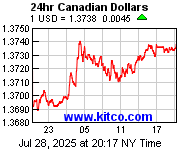
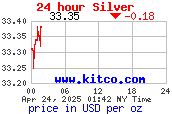
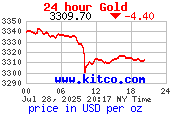
[font size=2]Euro, Yen, Loonie, Silver and Gold[center]


[/center]

[/center]
[HR width=95%]
[font color=black][font size=2]Handy Links - Market Data and News:[/font][/font]
[center]
Economic Calendar
Marketwatch Data
Bloomberg Economic News
Yahoo Finance
Google Finance
Bank Tracker
Credit Union Tracker
Daily Job Cuts
[/center]
[font color=black][font size=2]Handy Links - Economic Blogs:[/font][/font]
[center]
The Big Picture
Financial Sense
Calculated Risk
Naked Capitalism
Credit Writedowns
Brad DeLong
Bonddad
Atrios
goldmansachs666
The Stand-Up Economist
The Automatic Earth
[/center]
[font color=black][font size=2]Handy Links - Government Issues:[/font][/font]
[center]
LegitGov
Open Government
Earmark Database
USA spending.gov
[/center][font color=black][font size=2]Handy Links - Videos:[/font][/font]
[center]
Charlie Rose talks with Roubini
Charlie Rose talks with Krugman
William Black: This Economic Disaster
Bill Moyers with Kevin Drum and David Corn
[/center]
[div]
[font color=red]Partial List of Financial Sector Officials Convicted since 1/20/09 [/font][font color=red]
2/2/12 David Higgs and Salmaan Siddiqui, Credit Suisse, plead guilty to conspiracy involving valuation of MBS
3/6/12 Allen Stanford, former Caribbean billionaire and general schmuck, convicted on 13 of 14 counts in $2.2B Ponzi scheme, faces 20+ years in prison
6/4/12 Matthew Kluger, lawyer, sentenced to 12 years in prison, along with co-conspirator stock trader Garrett Bauer (9 years) and co-conspirator Kenneth Robinson (not yet sentenced) for 17 year insider trading scheme.
6/14/12 Allen Stanford sentenced to 110 years without parole.
6/15/12 Rajat Gupta, former Goldman Sachs director, found guilty of insider trading. Could face a decade in prison when sentenced later this year.
6/22/12 Timothy S. Durham, 49, former CEO of Fair Financial Company, convicted of one count conspiracy to commit wire and securities fraud, 10 counts of wire fraud, and one count of securities fraud.
6/22/12 James F. Cochran, 56, former chairman of the board of Fair, convicted of one count of conspiracy to commit wire and securities fraud, one count of securities fraud, and six counts of wire fraud.
6/22/12 Rick D. Snow, 48, former CFO of Fair, convicted of one count of conspiracy to commit wire and securities fraud, one count of securities fraud, and three counts of wire fraud.
7/13/12 Russell Wassendorf Sr., CEO of collapsed brokerage firm Peregrine Financial Group Inc. arrested and charged with lying to regulators after admitting to authorities he embezzled "millions of dollars" and forged bank statements for "nearly twenty years."
8/22/12 Doug Whitman, Whitman Capital LLC hedge fund founder, convicted of insider trading following a trial in which he spent more than two days on the stand telling jurors he was innocent
[HR width=95%]
[center]

[HR width=95%]
[font size=3][font color=red]This thread contains opinions and observations. Individuals may post their experiences, inferences and opinions on this thread. However, it should not be construed as advice. It is unethical (and probably illegal) for financial recommendations to be given here.[/font][/font][/font color=red][font color=black]
 = new reply since forum marked as read
Highlight:
NoneDon't highlight anything
5 newestHighlight 5 most recent replies
= new reply since forum marked as read
Highlight:
NoneDon't highlight anything
5 newestHighlight 5 most recent replies

Fuddnik
(8,846 posts)Everything deep in the red.

Tansy_Gold
(18,167 posts)Tomorrow may be verrrry interrrresting . . . . and scarrrrry.


Warpy
(114,615 posts)Dollar up, market down. Dollar down, market up. That's been generally true with only a few exceptions for the past 3 years.
Today the IMF gave the US a fairly high mark for being in a slow recovery instead of an austerity fueled continuing slump.
That probably drove the dollar higher and the market lower.
Fuddnik
(8,846 posts)What happened to Chuckie?
http://tpmdc.talkingpointsmemo.com/2012/10/schumer-to-dems-abandon-simpson-bowles-tax-model.php?ref=fpnewsfeed
Schumer To Dems: Abandon Simpson-Bowles Tax Model
October 9, 2012, 10:00 AM 7194
Senate Democrats’ top political and policy-making strategist is imploring members of his party to abandon a tax reform principle members of both parties increasingly share: that Congress should reform the tax code by closing myriad, costly loopholes, and then use the new revenue to lower tax rates across the board, particularly for the wealthiest.
It’s a break with an increasingly bipartisan orthodoxy, first forged in 1986 when it served as the basis of Ronald Reagan’s tax reform, and more recently with a tax reform model promoted by the chairmen of President Obama’s commission on fiscal responsibility, Alan Simpson and Erskine Bowles.
It’s also an admission that the approach requires adopting a losing negotiating posture.
“Tax reform 25 years ago was revenue-neutral. It did not strive to cut the debt. Today, we can’t afford for it not to,” Schumer will say at the National Press Club Tuesday. “It would be a huge mistake to take the dollars we gain from closing loopholes and put them into reducing rates for the highest income brackets, rather than into reducing the deficit.”
Unlike Reagan’s plan, the Simpson-Bowles’ blueprint isn’t revenue neutral. It does call for ending nearly all tax expenditures, and plying the savings into tax rate cuts, including an enormous rate cut for top earners. But it also calls for devoting $80 billion annually to deficit reduction.
Revenue neutral or not, Schumer says any approach that promises up-front rate cuts for high-income earners is a giveaway to the wealthiest, and a blow to the middle class, given current budget constraints.
“A 1986-style approach that promises upfront rate cuts to the wealthy is almost guaranteed to give middle-income earners the short end of the stick,” Schumer will say. “The reason is, in order to raise enough money to both reduce tax rates and cut the deficit, you would need to slash deductions and credits on a far greater scale than we ever did in 1986. Middle-income earners would not be spared.”
http://tpmdc.talkingpointsmemo.com/2012/10/schumer-tells-dems-to-grow-a-spine-in-tax-negotiations-with-gop.php?ref=fpnewsfeed
Sen. Chuck Schumer (D-NY) wants to stop some of his own colleagues from making a big mistake — one that he and many tax experts believe will result in either larger deficits or higher taxes on the middle class.
Specifically, he’s publicly urging Democrats to abandon a tax reform model that calls for ending tax expenditures, many of which benefit middle income earners, in order to finance a large tax rate cut for wealthier people. It’s a framework that’s popular among economists, particularly conservative ones, but that a group of Democrats negotiating with Republicans to avert large tax increases and sharp spending cuts next year have also embraced.
Instead, he proposes targeting tax loopholes and deductions that benefit top earners and raising their top income tax rate, while simultaneously narrowing the tax code’s preference for capital gains by ratcheting up the capital gains rate from its current, historically low rate of 15 percent. Taken altogether it’s a call for significantly more revenue from high-income earners than Dems have sought by proposing to allow the Bush tax cuts for top earners to expire; and an attempt to strengthen Dems’ negotiating posture, lest they get lured into conceding another large income tax cut for the wealthy.
“To me what has messed this up is the starting point of let’s bring the top rate down,” Schumer told reporters at the National Press Club Tuesday. “And as I’ve outlined, you can’t get a deal that way. So what I’m trying to do here is make some positive suggestions that lead to a path forward, and I did it now rather than waiting til November 13th because it might be too late then. … The biggest barrier standing in the way, is this view that has been accepted by Republicans but also some Democrats.”
(snip)
Demeter
(85,373 posts)Demeter
(85,373 posts)Senator Charles E. Schumer of New York, the Senate’s third-ranking Democrat, threw cold water on Tuesday on one emerging approach for striking a bipartisan deficit-reduction deal — an overhaul of the tax code that lowers top income tax rates but raises more revenue. Mr. Schumer’s position complicates efforts to seal a deal before January (COULD BE BLACKMAIL), when the “fiscal cliff” of tax increases and automatic spending cuts goes into effect.
In a speech to the National Press Club, Mr. Schumer branded the idea of a tax code overhaul that could simultaneously lower the top rates, bring in more revenue and protect middle-class taxpayers from increases as “little more than happy talk.” Instead, he said that the top two income tax rates should be frozen around 36 percent and 39.6 percent, which are levels from the Clinton era, and that any additional revenue generated by closing loopholes and curtailing or eliminating tax deductions and credits should be devoted to deficit reduction. (THAT'S NOT AN IMPROVEMENT IMO)
“It is an alluring prospect to cut taxes on the wealthiest people and somehow still reduce the deficit, but you can’t have your cake and eat it too,” said Mr. Schumer, a member of the tax-writing Finance Committee. “The reality is, any path forward on tax reform that promised to cut rates will end up either failing to reduce the deficit or failing to protect the middle class from a net tax increase.”
Republicans reacted harshly to Mr. Schumer’s position, which they said could ensure that the nation careers off the fiscal cliff in January, when all of the Bush-era tax cuts expire and $1 trillion in automatic across-the-board cuts to military and domestic programs over the next 10 years begin to go into force.
“A tax reform framework that lowers rates and closes loopholes has support from both parties, including the Obama administration, and it offers the best hope for bipartisan efforts to create robust economic growth and reduce our deficit,” said Kevin Smith, a spokesman for Speaker John A. Boehner of Ohio. “Senator Schumer seems to be off an island with these remarks.”
SOMEBODY PEED IN THEIR CORNFLAKES...DERAILED THE RAILROADING JOB...
bread_and_roses
(6,335 posts)http://www.schumer.senate.gov/
The Senate Committee on Rules and Administration oversees and will play a fundamental role in the 112th Congress as the Democratic agenda will include improving the election process, protecting voting rights, strengthening campaign finance law, and providing greater transparency in our political process. Additionally, any legislation related to ethics and lobbying reform must pass through the Committee. The Committee also has oversight authority over various government institutions and the Smithsonian. Additionally, the Committee has a historical place in the institution of the Senate, since it oversees all Senate rules and procedures and qualifications and credentials of Senators.)
Also on Rules Committee, on the Committee on Banking, Housing, and Urban Affairs; the Judiciary Committee, where he is Chairman of the Subcommittee on Immigration, Refugees, and Border Security; and the Joint Committee on the Library.
(my emphasis added)
You notice he's never in the news .... I always figured he's just quietly feathering his own nest - serving the real power brokers on those powerful committees while being a reliable vote on high-profile social issues for his base and the downstate constituency and distributing enough largesse upstate to keep the Rs quiescent ... (though I am surprised I haven't heard more from the gun nuts on his sponsorship of
Anyway, this bit of news is one of those that makes me go "hhhmmmmnnnnn ...and what does Chucky know that I don't?"
Demeter
(85,373 posts)WHY DON'T THEY TELL IT TO ROMNEY?
http://www.npr.org/blogs/itsallpolitics/2012/10/09/162571474/sesame-workshop-to-obama-campaign-leave-big-bird-out-of-it?ft=1&f=1001
In its attempt to turn the tables on Mitt Romney following the Republican presidential nominee's big win in the first presidential debate, President Obama's campaign has sought to enlist Big Bird. The president has repeatedly reminded supporters at rallies that Romney, during the debate, specifically cited Big Bird when he promised to defund the Public Broadcasting Service to reduce federal deficits.
Adding to its mockery of Romney, the Obama campaign cut an ad featuring the feathery yellow giant avian. But watch it while you can. On Tuesday, Sesame Workshop asked the Obama campaign to take down the ad, essentially saying it didn't have a bird in this fight. (Sorry, I couldn't resist.) Said the news release:
While the president and his campaign have used Big Bird to ridicule Romney, Republicans tried to deflect such criticism back onto the president. They alleged Obama's use of Big Bird against Romney proved the president couldn't fight the Republican standard-bearer on big issues and so was resorting to the trivial. In an official campaign statement, Amanda Henneberg, a Romney spokeswoman, said:
As we reported in a prior post:

tclambert
(11,193 posts)I never knew PBS cost $5 trillion.
(P.S. It actually costs less than $500 million a year. It would take 10,000 years to cover Romney's budget shortfall.)
Tansy_Gold
(18,167 posts)Demeter
(85,373 posts)The U.S. government filed a lawsuit against Wells Fargo & Co., today, saying the bank was reckless when it issued federally guaranteed mortgages.
Bloomberg reports:
"'As the complaint alleges, yet another major bank has engaged in a longstanding and reckless trifecta of deficient training, deficient underwriting and deficient disclosure, all while relying on the convenient backstop of government insurance,' Bharara said in the statement.
"The FHA has paid hundreds of millions of dollars in insurance claims on thousands of mortgages that defaulted in connection with the FHA's Direct Endorsement Lender Program as a result of false certifications by Wells Fargo, according to the complaint."
The Wall Street Journal reports that the government alleges the misconduct dates back to 2001. Essentially, the U.S. says the company issued more than 100,000 loans it said met Federal Housing Administration requirements when they did not...
Demeter
(85,373 posts)chaos theory—which says the particulars of the breakdown of the earth’s ecosystems (OR ECONOMIC SYSTEMS) are unpredictable—is going unread, disbelieved or ignored. Chaos theory does not lend itself to explanation in plain English. It is notoriously difficult to get across to the public. Even the highly educated can have a tough time grasping its abstract meanings and implications. In general terms, the theory holds that as an increasing number of essential parts of a complex system break down—such as a stock market, climate or mechanical engine—the overall system is destabilized, and its exact behavior becomes impossible to predict. This event precedes what’s known as “runaway,” which occurs when a critical number of those parts stop working and irreversible “tipping points” have been passed. At this stage, the only thing that can be predicted with certainty is that the system will deteriorate with increasing acceleration. Just as water always runs downhill, the processes triggered in runaway will continue irreversibly and on their own, and no one can tell what the final results will be.
Applied to the ecosystems in the earth’s oceans, this means that scientists cannot say exactly what will happen to a particular species of seaweed or fish at most stages in the process. This is because the number of variables that bear upon that species—temperature, salt levels and the state of species nearby or across the world, for example—becomes too great to be included in any predictive model. In other words, the relationships between parts within the system become so complex and the changes occur so rapidly that scientists cannot keep up. By the time they identify a problem and propose a solution, their work becomes obsolete, their discoveries made irrelevant. This fact can make it difficult to trust their predictions.
As a professional class, scientists are among the most reticent people in the world. They don’t want to be seen as alarmist, so most (with few exceptions) will err on the conservative side of the estimates that result from their work. This is especially true when they speak to the press, which means that environmental predictions reported in the mainstream media should almost always be viewed as idealistic and assumed in reality and over time to be much worse.
...None of this suggests that scientific research is meaningless. It simply shows that predictions made early in the process of growing chaos should be regarded as snapshots in time, relevant for only a short while. Scientists remain our best forecasters of what’s to come, but they can see only so far into the earth’s future. Aside from the unsettling fact that the systems that support human and other life are disintegrating at an increasing rate, no one can say for sure exactly what the world we’re rushing into will look like.
Demeter
(85,373 posts)
Demeter
(85,373 posts)After being rigged by some of the world’s biggest financial institutions, the London interbank offered rate, the benchmark for more than $300 trillion of securities and loans, is now increasingly being set by a smaller group of banks.
Bank of America Corp., Citigroup Inc. (C), Bank of Tokyo Mitsubishi UFJ Ltd., Royal Bank of Canada, Sumitomo Mitsui Financial Group Inc. and Lloyds Banking Group Plc (LLOY)’s submissions have been used in setting the rate on an almost daily basis in the past four months, data compiled by Bloomberg show. Two years ago, none of the 18 designated lenders made it into every fixing of the measure, which excludes outliers by stripping out the four highest and lowest contributions.
“You have a core group setting the rate and that’s a major concern,” said Bret Barker, a money manager at Los Angeles- based TCW Group Inc., which oversees $128 billion. “It’s going to be very tough to fix that and very tough to replace Libor.”
While Libor is supposed to represent the interest rates banks pay each other for short-term loans, the dominance of a smaller group shows the measure is failing to accurately reflect the true health of the financial system and borrowing costs...MORE
Demeter
(85,373 posts)THIS IS NEWS?
http://www.washingtonpost.com/politics/congress-members-back-legislation-that-could-benefit-themselves-relatives/2012/10/07/c2fa7d94-f3a9-11e1-a612-3cfc842a6d89_story.html
A California congressman helped secure tax breaks for racehorse owners — then purchased seven horses for himself when the new rules kicked in.
A Wyoming congresswoman co-sponsored legislation to double the life span of federal grazing permits that ranchers such as her husband rely on to feed cattle.
And a Pennsylvania congressman co-sponsored a natural gas bill as Exxon Mobil negotiated a deal that paid millions for his wife’s shares in two natural gas companies founded by her great-great-grandfather.
Those lawmakers were among 73 members of Congress who have sponsored or co-sponsored legislation in recent years that could benefit businesses or industries in which either they or their family members are involved or invested, according to a Washington Post analysis. The findings emerge from an examination by The Post of financial disclosure forms and public records for all 535 members of the House and Senate....
Demeter
(85,373 posts)With its economy still reeling from the housing crash, Ireland is making a bold move to help tens of thousands of struggling homeowners. The Irish government expects to pass a law this year that could encourage banks to substantially cut the amount that borrowers owe on their mortgages, a step that no major country has been willing to take on a broad scale. The initiative, which would lower a borrower’s monthly payment, could prevent a tide of foreclosures, an uncertainty that has been hanging over the Irish housing market for years. If it works, the plan could provide a road map for other troubled countries...Most countries that have suffered housing busts, including the United States, have made limited use of so-called mortgage write-downs, the process of forgiving a portion of the principal on the loan. The worry has been that some borrowers who can afford their mortgages will stop making payments to take advantage of a bailout. Banks have also been reluctant since they could face unexpected losses.
Ireland is different from the United States and most countries. During the financial crisis, Ireland bailed out the banks, and the government still has large ownership stakes in some of the biggest mortgage lenders. So taxpayers are already responsible for mortgage losses. In other countries, the burden of principal forgiveness would largely fall on privately owned banks.
But the debate is the same: whether to push lenders to take losses now, in hopes that things will get better faster, or wait for the housing market to heal on its own, which could cloud the economy for years to come. Countries suffering from a housing hangover will most likely be watching Ireland closely to see how the law works. Spain, swamped with mortgage defaults, introduced a measure in March that allows for debt forgiveness, though under strict conditions. In many ways, Ireland has to try something audacious. House prices are still 50 percent below their peak, compared with 30 percent in the United States. And more than half of Irish mortgages are underwater, meaning the house is worth less than the outstanding debt. While some of those borrowers can afford to keep making payments, more than a quarter of mortgage debt on first homes, roughly $39 billion, is in default or has been modified by lenders.
The housing market is now in a state of limbo as the government and the banks have made little effort to clean up the mortgage mess. Unlike in the United States, Irish banks have foreclosed on very few borrowers. While Ireland’s leaders have considered it socially unacceptable for banks to seize large numbers of homes, they also feared the fiscal cost of foreclosures. This approach creates doubt about the true level of bad mortgages at Irish banks. And borrowers, unsure of whether they will keep their homes, remain in a state of financial paralysis.
The new law aims to end this stalemate by overhauling Ireland’s consumer debt and bankruptcy laws...MORE
Demeter
(85,373 posts)The global default rate for speculative-grade debt increased 0.1 percentage point during the third quarter to 3 percent in September, the highest level in almost two years, according to Moody’s Investors Service. The ratings company’s trailing 12-month global speculative- grade default rate increased from 2.9 percent in the second quarter and compares with 1.8 percent a year ago, New York-based Moody’s said today. The rate remains less than a historical average of 4.8 percent in data going back to 1983 and is the highest since 3.2 percent in December 2010.
U.S. junk-rated defaults increased to 3.5 percent in September from a 3.2 percent rate in the second quarter. In Europe, the pace of high-yield defaults fell to 2.6 percent last month from 2.8 percent in the second quarter, Moody’s said.
High-yield global corporate defaults will end 2012 unchanged at 3 percent, before decreasing to 2.9 percent by September 2013, according to the report. In the U.S., the year- end rate is expected to be unchanged at 3.5 percent while decreasing to 2.4 percent in Europe...MORE
Demeter
(85,373 posts)India’s Kingfisher Airlines Ltd. (KAIR) escaped collapse in 2010 by restructuring 77.2 billion rupees ($1.4 billion) of debt it had run up buying airlines and adding routes amid the nation’s economic boom.
Less than two years later, the carrier controlled by billionaire Vijay Mallya was back in talks with creditors, while its net debt had increased by 9 billion rupees. The airline this month grounded its entire fleet after pilots went on strike to demand seven months of unpaid salaries, and was given time until the end of October by its creditors to submit a funding plan.
Kingfisher is among Indian companies resorting to an out- of-court loan-restructuring process that bankers and regulators say is too lenient on borrowers, leading to restructured debt that has more than doubled since March 2009. A fifth of the credit may sour as the economy falters and crimp profits at government-controlled lenders such as State Bank of India that account for three-quarters of the nation’s loans and deposits.
“No single lender can afford a large company going under, a la Titanic,” A.S.V. Krishnan, senior research analyst at Ambit Capital Pvt. in Mumbai, said in an interview last week. “Lenders have overdone restructuring, and it is coming to roost now on their balance sheets.” MORE
Demeter
(85,373 posts)As the presidential election enters its final phase, FTSE 100 companies are making use of relaxed campaign financing rules to bring their influence to bear...More than one in five of Britain's largest corporations are channelling political donations to favoured candidates ahead of next month's elections in the US – though these sums may be only the tip of a new campaign-financing iceberg, according to leading politicians, judges and pro-transparency watchdogs. As election year reaches its climax, America is forecast to experience the most extensively corporate-influenced race for the White House, and for control of Capitol Hill, in living memory.
Among the industries already well versed in bankrolling US politics are finance, pharmaceuticals, energy and defence. British multinationals such as HSBC, Barclays, Experian, Prudential, GlaxoSmithKline, AstraZeneca, BP, Shell and BAE all have political action committees (PACs) that channel donations from employees to US politicians. Some 14 of the top 50 most active foreign-controlled PACs have parent groups listed in London, according to Washington group the Centre for Responsive Politics. This makes the UK the biggest hub for non-US multinationals seeking to exert influence at the US ballot box on 6 November. Despite this, some FTSE 100 groups continue to tell shareholders in annual reports and elsewhere that they do not make political donations.
Companies are able to make such claims because PACs receive their funds from US employees – often led by the most senior American executives – and only dip into company coffers to cover administrative costs. Typically, the PACs are staffed by company lobbyists and distribute campaign contributions in line with the company's lobbying agenda. Recent supreme court rulings have transformed the regulatory landscape for corporations seeking to bring their influence to bear. So concerned has President Obama become that he raised the issue in his state of the union address two years ago: "I believe [the rulings] will open the floodgates for special interests – including foreign corporations – to spend without limit in our elections."
While investor attitudes in Europe have been hardening against public companies helping to finance campaigns, the trend is markedly in the opposite direction in the US. Transparency campaigners fear many tens of millions of dollars in "dark money" – that is, expenditure that need not be disclosed because it is not directly funding individual candidates – is already seeping into the American electoral process, raising the spectre of compromised democracy, even corruption. "The door has been pushed wide open to the abuses we had during Watergate," says Bruce Freed, president of the Washington-based Centre for Political Accountability. "Company shakedowns, massive amounts of money being given privately and much more." MORE
Demeter
(85,373 posts)The economy is a major force driving our lives, from the purchasing decisions we make to the public and private institutions we support. It determines how wealthy nations and their people are, and consequently becomes a determining factor for assessing quality of life. On the other hand, when the economy collapses, it brings us enormous devastation and takes wealth and prosperity back from the people. When an economy ceases to grow, it’s not easy –or maybe even impossible — to bring it back to the state where it used to be. Suppose that we are lucky enough to see economic growth and prosperity again, how can we know that a collapse is not going to happen in the future? Maybe it’s time for us not to rely too heavily on conventional economic theories, but instead start to look for a more sustainable and effective economic strategy. The Sufficiency Economy might be a better solution for mankind to pursue and improve upon.
The Sufficiency Economy is a philosophy developed by King Bhumibol Adulyadej of Thailand through his royal remarks over the past three decades. The Sufficiency Economy is a happiness development approach, which emphasizes the middle path as an overriding principle for appropriate conduct by people at all levels. The middle path is a way of thinking in which no one lives tooextravagantly or too thriftily. It encourages people to live in a way where they consume only what they really need, choose products carefully, and consider their impact on others and the planet. The sufficiency economy enhances the nation’s ability to modernize without defying globalization – it provides a means to respond to negative outcomes caused by rapid economic transitions. This philosophy is a guide to making decisions that will generate outcomes that are beneficial to the development of the country.
Thailand values this new economics philosophy as a practical tool to effectively manage capitalism in a way that aligns and engages it with social sustainable development. In doing so, Thailand hopes that this approach will foster accountability and empower people and their communities. More importantly, the main goal of The Sufficiency Economy is to measure economic development not just using GDP, but also by taking the reduction of social inequality and poverty into account. This philosophy is also expected to help prevent another economic collapse such as the one that occurred during the mid-90s, and to be a powerful tool for moving the nation overall economy upward.
In this globalized world, we too often expect economic decisions to happen quickly without realizing that these hasty choices could adversely affect our lives and the lives of generations that come after us. It could also be argued that many of the past economic recessions resulted from the greediness and shortsighted decision-making of a group of bankers and executives. I believe that integrating the concept of The Sufficiency Economy into our worldview will give us a different perspective that promotes gradual development based on self-reliance and the principle of having “enough.” We would all do well to keep the three main tenets of this philosophy (moderation, reasonableness, and self-immunity) in mind as we try to change peoples‘ attitudes, behaviors, and way of living at both the micro and macro level.

xchrom
(108,903 posts)

Fuddnik
(8,846 posts)AKA, Cleveland. We'll be there for 6 days.
The highest temperature for that period is forecast to be 67 on Tuesday. It gets down to 75 here at night.
I'm gonna be shivering my timbers for sure. But, when in Siberia, drink vodka! And no cockroach appetizers, unless I wander into one of those hot dog joints on Lorain Ave.
xchrom
(108,903 posts)cold, rain -- and more damp than you know what to do with.
i hope you have time for fun.
is this a visit or work?
Fuddnik
(8,846 posts)We're going up for a nieces wedding. Have a 6:30am flight out of Tampa, and land is Siberia at 11:00, after a flight change in Baltimore.
I just went out and bought a winter jacket. I don't have any more of that stuff. It's supposed to go down to 32 there tonight.

A wedding... Mazel Tov!
Give her SMW good wishes!

Hotler
(13,747 posts)Mimosa or Bloody Mary, Bloody Mary or Mimosa
xchrom
(108,903 posts)Have a croissant w/ it - then move on to mimosas w/ scrambled eggs & bacon.
VOILA!
Fuddnik
(8,846 posts)xchrom
(108,903 posts)xchrom
(108,903 posts)This chart is from a speech given (.pdf) by FedEx CEO Fred Smith at an investor dinner last night (via @CEP_Observer).
 ?maxX=986&maxY=550
DemReadingDU
(16,002 posts)That looks bad
xchrom
(108,903 posts)The New York State Comptroller's office is out with its annual review of the state of Wall Street, so we're picking through it for the interesting points.
And one point that's always interesting about Wall Street is compensation. It's no secret that the industry is being forced to rethink who it's employing and how much they're paid, but according to this report, Wall Streeters still making far, far more than the average New Yorker.
In fact, it's a little over 5 times more, though that down from its peak (6.2x) in 2007.
From the report:
In 2011, the average salary in the securities industry was 5.3 times greater than the average in the rest of the private sector ($67,900). At its peak in 2007, the average securities industry salary was 6.2 times greater than in other industries. Over the past three decades, the gap has generally widened. In 1981, for example, the average salary in the securities industry was only twice as high as the average in the rest of the private sector.

Demeter
(85,373 posts)put the banksters on minimum wage. Let them live off other people bribing them.
Wouldn't it be funny, if Congressmen had to bribe the banksters?
xchrom
(108,903 posts)Of cardiac arrests.
Demeter
(85,373 posts)Better them than us.

Roland99
(53,345 posts)DOW -0.2%
NASDAQ +0.0% [/font]
Plus, Asia down, Europe down, Dollar down, oil down, gold down.
xchrom
(108,903 posts)Last Wednesday night the terms “middle-income” and “middle-class” were mentioned 34 times over the course of the first 90-minute so-called presidential “debate.”The phrases rolled jauntily off the tongues of both candidates as they attempted to make impassioned appeals to what is often seen as the most important voting bloc.
Applying a term without first defining it, however, is the hallmark of ideology. Marx’s “Sie wissen das nicht, aber sie tun es” (“they do not know it, but they are doing it”) expression from Das Capital represents the most incisive definition of ideology to date. Ideology in its most elemental form entails unwittingly maintaining the taken-for-granted categorical presuppositions and omissions around which we choose to organize the world. And our collective presumption of “middle-classness” is one such ideological ruse.
Unfortunately, we Americans know troublingly little about income distribution and our relative position in it. We all seem to think we’re part of the ubiquitous “middle class” because, well, we’ve rarely bothered to hazard a definition. For instance, according to an April 2007 poll by CBS News only 2 percent of the 994 adults surveyed said they were "upper class.” 7 percent said they were "lower class.”
Class, of course, is as much a cultural concept as it is an economic one. There needn’t necessarily be any natural correlation between cultural habits and remuneration, and as such the relationship between class and income is often mystified. For example, the perceived high cultural class standing of, say, an adjunct professor, doesn’t necessary reflect her low income or job insecurity. For this reason it seems sensible to sidestep a theoretical discussion pertaining to the ideological convergences and divergences between class and wage for the sake of underscoring what’s at stake politically in the term “middle-income.”
xchrom
(108,903 posts)European shares fell for the third day running today, while the euro and Spanish and Italian bonds came under fresh pressure.
Having rallied 15-20 per cent between June and September, the majority of major markets, from equities to commodities, have been trading far more cautiously in recent weeks as the benefit of central bank support has made way for a return of concerns about growth and European debt.
The Euro STOXX 50 index of European bluechip firms , which has lost over 2 percent in the last week, slipped 0.2 percent. London's FTSE, Frankfurt's DAX and France's CAC were all down.
"The markets will be a little bit on the defensive, with concerns over Greece and Spain," said Berkeley Futures associate director Richard Griffiths.
xchrom
(108,903 posts)Five years after the start of the global financial crisis, officials at the International Monetary Fund fear the stability of the global financial system may yet again be threatened. As in the past, the global institution is pointing its finger at the euro zone as a primary cause of the threat.
In a report on global financial stability released on Wednesday, just days before an IMF meeting that will bring together the world's finance ministers in Tokyo, the Washington-based institution has called on European countries to move swiftly to implement a pan-euro zone banking oversight regime and other measures aimed at preventing a recession and restoring market confidence.
"Commitment to a clear roadmap on a banking union and fiscal integration are needed to restore confidence, reverse the capital flight and reintegrate the euro area," said José Viñals, the head of the IMF's monetary and capital markets department. "Despite many important steps already taken by policymakers, this agenda remains critically incomplete, exposing the euro area to a downward spiral of capital flight, break-up fears and economic decline," the IMF said in its report.
Faltering market confidence has led to capital flight from countries on the periphery to the core of the euro zone, the IMF stated. This is leading to higher borrowing costs and a "growing wedge between the economic and financial 'haves' and 'have nots'."
Demeter
(85,373 posts)Just so we are clear on the likelihood.
xchrom
(108,903 posts)The International Monetary Fund said European banks may need to sell as much as $4.5 trillion in assets through 2013 if policy makers fall short of pledges to stem the fiscal crisis, up 18 percent from its April estimate.
Failure to implement fiscal tightening or set up a single supervisory system in the timing agreed could force 58 European Union banks from UniCredit SpA (UCG) to Deutsche Bank AG (DBK) to shrink assets, the IMF wrote in its Global Financial Stability Report released today. That would hurt credit and crimp growth by 4 percentage points next year in Greece, Cyprus, Ireland, Italy, Portugal and Spain, Europe’s periphery.
“There is definitely a need for deleveraging in Europe,” said Michael Seufert, an analyst at Norddeutsche Landesbank in Hanover, Germany, with a “negative” rating on the European banking sector. “The danger is that this produced a downward spiral as the regulation gets stricter and stricter and the global economy cools, potentially meaning more writedowns for banks. States in the periphery are hit hardest.”
The IMF doesn’t need to lend money to Spain to help the country tackle its fiscal crisis, Managing Director Christine Lagarde indicated today. The Washington-based fund earlier this week cut its global growth forecasts and warned of even slower expansion if European officials don’t address threats to their economies.
xchrom
(108,903 posts)Japanese Prime Minister Yoshihiko Noda said his government will act against any disorderly gains for the yen, and urged policy makers around the world to follow through on pledges to rebalance global demand.
“We have to observe the market closely to see whether there are excessive or disorderly moves” in the currency market, Noda, 55, said in an interview today at his office in Tokyo. The yen’s strength is a “serious problem,” is out of step with Japan’s economic performance and “when necessary, we will take decisive action,” he said.
Noda spoke on the eve of a gathering of the Group of Seven in Tokyo, where finance chiefs will assess the recovery from the 2009 global recession. The prime minister said “we have seen a certain amount of progress, but we must remain on our guard.”
Japan will continue to contribute to market stability as the world’s largest creditor nation, he said. The prime minister also urged the Bank of Japan to take “decisive” action at the right time to end deflation that’s eroded wages and growth.
xchrom
(108,903 posts)TOKYO (AP) -- Toyota Motor Corp. is recalling 7.43 million vehicles in the U.S., Japan, Europe and elsewhere around the world for a faulty power-window switch - the latest, massive quality woes for Japan's top automaker.
The recall announced Wednesday affects more than a dozen models produced from 2005 through 2010. The power-window switch on the driver's side didn't have grease applied evenly during production, causing friction in the switch and sometimes smoke, according to Toyota.
No crashes or injuries have been reported related to the defect. But more than 200 problems were reported in U.S. and a fewer number of problems were reported elsewhere, including 39 cases in Japan, Toyota spokesman Joichi Tachikawa said.
Recalled in North America are the Yaris, Corolla, Matrix, Camry, RAV4, Highlander, Tundra, Sequoia and Scion models xB and xD, spanning 2.47 million vehicles.
xchrom
(108,903 posts)WASHINGTON (AP) -- U.S. wholesalers increased their stockpiles in August and their sales rose for the first time in four months. The gains could provide a boost to the still-weak economy.
The Commerce Department said Wednesday that wholesale stockpiles grew 0.5 percent in August after a 0.6 percent increase in July. Sales jumped 0.9 percent in August, ending three months of declines. The sales increase was the biggest one-month gain since February.
Total wholesale inventories stood at $487.5 billion. That's 26.9 percent higher than the post-recession low hit in September 2009.
Companies typically boost their stockpiles when they anticipate sales will rise in coming months. Faster restocking helps drive economic growth. When businesses order more goods, it generally leads to more factory production.
Demeter
(85,373 posts)The Kid is in her new program. The new kitty is in the house, in one room to get used to the idea. The old kitty is cautious, but separated for today.
And I am a nervous wreck, or getting over one. Still got work, fetch the Kid (25 minutes, 13.5 miles one way) work some more, budget meeting, and then the whole paper route...
I'm going to try to catch some zzzz's somewhere (not at red lights!)
And then tomorrow, we do it again.
bread_and_roses
(6,335 posts)Demeter
(85,373 posts)I think she will fit in just fine.