Economy
Related: About this forum
STOCK MARKET WATCH -- Wednesday, 9 January 2013
[font size=3]STOCK MARKET WATCH, Wednesday, 9 January 2013[font color=black][/font]
SMW for 8 January 2013
AT THE CLOSING BELL ON 8 January 2013
[center][font color=red]
Dow Jones 13,328.85 -55.44 (-0.41%)
S&P 500 1,457.15 -4.74 (-0.32%)
Nasdaq 3,091.81 -7.00 (-0.23%)
[font color=green]10 Year 1.86% -0.02 (-1.06%)
30 Year 3.07% -0.02 (-0.65%)[font color=black]
[center][/font]
[HR width=85%]
[font size=2]Market Conditions During Trading Hours[/font]
[center]


[/center]
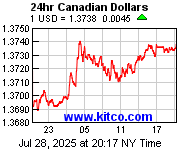
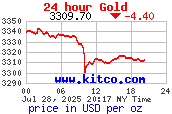
[font size=2]Euro, Yen, Loonie, Silver and Gold[center]


[/center]

[/center]
[HR width=95%]
[font color=black][font size=2]Handy Links - Market Data and News:[/font][/font]
[center]
Economic Calendar
Marketwatch Data
Bloomberg Economic News
Yahoo Finance
Google Finance
Bank Tracker
Credit Union Tracker
Daily Job Cuts
[/center]
[font color=black][font size=2]Handy Links - Economic Blogs:[/font][/font]
[center]
The Big Picture
Financial Sense
Calculated Risk
Naked Capitalism
Credit Writedowns
Brad DeLong
Bonddad
Atrios
goldmansachs666
The Stand-Up Economist
The Automatic Earth
[/center]
[font color=black][font size=2]Handy Links - Essential Reading:[/font][/font]
[center]
Matt Taibi: Secret and Lies of the Bailout
[/center]
[font color=black][font size=2]Handy Links - Government Issues:[/font][/font]
[center]
LegitGov
Open Government
Earmark Database
USA spending.gov
[/center][font color=black][font size=2]Handy Links - Videos:[/font][/font]
[center]
Charlie Rose talks with Roubini
Charlie Rose talks with Krugman
William Black: This Economic Disaster
Bill Moyers with Kevin Drum and David Corn
[/center]
[div]
[font color=red]Partial List of Financial Sector Officials Convicted since 1/20/09 [/font][font color=red]
2/2/12 David Higgs and Salmaan Siddiqui, Credit Suisse, plead guilty to conspiracy involving valuation of MBS
3/6/12 Allen Stanford, former Caribbean billionaire and general schmuck, convicted on 13 of 14 counts in $2.2B Ponzi scheme, faces 20+ years in prison
6/4/12 Matthew Kluger, lawyer, sentenced to 12 years in prison, along with co-conspirator stock trader Garrett Bauer (9 years) and co-conspirator Kenneth Robinson (not yet sentenced) for 17 year insider trading scheme.
6/14/12 Allen Stanford sentenced to 110 years without parole.
6/15/12 Rajat Gupta, former Goldman Sachs director, found guilty of insider trading. Could face a decade in prison when sentenced later this year.
6/22/12 Timothy S. Durham, 49, former CEO of Fair Financial Company, convicted of one count conspiracy to commit wire and securities fraud, 10 counts of wire fraud, and one count of securities fraud.
6/22/12 James F. Cochran, 56, former chairman of the board of Fair, convicted of one count of conspiracy to commit wire and securities fraud, one count of securities fraud, and six counts of wire fraud.
6/22/12 Rick D. Snow, 48, former CFO of Fair, convicted of one count of conspiracy to commit wire and securities fraud, one count of securities fraud, and three counts of wire fraud.
7/13/12 Russell Wassendorf Sr., CEO of collapsed brokerage firm Peregrine Financial Group Inc. arrested and charged with lying to regulators after admitting to authorities he embezzled "millions of dollars" and forged bank statements for "nearly twenty years."
8/22/12 Doug Whitman, Whitman Capital LLC hedge fund founder, convicted of insider trading following a trial in which he spent more than two days on the stand telling jurors he was innocent
10/26/12 UPDATE: Former Goldman Sachs director Rajat Gupta sentenced to two years in federal prison. He will, of course, appeal. . .
11/20/12 Hedge fund manager Matthew Martoma charged with insider trading at SAC Capital Advisors, and prosecutors are looking at Martoma's boss, Steven Cohen, for possible involvement.
[HR width=95%]
[center]

[HR width=95%]
[font size=3][font color=red]This thread contains opinions and observations. Individuals may post their experiences, inferences and opinions on this thread. However, it should not be construed as advice. It is unethical (and probably illegal) for financial recommendations to be given here.[/font][/font][/font color=red][font color=black]
 = new reply since forum marked as read
Highlight:
NoneDon't highlight anything
5 newestHighlight 5 most recent replies
= new reply since forum marked as read
Highlight:
NoneDon't highlight anything
5 newestHighlight 5 most recent replies
Demeter
(85,373 posts)love,
Demeter


AnneD
(15,774 posts)since Robin Hood Prince of Thieves. He stole every scene he was in. In drama school, he was criticized for his voice and delivery. Frankly, those are the two things I find most endearing. He is not a cookie cutter actor.

Demeter
(85,373 posts)The news today from the Bureau of Labor Statistics is that the U.S. job market is treading water. The number of new jobs created in December (155,000), and percent unemployment (7.8), were the same as the revised numbers for November. Also, about the same number of people are looking for work (12.2 million), with additional millions too discouraged even to look.
Put simply, we’re a very long way from the job growth we need to get out of the gravitational pull of the Great Recession. That would be at least 300,000 new jobs per month. All of which means job growth and wage growth should be the central focus of economic policy, not deficit reduction. Yet all we’re hearing from Washington — and all we’re likely to hear as Republicans and Democrats negotiate over raising the debt ceiling — is how to cut the deficit.
The typical American worker’s paycheck will drop this week because his or her Social Security tax will rise, from 4.2 percent to 6.2 percent. That’s nonsensical. We need to put more money into the pockets of average workers, not less. The first $25,000 of income should be exempt from Social Security taxes altogether, and we should make up the difference by eliminating the ceiling on income subject to Social Security taxes.
Demeter
(85,373 posts)(1) Teach lies as truth like “markets are free” and “we need to spread democracy to the rest of the world.” Plant agent provocateurs in all movements of resistance like OWS to discredit these movements whenever possible.
(2) Commandeer and effectively take over all control of global governments, mass media, state police, and federal military elements to suppress truth from reaching the masses.
(3) Take over the education system, design it to dumb down instead of enlighten the masses, and export this model to the rest of the world.
Bankers and industrialists like the Rockefellers and the Carnegies financed the development of our global education system during the American Industrial Revolution, and thus were able to promote the lies they wanted the masses to embrace such as the myth that America experienced a “revolution” in 1776 and that US President Abraham Lincoln ended slavery in 1863. The bankers were always happy to give the colonialists the illusion of gained “freedom” as an outcome of the “revolutionary” war in exchange for maintaining their control over the newly formed republic’s monetary supply. Thus, the Rothschild banking family quickly established the Bank of the United States (which has since become the US Federal Reserve today) through their colonialist agents in the United States in 1791. When this bank’s charter expired in 1811, Nathan Rothschild of the Bank of England and the Rothschild banking clan declared a grave warning: “Either the application for the renewal of the charter is granted, or the United States will find itself involved in a most disastrous war.” When US Congress chose not to renew the bank's charter, Nathan Rothschild responded, “Teach these impudent Americans a lesson. Bring them back to Colonial status.”
Even though African Americans were given their physical freedom in 1863, they were never granted their financial freedom by the bankers. How does Lincoln end slavery in America with his 1863 Emancipation Proclamation when just 50 years later, the bankers financially enslaved everyone with the founding of the US Federal Reserve....
(4) Teach young adults that a tax on tea and a tax on stamps caused the American colonialists to hate the British monarchy and triggered a successful revolt in 1776, when it was the debt enslavement component of the monetary system and the bankers’ system of theft through numerous taxes that truly caused the revolt.
(5) Learn from the mistakes of Kings by hiding the robberies of citizens’ money and disguising this robbery as a silent tax called “inflation”. Transform the violent method of tax collection that lead to the beheading of past members of nobility during Medieval times into a passive method of automatic deductions from paychecks.
(6) Engage in huge disinformation and propaganda campaigns to convince citizens in every country that income tax is not flat out robbery and not equivalent to King George’s act of sending 40,000 soldiers to force colonists to turn their hard-earned money over to him.
(7) Sell concepts like “nationalism”, and incite religious-based and race-based hate to divide and conquer people from uniting against a segment of society (bankers) that commits a long list of atrocities that would have landed anyone else in jail centuries ago.
(8) Falsely teach people that paper fiat currency and paper derivative products offered by bogus gold and silver derivative markets of the LBMA and COMEX are better stores of value and purchasing power than physical gold and physical silver...
(9) Teach people that the law is the final word so that they believe that anything legal is moral and anything illegal is immoral. The bankers have flipped the paradigm of morality on its head by convincing people that anything legal is moral and anything illegal is immoral when in fact, many things they have legislated as illegal is still moral and many things they have legislated as legal is highly immoral.
THE SUPPORTIVE DETAIL IS EQUALLY PROVOCATIVE, AND NOT EASILY IGNORED...
Demeter
(85,373 posts)Post-Sandy and post-Katrina "disaster relief" has been characterized by more profit-taking by big business than relief to families and small businesses. The Bank of North Dakota demonstrated it doesn't have to be that way after flooding devastated Grand Forks in 1997....North Dakota is the only state in the union to have its own state-owned bank. The Bank of North Dakota (BND) has a mandate to serve the public interest, and it has no shareholders other than the state itself. That gives it wide-reaching flexibility in emergencies, allowing it to act quickly to catalyze and coordinate resources. The BND's emergency capabilities were demonstrated in 1997, when record flooding and fires devastated Grand Forks, North Dakota. The town and its sister city, East Grand Forks on the Minnesota side of the river, lay in ruins. Floodwaters covered virtually the entire city and took weeks to fully recede. Property losses topped $3.5 billion.
The response of the state-owned bank was immediate and comprehensive, demonstrating a financial flexibility and public generosity that no privately-owned bank could match. Soon after the floodwaters swept through Grand Forks, the BND was helping families and businesses recover. Led by then-president and CEO John Hoeven (future North Dakota governor and US senator), the bank quickly established nearly $70 million in credit lines – to the city, the state National Guard, the state Division of Emergency Management, the University of North Dakota in Grand Forks, and for individuals, businesses and farms. It also launched a Grand Forks disaster relief loan program and allocated $5 million to help other areas affected by the spring floods. Local financial institutions matched these funds, making a total of more than $70 million available.
Besides property damage, flooding swept away many jobs, leaving families without livelihoods. The BND coordinated with the US Department of Education to ensure forbearance on student loans; worked closely with the Federal Housing Administration and Veterans Administration to gain forbearance on federally-backed home loans; established a center where people could apply for federal/state housing assistance; and worked with the North Dakota Community Foundation to coordinate a disaster relief fund, for which the bank served as the deposit base. The bank also reduced interest rates on existing Family Farm and Farm Operating programs. Families used these low-interest loans to restructure debt and cover operating losses caused by wet conditions in their fields.
To help finance the disaster recovery, the BND obtained funds at reduced rates from the Federal Home Loan Bank. These savings were then passed on to flood-affected borrowers in the form of lower interest rates.
The city was quickly rebuilt and restored. As a result, Grand Forks lost only 3% of its population between the 1997 floods and 2000, while East Grand Forks, right across the river in Minnesota, lost 17% of its population.
.........................................................
The damage wrought by Sandy to New York and New Jersey coastal areas was similar in scale to that to New Orleans from Hurricane Katrina in 2005. Just two weeks after Katrina hit, Congress approved $62.3 billion in emergency appropriations, along with numerous subsequent emergency funding requests to cover the damages, which topped $100 billion. Yet as noted on the Occupy Sandy Facebook page, federal relief funds post-Katrina were gutted in favor of "privatizing and outsourcing relief, making room for predatory lenders, disaster capitalists, and gentrification developers."
According to a report by Strike Debt, the vast majority of FEMA's resources and efforts are spent on public assistance programs that provide infrastructure restoration. Individual victims of disaster are for the most part just offered personal loans - loans that have many features of predatory subprime lending.
Disaster victims are now being expected to shoulder relief expenses that used to be shared publicly. Most people believe they are covered by their insurance policies or by the Federal Emergency Management Agency (FEMA), but many disaster victims have found that their insurance policies include obscure provisions that exclude coverage, and the only aid that FEMA gives to individuals is the opportunity to take on more debt.
It is a failing of our austerity-strapped federal disaster relief system that it can offer little real help to individuals; and it is a failing of our private, for-profit insurance system that the legal duty of management is to extort as much money as possible from customers while returning as little as possible to them, in order to maximize shareholder profits...
Demeter
(85,373 posts)Director Oliver Stone and historian Peter Kuznick offer a major reexamination of modern American history in “The Untold History of the United States,” which has many strengths....The title of Oliver Stone’s “The Untold History of the United States” is a bit of a misnomer, both as a book and a Showtime series. It’s more precisely a reinterpretation of official U.S. history over the past century or so. You might call it “The Little Understood Back Story of America’s Imperial Era.”
A LENGTHY READ, AND WORTH THE EFFORT
Demeter
(85,373 posts)To make sense of what happened with last week’s deal in the United States, we need to ask what is really at stake, and how much difference it makes in the larger picture...So, what are the two sides really fighting about? Surely the answer is the future of the welfare state. Progressives want to maintain the achievements of the New Deal and the Great Society, and also to implement and improve Obamacare so that the United States becomes a normal advanced country that guarantees essential health care to all its citizens. The right wants to roll the clock back to 1930, if not to the 19th century.
There are two ways progressives can lose this fight. One is direct defeat on the question of social insurance, with Congress actually voting to privatize and eventually phase out key programs — or with Democratic politicians themselves giving away their political birthright in the name of a Grand Bargain. The other is for conservatives to successfully starve the beast — to drive revenue so low through tax cuts that the social insurance programs can’t be sustained...The good news for progressives is that danger No. 1 has been averted, at least so far — and not without a lot of anxiety first. Mitt Romney lost, so nothing like the Ryan plan is on the table until President Santorum takes office, or something. Meanwhile, in 2011 President Obama was willing to raise the Medicare age, and in 2012 to cut Social Security benefits. But luckily the extremists on the right scuttled both deals. There are no cuts to benefits in this deal.
The bad news is that the deal falls short on making up for the revenue lost due to the tax cuts passed during president george w. Bush's administration. Here, though, it's important to put the numbers in perspective. Mr. Obama wasn’t going to let all the Bush tax cuts go away in any case; only the high-end cuts were on the table. Getting all of those ended would have yielded something like $800 billion; he actually got around $600 billion. How big a difference does that make? Well, the Congressional Budget Office estimates cumulative potential gross domestic product over the next decade at $208 trillion. So the difference between what Mr. Obama got and what he arguably should have gotten is around 0.1 percent of potential G.D.P. That’s not crucial, to say the least.
And on the principle of the thing, you could say that Democrats held their ground on the essentials — no cuts in benefits — while Republicans have just voted for a tax increase for the first time in decades. So why the bad taste in progressives’ mouths? It has less to do with where Mr. Obama ended up than with how he got there. He kept drawing lines in the sand, then erasing them and retreating to a new position. And his evident desire to reach a deal before hitting the essentially innocuous fiscal cliff bodes very badly for the confrontation looming in a few weeks over the debt ceiling. If Mr. Obama stands his ground in that confrontation, this deal won’t look bad in retrospect. If he doesn’t, then Dec. 31, 2012, will be seen as the day he began throwing away his presidency and the hopes of everyone who supported him.
Demeter
(85,373 posts)KRUGMAN HAS SAID BEFORE, HE DOESN'T WANT THE JOB..
http://truth-out.org/opinion/item/13735-save-social-security-paul-krugman-for-treasury-secretary
...With the automatic Pentagon cuts of the "sequester" postponed, rather than canceled, we're still operating in the framework of the Budget Control Act, which mandates $1.2 trillion in reduced projected government debt over 10 years. The deal on revenue took care of half of that. The Washington understanding is that the other half will come from cuts.
The two most dangerous proposed cuts from the point of view of the long-term interests of the majority of Americans are the proposal to cut Social Security benefits forever by reducing the annual cost-of-living increase (using "chained CPI," a measure of inflation that rises more slowly than the currently used measure) and the proposal to cut Medicare benefits forever by raising the Medicare retirement age to 67, forcing more seniors onto the private insurance market. Many establishment Republicans want these cuts; many Wall Street Democrats want these cuts; and the President has signaled his potential willingness to agree to these cuts as part of a "big deal." Most liberal groups vehemently oppose these cuts, and the majority of Americans would never go along with these cuts - reducing the benefits working families have already paid for through their payroll taxes - if they have effective say.
But two months from now, automatic cuts to Pentagon discretionary spending will again loom, tax increases will likely not be on the menu of negotiations and Republicans may again try to wield the purported threat of default by saying that they won't raise the debt ceiling without big cuts, including cutting Social Security and raising the Medicare retirement age.
Two months from now, who do you want leading the President's negotiating team? Someone who will fight tooth and nail to protect Social Security and Medicare benefits, or someone who will trade those paid-for benefits away in order to protect bloated Pentagon spending and endless war?...Beltway conventional wisdom is that the Treasury secretary has to be vetted by Wall Street. In the wake of the financial and economic crisis brought on by Wall Street gambling, that's a bad idea to start with. We need a Treasury secretary who can stand up to Wall Street, not a Treasury secretary chosen by Wall Street. But the fact that negotiations over 10 years of cutting debt are hanging fire makes the idea of a Wall Street-chosen Treasury secretary especially dangerous, because Social Security and Medicare benefits are in peril, and bigfoot military contractor lobbyists will be pushing Congress to cut domestic spending instead of Pentagon spending. Now, more than ever, we need a Treasury secretary for the 99%. We need a Treasury secretary who will see job creation, not austerity, as job one...
Danny Glover has started a petition at MoveOn urging President Obama to nominate Paul Krugman for Secretary of the Treasury. Why not help Danny change our national conversation about economic policy?
http://signon.org/sign/nominate-paul-krugman?source=c.url&r_by=1135580
Demeter
(85,373 posts)That headline has all the DC insider types rolling their eyes right now, since they know it is absurd to imagine that President Obama would pick Krugman to be Timothy Geithner’s replacement as Treasury Secretary. They aren’t wrong, it is absurd. There is no way on earth that Obama would select Krugman. This fact tells us a great deal about what is wrong with the shape of the economic policy being debated in the nation’s capital...No one can question Krugman’s qualifications for the administration’s top economic policy position. He is a winner of both the John Bates Clark award, which is given out every second year to the best economist under age 40, and the Nobel Prize. He has published hundreds of articles in academic journals, many of them leading to path breaking innovations in economic theory. Arguing that he lacks the background is just silly. Some might raise issues about his personality or temperament. While it’s probably true that he can be abrasive, if personality was a critical issue then Larry Summers would be handing out fish parts to penguins in Antarctica rather than a leading contender to be the next chair of the Federal Reserve Board.
The major reason that Krugman is not on anyone’s short list is that he has been right about most of the important issues in economic policy over the last decade.
The list where Krugman has been right and the Washington insiders have been wrong is a long one. It starts with the housing bubble, which Krugman warned of as early as 2002. Krugman correctly recognized both that house prices had grown out of line with their historic trend and that the collapse of the bubble would have a devastating impact on the economy. In the fall of 2008 when the financial system was freezing up, Krugman called for a takeover and recapitalization of the big banks, rather than a bailout that left them largely in tack. Can anyone seriously doubt that the economy would be in much better shape today if the Wall Street behemoths had been reorganized and broken up? He also argued for mortgage write-downs for underwater homeowners both as a matter of fairness to people who had gotten caught up in the irrational exuberance of the housing bubble and also as a mechanism for boosting demand in the economy. At the time the first stimulus was passed in early 2009 Krugman correctly warned that it would be inadequate and that its failure to restore full employment was likely to discredit the concept of stimulus in policy circles. He also said that worries about large deficits leading to high interest rates or inflation had no foundation in the context of a seriously depressed economy. He warned against the austerity being pursued in the euro zone crisis countries and then embraced by the Conservative government in the United Kingdom in the summer of 2010. He correctly predicted that these polices would lead to recessions and higher unemployment.
It is precisely this track record of being right on most of the key policy calls of the last decade that makes Krugman unacceptable as a candidate for Treasury Secretary. To be a serious candidate for this position it is necessary to have been wrong on most or all of these issues. This should make the public very angry. Apart from what this says about the state of meritocracy in the United States -- we like to think that people advance for being right and get demoted or fired for being wrong -- there is the more important issue of what it says about the course of our economic policy. If Krugman were Treasury Secretary we could envision a policy that was focused on creating jobs rather than reducing a deficit that exists almost entirely because of the downturn in the economy.We could also envision a policy that sought to tame the bloated financial sector with a speculation tax that would make much of the creative finance on Wall Street unprofitable. And, we would not have to worry that cutting Social Security and Medicare is the top priority for the Obama administration.
But, Krugman is not on the short list for Treasury Secretary. This list has the names of people who are much more acceptable to Wall Street who, by the way, have been wrong on almost everything important about the economy in the last decade. As a result, we should be very very afraid.
Demeter
(85,373 posts)Wanted: Experienced individual to lead major Cabinet department. Candidate must have prior Washington experience and good crisis management skills. Goldman Sachs pedigree preferred, but overall familiarity with Wall Street required. Candidates with history of tax evasion need not apply. Must be ready to start immediately... Who will replace Tim Geithner, Obama's point man in dealing with Congress on all things financial?
Jacob Lew, the White House chief of staff and former budget director, is on everyone's short list. In fact, he is the short list. Yes, the White House reportedly approached American Express CEO Ken Chenault, but that seems more like a business-friendly gesture on Obama's part than a serious job offer...

DemReadingDU
(16,002 posts)In June 2006, Lew was named chief operating officer of Citigroup's Alternative Investments unit, a proprietary trading group. The unit he oversaw invested in a hedge fund "that bet on the housing market to collapse."
More from Wikipedia
http://en.wikipedia.org/wiki/Jacob_Lew
Edit...
1/9/13 Obama To Appoint Jack Lew As Treasury Secretary Tomorrow, Bloomberg Reports
http://www.zerohedge.com/news/2013-01-09/obama-appoint-jack-lew-treasury-secretary-tomorrow-bloomberg-reports
AnneD
(15,774 posts)


Demeter
(85,373 posts)...With only one Senate election nationally, a host of political groups from around the country would be able to focus all their attention and cash in Massachusetts, as they did ahead of the 2010 special election to replace Edward M. Kennedy....(WHICH ELECTED SCOTT BROWN)
Brown and Warren made campaign history a year ago when they signed a pact, dubbed the People’s Pledge. They agreed that if an outside group ran an advertisement on television, radio, or online, the campaign that benefits must pay a penalty to charity.
To the surprise of many, those groups largely abided by the Brown-Warren pledge, even as the campaign turned negative. That led some, including Brown, to speculate whether it could be duplicated elsewhere to curb an explosion in spending by outside groups.
“What we did together was historic and it’s something that I’m very, very proud of, and I know she is too,” Brown said the day before the election in November. “It’s really a model, I think, for the rest of the country.”
INTERESTING TWIST ON POLITICS AS USUAL ON STEROIDS...
AnneD
(15,774 posts)If the State Dems have a good candidate and the National Dems get off their duffs and help out, the Dems can pull this one off.
Demeter
(85,373 posts)PAUL BUCHHEIT FOR BUZZFLASH AT TRUTHOUT
Three trillion dollars a year. That's how much the wealthiest Americans avoid through the system of subsidies and schemes and sweet deals that deprive middle-class workers of their earned benefits. That's three times more than the deficit. That's enough for a full-time job for every middle-class household in America. Here are the distressing details:
1. Tax Expenditures: $1.25 trillion
These subsidies from special deductions, exemptions, exclusions, credits, capital gains, and loopholes are estimated to be worth 7.4% of the GDP, or about $1.1 trillion. They largelybenefit the richest taxpayers. Business subsidies bring the total to $1.25 trillion.
That alone is almost enough to pay for Social Security ($884 billion) and Medicare ($524 billion).
But there's so much more.
2. Tax Underpayments: $450 billion
3. Tax Havens: up to $250 billion
4. Corporate Taxes: $250 billion
5. Financial Transaction Tax (FTT): $500 billion
6. Payroll Tax: $300 billion
7. Estate Tax: $100 billion
Conclusion
The total surpasses $3 trillion. The figures may be on the high end, and there may be some overlap, and wealthy Americans may argue that much of it is legal. But the system of loopholes and deductions and exclusions is a statement by the rich that they don't have to pay for their lopsided share of benefits, and that middle-income Americans should give up their own earned benefits to pay the country's bills.
And if tax avoidance is legal it's because the people with money have redefined 'legal.'
DETAILS AT LINK
Demeter
(85,373 posts)

Roland99
(53,345 posts)Demeter
(85,373 posts)...“Since 2001, the base defense budget has soared from $287 billion to $530 billion — and that’s before accounting for the primary costs of the Iraq and Afghanistan wars.” Or, if you prefer to see it in graph form:

That’s big money. More than we spent on Medicare, in fact. But it’s big money that doesn’t often get recognized in our budget conversation...

The Bush tax cuts, he finds, were responsible for about a quarter of the deterioration in the budget outlook, making them the single most expensive set of policies enacted. But all spending, together, was responsible for about half of the turn towards deficits. Finally, the flagging economy accounts for another quarter. “Had the tax relief never been enacted but everything else happened as it has, we still would face enormous deficits today,” Blahous concludes.
So where did all the new spending come from? Well, largely from the post-9/11 defense build-up. “One major factor that worsened the fiscal outlook was a large increase in federal discretionary spending. Much of this, of course, happened after the United States was attacked on September 11, 2001. The U.S. thereafter conducted major military operations in Afghanistan and Iraq, and also increased expenditures on homeland security.”

MORE
Demeter
(85,373 posts)1) The United States spent 20 percent of the federal budget on defense in 2011.

3) The Pentagon’s budget mostly consists of personnel pay, weapons procurement, and operations.

4) The United States spent more on its military than the next 13 nations combined in 2011.

MORE AT LINK
Demeter
(85,373 posts)Take out those two non-budget items, which have their own separate accounting and income streams, and defense is more like ONE THIRD of the national budget.
Throwing these two red herrings in minimizes the impact of defense spending on the US economy.
Demeter
(85,373 posts)..if you're trying to figure out how safe banks are — and how willing they'll be to make loans to ordinary people — liquidity is at least as important as other, more-dramatic-sounding corners of finance.
So the new liquidity rules global banking regulators released yesterday are a big deal for the real economy...The liquidity rules released yesterday are significantly less restrictive than what was previously proposed. They're part of a set of global banking rules called Basel III (here's a Planet Money story on the Basel rules.)
The rules were initially supposed to kick in in 2015; instead, they will be phased in gradually, and won't fully take effect until 2019. And, rather than being restricted to government bonds and other super-safe assets banks will now be allowed to count some riskier assets toward their liquidity requirements... when people start to panic again about the health of the world's banks, and big institutions rush to pull their money out, the looser liquidity rules mean the banks will be in a much riskier position when that day comes — especially if it comes before 2019, when the new rules fully take effect...
MORE
Demeter
(85,373 posts)This is the twenty-second installment of an exclusive Truthout series from political economist and author Gar Alperovitz. We are publishing weekly installments of the new edition of America Beyond Capitalism, a visionary book first published in 2005 whose time has come. Donate to Truthout and receive a free copy...
At the time of the declaration of Independence, the United States comprised a modest line of settlements along a thin shelf of land bordering the Atlantic Ocean, plus a smattering of inland farms and small community groupings. The first census in 1790 registered a total population of less than 4 million. Only five cities numbered more than ten thousand; the two largest, New York and Philadelphia, fewer than fifty thousand.
The majority of Americans earned their living in agriculture; technologically, the horse and iron plow were standard. Commerce was mainly restricted to traders and small manufacturers. Neither men without significant property, nor women, nor slaves could vote. For them - a large majority of the population - there was no democracy. Government constituted a tiny percentage of the small postcolonial economy; federal spending had reached only a little over $7.5 million by 1795....
Demeter
(85,373 posts)-- Nomi Prins, Author of It Takes a Pillage and Black Tuesday
Few are better equipped than economist Richard Wolff, professor emeritus at the University of Massachusetts, to address the massive failings and inequalities of capitalism as he does in his latest book, Democracy at Work: A Cure for Capitalism.
He also describes Workers' Self-Directed Enterprises (WSDEs) as an alternative to the capitalism that broke the US economy and has resulted in massive economic redistribution to the ruling elites...
"Capitalism, like all other economic systems, displays a variety of forms. There are, for example, largely private, laissez-faire kinds of capitalism that differ in many ways from forms of capitalism in which the state plays more significant roles, such as market regulator or social welfare guarantor (as in "state welfare capitalism"
 , or as a close partner of capitalists as in fascism. What remains the same across all such forms - why they all deserve the label "capitalist" - is the exclusion of the mass of workers that produces the output and generates the profits from receiving and distributing that profit, and from generally participating democratically in enterprise decisions. Capitalism excludes workers from deciding what is produced, how it is produced, where it is produced and how profits are to be used and distributed."
MONDRAGON, ANYONE?
Demeter
(85,373 posts)Today’s economic warfare is not the kind waged a century ago between labor and its industrial employers. Finance has moved to capture the economy at large, industry and mining, public infrastructure (via privatization) and now even the educational system. (At over $1 trillion, U.S. student loan debt came to exceed credit-card debt in 2012.) The weapon in this financial warfare is no larger military force. The tactic is to load economies (governments, companies and families) with debt, siphon off their income as debt service and then foreclose when debtors lack the means to pay. Indebting government gives creditors a lever to pry away land, public infrastructure and other property in the public domain. Indebting companies enables creditors to seize employee pension savings. And indebting labor means that it no longer is necessary to hire strikebreakers to attack union organizers and strikers.
Workers have become so deeply indebted on their home mortgages, credit cards and other bank debt that they fear to strike or even to complain about working conditions. Losing work means missing payments on their monthly bills, enabling banks to jack up interest rates to levels that used to be deemed usurious. So debt peonage and unemployment loom on top of the wage slavery that was the main focus of class warfare a century ago. And to cap matters, credit-card bank lobbyists have rewritten the bankruptcy laws to curtail debtor rights, and the referees appointed to adjudicate disputes brought by debtors and consumers are subject to veto from the banks and businesses that are mainly responsible for inflicting injury.
The aim of financial warfare is not merely to acquire land, natural resources and key infrastructure rents as in military warfare; it is to centralize creditor control over society. In contrast to the promise of democratic reform nurturing a middle class a century ago, we are witnessing a regression to a world of special privilege in which one must inherit wealth in order to avoid debt and job dependency.
The emerging financial oligarchy seeks to shift taxes off banks and their major customers (real estate, natural resources and monopolies) onto labor. Given the need to win voter acquiescence, this aim is best achieved by rolling back everyone’s taxes. The easiest way to do this is to shrink government spending, headed by Social Security, Medicare and Medicaid. Yet these are the programs that enjoy the strongest voter support. This fact has inspired what may be called the Big Lie of our epoch: the pretense that governments can only create money to pay the financial sector, and that the beneficiaries of social programs should be entirely responsible for paying for Social Security, Medicare and Medicaid, not the wealthy. This Big Lie is used to reverse the concept of progressive taxation, turning the tax system into a ploy of the financial sector to levy tribute on the economy at large...
MUCH MORE AT LINK
Demeter
(85,373 posts)Perhaps I'll see you all later...

xchrom
(108,903 posts)
DemReadingDU
(16,002 posts)1/8/13 It's KFC's Next PR Nightmare
http://www.zerohedge.com/news/2013-01-08/its-brain-its-kidney-its-kfcs-next-pr-nightmare


Fuddnik
(8,846 posts)We ordered a couple of buckets Friday night. Thighs and breasteses. It's the first time I ever saw a thigh with little rib bones going through it.
Never again.
Demeter
(85,373 posts)DemReadingDU
(16,002 posts)So a month ago, I heard some rustling in the furnace closet. None, NONE of the 3 dogs or cat or spouse heard these noises. We set an old-fashioned trap, with lots of cheese, in the closet. The next day, the cheese was gone! But no mouse.
Spouse next went and got a live-trap type of mouse catcher. Loaded it up with peanut butter. Worked great, and the mouse was released outside.
Just last week, one of my dogs heard something in my storage room. I loaded up the trap with lots of peanut butter. A mouse was caught and released outside.
It is rare to get critters inside the house. I think it's been 20 years since the last mouse, and within a month, we've had 2. Or maybe it is the same mouse coming back to eat the peanut butter.
AnneD
(15,774 posts)they absolutely adore peanut butter. This is one of the reasons you get salmonella in the PB on occasion. Sorry information over share.
Check for an opening, especially around your water pipes. Cat urine scares them off. Actually it scares everyone off.
Demeter
(85,373 posts)I do have a new cat that's acting out her hostility towards the old one, and vice versa.
DemReadingDU
(16,002 posts)to stir things up with the old cat and 3 dogs


kickysnana
(3,908 posts)at Dads house and then indoors with him for a couple years.
Her mother was abusive, really, but they were still bonded. This kitty is a sweetheart but only seldom plays with anything. She will watch while we play with what ever we are trying to interest her. She will play hide and chase only when she initiates it otherwise she thinks it is for real and hides all day.
I just said today we needed to get her a little kitten to show her how to play before she gets too old, she will be 9 this year.
xchrom
(108,903 posts)German Chancellor Angela Merkel’s economic machine is beginning to show signs of neglect.
As the continent’s growth engine and self-appointed fiscal paragon orders budget cuts for its peers, investors, economists and policy makers are starting to warn Germany is turning a blind eye to its own weaknesses. Joerg Asmussen, a European Central Bank board member nominated by Merkel, has gone as far as to predict a return to the status of “Sick Man of Europe” should they go unfixed.
Without Merkel and a largely supportive German electorate ready to back over 300 billion euros ($393 billion) in bailouts and guarantees, Europe’s debt crisis could have already broken up the single currency. At the same time, the drive to rescue Europe has distracted her from signs of economic drift at home as labor costs rise at the fastest pace in a decade, erasing most of the progress made under predecessor Gerhard Schroeder.
“Merkel has had to work with the cards that history has dealt to her and Europe has been a priority,” said Irwin Collier, professor of economics at the Freie Universitaet in Berlin. “But you have to do a lot of things at the same time, and it’s clear now things have to change at home too.”
xchrom
(108,903 posts)Blackstone Group LP (BX), the largest U.S. private real estate owner, accelerated purchases of single- family homes as prices jumped faster than it anticipated.
Blackstone has spent more than more than $2.5 billion on 16,000 homes to manage as rentals, deploying capital from the $13.3 billion fund it raised last year, said Jonathan Gray, global head of real estate for the world’s largest private equity firm. That’s up from $1 billion of homes owned in October, when Blackstone Chairman Stephen Schwarzman said the company was spending $100 million a week on houses.
xchrom
(108,903 posts)SAC Capital Advisors LP is raising bonuses for its portfolio managers by 3 percentage points to help retain employees as the U.S. government’s insider-trading probe moves closer to Steven A. Cohen’s $14 billion hedge fund, according to a person familiar with the matter.
The bonus increase announced yesterday will be paid to equity, macro and commodity portfolio managers, said the person who asked not to be named because the information is private. The firm’s portfolio managers are typically paid an annual bonus of about 15 percent to 25 percent of the profits they generate from their investments, according to another person.
“This raise should help to allay fears for some SAC employees,” said Michael Karp, chief executive officer of Options Group Inc., a New York-based recruiting firm. Hedge funds typically pay bonuses of about 10 percent to 12 percent with larger funds paying more, depending on strategy and fees, he said.
SAC was told by the U.S. Securities and Exchange Commission last year that the agency is considering pursuing civil fraud claims related to alleged insider trading in two drugmakers by a former portfolio manager. Prosecutors say Cohen, the 56-year-old billionaire founder of SAC, discussed the stocks with the manager, the first time they linked him to a transaction at the center of an insider-trading case.
xchrom
(108,903 posts)US oil production will jump by a quarter by 2014 to its highest level in 26 years, figures suggest.
This is mainly because of the discovery of vast reserves of shale oil.
The Energy Information Administration (EIA) in the US also forecast average global oil prices would fall from $112 a barrel in 2012 to $99 in 2014.
It said US oil imports would fall by a quarter between 2012 and 2014, because of rising domestic production and the discovery of shale gas.
xchrom
(108,903 posts)The International Monetary Fund has warned that a credit boom in Cambodia poses a threat to economic growth.
Banks have been cutting interest rates to win customers and private sector credit has increased by almost a third in the past 12 months, the fund said.
This means that borrowing levels are now equal to 37% of the country's total economic output, well above the median for most other low-income nations.
A similar surge in 2008 saw a real-estate boom and bust, the fund warned.
DemReadingDU
(16,002 posts)1/8/13 Secrets and Lies of the Bailout: One Broker's Story
I have a feature in the new issue of Rolling Stone called "Secrets and Lies of the Bailout," which focuses in large part on the seemingly intentional policy of deception in the government's rescue of the financial sector. The government didn't just bail out Wall Street with money: It also lied on Wall Street's behalf, calling unhealthy banks healthy, and helping banks cover up just how much aid they were getting in secret.
Proponents of the bailouts will say that whatever the government did, it worked. The economy didn't collapse as it appeared it might in late 2008, and the stock markets are puffed up all over again, as financial companies in particular are back making huge profits.
But in the course of researching the magazine piece, we discovered definite victims of the myriad deceptions that became a baked-in feature of the bailouts. One of those victims was a southern investment broker who lost lots of his own money, lost money for family members who'd invested with him, and (maybe worst of all) lost plenty of his clients' money, when he made investment decisions based on what turned out to be incomplete information.
If this particular broker had known exactly how far the bailouts reached, neither he nor his clients would ever have lost so much. But during the crisis it was decided, by people deemed more important than small-town investment advisers and their clients, that the full story of the bailouts didn't need to be told.
As a result, George Hartzman and his clients got creamed. In recent years we've heard a lot about how the bailouts saved the world. This is the other side of the story.
Click to read the story of George Hartzman...
http://www.rollingstone.com/politics/blogs/taibblog/secrets-and-lies-of-the-bailout-one-brokers-story-20130108
DemReadingDU
(16,002 posts)A few more paragraphs from Taibbi...
The real import of Hartzman's story is that he and his clients lost money when they made what in retrospect turned out to be poor investment decisions, because they were denied access to the same information many of America's leading banks (and, by extension, its leading bankers) had in the years after the crash. Most galling of all to Hartzman was Bloomberg's analysis which showed that the banks receiving secret bailout monies earned some $13 billion in profits by taking advantage of the Fed's below-market rates. It was one thing when he'd merely lost money betting against firms without all the data at his fingertips – it was another when companies like his very own former firm Wells Fargo could make (according to Bloomberg) $878 million in profits by availing itself of the secret aid.
.
.
This is the real problem with the bailouts, and the issue we tried to underscore with the "Secrets and Lies" piece. With their hide-and-seek policies, bogus stress testing and stubborn insistence on calling failing banks healthy and publicly endorsing other such fibs, the architects of the federal rescue (from both the Bush and Obama administrations, as well as from the Federal Reserve) created a two-tiered market. The new economy has two classes of investors: those who know the real numbers, and those who don't.
So while the proponents of the bailout will argue they were a success, and the covert and overt federal support helped bring the Dow all the way back from below 7,000 to above 13,000 – seemingly a good thing no matter how you look at it – there's another bitter reality, which is that the bailouts officially created a sucker class.
When banks started making fortunes again in 2009 and beyond, it wasn't a victimless situation. There were losers in this trade, too. Hartzman and his clients are examples of the kind of people who lost when the government made decisions about who's entitled to the truth and who wasn't. As one former hedge fund manager put it to me recently, "Joe Sixpack has no chance in this market."
http://www.rollingstone.com/politics/blogs/taibblog/secrets-and-lies-of-the-bailout-one-brokers-story-20130108
Demeter
(85,373 posts)Taibbi has earned that Pulitzer--they better give it to him!
xchrom
(108,903 posts)The European Union’s statistics office Eurostat said Tuesday that Spain’s jobless rate hit 26.6 percent in November, up from 26.2 percent in October and 23.0 percent for the same month a year earlier.
On that basis, the total number of people out of work in the country amounted to 6.157 million, after topping the six-million mark for the first time ever in October. Spain accounts for about a third of the 18.820 million people looking for work in the European Union.
Spain has also extended its woeful lead as the EU member with the highest unemployment rate. The average in the EU in November was 10.7 percent, and 11.8 percent in the euro zone. Both figures were unchanged from the previous month.
Despite the Spanish economy continuing to hemorrhage jobs, the EU commissioner for employment, Laszlo Andor, said Tuesday the increase in unemployment in Spain is probably close to peaking based on the latest available figures.
DemReadingDU
(16,002 posts)1/9/13
Readers already know that when it comes to Europe, the scariest chart, from a political, economic, financial and social perspective, is that showing youth unemployment - youth, which engaged in idle, non-productive activity is a powder keg for both future economic instability and social upheaval. The monthly update is presented below. This time, we are happy to also present the "scariest heatmap" that goes with it, showing the geographic breakdown of unemployment in the critical 15-24 age groups. Those looking for geopolitical hotspots in the coming months and years, look no further than the dark shaded areas.

http://www.zerohedge.com/news/2013-01-09/europes-scariest-heatmap
xchrom
(108,903 posts)Greece’s efforts to control its debt crisis threaten to hobble the fight against an outbreak of HIV that has become the largest among drug users in the European Union.
The nation’s Organization Against Drugs, or Okana, may close treatment centers after its budget was more than halved to 18 million euros ($23.5 million) this year from about 40 million euros in 2011, said Meni Malliori, Okana’s president. That’s jeopardizing progress the group has made in almost tripling the number of centers it operates in Athens to help arrest new infections.
“We have to face this very difficult problem under the worst circumstances,” Malliori said in a telephone interview. “If we don’t get more money, we can’t even maintain what we did during the last year.”
New infections among drug users have exploded 35-fold in two years, adding pressure on a strained medical system that’s been battling simultaneous outbreaks of malaria and West Nile virus with shrinking resources amid the financial crisis. A government hiring freeze and spending cuts aimed at curbing the nation’s spiraling debt threaten to stall the response and extend the almost four-year wait for opioid substitutes that ease withdrawal symptoms so addicts can quit and avoid HIV.
Demeter
(85,373 posts)So the "fiscal cliff" crisis has been postponed and the debate continues about how Republicans and Democrats want to narrow the deficit. The left wants to include some higher taxes. The right wants to achieve it through spending cuts and, possibly, closure of some tax loopholes. Both sides are looking for answers, but they've asked the wrong question.
The real question -- the one that should be answered first -- is, "What size should the deficit be, given our current circumstances?" Even better would be the question, "How can we set our laws to ensure our federal deficit (or surplus) comports itself to the needs of our economy now and as conditions change in the future?" Instead, what we have is a question born out of irrational fear: "How drastically and by what means should we cut the deficit?" I believe this fear comes from misunderstandings about the role of the federal budget deficit and federal debt in our economy reinforced by prominent (which is not to say correct) economists and business people who see opportunities for profit in suffering.
The federal debt and federal budget deficit are, without question, big numbers. I think, though, that it is the concept of debt -- linked, out of our personal experiences, with worry -- coupled with these large numbers that produces our collective, national fear. The antidote to that fear is understanding: understanding what the debt means, why it was accumulated, and why we need not fear about defaulting on it.
First, the largest number: the debt. Every dollar that the federal government spends in excess of the amount of taxes collected (also called "net spending"
has, customarily, been "financed" through the sale of Treasuries (bonds, notes, and bills). These instruments, until maturity, represent an obligation of the United States government to deliver certain numbers of dollars to the holder at certain times and, as a whole, constitute our federal debt. Almost every dollar of this net spending went into the hands of an American person or corporation. In short, nearly every dollar of government net spending resulted in private, American wealth (although some leakage to foreign consumables probably occurred later).
So now we hear that we should work to reduce the national debt, because that debt is somehow "bad." There is one simple way to reduce the debt: coin new money. This would have a two-fold effect: the coined money could be used to directly retire some of the debt and the inflation caused would decrease the real value of the debt remaining. Of course, that same inflation would hurt any holder of US dollars, anyone who lent dollars expecting low inflation and anyone who borrowed heavily at a variable rate. The only other source available to pay down the national debt is the private wealth it was used to create. And you can bet that it won't be the wealthy and extremely wealthy of this country shouldering the lions share of that pain -- it will be the middle class.
Why is national debt "bad?" A family or business in debt has to make regular payment to service the debt or risk collection proceedings and bad marks on their credit that can cost them even more in the long run. If that family or business runs out of money before the debt service is paid, it is insolvent and bad things start happening. Any private debtor can, sometimes through no fault of their own, run into this situation, which is why taking on such debt is always somewhat risky. But public debt is different because of a power the federal government has which families and businesses lack: the legal right to create as much money as it chooses. The government creates money not through taxes (which actually destroy money) but by law (although the actual process does use coins). We no longer, thank God, use a commodity-based currency (since 1971); our currency is now backed by the value of "not going to jail for unpaid taxes." So there is no real danger of insolvency for our federal government, contrary to the claim frequently made by more conservative politicians. We have public debt because we choose to, not because it is necessary. It can't be that bad, or we'd have gotten rid of it already.
With that knowledge about the nature the federal debt, let's look how it came to be: the federal budget deficit and Congress's "financing" practices. In most years, the US Federal Government, through appropriations bills passed by Congress, has chosen to spend more dollars than it received in revenues (mostly taxes). Rather than coining new money, Congress chose to "finance" this spending by borrowing dollars with a promise to repay them with interest. Most economists recommend this to prevent inflation, since coining new money increases the money supply (which may bring images of money-dropping helicopters to mind). Congress's net spending is not, however, like helicopters dropping money because it buys goods and services that would otherwise not be produced or provided. Thus, the net spending is not inflationary. In fact, if anything is inflationary, it is the interest offered on Treasuries -- money spent only to keep other money out of circulation.
If Congressional borrowing is not necessary for deficit spending, then why do they do it? Looking in depth at our banking sector we can see the role that Congress's "financing" really plays: it provides a way for banks to earn money on excess reserves that wouldn't make as much return in the interbank reserve market. Were Congress to coin money without taking on debt, the money would be deposited with banks. Part of these deposits become excess reserves -- reserves the bank could lend out to other banks finding themselves short of reserves. But these reserves entered the system, increasing supply, without any matching increase in demand. Classic market economics tells us that the price/profit on the loan of reserve funds will go down in this case. If they rate slips low enough, and if Congress is borrowing money, the bank can choose the returns guaranteed by Treasuries over the lower return of the reserve market. In fact, if Congress net spent without full financing, the reserve situation would look much like Japan in, to pick a year, 2010 -- with excess reserves earning almost no interest.
So, not too surprisingly, the "financing" of our federal budget deficit is mostly a handout to the banking industry. It does also benefit people looking for risk-free investments -- like workers near retirement age. Alternatives would be needed if our country decided to entirely forgo borrowing. But the banking industry likes the status quo, so their big money funds the economics departments and think tanks insisting that "printing money" will cause rampant inflation; that story consistently drowns out the alternative analysis. The worst part of it is that politicians are either not hearing this reasoning about our debt and budget deficit, not believing it to be correct (because their experts, endorsed by the bank-owned economics establishment, tell them so), or because they don't think they can sell it to the public. They don't realize how important it is to do the critical thinking exercise about our economic situation themselves and, if necessary, educate the public to the realities.
http://www.democraticunderground.com/111628892
LT WELCOMES FEEDBACK ON THIS ORIGINAL PIECE
jtuck004
(15,882 posts)Demeter
(85,373 posts)and PIECEMEAL. And SPECIAL DEALS FOR MY SPECIAL FRIENDS.
Corporate Cronyism....it's the Corruption!
AnneD
(15,774 posts)for the 2nd amendment, imho. I don't trust the government now as it is and cannot imagine trusting them if they have all the means of defense in their hands. But I am just a paranoid crazy Indian. If they take aeay the guns, I'll be making arrowheads in my spare time I guess.
I just think of places like Darfur and other places in the world (US) and what would happen if these citizens could defend themselves.
Demeter
(85,373 posts)The thaw is 2 weeks early, but the snowdrops were up on January 1st, last year....I guess this is progress.
Demeter
(85,373 posts)She's walking around like her brains fell out....