Economy
Related: About this forumSTOCK MARKET WATCH - Wednesday, 11 January 2012
[font size=3]STOCK MARKET WATCH, Wednesday, 11 January 2012[/font]
SMW for 10 January 2012
AT THE CLOSING BELL ON 10 January 2012
[center][font color=green]
Dow Jones 12,462.47 +69.78 (0.56%)
S&P 500 1,292.08 +11.38 (0.89%)
Nasdaq 2,702.50 +25.94 (0.97%)
[font color=red]10 Year 1.96% -0.03 (-1.51%)
30 Year 3.02% -0.05 (-1.63%)
[center][/font]
[HR width=85%]
[font size=2]Market Conditions During Trading Hours[/font]
[center]


[/center]
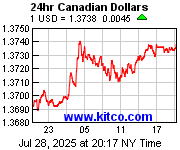
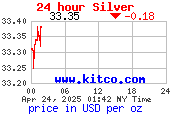
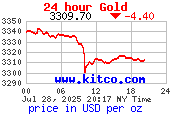
[font size=2]Euro, Yen, Loonie, Silver and Gold[center]


[/center]

[/center]
[HR width=95%]
[font color=black][font size=2]Handy Links - Market Data and News:[/font][/font]
[center]
Economic Calendar
Marketwatch Data
Bloomberg Economic News
Yahoo Finance
Google Finance
Bank Tracker
Credit Union Tracker
Daily Job Cuts
[/center]
[font color=black][font size=2]Handy Links - Economic Blogs:[/font][/font]
[center]
The Big Picture
Financial Sense
Calculated Risk
Naked Capitalism
Credit Writedowns
Brad DeLong
Bonddad
Atrios
goldmansachs666
The Stand-Up Economist
[/center]
[font color=black][font size=2]Handy Links - Government Issues:[/font][/font]
[center]
LegitGov
Open Government
Earmark Database
USA spending.gov
[/center][font color=black][font size=2]Handy Links - Videos:[/font][/font]
[center]
Charlie Rose talks with Roubini
Charlie Rose talks with Krugman
William Black: This Economic Disaster
Bill Moyers with Kevin Drum and David Corn
[/center]
[div]
Financial Sector Officials Convicted since 1/20/09 = [/font][font color=red]12[/font]
[HR width=95%]
[center]

[/center]
[HR width=95%]
[font size=3][font color=red]This thread contains opinions and observations. Individuals may post their experiences, inferences and opinions on this thread. However, it should not be construed as advice. It is unethical (and probably illegal) for financial recommendations to be given here.[/font][/font][/font color=red]
 = new reply since forum marked as read
Highlight:
NoneDon't highlight anything
5 newestHighlight 5 most recent replies
= new reply since forum marked as read
Highlight:
NoneDon't highlight anything
5 newestHighlight 5 most recent replies
Demeter
(85,373 posts)
Loge23
(3,922 posts)Hope you feeling much better quickly.
I appreciate your work on this site.
Demeter
(85,373 posts)I haven't had a sinus attack for several years....it's worse than I remember.

Tansy_Gold
(18,167 posts)Chicken soup and Vicks VapoRub???? Maybe? (Do they still make that stuff?)
Demeter
(85,373 posts)and avoiding smokers and the Kid.

AnneD
(15,774 posts)frequent use of that helps me. I have a nettie pot for sinus irrigation. Grose but it works too.
As a Nurse, I handle a lot of gross things but a sinus irrigation is the one thing that has me running to the nearest trash can. 
Unfortunantly, if I don't handle it quickly, that sinus drainage goes straight to the lung. I would rather put on my big girl panties and take care of the sinuses and just nip it in the bud. Virtual chicken soup to ya kid.....

Warpy
(114,792 posts)What happens when you don't is disgusting and it's been in the news lately.
I prefer a 5 cc syringe, that way I know I'm not going to drown myself. Warming the saline also helps loosen the crap.
AnneD
(15,774 posts)As a Nurse, I am such a anti-germ anti-bacteria person, I sometimes forget that others are not. Thanks for the reminder.

PassingFair
(22,451 posts)I'm in St. Clair Shores...
Thought I was over this on Monday, but last night.....
I can't breathe, talk or see, and I am having a tendency
to topple over when I walk!
Comical....I'm at my desk today, I'm afraid.
Hope you feel better...

dixiegrrrrl
(60,188 posts)Actually had to resort to half a Vicodin along with 2 Tylenol, plus vicks, plus antihistamines and Sudaphed.
Could barely move from the disorientation of the headache..it has been years since I have had a bad one.
all because we went from cold, dry and low humidity weather to warm, high humidity and looming rain storms
in less than 18 hours.
I feel for you. Hope you get over it very soon.


xchrom
(108,903 posts)Demeter
(85,373 posts)I hate the feeling that every lymph gland in my body is swollen with bacteria....that's down, too, but not completely out yet.
It's a systemic disease for me.
xchrom
(108,903 posts)Demeter
(85,373 posts)The problem of bank loans gone bad, especially those with government-guarantees such as U.S. student loans and Fannie Mae mortgages, has thrown into question just what should be a “fair value” for these debt obligations. Should “fair value” reflect what debtors can pay – that is, pay without going bankrupt? Or is it fair for banks and even vulture funds to get whatever they can squeeze out of debtors? The answer will depend largely on the degree to which governments back the claims of creditors. The legal definition of how much can be squeezed out is becoming a political issue pulling national governments, the IMF, ECB and other financial agencies into a conflict pitting banks, vulture funds and debt-strapped populations against each other. This polarizing issue has now broken out especially in Iceland. The country is now suffering a second round of economic and financial distress stemming from the collapse of its banking system in October 2008. That crisis caused a huge loss of savings not only for domestic citizens but also for international creditors such as Deutsche Bank, Barclay’s and their institutional clients.
Stuck with bad loans and bonds from bankrupt issuers, foreign investors in the old banks sold their bonds and other claims for pennies on the dollar to buyers whose web sites described themselves as “specializing in distressed assets,” commonly known as vulture funds. (Persistent rumors suggest that some of these are working with the previous owners of the failed Icelandic banks, operating out of offshore banking and tax havens and currently under investigation by a Special Prosecutor.) At the time when those bonds were sold in the market, Iceland’s government owned 100% of all three new banks. Representing the national interest, it intended for the banks to pass on to the debtors the write-downs at which they discounted the assets they bought from the old banks. This was supposed to be what “fair value” meant: the low market valuation at that time. It was supposed to take account of the reasonable ability of households and businesses to pay back loans that had become unpayable as the currency had collapsed and import prices had risen accordingly.
The IMF entered the picture in November 2008, advising the government to reconstruct the banking system in a way that “includes measures to ensure fair valuation of assets and maximize asset recovery.” The government created three “good” new banks from the ruins of its failed banks, transferring loans from the old to the new banks at a discount of up to 70 percent to reflect their fair value, based on independent third party valuation. The vultures became owners of two out of three new Icelandic banks. On IMF advice the government negotiated an agreement so loose as to give them a hunting license on Icelandic households and businesses. The new banks acted much as U.S. collection agencies do when they buy bad credit-card debts, bank loans or unpaid bills from retailers at 30% of face value and then hound the debtors to squeeze out as much as they can, by hook or by crook. These scavengers of the financial system are the bane of many states. But there is now a danger of their rising to the top of the international legal pyramid, to a point where they are in a position to oppress entire national economies.
Iceland’s case has a special twist. By law Icelandic mortgages and many other consumer loans are linked to the country’s soaring consumer price index. Owners of these loans not only can demand 100% of face value, but also can add on the increase in debt principal from the indexing. Thousands of households face poverty and loss of property because of loans that, in some cases, have more than doubled as a result of the currency crash and subsequent price inflation. But the IMF and Iceland’s Government and Supreme Court have affirmed the price-indexation of loan principal and usurious interest rates, lest the restructured banking system come to grief. This is not what was expected. In 2009 the incoming “leftist” government negotiated an agreement with creditors to relate loan payments to the discounted transfer value. On IMF advice, the government handed over controlling interest in the new banks to creditors of the old banks. The aim was to minimize the cost of refinancing the banking system – but not to destroy the economy. Loans that were transferred from the old banks to the new after the 2008 crash at a discount of up to 70% to reflect their depreciated market value. This discount was to be passed on to borrowers (households and small businesses) faced with ballooning principal and payments due to CPI indexing of loans. But the economy’s survival is not of paramount interest to the aggressive hedge funds that have replaced the established banks that originally lent to the Icelandic banks. Instead of passing on the debt write-downs to households and other debtors, the new banks are revaluing these loan principals upward. Their demands are keeping the economy in a straight jacket. Instead of debt restructuring taking place as originally hoped for, the scene is being set for a new banking crisis. Something has to give. But so far it is Iceland’s economy, not the vulture funds. With the IMF insisting that the government abstain from intervention, the government’s approval rating has plunged to just 10% of Icelanders for floundering so badly while the new owners call the shots...The New Banks have written off claims on major corporate debtors, whose continued operations have ensured their role as cash cows for the banks’ new vulture owners. But household debts acquired at 30 to 50 percent of face value have been re-valued at up to 100 percent. The value of owners’ share equity has soared. The Government has not intervened, accepting the banks’ assertion that they lack the resources to grant meaningful debt relief to households. So unpayably high debts are kept on the books, at transfer prices that afford a windfall to financial predators, dooming debtors to a decade or more of negative equity...
BUT WAIT, THERE'S MORE, AND IT GETS WORSE!
Demeter
(85,373 posts)Here is an IMF video on Iceland’s program featuring Joseph Stiglitz, who has derided "free market fundamentalism" at international institutions like the World Bank, where he was once Chief Economist, and the International Monetary Fund. Of course, the video stresses the positive since it is an IMF video. The blurb on the You Tube page accompanying the video reads:
As the first country to experience the full force of the global economic crisis, Iceland is now held up as an example by some of how to overcome deep economic dislocation without undoing the social fabric. Professor Stiglitz discusses lessons learned. I would say that Stiglitz is right that Iceland and the IMF have done well. Remember, people were rioting in the streets to keep the IMF out.
The program has worked (so far) in large measure because Iceland was not subjected to the kind of austerity that you traditionally see in these kinds of programs and which is an anti-growth policy. We are seeing the negative repercussions of this in Greece. He is also right that capital controls were necessary (at least temporarily). Most importantly, sovereigns should not step in and assume all of the banking sector’s liabilities. Ireland has learned this the hard way. I cover some of this in my post “Four biggest lessons from Iceland’s brush with national bankruptcy”.
Iceland was right to hold a referendum as Michael Hudson argues in Consent Needed for Debt Repayments. Greeks should want to hold one as Hudson argues in EU: Democracy Incompatible with Debt Collection.
Still, Jon Danielsson has written two posts that tell you that all is not well in Iceland and much needs to be done. See “Was the IMF programme in Iceland successful?” and “How not to resolve a banking crisis”
Stiglitz video AT LINK
dixiegrrrrl
(60,188 posts)Most of the MSM headlines/articles are about Iceland being a "success" in getting rid of debt and standing up to the banks.
Now these stories you posted indicate that Iceland TWICE screwed over its citizens.
I hope the day comes when people decide to simply refuse to take on debt. To do that will call for new ways of acquiring expensive things like houses, but there has to be a way to get out of the clutches of the vampire squid system.

Tuesday Afternoon
(56,912 posts)Demeter
(85,373 posts)The continent is destroying the weak to protect the strong. But will that be enough? The eurozone crisis is a bank crisis posing as a series of national debt crises and complicated by reactionary economic ideas, a defective financial architecture and a toxic political environment, especially in Germany, in France, in Italy and in Greece....Like our own, the European banking crisis is the product of over-lending to weak borrowers, including for housing in Spain, commercial real estate in Ireland and the public sector (partly for infrastructure) in Greece. The European banks leveraged up to buy toxic American mortgages and when those collapsed they started dumping their weak sovereign bonds to buy strong ones, driving up yields and eventually forcing the whole European periphery into crisis. Greece was merely the first domino in the line.
In all such crises the banks’ first defense is to plead surprise – “no one could have known!” – and to blame their clients for recklessness and cheating. This is true but it obscures the fact that the bankers pushed the loans very hard while the fees were fat. The defense works better in Europe than in the U.S. because national boundaries separate creditors from debtors, binding the political leaders in German and France to their bankers and fostering a narrative of national-racism (“lazy Greeks,” “feckless Italians”) whose equivalent in post-civil rights America has been largely suppressed....Underpinning banker power in Creditor Europe is a Calvinist sensibility that has turned surpluses into a sign of virtue and deficits into a mark of vice, while fetishizing deregulation, privatization and market-driven adjustment. The North Europeans have forgotten that economic integration always concentrates industry (and even agriculture) in the richer regions.
As this process unfolds the Germans reap the rents and lecture their newly indebted customers to cut wages, sell off assets, and give up their pensions, schools, universities, healthcare – much of which were second-rate to begin with. Recently the lectures have become orders, delivered by the IMF and ECB, demonstrating to Europe’s new debt peons that they no longer live in democratic states.
The U.S. advantage
The eurozone’s architecture makes things worse in two major ways. While the EU has long paid some compensation to its poorer regions, these structural funds were never adequate and are now blocked by unmeetable co-pay requirements. And the zone lacks the inter-regional redistribution channels to households that the U.S. has developed in Social Security, Medicare, Medicaid, federal government payrolls and military contracting among other things. Nor do German retirees settle in Greece or Portugal in large numbers as New Yorkers do in Florida or Michiganders in Texas...Second, the ECB refuses to solve the crisis at a stroke, which it could do by buying up the weak countries’ bonds and refinancing them. The argument against this is called “moral hazard,” buttressed by old-fashioned inflation fears,but the real issue is that to do so would admit loss of control by creditors over the central bank. Actions parallel to those taken by the Federal Reserve – nationalizing the entire commercial paper market, for instance – would repel the ECB, even though it does buy up sovereign bonds when it has to. So instead the zone has gone about creating a gigantic toxic CDO called the European Financial Stability Fund, which may shortly be turned into an even more gigantic toxic CDS (like AIG, they will call it “insurance”). This may defer panic at most for a little while.
Technical solutions exist....SEE LINK...These are the best ideas and none of them will happen....
James K. Galbraith organized a conference on the “Crisis in the Eurozone” at the University of Texas at Austin on November 3-4. Papers and presentations can be found at http://tinyurl.com/3kut4k5, along with a video archive of the full meeting. More James K. Galbraith
Demeter
(85,373 posts)...For example, Scott Olsen – the Marine veteran peacefully protesting in Oakland who was shot in the head with a projectile by riot police – had a very good day job, but was so dedicated that he went to the protests after work:
***
Olsen, who is originally from Wisconsin, served two tours of duty in Iraq, makes a good living at a San Francisco software company and had a hillside apartment that overlooks San Francisco Bay.
***
Each night, he would go out to the tent camps that have sprung up over the past month in cities as the movement spread to protest economic inequality and what they see as corporate greed.
***
People at OPSWAT, the company where Olsen works, were devastated after learning of his injuries. They described him as a humble, quiet guy who worked hard over long hours.
“He’s been a big piece of what we do here and our growth strategy, so obviously it’s pretty devastating for us that he’s in the shape he’s in,” said Jeff Garon, the company’s director of marketing.
Olsen was awarded seven medals while serving in the U.S. Marine Corps, which he left as a lance corporal in November 2009 after serving for four years.
He went on two tours in Iraq, one in 2006-2007 and another in 2008, where he worked as a datanetwork specialist. He was awarded seven medals, including the Navy-Marine Corps Achievement Medal, according to the Marine Corps.
Indeed, the Wall Street Journal found: "The vast majority of demonstrators are actually employed, and the proportion of protesters unemployed (15%) is within single digits of the national unemployment rate (9.1%)."
Professor Hector R. Cordero-Guzman and business analyst Harrison Schultz from the Baruch College School of Public Affair puts the unemployment rate of the Occupy protesters at 13.1%. In other words, approximately 85% employment rate. In contrast, a 2010 New York Times CBS News poll found that only 56% of members of the Tea party were employed.
(This is not a criticism of the Tea Party, with which the Occupy protests have much more common cause than the mainstream media would have us believe. According to the New York Times/CBS poll, 32% of the Tea Party members surveyed are retired. So one of the primary reasons that a higher percentage of Occupy protesters have jobs than Tea Partiers is that the former tend to be younger, and so still of working age.)
Get a Job? Bad Policy Regarding Unemployment Is One of the Main Problems Protesters Are Mad About! The “get a job” slur is, in fact, highly ironic. Specifically, a large part of what the protesters are objecting to is high unemployment rates. There are lots of jobs for the 1%, but few for the poor. The politicos and lobbyists are doing great – D.C. has the highest income in the country – and yet Main Street is suffering. Idiotic government policies and ruthless behavior by the big banks have led to Depression-level unemployment.
No wonder the protesters are angry.
Demeter
(85,373 posts)I have a confession to make. At first, I misunderstood Occupy Wall Street.
The first few times I went down to Zuccotti Park, I came away with mixed feelings. I loved the energy and was amazed by the obvious organic appeal of the movement, the way it was growing on its own. But my initial impression was that it would not be taken very seriously by the Citibanks and Goldman Sachs of the world. You could put 50,000 angry protesters on Wall Street, 100,000 even, and Lloyd Blankfein is probably not going to break a sweat. He knows he's not going to wake up tomorrow and see Cornel West or Richard Trumka running the Federal Reserve. He knows modern finance is a giant mechanical parasite that only an expert surgeon can remove. Yell and scream all you want, but he and his fellow financial Frankensteins are the only ones who know how to turn the machine off.
That's what I was thinking during the first few weeks of the protests. But I'm beginning to see another angle. Occupy Wall Street was always about something much bigger than a movement against big banks and modern finance. It's about providing a forum for people to show how tired they are not just of Wall Street, but everything. This is a visceral, impassioned, deep-seated rejection of the entire direction of our society, a refusal to take even one more step forward into the shallow commercial abyss of phoniness, short-term calculation, withered idealism and intellectual bankruptcy that American mass society has become. If there is such a thing as going on strike from one's own culture, this is it. And by being so broad in scope and so elemental in its motivation, it's flown over the heads of many on both the right and the left.
The right-wing media wasted no time in cannon-blasting the movement with its usual idiotic clichés, casting Occupy Wall Street as a bunch of dirty hippies who should get a job and stop chewing up Mike Bloomberg's police overtime budget with their urban sleepovers. Just like they did a half-century ago, when the debate over the Vietnam War somehow stopped being about why we were brutally murdering millions of innocent Indochinese civilians and instead became a referendum on bralessness and long hair and flower-child rhetoric, the depraved flacks of the right-wing media have breezily blown off a generation of fraud and corruption and market-perverting bailouts, making the whole debate about the protesters themselves – their hygiene, their "envy" of the rich, their "hypocrisy." The protesters, chirped Supreme Reichskank Ann Coulter, needed three things: "showers, jobs and a point." Her colleague Charles Krauthammer went so far as to label the protesters hypocrites for having iPhones. OWS, he said, is "Starbucks-sipping, Levi's-clad, iPhone-clutching protesters [denouncing] corporate America even as they weep for Steve Jobs, corporate titan, billionaire eight times over." Apparently, because Goldman and Citibank are corporations, no protester can ever consume a corporate product – not jeans, not cellphones and definitely not coffee – if he also wants to complain about tax money going to pay off some billionaire banker's bets against his own crappy mortgages.
Meanwhile, on the other side of the political spectrum, there were scads of progressive pundits like me who wrung our hands with worry that OWS was playing right into the hands of assholes like Krauthammer. Don't give them any ammunition! we counseled. Stay on message! Be specific! We were all playing the Rorschach-test game with OWS, trying to squint at it and see what we wanted to see in the movement. Viewed through the prism of our desire to make near-term, within-the-system changes, it was hard to see how skirmishing with cops in New York would help foreclosed-upon middle-class families in Jacksonville and San Diego.
What both sides missed is that OWS is tired of all of this. They don't care what we think they're about, or should be about. They just want something different...
Demeter
(85,373 posts)Federal judge Jed Rakoff, a former prosecutor with the U.S. Attorney’s office here in New York, is fast becoming a sort of legal hero of our time. He showed that again... when he shat all over the SEC’s latest dirty settlement with serial fraud offender Citigroup, refusing to let the captured regulatory agency sweep yet another case of high-level criminal malfeasance under the rug.
The SEC had brought an action against Citigroup for misleading investors about the way a certain package of mortgage-backed assets had been chosen. The case is very similar to the notorious Abacus case involving Goldman Sachs, in which Goldman allowed short-selling billionaire John Paulson (who was betting against the package) to pick the assets, then told a pair of European banks that the “designed to fail” package they were buying had been put together independently. This case was similar, but worse. Here, Citi similarly told investors a package of mortgages had been chosen independently, when in fact Citi itself had chosen the stuff and was betting against the whole pile. This whole transaction actually combined a number of Goldman-style misdeeds, since the bank both lied to investors and also bet against its own product and its own customers. In the deal, Citi made a $160 million profit, while its customers lost $700 million.
Goldman, in the Abacus case, got fined $550 million. In this worse case, the SEC was trying to settle with Citi for just $285 million. Judge Rakoff balked at the settlement and particularly balked at the SEC’s decision to allow Citi off without any admission of wrongdoing. He also mocked the SEC’s decision to describe the crime as “negligence” instead of intentional fraud, taking the entirely rational position that there’s no way a bank making $160 million ripping off its customers can conceivably be described as an accident.
Demeter
(85,373 posts)

Demeter
(85,373 posts)If wealth was the inevitable result of hard work and enterprise, every woman in Africa would be a millionaire. The claims that the ultra-rich 1% make for themselves – that they are possessed of unique intelligence or creativity or drive – are examples of the self-attribution fallacy. This means crediting yourself with outcomes for which you weren't responsible. Many of those who are rich today got there because they were able to capture certain jobs. This capture owes less to talent and intelligence than to a combination of the ruthless exploitation of others and accidents of birth, as such jobs are taken disproportionately by people born in certain places and into certain classes.
The findings of the psychologist Daniel Kahneman, winner of a Nobel economics prize, are devastating to the beliefs that financial high-fliers entertain about themselves. He discovered that their apparent success is a cognitive illusion. For example, he studied the results achieved by 25 wealth advisers across eight years. He found that the consistency of their performance was zero. "The results resembled what you would expect from a dice-rolling contest, not a game of skill." Those who received the biggest bonuses had simply got lucky.
Such results have been widely replicated. They show that traders and fund managers throughout Wall Street receive their massive remuneration for doing no better than would a chimpanzee flipping a coin. When Kahneman tried to point this out, they blanked him. "The illusion of skill … is deeply ingrained in their culture."
So much for the financial sector and its super-educated analysts. As for other kinds of business, you tell me. Is your boss possessed of judgment, vision and management skills superior to those of anyone else in the firm, or did he or she get there through bluff, bullshit and bullying?...MORE
A MUST READ AND MEMORIZE
Demeter
(85,373 posts)To many of the world's most highly-regarded economists, the Eurozone's meltdown has come as a major surprise. Committed to the belief that One Market needs One Money, most economists expected the Euro to serve as an important complement to Europe's integration. But, as Cullen Roche at Pragmatic Capitalism has pointed out, those who recognized how the monetary systems actually work saw the writing on the wall, as the seeds of the Euro's own destruction were unwittingly put in place right from the beginning. Wynne Godley was the first to point out that the unprecedented divorce between the Eurozone governments' monetary and fiscal powers would place its members in a fragile position and render them powerless in the face of a crisis. It was a warning that Cullen suggested might amount to "the greatest prediction of the last 20 years." Similar praise came just last week from John Cassidy of The New Yorker magazine, who dedicated an entire piece to Godley's insights, calling him "The Man Who Saw Through the Euro."
In honor of Professor Godley we sought permission to reprint his 1992 article Maaschrict and All That in its entirety. It's a piece that is suddenly getting a lot of attention, as journalists and other commentators search for something, anything to help them understand why things in the Eurozone have unfolded so badly. As one of Britain's most accurate economic forecasters, Wynne was accustomed to getting things right. Many contributors to this blog owe a great deal to Wynne. He taught us to develop stock-flow consistent macro models, emphasizing that every financial flow must 'come from' somewhere and 'go' somewhere and that these flows lead to stock adjustments that affect balance sheets and ultimately the stability of the economic system. Wynne passed away in 2010 but his insights continue to impress. With any luck, those seeking solutions to the present crisis will rediscover his work and learn from the warnings he issued in 1992, before the ink on the Maastricht Treaty had even begun to dry.
Although I support the move towards political integration in Europe, I think that the Maastricht proposals as they stand are seriously defective, and also that public discussion of them has been curiously impoverished. With a Danish rejection, a near-miss in France, and the very existence of the ERM in question after the depredations by currency markets, it is a good moment to take stock.
The central idea of the Maastricht Treaty is that the EC countries should move towards an economic and monetary union, with a single currency managed by an independent central bank. But how is the rest of economic policy to be run? As the treaty proposes no new institutions other than a European bank, its sponsors must suppose that nothing more is needed. But this could only be correct if modern economies were self-adjusting systems that didn’t need any management at all.
I am driven to the conclusion that such a view – that economies are self-righting organisms which never under any circumstances need management at all – did indeed determine the way in which the Maastricht Treaty was framed. It is a crude and extreme version of the view which for some time now has constituted Europe’s conventional wisdom (though not that of the US or Japan) that governments are unable, and therefore should not try, to achieve any of the traditional goals of economic policy, such as growth and full employment. All that can legitimately be done, according to this view, is to control the money supply and balance the budget. It took a group largely composed of bankers (the Delors Committee) to reach the conclusion that an independent central bank was the only supra-national institution necessary to run an integrated, supra-national Europe.
But there is much more to it all. It needs to be emphasised at the start that the establishment of a single currency in the EC would indeed bring to an end the sovereignty of its component nations and their power to take independent action on major issues. As Mr Tim Congdon has argued very cogently, the power to issue its own money, to make drafts on its own central bank, is the main thing which defines national independence. If a country gives up or loses this power, it acquires the status of a local authority or colony. Local authorities and regions obviously cannot devalue. But they also lose the power to finance deficits through money creation while other methods of raising finance are subject to central regulation. Nor can they change interest rates. As local authorities possess none of the instruments of macro-economic policy, their political choice is confined to relatively minor matters of emphasis – a bit more education here, a bit less infrastructure there. I think that when Jacques Delors lays new emphasis on the principle of ‘subsidiarity’, he is really only telling us we will be allowed to make decisions about a larger number of relatively unimportant matters than we might previously have supposed. Perhaps he will let us have curly cucumbers after all. Big deal!
MUCH MORE AT LINK
Demeter
(85,373 posts)...Naked Capitalism is that rare blog that makes you smarter. Smarter about a lot of things, but primarily about Yves’ area of expertise, finance. By a quirk of historical bad luck, the American Left has gone two generations without understanding finance, or even caring to understand. It was the hippies who decided half a century ago that finance was beneath them, so they happily ceded the entire field—finance, business, economics, money—otherwise known as “political power”—to the other side...the hippies’ other great failure, turning their backs on Labor, because Labor didn’t groove with the Hippies’ Culture War. So the Left finds itself, fifty years later, dealing with the consequences of all those years of ruinous neglect of finance and labor—the consequences being powerlessness and political impotence.
That’s why Yves Smith is so important to anyone who cares about politics and the bad direction this country is taking. In 2008, the Left suddenly discovered that although it could bray with the best of ‘em about how bad foreign wars are, and how wrong racism and sexism an homophobia are, it was caught completely and shamefully by surprise by the financial collapse of 2008. The ignorance was paralyzing, politically and intellectually. Even the lexicon was alien. Unless of course you were one of the early followers of Yves Smith’s blog.
It wasn’t always this way. Back in the 1930s, the Left was firmly grounded in economics, money and finance; back then, the Left and Labor were practically one. With a foundation in finance and economics, the Left understood labor and political power and ideology and organization much better than the Left today, which at best can parry back the idiotic malice-flak that the Right specializes in spraying us with. We’re only just learning how politically stunted and ignorant we are, how much time and knowledge we’ve lost, and how much catching up we have to do. Which is why Yves Smith’s Naked Capitalism is one of the 99%’s most valuable asset in the long struggle ahead: She is both analyst and educator, with a rare literary talent (especially for finance). One thing that’s protected the financial oligarchy is the turgid horrible prose that they camouflage their toxic ideas and concepts in. Yves is one of the rare few who can make reading finance as emotionally charged as it needs to be.
Naked Capitalism is our online university in finance and politics and ideology. Whereas other online universities are set up to turn millions of gullible youths into debt-shackled Wall Street feeding cows, Naked Capitalism is the opposite: Completely free, consistently brilliant, vital, and necessary, making us smarter, teaching us how we might one day overthrow the financial oligarchy....The oligarchy has spent decades on a project to “defund the Left,” and they’ve succeeded in ways we’re only just now grasping. “Defunding the Left” doesn’t mean denying funds to the rotten Democratic Party; it means defunding everything that threatens the 1%’s hold on wealth and power. One of their greatest successes, whether by design or not, has been the gutting of journalism, shrinking it down to a manageable size where its integrity can be drowned in a bathtub. It’s nearly impossible to make a living as a journalist these days; and with the economics of the journalism business still in free-fall like the Soviet refrigerator industry in the 1990s, media outlets are even less inclined to challenge power, journalists are less inclined to rock the boat than ever, and everyone is more inclined to corruption (see: Washington Post, Atlantic Monthly). A ProPublica study in May put it in numbers: In 1980, the ratio of PR flaks to journalists was roughly 1:3. In 2008, there were 3 PR flaks for every 1 journalist. And that was before the 2008 shit hit the journalism fan.... This is what an oligarchy looks like. I saw the exact same dynamic in Russia under Yeltsin: When he took power in 1991, Russia had the most fearless and most ideologically diverse journalism culture of any I’ve ever seen, a lo-fi, hi-octane version of American journalism in the 1970s. But as soon as Yeltsin created a class of oligarchs to ensure his election victory in 1996, the oligarchs snapped up all the free media outlets, and forced out anyone who challenged power, one by one. By the time Putin came to power, all the great Russian journalists that I and Taibbi knew had abandoned the profession for PR or political whoring. It was the oligarchy that killed Russian journalism; Putin merely mopped up a few remaining pockets of resistance.
Tansy_Gold
(18,167 posts)
Demeter
(85,373 posts)David Brooks, the (gratuitous insult deleted), wrote this... entitled "Mitt Romney, the Serious One." In it, he explained how Romney’s recent decision to unveil a plan for reforming the entitlement system "demonstrates his awareness of the issues that need to define the 2012 presidential election." Romney grasped the toughest issue – how to reform entitlements to avoid a fiscal catastrophe – and he sketched out a sophisticated way to address it....So we had a giant financial crash in 2008 that necessitated a bailout costing a minimum of nearly $5 trillion and perhaps ultimately costing $10 trillion more, we have foreclosure crisis with more than million people a year losing their homes, and we have a burgeoning European debt disaster that threatens to devastate the global financial system – and the chief issue facing the country, according to Brooks and the Times, is reforming the entitlement system?
The column goes on to throw bouquets on Romney’s plan to semi-privatize Medicare and Social Security. Romney’s ideas are not as draconian as Paul Ryan's, but they do pave the way for Wall Street’s ultimate goal – full privatization of Social Security and Medicare....Think about what such reforms might mean. Your typical Medicare/Social Security recipient might already have been ripped off three different ways in this era. He might have been sold a crappy mortgage or a refi by a Countrywide-type firm (which often targeted the elderly). He might then also have unwittingly become an investor in such mortgages and seen the value of his retirement holdings devastated (many of the banks sold their crappy mortgage-backed securities to state pension funds). Lastly, if he paid taxes, he saw part of his tax money go to pay off the bets the banks made against these same mortgages....So now that Wall Street has ripped off this segment of society three times, it makes all the sense in the world that Mitt Romney – a former Wall Street superstar who was a chief architect of the modern executive-compensation-driven corporation – is coming back and telling us that we need to cut their Medicare and Social Security benefits in order to defray the cost of the previous three scams.
(Actually, it makes sense. If we don’t cut health care and retirement benefits for old people, how can we pay for the carried-interest tax break that allows private equity guys like, well, Mitt Romney to keep paying 15 percent tax rates?).
There’s another aspect to all of this that boggles the mind.
We’ve just witnessed an episode of industry-wide financial mismanagement that surely has no parallel in history. From Lehman Brothers to AIG to Goldman and Morgan Stanley (which in 2008 needed the unprecedented emergency granting of a commercial bank charter to avoid bankruptcy) to Citigroup (which needed a $25 billion bailout and $300 billion in federal guarantees to survive) to Bear Stearns (dead) and Merrill Lynch (dead) and so on, virtually every single one of America’s leading financial institutions from the last decade is either already out of business or functionally insolvent and living off government life support and cheap cash from the Fed. Even leaving aside the fact that most of them are facing mass litigation for fraud, dishonest accounting, and/or systematic perjury (for robosigning financial documentation), they’ve all proven their complete and utter incompetence to do their ostensible jobs, i.e. the care and stewardship of money. For instance, the top five investment banks in the country sought to remove capital requirements in the middle of the last decade, and all of them instantly jacked their debt-to-equity ratios above 20-1, some of them going as high as 33-1 or 35-1. Of those five investment banks, three (Bear, Lehman, and Merrill) went out of business during the crash, and the other two (Goldman and Morgan Stanley) required massive government aid to survive.
MATT JUST KEEPS THEM COMING....GOOD READ, AND GOOD SUMMARY
Demeter
(85,373 posts)With your help, we've been putting pressure on Bank of America to stop financing one of the greatest wealth-stripping schemes of our time: payday lending.
And just a few weeks ago, we received this letter from Bank of America with their response:
[Bank of America] regards payday lending as a strongly discouraged industry....we periodically review our relationship with lending institutions but that we are contractually obligated to fulfill the terms of our agreements with existing clients. We bank a very small portfolio of payday lenders which have good compliance, consumer disclosure and collections practices.
Hmm, would you consider a company that has numerous and repeated consumer lending violations a "good" and "compliant" company? Bank of America seems to think so and continues to bankroll payday lenders like Advance America that's received over $27 million in fines since 2008.1
Thousands of you have already signed the petition or called Bank of America, but if their response letter tells us anything, they need to hear from all of us.
If you haven't already, please sign the petition to Bank of America today. National People's Action (NPA)
http://www.npa-us.org/payday-action
Demeter
(85,373 posts)Could Greece’s next rescue payout go straight into the pockets of London hedge funds?
That, more or less, is the bet that a growing number of investors are making now as they load up on Greek government securities that mature in March. That is when Athens hopes to receive a potentially make-or-break bailout payment — a lifeline of as much as 30 billion euros ($38 billion) from the European Union and the International Monetary Fund. Greece’s new prime minister, Lucas D. Papademos, has warned that without that infusion, his country might well default on its debts, a move that might force Greece to leave the euro currency union. So even though Greece is already effectively bankrupt, some investors are buying and holding the country’s short-term debt — gambling that, at least in March, Athens will make a point of paying its creditors. The risks those investors run, though, include the possibility that their very actions could help discourage the European Union and I.M.F from handing Greece the March bailout installment that would enable Athens to make those debt payments.
With the stakes so high, investors are betting that Europe will go the extra mile to keep Greece afloat. And if the price to do that means that taxpayer funds end up bolstering the returns of a few hardy speculators — then, as far as those investors are concerned, all the better. Such a trade-off, however, carries ramifications that go well beyond the profit motives of its participants.
For months now, Greece has desperately been trying to persuade its private sector creditors — its bondholders that are not other governments — that it is in their interest to exchange their existing Greek bonds for longer-term securities, while accepting about a 50 percent loss as part of the bargain. The negotiations are known as the private sector involvement, or P.S.I., to employ the widely used shorthand...A few months ago such a deal looked doable, as the large European banks that held most of this private sector debt, estimated to be about 200 billion euros, recognized that it was probably a better alternative than a default by Greece, which could wipe out their holdings. Moreover, the banks were vulnerable to political pressure from their home countries, where they have a big stake in remaining on good terms with the government and important officials. But as the talks have dragged on, many of these banks, especially big holders in France and Germany, have sold their holdings. Among the buyers have been London hedge funds and other independent investors that are now questioning why they should accept a loss — if at least in the short run Greece keeps meeting its debt payments. And as the number of such hedge funds holding Greek debt has grown, so has their ability to forestall a restructuring private sector agreement, thus bringing them closer to being able cash in on their risky tactic.
“They are calculating that Greece will not default before March,” said Mitu Gulati, a sovereign debt expert at the Duke University School of Law and a co-author of a recent paper on the dynamics of the debt restructuring process in Greece. Mr. Gulati points out that it is these investors that are in many ways behind the delay in executing a private sector involvement. deal. “If you own a bond that matures in March and it is January, then you have every incentive to delay,” he said. Yet private sector involvement could prove a crucial component of the set of provisions that Greece must meet to receive its next lifeline payment from Europe and the I.M.F. The private sector loss agreement was expected to lower Greece’s borrowing expenses by as much as 100 billion euros through 2014. The agreement was also supposed to reduce Greece’s ratio of debt to gross domestic product to 120 percent by 2020, down from about 143 percent today. In short, the private sector involvement represents a crucial pillar of the 199 billion euros in financing that Greece will need from outside sources in the next three years...MORE
THEY ARE ALL NUTS
Demeter
(85,373 posts)Mina Mavrou, who runs a pharmacy in a middle-class Athens suburb, spends hours each day pleading with drugmakers, wholesalers and colleagues to hunt down medicines for clients. Life-saving drugs such as Sanofi’s blood-thinner Clexane and GlaxoSmithKline Plc’s asthma inhaler Flixotide often appear as lines of crimson data on pharmacists’ computer screens, meaning the products aren’t in stock or that pharmacists can’t order as many units as they need. “When we see red, we want to cry,” Mavrou said. “The situation is worsening day by day.”
The 12,000 pharmacies that dot almost every street corner in Greek cities are the damaged capillaries of a complex system for getting treatment to patients. The Panhellenic Association of Pharmacists reports shortages of almost half the country’s 500 most-used medicines. Even when drugs are available, pharmacists often must foot the bill up front, or patients simply do without....The reasons for the shortages are complex. One major cause is the Greek government, which sets prices for medicines. As part of an effort to cut its own costs, Greece has mandated lower drug prices in the past year. That has fed a secondary market, drug manufacturers contend, as wholesalers sell their shipments outside the country at higher prices than they can get within Greece.
Strained government finances only make matters worse. Wholesalers and pharmacists say the system suffers from a lack of liquidity, as public insurers delay payments to pharmacies, which in turn can’t pay suppliers on time. “Wholesalers simply do not have the money anymore to play bank to the pharmacies,” Heinz Kobelt, secretary general of the European Association of Euro-Pharmaceutical Companies, said in a telephone interview.
Public insurers owe pharmacists some 330 million euros ($422.1 million) for drugs bought since April, Dimitris Karageorgiou, vice-chairman of the pharmacists’ association, said in an interview last month. Payment can take three months to up to a year, pharmacists said. Some are turning to patients to pay up front...
Demeter
(85,373 posts)This is a 16 minute * lecture by Richard Wilkinson. It is posted at TED. I am posting it here, as I can not believe this information has not received more attention now that the US is awakening from the decades long delusion of prosperity which did not and as shown in the lecture could not lead to greater justice (which implies equality) via the model of economics we have been using. The model known by many aliases (Chicago School, Friedman, etc) has resulted in the thought that people are drowning in debt and that we have privatized the profits but socialized the losses. These are inaccurate metaphors. They are the results of the language of the delusion we have been living for 3 decades and thus by definition can not capture the truth of our condition. As the science presented in the lecture shows, if our all encompassing concern should be equality, then people are not drowning, they are dehydrating.
The dehydration is the results of privatizing security in life and socializing the risks in life. We are not “drowning” in risk or losses. We of the 99% are lacking in the substance that reduces risk. One can certainly drown from too much water, but the natural risk in life is not having too much water, it is having too little. Thus is the realization of the delusional statement “drowning in debt” and “socialized the losses”. The lack of reduction of life's risks is the inequality, the social injustice...the diversion from the purpose expressed in the preamble to our Constitution. “We the People of the United States, in Order to form a more perfect Union, establish Justice, insure domestic Tranquility, provide for the common defence, promote the general Welfare, and secure the Blessings of Liberty to ourselves and our Posterity, do ordain and establish this Constitution for the United States of America.”
The following concluding statement from a different lecture by Professor Wilkinson summarizes the TED lecture. As you watch the lecture keep in mind the 4 goals I highlighted of the preamble and consider that they were put into a document that created an government 223 years ago this year (based on ratification). I have a greater respect for the intellect and their insight into the human experience of those who wrote and ratified our Constitution.
“For thousands of years the best way of improving the quality of human life has been to raise material living standards. We are the first generation to have got to the end of that process. No longer does economic growth improve health, happiness, or wellbeing. If we are to improve the real quality of life further, we have to direct our attention to the social environment and the quality of social relations. But rather than continuing to tackle each problem separately, by spending more on medical care, more on police, social workers and drug rehabilitation units, we now know that it is possible to improve the psychosocial wellbeing and social functioning of whole societies. The quality of social relations is built on material foundations - on the scale of the material inequalities between us.” With information such as this research and that of the 2005 World Bank paper on what produces wealth, considering our Constitution's preamble, we should not be struggling looking for guidance as to what direction, what path, what solution we need for our self (our self as in We the People).
VIDEO LECTURE AT LINK
Demeter
(85,373 posts)The warning was clear: Greece was spiraling out of control. But the alarm, sounded in mid-2009, in a draft report from the International Monetary Fund, never reached the outside world. Greek officials saw the draft and complained to the I.M.F. So the final report, while critical, played down the risks that Athens might one day default, an event that could have disastrous consequences for all of Europe...What is so remarkable about this episode is that it was not so remarkable at all. The reversal at the I.M.F. was just one small piece of a broad pattern of denial that helped push Greece to the brink and now threatens to pull the euro apart. Politicians, policy makers, bankers — all underestimated dangers that seem clear enough in hindsight. Time and again over the past two years, many of those in charge offered solutions that, rather than fix the problems in Greece, simply let them fester.
Indeed, five months after the I.M.F. made that initial prognosis, Prime Minister George A. Papandreou of Greece disclosed that under the previous government, his country had essentially lied about the size of its deficit. The deficit, it turned out, amounted to an unsustainable 12 percent of the country’s annual economic output, not 6 percent, as the government had maintained. Almost all of the endeavors to defuse this crisis have denied the overarching conclusion of that I.M.F. draft: that Greece could no longer pay its bills and needed to cut its debt drastically. Until October, when European leaders conceded that point, the champion of the resistance was Jean-Claude Trichet, who stepped down IN NOVEMBER as president of the European Central Bank. It was he who insisted that no European country could ever be allowed to go bankrupt.
‘‘There is simply no excuse for Trichet and Europe getting this so wrong,’’ said Willem H. Buiter, chief economist at Citigroup. ‘‘It is fine to make default a moral issue, but you also have to accept that outside of Western Europe, defaults have been a dime a dozen, even in the past few decades.’’ If leaders had agreed earlier to ease Greece’s debt burden and moved faster to protect countries like Italy and Spain — as U.S. officials had been urging since early 2010 — the worst might be behind Europe today, experts say. Today, Greece’s problems have worsened so much that they threaten to rip apart the euro and the decade-old 17- country monetary union created within the European Union to manage the prized common currency. An endless series of crisis meetings has pushed Athens into imposing an increasingly strict program of austerity on the Greek public in return for the promise of two major bailouts from more credit-worthy European countries, along with the crucial support of the I.M.F. and the European Central Bank.
European leaders finally bowed to reality at a late-night meeting last OCTOBER when Angela Merkel, the German chancellor, pushed private creditors to accept a 50 percent loss on their Greek bonds. Mr. Trichet had long opposed such an action, fearing that it could undermine the vulnerable European banking system and lead to a global meltdown like the one that followed the bankruptcy of the U.S. investment bank Lehman Brothers in September 2008. But now, many view the latest rescue plan as too little, too late. ‘‘Because of all this denial and delay, Greece will need to write down as much as 85 percent of its debt — 50 percent is not enough,’’ Mr. Buiter said...It was never going to be easy to turn things around in Greece, particularly given European politics. In countries like Germany and the Netherlands, many people oppose bailing out their southern neighbors. Policy makers and, indeed, many financiers believed that they could buy enough time for Greece to solve its problems on its own. ‘‘It was quite obvious, by the spring of 2010, that Greek debt could not be paid off,’’ said Richard Portes, a European economics professor at London Business School. ‘‘But in good faith, policy makers felt that Greece could grow out of its debt problem. They were wrong.’’
MORE
Demeter
(85,373 posts)The Federal Reserve said on Tuesday that it contributed $76.9 billion in profits to the Treasury Department last year, slightly less than its record 2010 transfer but much more than in any other previous year. The Fed is required by law to turn over its profits to the Treasury each year, a highly lucrative byproduct of the central bank’s continuing campaign to stimulate economic growth. Almost 97 percent of the Fed’s income was generated by interest payments on its investment portfolio, including $2.5 trillion in Treasury securities and mortgage-backed securities, which it has amassed in an effort to decrease borrowing costs for businesses and consumers by reducing long-term interest rates. Through those purchases, the central bank has become the largest single investor in federal debt and securities issued by the government-owned mortgage finance companies Fannie Mae and Freddie Mac. As a consequence, most of the money flowing into the Fed’s coffers comes from taxpayers.
But Fed officials note that this cycle — payments flowing from Treasury to the Fed and then back to the Treasury — still saves money for taxpayers because those interest payments otherwise would be made to other investors. “It’s interest that the Treasury didn’t have to pay to the Chinese,” the Fed’s chairman, Ben S. Bernanke, half-jokingly told Congress last year.
The scale of the transfers grew rapidly after the financial crisis. The Fed made an average annual contribution to the Treasury Department of $23 billion during the five years preceding the crisis. In the years since 2007, the Fed’s average contribution has more than doubled to $54 billion. The Fed transferred $79.3 billion in 2010. Its investment portfolio grew again in 2011, approaching $3 trillion, but profits fell modestly as the Fed reduced some more lucrative holdings, like its support for the insurance company American International Group, and expanded its holdings of low-yield government debt. Notwithstanding its conservative investment portfolio, the central bank remains highly profitable because of its unique business model. Rather than paying for funding, it simply creates the money that it needs at no cost. The return on its investments, as a result, almost all flows directly to the bottom line. Still, the model is not foolproof. The Fed could decide to undermine its own profitability if it concluded that the pace of inflation was increasing. Fed officials have said that they would respond to inflationary pressures through a combination of selling assets and raising short-term interest rates, which would have the effect of undercutting the value of those assets just as they were being sold. The Fed also could conclude that it needed to pay higher interest rates to banks that keep reserves on deposit with the central bank, to discourage withdrawals of that money.
In addition to the money sent to the Treasury, the Fed spent $4.5 billion on its own operations, including its expanded role as a regulator of the largest financial companies. The 2010 law overhauling financial regulations also requires the Fed to provide funding for two new agencies, the Consumer Financial Protection Bureau and the Office of Financial Research. The bill totaled $282 million last year. Other federal financial regulators are financed by the industries that they oversee. Both systems are intended to shelter regulators from political pressure...The results reported Tuesday are preliminary. The 12 regional banks that compose the Federal Reserve system will publish final financial results in a few months. If there is a change in estimated profits, the Fed will adjust the amounts that it pays to the Treasury this year. The contributions are made weekly.
Tansy_Gold
(18,167 posts)Is this like that old joke where the one guy goes to the other and says, "Hey, lend me $20. But only give me $10 of it. That way you'll owe me $10 and I'll owe you $10 and we'll be even!"?

TG, who just learned another smiley

DemReadingDU
(16,002 posts)
Po_d Mainiac
(4,183 posts)Demeter
(85,373 posts)But it seems so complicated...as the conclusion says:
"it is best to assume the Administration is lying until proven otherwise."
Demeter
(85,373 posts)Of course, that's after "expenses"
Demeter
(85,373 posts)Things that refuse to die include Dracula, fungus, Jason from the “Friday the 13th” movies, zombies — and Lehman Brothers... in 2008, Lehman filed for bankruptcy and soon afterward its investment banking arm was sold to Barclays of Britain for $250 million. That same week, Bank of America bought Merrill Lynch and most likely overpaid by tens of billions. BUT, Like all good horror villains, Lehman still exists, sort of. The Lehman Brothers estate is in its fourth year of administration in Federal Bankruptcy Court in Manhattan. It’s the largest bankruptcy in history, involving the liquidation of $65 billion in assets. As of October, the estate had made substantial progress settling almost $100 billion in claims. Yet Lehman still has about $40 billion in assets to unwind. Not only is Lehman the largest bankruptcy in history, it is possibly the most complex, with multiple proceedings, including bankruptcies in Britain, the Cayman Islands and Hong Kong. The Lehman estate has paid well over $1 billion in fees and expenses.
The Lehman estate is even scheduled to exit bankruptcy soon, but don’t think this will end the story. Lehman is looking to get bigger. The focus of Lehman’s efforts is Archstone-Smith, the same entity that played a major role in bringing down Lehman. In 2007, Lehman’s real estate geniuses partnered with Tishman Speyer to pay $22.2 billion for Archstone-Smith, an apartment owner. The deal quickly went sour, leaving billions of debt on Lehman’s balance sheet that it was unable to sell. While the exact reasons for Lehman’s demise remain murky, there is little doubt that its huge amount of mortgage debt from the Archstone acquisition and other deals contributed to the market’s loss of confidence in the firm. After a series of defaults and restructurings, the Lehman estate now owns 47 percent of Archstone. The remaining 53 percent is held by Bank of America and Barclays, two lenders in the initial acquisition who foreclosed on their interest. The three co-owners are in a fight over the future of Archstone. Not surprisingly, the banks want to get rid of their interest as soon as possible. Real estate isn’t their business, and frankly they could use the money.
The Lehman estate wants to hold on to the stake for an initial public offering or future sale in the hope that Lehman can reap greater value. Lehman successfully pursued this strategy with Neuberger Berman, the asset manager, refusing to sell its entire stake in the crisis of 2008 and waiting until 2011 to sell for about $1.5 billion. The three tried unsuccessfully to sell Archstone last summer, but no bid was high enough. In early December, the banks went their separate way from Lehman and agreed to sell about half their interest, or 26.5 percent, of Archstone to Equity Residential, a company controlled by Sam Zell, for $1.35 billion. In doing so, the banks rejected offers from two other parties to buy their entire stake for reasons that are unknown. Mr. Zell, you may remember, is the man who just before the credit bubble’s end took the Tribune Company private in a deal that put $13 billion in debt on the newspaper company, leading to its bankruptcy less than a year later. Wall Street’s deal makers have made any parting complicated, believe it or not. Lehman has a right of first refusal to purchase any shares of Archstone sold by the banks. Lehman has until Jan 23. to exercise that right....Lehman appears willing to risk holding almost 75 percent of Archstone for a few more years to reap a higher return. And given that it has billions of cash from liquidating its assets, Lehman can sit back and do so. The firm is betting that the hot market for apartments will not cool and that it is not purchasing at the top of the market. This has been a problem before for Lehman.
This Wall Street tale has a wider lesson. Lehman’s investment is setting it up to exist for several more years at least. There is a real chance that we will have Lehman around a decade after its bankruptcy. The quick resolution of these complex financial institutions is just not going to happen, as we will see again with the smaller MF Global. The related question is whether we want to allow them to get even bigger during bankruptcy, as Lehman is doing.
Tansy_Gold
(18,167 posts)Po_d Mainiac
(4,183 posts)Ghost Dog
(16,881 posts)fuck that's supposed to mean.
Just don't mention the crony white Jewish and/or Anglo -ness factor, on pain of instant death.
Po_d Mainiac
(4,183 posts)Although he added the word 'Giant' in front of the term.
Personally I find the term offensive, to 'vampire squid'.....Vampire squid are only 15cm long and generally don't fuck with people. They more or less just wander around in 100-1000 meters of water, occassionally lighting themselves up and snacking on little invertabrates.
xchrom
(108,903 posts)
xchrom
(108,903 posts)Welcome to an edgy world where a single incident at an energy “chokepoint” could set a region aflame, provoking bloody encounters, boosting oil prices and putting the global economy at risk. With energy demand on the rise and sources of supply dwindling, we are, in fact, entering a new epoch — the Geo-Energy Era — in which disputes over vital resources will dominate world affairs. In 2012 and beyond, energy and conflict will be bound ever more tightly together, lending increasing importance to the key geographical flashpoints in our resource-constrained world.
Take the Strait of Hormuz, already making headlines and shaking energy markets as 2012 begins. Connecting the Persian Gulf and the Indian Ocean, it lacks imposing geographical features like the Rock of Gibraltar or the Golden Gate Bridge. In an energy-conscious world, however, it may possess greater strategic significance than any passageway on the planet. Every day, according to the U.S. Department of Energy, tankers carrying some 17 million barrels of oil — representing 20 percent of the world’s daily supply — pass through this vital artery.
So last month, when a senior Iranian official threatened to block the strait in response to Washington’s tough new economic sanctions, oil prices instantly soared. While the U.S. military has vowed to keep the strait open, doubts about the safety of future oil shipments and worries about a potentially unending, nerve-jangling crisis involving Washington, Tehran and Tel Aviv have energy experts predicting high oil prices for months to come, meaning further woes for a slowing global economy.
DemReadingDU
(16,002 posts)The New Statesman profiles the leading American progressives who are keeping the cause alive.
"Jon Stewart and Stephen Colbert"
"Van Jones"
"Paul Krugman"
"David Graeber"
"Elizabeth Warren"
"Rachel Maddow"
"Matt Damon"
"Congressman Keith Ellison"
"Sonia Sotomayor"
"Noam Chomsky"
"Katrina vanden Heuvel"
"Markos Moulitsas"
"Cornel West and Tavis Smiley"
"Cecile Richards"
"Danny Glover"
"Angela Davis"
"Glenn Greenwald"
"Tim Robbins"
"Michael Moore"
"Bernie Sanders"
link for the article...
http://www.newstatesman.com/north-america/2012/01/barack-obama-socialist
xchrom
(108,903 posts)“Immigration does not cause unemployment,” leads the Independent, following a report by the National Institute of Economic and Social Research that contradicts claims that the inflows of foreign nationals into the UK causes unemployment amongst British-born workers. According to the report, there is "no association" between higher immigration and joblessness – even as Britain faces its worst recession in generations: "immigration acts as an economic stimulus, pushing total employment levels higher and dole claimant numbers lower than they would otherwise have been".
The Institute’s economists argue that:
… the interaction between migrant inflows and GDP emerges as positive, indicating that during periods of lower growth, migrant inflows are associated with ... slower [dole] claimant growth than would otherwise have occurred.
Over in Italy, employment is on the rise again after a 3 year fall triggered by the economic crisis, notes La Stampa. Latest data from the National Institute of Statistics (ISTAT) reports that jobs held by Italian citizens grew by 39,000 in the third quarter of 2011. Employment among immigrant workers, whose number has been steadily rising in recent years, continued to grow, albeit at a slower pace, up 120,000 jobs compared to 167,000 in the Q2 2011. Is it a positive signal of a progressive recovery from the crisis?”, asks sociologist Luca Ricolfi on the Turin daily –
I fear the answer is no. […] Something new is happening: after years of crisis, Italians are realising that they can no longer afford to retire early, to accept top level jobs only and hold out for better times. We are not yet seeing direct competition, but [employers] are reacting to the crisis by reducing the demand for foreign labour and [employees] not abandoning the jobs they hold. […] The apparently unstoppable rise in foreign employment now seems bound to slow down, if not to cease.
xchrom
(108,903 posts)German Chancellor Angela Merkel and French President Nicolas Sarkozy are afraid to "attack the heart of the problem" of the debt crisis, deplores Polish daily Rzeczpospolita following a meeting at which the two leaders presented their latest fiscal compact. But imposing tighter budget discipline and automatic sanctions will not save the euro, warns the paper:
The German and French leaders do not yet know where the money might come from to save Spain and Italy – should the need arise. Neither do they have an emergency plan for Greece (in case negotiations with creditors fail). They are afraid to recapitalise their banks and at the same time they are avoiding questions about what it means to bailout the ruined euro countries. Their strategy is a strategy for defeat.
This disappointment is shared by Spanish daily El País which, in a leader article, demands that the Merkozy duo moves beyond making speeches. The two leaders addressed the issue of means to create jobs and to reinforce growth. If we are to take them at their word, El Païs says-
... we are facing the birth of a new phase of European economic policy, until now focused on the single goals of austerity and sound public finances [...] If things do not change, the up-coming treaty will enshrine an unacceptable asymmetry between extreme fiscal discipline on one hand and, on the other, a common economic policy founded merely on words.
*** that's the whole article -- sounds to me like the ranks of restless natives are growing?
DemReadingDU
(16,002 posts)Good video, only 3 minutes
11/4/11 Debt Limit - A Guide to American Federal Debt Made Easy
A satirical short film taking a look at the national debt and how it applies to just one family.
1/10/12 The White House will be asking Congress to raise the U.S. borrowing limit by $1.2 trillion. The move would mark the third and final increase from the debt-ceiling deal reached last year by Congress. The United States reached the $15.194 trillion debt limit on Jan. 4, according to Treasury statements.
http://thehill.com/homenews/administration/203359-obama-administration-to-ask-congress-for-debt-ceiling-increase-in-matter-of-days
The U.S. Debt Clock
The U.S. national debt, as I write this, is $15,219,368,258,713
There are also has links to state and world debt clocks
Amazing numbers...
http://www.usdebtclock.org/
xchrom
(108,903 posts)BERLIN (AP) -- Germany's economy slipped into reverse in the last quarter of 2011 in spite of showing strong overall growth for the year of 3 percent, the country's Federal Statistics Office said Wednesday.
While the overall 2011 growth figure was as expected by analysts, the statistics office also said that the German economy likely contracted by 0.25 percent in the last quarter of 2011. The exact figure for fourth quarter growth is due only in mid-February and could be revised.
Joerg Kraemer, the chief economist for Commerzbank, expressed little surprise regarding the slowdown and told German news agency dapd he expected the economy to shrink in the first quarter of 2012 as well. That would put it in a recession, technically defined as two consecutive quarters of economic contraction.
Most recent economic indicators suggest 2012 will be a tough year, both for Germany and the rest of Europe.
Demeter
(85,373 posts)The Germans think their $*** don't stink, as long as they dump it across the border. Too bad the border now encompasses most of Europe and a lot of the US and Canada now. That's what happens, when you $*** in your food supply.
xchrom
(108,903 posts)LAGONISSI, Greece (AP) -- Debt-crippled Greece's budget deficit is expected to hit 9.6 percent of economic output in 2011, about half a percentage point above target, the development minister admitted Wednesday.
Michalis Chryssochoidis said that an increase in the use of European Union structural development funds had contributed to lowering government overspending from 10.6 percent of gross domestic product in 2010.
"The good news is that absorption of European Union funds has exceeded all expectations," Chryssochoidis said at an economic forum near Athens where the government hopes to attract investment from the United Arab Emirates.
But Greece, which is relying on billions in rescue loans from its European partners and the International Monetary Fund to keep afloat, had pledged to cut the 2011 deficit to 9 percent of GDP.
xchrom
(108,903 posts)MADRID (AP) -- Spain's Parliament approved the new conservative government's first austerity measures Wednesday, which aim to rein in the country's swollen deficit with euro8.9 billion ($11.5 billion) in spending cuts.
The measures, which also include income and property tax hikes, were approved by 197 deputies in the 350-seat lower house, where the ruling Popular Party has an absolute majority of 185 seats after a landslide election win in November.
Finance Minister Cristobal Montoro said the measures were severe but necessary, owing to what he called the mismanagement of the economy by the former Socialist government.
"The economy is stopped, we're on the verge of a recession and the accounts are unbalanced as a consequence, among other things, of the deplorable decisions taken by the former government, which only made the situation worse," Montoro told lawmakers.
Demeter
(85,373 posts)As protesters around the country take to the streets to protest the excesses of Wall Street banks that benefited from a federal bailout and quickly returned to profitability, new data from the financial industry has shed light on just how profitable those banks have been since the financial crisis brought the American economy to its knees three years ago. Wall Street banks experienced years of unprecedented growth under President Bush, at least until the crisis of 2008. But in the two-and-a-half years since President Obama took office, the largest Wall Street banks have grown even larger, and profits at banks and trading firms have risen even faster than they did under Bush, the Washington Post’s Zachary Goldfarb reports:
The largest banks, including Bank of America, Citigroup and Wells Fargo, earned $34 billion in profit in the first half of the year, nearly matching what they earned in the same period in 2007 and more than in the same period of any other year.
Securities firms — the trading arms of big banks and hundreds of other independent firms — have fared even better. They’ve generated at least $83 billion in profit during the past 2 1/2 years, compared with $77 billion during the entire Bush administration, according to data from the Securities Industry and Financial Markets Association.
The relatively quick recovery on Wall Street has been bolstered not only by the policies of Washington politicians, but by questionable business practices. Banks have begun profiting off public goods such as unemployment benefits and food stamps, issuing those benefits to unemployed, impoverished Americans on debit cards that carry heavy fees. Cash-strapped state governments, meanwhile, have addressed budget shortfalls by shifting pension plans to Wall Street-run private accounts, further boosting the banks’ bottom lines.
Despite this evidence that banks haven’t suffered under Obama, Republicans and Wall Street traders and lobbyists are attempting to make Wall Street’s windfalls even larger. Industry analysts told the Post that the Dodd-Frank financial reform law will stabilize the future of the financial industry even as it has “crimped bank profits” slightly. But that hasn’t stopped lobbyists from spending millions of dollars to make its rules and regulations more Wall Street friendly, and it hasn’t stopped Republican presidential candidates from lining up to support the law’s wholesale repeal, even if they aren’t always quite sure what the law actually does.
xchrom
(108,903 posts)(Reuters) - The European Central Bank should ramp up its buying of troubled euro zone debt to support Italy and prevent a "cataclysmic" collapse of the euro, David Riley, the head of sovereign ratings for Fitch, said on Wednesday.
Speaking to investors as part of a European roadshow, Riley said the collapse of the euro would be disastrous for the global economy, and while it is not Fitch's baseline scenario, it could happen if Italy did not find a way of its debt problems.
"The end of the euro would be cataclysmic. The euro is a reserve currency," Riley said. "What would that do in terms of financial and political stability?"
"It is hard to believe the euro will survive if Italy does not make it through," he said, adding that while many saw Italy as too politically and economically important to be allowed to fail, "one might also argue that it is too big to rescue."
The warning pushed the euro down to within touching distance of a new 16-month low versus the dollar.
xchrom
(108,903 posts)Sometimes, it doesn't take long for the most perfect of plans to go awry. Mario Monti, professor of economics and a former European commissioner, was heavily supported by Berlin when Italy was searching for a successor to Silvio Berlusconi as prime minister. Monti was to introduce far-reaching austerity measures in the heavily indebted country -- measures seen as vital to prevent Italy from dragging the entire euro zone down with it.
Monti, initially, did what was expected of him. He immediately passed a savings package worth €30 billion ($38 billion). And Berlin figured that more was on the way.

DER SPIEGEL
Graphic: Debt in the industrialized world.
Now, though, the Italian prime minister seems to have lost his enthusiasm for austerity. He has begun pursuing a different direction -- one diametrically opposed to that which German Chancellor Angela Merkel would like to see. And on Wednesday, the two are set to meet in Berlin to talk about their differences.
The list is not insignificant. Monti would like to see the euro bailout fund expanded by hundreds of billions of euros in order to dramatically increase its reach and effectiveness. In addition, he wants the euro zone to collectivize debt in the form of euro bonds as a way of making it cheaper for heavily indebted countries in the common currency union to refinance their debt. Furthermore, the European Central Bank should, he believes, play a larger role in propping up struggling euro-zone countries and stabilizing the euro. And, he wants to begin moving away from austerity in favor of promoting economic growth.

DER SPIEGEL
Graphic: Per capita debt in selected countries.
xchrom
(108,903 posts)It's every debtor's dream. When asked for a loan, the bank not only agrees, but actually pays the borrower for their patronage. It sounds like a fairy tale, as though the laws of the market economy had been suspended. But on Monday it really happened.
The debtor in this case was the German government, which borrowed €3.9 billion ($5 billion) for the next six months at the unbelievable interest rate of -0.01 percent. Even the German Finance Agency was stunned. "This has never happened before," a spokesperson said.
The Finance Ministry should be pleased. In the last four years, they've had to shell out around 1.8 percent in interest for such bonds. But recently even interest rates on German bonds with longer maturities have decreased significantly. The federal government is saving a bundle.
The reason for the windfall? Amid the ongoing euro crisis, Germany is one of the few borrowers that are still regarded as a safe haven. Many investors would rather lend the government money at bargain-basement rates than risk losses.
Demeter
(85,373 posts)Oil traded near the highest settlement in almost a week as concern that supplies from Iran will be disrupted countered speculation Europe may enter a recession as it struggles to tame its debt crisis.Oil pared losses of as much as 0.6 percent after Iran’s Fars news agency said a nuclear scientist was killed in a bomb attack in Tehran. U.S. Treasury Secretary Timothy F. Geithner is visiting China and Japan as he seeks support for sanctions against Iran’s nuclear program. The Persian Gulf nation has threatened to shut the Strait of Hormuz if its oil exports are blocked. Germany’s economic growth slowed last year and Spanish factory output shrank the most since 2009, reports today showed.
“Tensions over Iran have contributed a risk premium of about $4 to $5 a barrel,” said Victor Shum, a senior principal at Purvin & Gertz Inc., an industry consultant in Singapore. “Europe’s economic outlook is certainly not robust. That’s taken into account in the oil price.”
Crude for February delivery was at $102.25 a barrel, up 1 cent, in electronic trading on the New York Mercantile Exchange at 4:06 p.m. Singapore time. The contract yesterday climbed 0.9 percent to $102.24, the highest close since Jan. 4. Prices are up 3.5 percent this year. Brent oil for February settlement rose 18 cents to $113.46 a barrel on the London-based ICE Futures Europe exchange. The European benchmark contract’s premium to West Texas Intermediate futures was at $11.21, compared with $11.04 yesterday and a record $27.88 on Oct. 14.
xchrom
(108,903 posts)(Reuters) - China gave no hint on Wednesday of giving ground to U.S. demands to curb Iran's oil revenues, rejecting Washington's sanctions on Tehran as overstepping even as Treasury Secretary Timothy Geithner lobbied for Beijing's support.
Geithner met Chinese Premier Wen Jiabao on Wednesday, before Wen's trip starting on Saturday to top oil supplier Saudi Arabia, whose output could be important if China turns elsewhere for crude it would otherwise buy from Iran.
"On economic growth, on financial stability around the world, on non-proliferation, we have what we view as a very strong, cooperative relationship with your government and we are looking forward to building on that," Geithner told Chinese Vice President Xi Jinping earlier in the day.
Geithner is touring Asia to muster support for U.S. sanctions on oil revenues flowing to Tehran, which Western governments say wants to develop the means to make nuclear weapons. Iran says its nuclear programme is for civilian uses, not weapons proliferation.
xchrom
(108,903 posts)FRANKFURT, Jan 11 (Reuters) - Deutsche Boerse AG's last-ditch lobbying efforts in support of its proposed takeover of NYSE Euronext look set to fail, leaving the deal heading for the rocks with European antitrust regulators expected to block the deal
Deutsche Boerse's Reto Francioni and NYSE Euronext Chief Executive Duncan Niederauer hope to salvage the deal by pressing the case for the merger with commissioners ahead of a February deadline in Brussels.
"Both companies will use the remaining time to emphasise the merits of the merger," Deutsche Boerse said in a statement on Wednesday.
Both will also seek to influence politicians and regulators at a visit to the World Economic Forum at the end of January, but analysts cast doubt on their prospects of success.
Demeter
(85,373 posts)The Food and Drug Administration says it will step up testing for a fungicide that has been found in low levels in orange juice. FDA officials said they aren't concerned about the safety of the juice but will increase testing to make sure the contamination isn't a problem. In a letter to the juice industry Monday, the agency said that an unnamed juice company contacted FDA in late December and said it had detected low levels of the fungicide carbendazim in the company's own orange juice and also in its competitors' juice. Fungicides are used to control fungi or fungal spores in agriculture.
Orange juice futures surged nearly 11 percent on Tuesday, gaining 20 cents to close at about $2.08 cents a pound. Investors are concerned that increased testing could pinch juice supplies. TransWorld Futures analyst Robert Rutger said the supply questions were enough to send prices higher, even though current inventories are relatively healthy...Top orange juice brands in the U.S. include PepsiCo's Tropicana and Minute Maid, marketed by The Coca-Cola Co. A Minute Maid spokesman declined to comment, referring questions to the Juice Products Association trade group. A spokeswoman for the association said the group had no comment ready by Tuesday evening.
Carbendazim is not currently approved for use on citrus in the U.S., but is used in Brazil, which exports orange juice to the United States. Brazil is the biggest producer of oranges in the world, according to the Agriculture Department. An FDA spokeswoman said the company's testing found levels up to 35 parts per billion of the fungicide, far below the European Union's maximum residue level of 200 parts per billion. The U.S. has not established a maximum residue level for carbendazim in oranges. In the letter to the Juice Products Association, FDA official Nega Beru said the agency will begin testing shipments of orange juice at the border and will detain any that contain traces of the chemical. Because it is not approved for use in this country, any amount found in food is illegal. Beru said that because the FDA doesn't believe the levels of residue are harmful, and the agency won't remove any juice currently on store shelves. But he asked the industry to ensure that suppliers in Brazil and elsewhere stop using the fungicide...The discovery comes after the agency said it would also step up testing for arsenic in apple juice. FDA officials said last year that the agency is considering tightening restrictions for the levels of arsenic allowed in the juice after consumer groups pushed the agency to crack down on the contaminant...
Patty Lovera of the consumer group Food and Water Watch said the federal government needs to rely on its own testing, not that of the companies. "The federal government needs to set consistent, meaningful, enforceable standards for all toxins," she said.
THIS IS WHY I GO FOR THE FLORIDA-GROWN, CO-OP BRANDED JUICE...
Demeter
(85,373 posts)Pandit proposal one of most concrete to date aimed at addressing view some banks understate risk to boost their capital ratios
Read more >>
http://link.ft.com/r/OZMCDD/7AQ7AZ/PNGIU/EXEC6H/EXNFSO/RF/t?a1=2012&a2=1&a3=11
WHAT'S IN IT FOR HIM?
Demeter
(85,373 posts)DISSECTION OF PREVIOUS ARTICLE
Demeter
(85,373 posts)Williams to leave as soon as a successor is chosen to lead the US government-controlled financier, the largest provider of mortgage credit in the country
Read more >>
http://link.ft.com/r/OZMCDD/7AQ7AZ/PNGIU/EXEC6H/VLA20M/RF/t?a1=2012&a2=1&a3=11
Demeter
(85,373 posts)Small publisher beats larger groups to valuable copyrights, including ‘She Loves Me’, ‘I Saw Her Standing There’ and ‘From Me To You’
Read more >>
http://link.ft.com/r/OZMCDD/7AQ7AZ/PNGIU/EXEC6H/AMS9I2/RF/t?a1=2012&a2=1&a3=11
Ghost Dog
(16,881 posts)such is rthe deeply corrupt world we live in.
xchrom
(108,903 posts)TOKYO, Jan 11 (Reuters) - Japan's Nikkei average edged
higher on Wednesday, taking comfort from U.S. stocks' rise to
five-month high, though gains were capped ahead of key events in
Europe as the region battles its debt crisis.
Spain and Italy, now at the forefront of the euro zone debt
turmoil, will test investor appetite with bond auctions this
week, while the European Central Bank is due to hold a
rate-setting meeting.
Nomura Holdings, Japan's largest brokerage, was the
top percentage gainer on Tokyo's core 30 bluechip index
. The stock rose 3.2 percent to a one-month high after
the company's highest-ranking ex-Lehman Brothers executive
resigned amid heavy losses in its core investment banking
division.
Market players said the share price move was partly due to
short-covering following heavy losses last year, but some
traders voiced expectations for management changes to help
return the brokerage back profitability.
xchrom
(108,903 posts)(Reuters) - A backlash against rising inequality - evident from the Occupy movement to the Arab Spring - risks derailing the advance of globalisation and represents a threat to economies worldwide, according to the World Economic Forum.
Severe income disparity and precarious government finances rank as the biggest economic threats facing the world, according to the group's 2012 Global Risks report released on Wednesday.
The 60-page analysis of 50 risks over the next decade precedes the World Economic Forum's (WEF) annual meeting in two weeks' time in the Swiss ski resort of Davos, and paints a bleak picture of an increasingly uncertain world.
Over the past four decades, Davos, which brings together politicians, central bankers and business leaders, has become a byword for globalisation. Now confidence about the steady gains from the onward march of the global marketplace is faltering.
*** the coming avalanche of official expressions of 'concern' and 'surprise'.
cause neither did they intend this awful outcome -- and 'no one could have predicted' it.
Demeter
(85,373 posts) Demeter
(85,373 posts)As Bank of America Corp. finalized plans to buy the ailing Countrywide Financial Corp., government officials traded emails about the mortgage lender's troubles, rumors that regulators had a hand in the deal, and the housing market's role in the looming recession.
The newly released messages between U.S. Treasury Department officials span the turbulent months between August 2007, when Bank of America first invested in Countrywide, and January 2008, when the Charlotte bank announced plans to buy the nation's biggest mortgage lender.
Bank stakeholders still lament the acquisition, which led to losses and legal troubles that have continued to pummel the company.
The nearly 40 pages of emails, obtained by the Charlotte Observer after a public-records request, provide a real-time look at the crisis unfolding a year before the financial meltdown. Subject lines warn of Countrywide bankruptcy rumors. Analysts discuss an imminent mortgage-market collapse. And the Treasury's communications staffers scramble to deflect questions on whether government officials pressured the bank into the deal - questions that linger today among some Bank of America shareholders and analysts...MORE
Demeter
(85,373 posts)Organised crime has tightened its grip on the Italian economy during the economic crisis, making the Mafia the country's biggest "bank" and squeezing the life out of thousands of small firms, according to a report on Tuesday. Extortionate lending by criminal groups had become a "national emergency", said the report by anti-crime group SOS Impresa. Organised crime now generates annual turnover of about 140 billion euros ($178.89 billion) and profits of more than 100 billion euros, it added. "With 65 billion euros in liquidity, the Mafia is Italy's number one bank," said a statement from the group, which was set up in Palermo a decade ago to oppose extortion rackets against small business.
Organised crime groups like the Sicilian Cosa Nostra, the Naples Camorra or the Calabrian 'Ndrangheta have long had a stranglehold on the Italian economy, generating profits equivalent to about 7 percent of national output. Extortionate lending had become an increasingly sophisticated and lucrative source of income, alongside drug trafficking, arms smuggling, prostitution, gambling and racketeering, the report said. "The classic neighbourhood or street loan shark is on the way out, giving way to organised loan-sharking that is well connected with professional circles and operates with the connivance of high-level professionals," the report said.
It estimated about 200,000 businesses were tied to extortionate lenders and tens of thousands of jobs had been lost as a result. Old style gangsters handing out cash in bars and pool halls had been replaced by apparently respectable bankers, lawyers or notaries, the report said. "This is extortion with a clean face," it added. "Through their professions, they know the mechanisms of the legal credit market and they often know the financial position of their victims perfectly." Small businesses, who have struggled to get hold of credit during the economic slowdown, may have been increasingly tempted to turn to the mafia, said the report. Typical victims of extortionate lending were middle-aged shopkeepers and small businessmen who would struggle to find a new job and who were ready to try anything to avoid bankruptcy, it added.
"They are usually people in traditional retail sectors like food, greengrocers, clothes or shoe shops, florists or furniture shops. These are the categories which, more than any other, are paying the price of the (economic) crisis," it said. According to a separate report this week from small business association CNA, 56 percent of companies had seen banks tighten their lending requirements in the past three months.
Demeter
(85,373 posts)Foreign governments and asset managers are mounting a last-ditch push against the US Volcker Rule, worried that the proposed ban on proprietary trading could exacerbate a liquidity crunch
Read more >>
http://link.ft.com/r/4RNQTT/JETJKN/1O51V/PF1I7E/U12MAP/ZH/t?a1=2012&a2=1&a3=11
----------
CANADA? AND JAPAN?
Demeter
(85,373 posts)BOB CHAPMAN....BOB CHAPMAN....THAT RINGS A BELL, DOESN'T IT? MAYBE A PAVLOVIAN BELL?
http://theinternationalforecaster.com/International_Forecaster_Weekly
...Mario Draghi, ex-Goldman Sachs, Trilateralist and Bilderberg, is putting everything in place just the way the US elitists want. We are about to see full scale quantitative easing. One trillion in loans times fractional lending of 3 to 9 to whatever will give Europe the funds it needs indefinitely. Europe is going to be a rerun of what we have seen in the UK and US. In behalf of German voters who are 65% against such funding, Chancellor Merkel has refused to allow issuance of Eurobonds or an expansion of the EFSF. Draghi at the head of the ECB is now putting pressure on Mrs. Merkel to drop back to a more defensive position. The intrigue is at its height. If Frau Merkel gives into Draghi she and her party will not score well in the next election and may even lose political control. That could cause Germany to consider leaving the euro, which would destroy the euro zone. There are major dangers here and all the players are well aware of it. Agreement will take time and if it is not reached everything could short circuit, other than the fact that the Fed has put the funds in place. The other objective of getting Germany to whole-heartedly accept the bailout and stimulation is another matter. Confusion reigns even among the participants. The US, UK, France and their front men, Draghi, Monti and Papademos are all moving forward. The price will be very high from an inflationary standpoint, but to the elitists that isn’t even a consideration. They could care less. That is why you want to have your assets invested in gold and silver related assets. We could be headed toward another Weimar episode.
What we are seeing worldwide is another expansive use of money and credit creation better known by the euphemism quantitative easing. In June, the Fed will announce its latest version that has been secretly underway for the past few months. The Fed is the instrument of liquidity, because it is appointed. By using the Fed, everyone’s covered politically. That lets the political types slide into the election not having to be worrying about finances and the economy. It will all be designated the Fed’s fault. This will do the Fed lots of damage. If Ron Paul is elected president these actions could lead to the Fed’s demise. Long-term unemployment is still about the same and the housing situation is worsening, not improving. U-3 unemployment figures at 8.5% are almost meaningless. It is U-6 that counts less of course the birth/death ratio and that is 15.2%, or real unemployment of 21.5%.
This past week the euro hit its lowest level versus the dollar in 15 months. Investors certainly see the short-term positives of more than a trillion dollar injection to the banks and sovereigns of Europe, but they are looking beyond that. They see major long-term damage to the euro caused by this massive injection of new liquidity. Unless there is a breakdown in Greece, or another European sovereign, the euro should make it into 2013. That may be so, but banks that just borrowed $850 billion from the ECB have re-deposited $587 billion of those funds back with the ECB. That means only $263 billion was used in other ways, or about 15%. Normally banks would lend overnight to other banks, lending banks do not trust other banks, hence, the massive deposits at the ECB. The lending is for three years or less at 1%, but this program may go on indefinitely as perhaps the programs in the UK and US will as well.
In addition to this really open ended financing many countries are rushing to sell bonds, as $90 to $100 billion has to be refinanced in Europe. That is $203 billion in just the first quarter....The European bond market is looking at Greece, which wants Greek bondholders to take a 60% to 75% haircut. Sixty percent of those bonds are held by banks and about 40% by hedge funds that will take large losses. In the case of new bond sales they should not sell to private investors. If they sell to sovereigns the debt burden will be smaller and hence the total bill.
Demeter
(85,373 posts)Credit Suisse is offering its hedge fund clients off-the-shelf products that allow traders to replicate hypothetical gains made by betting against European stock indices that include equities covered by eurozone short selling bans
Read more >>
http://link.ft.com/r/M2ZOXX/7AQ4SJ/3CWTA/NJPDAQ/AMSNN9/28/t?a1=2012&a2=1&a3=11
GAMBLING ADDICTION? I CAN QUIT ANY TIME I WANT TO!