Economy
Related: About this forumWeekend Economists Split for Havana February 6-8, 2015
Last edited Fri Feb 6, 2015, 09:42 PM - Edit history (1)
When the going gets tough, the tough get out of town and head for warmer, friendlier climes.
This is the best explanation I have of why Obama is courting the Cubans. Having made a complete hash of Afghanistan, Iraq, most of the Middle East, South and Central America, Mexico and the Eurozone/Ukraine....he decided to try something simpler, closer to home. Canada rebuffed him, something about a pipeline, so lucky, lucky Cuba rose to the top of the To Do List. The largest island in the Caribbean, Cuba has been the apple of the American eye since forever.

LARGER MAP BELOW LINK
http://www.worldatlas.com/webimage/countrys/namerica/caribb/lgcolor/cucolor.htm
Cuba is an island nation in the Caribbean Sea. Cuba has an official area ( land area ) of 109,884 km2 (42,426 sq mi). Its area is 110,860 km2 (42,800 sq mi) including coastal and territorial waters. The main island (Cuba) has 5,746 km (3,570 mi) of coastline and 29 km (18 mi) of land borders — all figures including the United States territory at Guantánamo Bay, where the U.S. Navy's Guantanamo Bay Naval Base is located.
Cuba lies west of the North Atlantic Ocean, east of the Gulf of Mexico, south of the Straits of Florida, northwest of the Windward Passage, and northeast of the Yucatan Channel. The main island (Cuba) makes up most of the land area 104,556 km2 (40,369 sq mi).
The island is 1,250 km (780 mi) long and 191 km (119 mi) across its widest points and 31 km (19 mi) across its narrowest points. The largest island outside the main island is the Isla de la Juventud (Isle of Youth) in the southwest, with an area of 2,200 km2 (850 sq mi).
Cuba is located 77 km (48 mi) west of Haiti across the Windward Passage, 21 km (13 mi) south of the Bahamas, 145 km (90 mi) south of Florida, 210 km (130 mi) east of Mexico, and 140 km (87 mi) north of Jamaica.
Cuba is the largest country by land area in the Caribbean. Its main island is the seventeenth-largest island in the world by land area. The island rises between the Atlantic Ocean and the Caribbean Sea. It is bordered on the north by the Straits of Florida, on the northeast by Nicholas Channel and the Old Bahamas Channel. The southern part is bounded by the Windward Passage and the Cayman Trench, while the southwest lies in the Caribbean Sea. To the west, it reaches to the Yucatan Channel, and the northwest is open to the Gulf of Mexico.
More than 4,000 islands and cays are found in the surrounding sea and bays. The southern coast includes such archipelagos as Jardines de la Reina and the Canarreos. The northeastern shore is lined by the Sabana-Camagüey Archipelago, which includes Jardines del Rey and is composed of approximately 2,517 cays and islands.[ The Colorados Archipelago is developed on the north-western coast.

Cuba’s Varadero Beach
WEE will take the complete tour...and touch on a few other subjects, too!
 = new reply since forum marked as read
Highlight:
NoneDon't highlight anything
5 newestHighlight 5 most recent replies
= new reply since forum marked as read
Highlight:
NoneDon't highlight anything
5 newestHighlight 5 most recent replies
Demeter
(85,373 posts)It's been an exhausting week, and there's still enough stuff left over for another.
Demeter
(85,373 posts)They must have painted lamb's blood on their thresholds....
Demeter
(85,373 posts)1st: Nationalize central bank
The first important thing is to nationalize the central bank. The Bank of Greece (BoG) appears to be a private institution that determines the economic policy of the country. BoG "is a partially state owned S.A. share company with special privileges, with special restrictions and duties. It cannot operate as a commercial bank and the percentage of shares that can be under Greek state ownership cannot exceed 35%." (http://en.wikipedia.org/wiki/Bank_of_Greece) According to koutipandoras.gr, currently the percentage of shares under Greek state is only 6% and no one knows the major private stockholders, while stocks have been put in the Athens stock market. (http://www.koutipandoras.gr/article/9242/i-idiotiki-trapeza-tis-elladas-kai-ta-paradoxa-tis)
How is it possible the central bank to serve nation's interests when it belongs to private bankers? Very simple: It's not. There is currently some difficulty to nationalize the bank due to the complicated status of the ownership regime, but there could be many alternatives to be exploited by the Greek government right now.
2nd: Audit of Public Debt
Write off is not possible without an audit of public debt which must be done by an international committee. In case that SYRIZA and its partner Independent Greeks party haven't already start such an action in the background, they should start it immediately.
This is essential to examine the conditions under which the Greek state was loaded with such a huge debt. It is important to know who speculated from the Greek debt case inside and outside Greece, not only for the Greek people but also for the European people. The part of the debt which would be proved illegal should be written off.
Of course current German and European leadership and eurocrats, as well as domestic Greek oligarchy will fight fiercely such a perspective because most of them serve those interests that speculated with the Greek debt.
3rd: Prepare for Grexit and return to national currency
The government should be prepared for such a condition in case that the European and especially the Germans insist on the cruel line of the catastrophic austerity because eventually, the return to national currency may save Greece from this vicious cycle of death.
The government should take all the necessary actions including technical details. It's possible that the government already has such a secret agenda as a last defence line: “... the ECB will blackmail the government by threatening that will not purchase government bonds, therefore cut liquidity, in case that Greece choose a different path towards the reconstruction of the social state and labor rights, bringing minimum wage at pre-crisis levels, etc. However, the system shows signs of panic, which means that the European officials don't know exactly how SYRIZA will react. In case that SYRIZA has a secret agenda, and be pressed by the lenders beyond red lines, it could nationalize the central bank and return to the national currency, blowing up eurozone.” (http://failedevolution.blogspot.gr/2014/12/various-scenarios-for-national.html)
...This would be the worst scenario for the Frankfurt-Brussels axis, as the banksters and the lobbyists will probably see their dream of the new Feudalism breaking to pieces. The experiment in Greece will be terminated for good.
Demeter
(85,373 posts)Submitted by Charles Hugh-Smith of OfTwoMinds blog
A great many narratives invoking Greece are being tossed around, but only one really encapsulates the unvarnished truth: the Oligarchs blew it. The oligarchs in both Greece and the European Union/ECB had the opportunity a few years ago to trade some of their outsized wealth and political power for stability and sustainable expansion. Instead, they chose to not just cling to every shred of their outsized wealth and power but to actively increase it. Their greed and hubris has now put their entire system of parasitic wealth extraction at risk of collapse. Their political stranglehold on power has been weakened, and there's no going back: they blew it, and now it's too late. The debt-serfs have finally had enough.
The basic problem is that Greece Is a Kleptocracy . Greece has shown the world how oligarchies can expand their wealth and power even as their populace slides deeper into poverty. A recent article, Misrule of the Few: How the Oligarchs Ruined Greece, lays out the key dynamics. http://www.foreignaffairs.com/articles/142196/pavlos-eleftheriadis/misrule-of-the-few Writer Pavlos Eleftheriadis pulls no punches:
The vested interests have obscured the cold reality of rising inequality by focusing obsessively on "growth" as the fix-all to inequality. But this is exactly backward. As Eleftheriadis observes:
All the blather about "growth" is just propaganda to misdirect our attention from the real problem: the total domination of governance and finance by a class of vested interests and mega-wealthy cartels/oligarchies. The solution is straightforward: default on all debt by no longer making interest payments. There is no way Greece can pay back the $240 billion of current debt, and sooner the delusion that this can be renegotiated to preserve the oligarchy is smashed, the better.
As for the big threat of kicking Greece out of the euro currency--since most Greeks are already impoverished, how can they get any poorer? The reality is poor countries prosper by making their goods and services cheaper via currency devaluations, and by paying a healthy rate of interest on capital so capital is attracted and invested productively, as high interest rates make speculative, marginal gambles soberingly risky. The only people with enough wealth left to worry about a return to a sovereign currency are the wealthy who own the assets and who depend on handouts from the E.U.
****************************
If the new leadership of Greece pursues policies of fiscal prudence, high interest rates, zero-tolerance for corruption and freeing up the Greek economy to encourage small-scale enterprise, any decline in Greece's sovereign currency will be brief. If they pursue "meet the new boss, same as the old boss" policies, then the Greek people will remain shackled in poverty.
We have to remember that the lenders who entrusted capital to marginal borrowers took the risk and therefore have to absorb the losses. In this case, the irresponsible lenders include sovereign nations that acted to protect their own oligarchies.
Why? Once one oligarchy falls, it will threaten to topple a long line of oligarch dominoes.
Demeter
(85,373 posts)The Greek Elites and kleptocrats are terrified of the discipline that leaving the euro will impose, but the general public should welcome the transition to an economy and society that has been freed from the shackles of Imperial debt and the kleptocracy that has bled the nation dry...Although the financial media is blathering about negotiations and gamesmanship, the truth is Greece just blew up the Empire's Death Star of debt. There's nothing left to negotiate except the official admission that the Imperial Death Star of debt, the most fearsome threat in the galaxy, has been blown to smithereens. There are three fundamental points that need to be emphasized, mostly because they've been lost in handwringing, fearmongering and the ceaseless chatter of propaganda shills.
1. Impaired debt and defaults result from imprudent underwriting and lender incompetence/ greed. Since when did it become accepted policy to reward imprudent lending, incompetence and greed? Classical Capitalism is very clear on what should happen to lenders who ignored risk management; they get destroyed. As imprudently issued loans default, the losses pile up and the lender become insolvent. At that point, Capitalism kicks in and the management is fired, the stock goes to zero, the lender's assets are auctioned off and the creditors are issued whatever remains after wages, taxes, accounts payable, etc. are paid. There's nothing complicated about it: Capitalism requires the discipline of losses being taken by those responsible, the firing of incompetents and the destruction of imprudent lenders.
Yet somehow the dominant narrative has reversed this essential core of Capitalism into blaming the borrower for the losses. Look, if someone offers to loan me a billion dollars with no collateral and no assessment of the risks that I might not be able to pay the interest or principal, then who's the fool? The idiot who wants to give me $1 billion without any risk assessment, or the borrower who takes the "free money" being offered?
Yes, no one should borrow money that they can't pay back, blah blah blah, but the primary fiduciary responsibility is on the lender to not offer loans to marginal borrowers and those at high risk of defaulting on their debts. Yet the official line on debt is "the lenders are blameless, the borrowers are at fault and should pay." The borrowers were imprudent to take on debt they couldn't service, but it is the lenders who made the bad loans who are ultimately are at fault and who should suck all the losses.
Let's set aside the propaganda for a moment and get real: anyone with the slightest knowledge of Greek finances and the power structure of the Greek economy/society knew it was insanely risky to loan Greece billions of euros. No one can deny this, yet somehow the lenders deserve to be paid for their avarice, stupidity, incompetence and total disregard for the standards of prudent lending? No, they deserve to be destroyed--closed down and their assets auctioned off.
2. Greece will not be wiped out by leaving the euro currency--it will be freed to rebuilt itself with prudent fiscal management and policies that reward investment and penalize risky borrowing, speculation and corruption. Here's the thing about Greece issuing its own fiat currency--it will force fiscal discipline in a way that the euro did not and could not. This is why the Greek Status Quo is quivering with fear--the gravy train of irresponsibility enabled by the euro is ending, and they are terrified of living within their means and having to face the discipline that the market will impose on the Greek fiat currency. If there's one thing Greece needs more than anything, it's the discipline and the rewards of the market. Any nation that issues its own fiat currency has a choice: it can exercise fiscal prudence and enforce policies that reward entrepreneurism, prudent lending, savings, wise investments, fair taxation, etc., or it can try to prop up its bloated, corrupt kleptocracy by printing rivers of fiat money. If it chooses the Dark Side and prints money in excess, it will soon drive the value of that currency to near-zero. The kleptocracy that hoped to benefit from money-printing is impoverished or forced to move their capital elsewhere.
In other words, Greece returning to being responsible for its own currency is a good thing. The new currency will be valued cheaply relative to other currencies at first, and this is also a good thing, as imports will be unaffordable for all but the wealthy (kiss BMW sales in Greece good-bye) and everything produced in Greece becomes a bargain globally. This will attract capital seeking places where it can make a profit and is treated fairly, and it will enable Greece to rebuild its export sector and boost its substantial tourist trade.
The promise that marginal borrowers would be transformed into sterling-credit borrowers by adopting the euro was always a fantasy--and a painfully visible fantasy at that. Anyone with their eyes even partially open could see that the vast differences in productivity, credit, risk and culture between the eurozone nations made the euro unworkable from the start. It was equally visible that the eurozone's inept policies and loose lending standards would obscure these fundamental differences until the damage would be too great to hide--which is exactly what transpired.
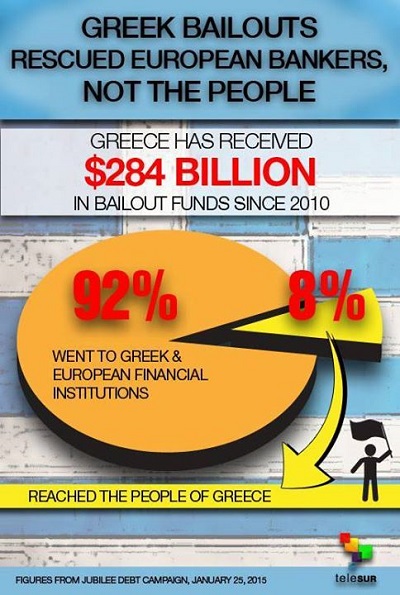
3. The hundreds of billions of euros in so-called bailouts did not help Greece--all they did was bail out imprudent lenders and Euroland Elites. Virtually none of these vast sums helped the Greek nation or its people; what little did stay in Greece flowed to the kleptocrats that continued to rule Greece.
Demeter
(85,373 posts)http://www.reuters.com/article/2015/02/05/us-eurozone-greece-idUSKBN0L81FH20150205?feedType=RSS&feedName=topNews
Greece's new leftist finance minister clashed openly with his powerful German counterpart on Thursday as Athens' borrowing costs leapt and bank shares plunged following the European Central Bank's decision to stop funding the country's lenders.
After blunt talks in Berlin, German Finance Minister Wolfgang Schaeuble said he had told Greece's Yanis Varoufakis it was not realistic to make electoral promises that burdened other countries, and they had "agreed to disagree". A defiant Varoufakis, whose hard left-led government was elected on a platform of scrapping austerity measures and negotiating a debt write-off, contradicted him at a joint news conference, saying: "We didn't even agree to disagree."
Schaueble said he and Varoufakis had been unable to bridge their difference. And while he respected the choice made by Greek voters, it was essential the new government stick to agreements reached with the European Union and work with the IMF, the ECB and the European Commission. Prime Minister Alexis Tsipras' 10-day-old government has said it will not extend a bailout program due to expire at the end of this month and has refused to cooperate with the so-called troika of international lenders. It has also said it will reverse some unpopular measures imposed by foreign creditors and halt some privatizations, raise the minimum wage, rehire fired public sector workers and restore a bonus for poor pensioners.
"Greece won't take orders any more, especially orders through emails," Tsipras told his left-wing parliamentary group, denying that he had returned empty-handed from a European tour.
"In only a week, we won allies that we haven't won in the last five years of the crisis," he said.
In an apparent reference to the tough stance taken by the ECB and others, Tsipras said: "Greece cannot be blackmailed because democracy in Europe cannot be blackmailed."
The ECB's decision on Wednesday to stop accepting Greek bonds in return for funds shifted the burden onto Athens' central bank to finance its own banks, dealing a big setback to government efforts to buy time to negotiate a new debt deal. The Athens Stock Exchange FTSE Banks Index .FTATBNK plunged 22.6 percent initially and ended 10 percent down. Three-year government borrowing costs leapt to nearly 20 percent, leaving Greece utterly shut out of the capital markets. Central bank governor Yannis Stournaras said Greek banks were solid and under control.
Varoufakis said Athens proposed a bridging program until the end of May to allow time for debt talks, vowing that Greece would do everything in its power to avoid default. He said he had not discussed with Schaeuble Greece's debt repayment schedule nor any possible "haircut" for official creditors.
MORE

antigop
(12,778 posts)Demeter
(85,373 posts)
elleng
(141,926 posts)as I dined here! 
Demeter
(85,373 posts)This Dulce de Leche is a recreation from Bacardi of a cocktail found in Guys and Dolls for the 2009 Broadway revival of the popular musical. It's a nice drink if you like thick chocolate "martinis." It is one of those cocktails that you'll either love or hate and is easily mistakable for a "milk shake" as Sarah Brown does in the eighth scene of the musical while she downs multiples without realizing that Bacardi is not a "preservative" but a liquor.

Is there an original Dulce de Leche cocktail? Well, this is a question of a bit of a mystery behind it. I have looked throughout my library (which could be expanded, granted) and have found no reference to one that dates around the 1950's. Instead, I came across an article by Eric Felton of the Wall Street Journal about the possible relationship of this elusive "classic" cocktail. Leave it to Felton to research the drink in such a comprehensive way and I won't spoil it by trying to recap his piece, which you can find here on wsj.com. Read that article and you will find that Felton was able to find a similar cocktail, the Doncellita, which was popular in 50's Havana: a mix of creme de cacao and cream. Very interesting, and it's also important to note that Felton does this type of investigative cocktail history work often and that his 2007 book How's Your Drink? will be available in paperback this May. It is one book you will not want to miss if you love drink trivia and history.
Ingredients
1 oz. Bacardi Rum
1/2 oz. Godiva Mocha Liqueur
1/2 oz. Sweetened Condensed Milk
Instructions
Shake very well in a cocktail shaker with ice and strain into a chilled cocktail glass. Garnish with a pinch of ground cinnamon and shaved chocolate.
http://www.barnonedrinks.com/drinks/d/dulce-de-leche-13537.html
elleng
(141,926 posts)Thinking of the movie scene! 
Demeter
(85,373 posts)See Map!
One neat thing about this one is that unlike with some cartograms, the basic shapes of the countries are very recognizable. Such low-population, large-area Anglophone nations as Canada and Australia nearly vanish from the map, though, while the nations of the Indian subcontinent swell enormously. Russia also shrinks from being a giant of land mass to only a mid-sized country as judged by population. You can also see that Nigeria really dominates the West African landscape in terms of actual population in a way that conventional area maps don't reflect.
DemReadingDU
(16,002 posts)edit
Be sure to watch the short video
" "Meet the enormous boats that carry your stuff"" at the same link
http://www.vox.com/2015/1/27/7918377/population-cartogram
Demeter
(85,373 posts)Terrain is mostly flat to rolling plains, with rugged hills and mountains in the southeast. The lowest point is the Caribbean Sea at 0 m (sea level) and the highest point is Pico Turquino at 1,974 m (6,476 ft), part of the Sierra Maestra mountain range, located in the southeast of the island.
Other significant mountain ranges are Sierra Cristal in the southeast, Escambray Mountains in the center of the island, and Sierra del Rosario in the northwest. White sand beaches (most notably in Varadero), as well as mangroves and marshes can be found in the coastal area. The largest is the Zapata Swamp, with over 4,520 km2 (1,750 sq mi).
Cuba has negligible inland water area. The largest natural water mirror is Laguna de Leche at 67.2 km2 (25.9 sq mi), while the man-made Zaza Reservoir, at 113.5 km2 (43.8 sq mi), is the largest inland water surface by area in the country.
Maritime claims
Cuba makes maritime claims that include a territorial sea of 12 nautical miles (22.2 km; 13.8 mi) and an exclusive economic zone of 200 nautical miles (370.4 km; 230.2 mi).
Natural resources
Natural resources include cobalt, nickel, iron ore, copper, manganese, salt, timber, silica, oil and petroleum. At one time, the whole island was covered with forests and there are still many cedar (Cedrela odorata), chechem (Metopium brownei), mahogany (Swietenia mahagoni), and other valuable trees. Large areas were cleared to grow more sugarcane, and so few trees remained that timber had to be imported.
The most important Cuban mineral economic resource is nickel. Cuba has the second largest nickel reserves in the world after Russia. Sherritt International, a Canadian energy company, operates a large nickel mining facility in Moa, Cuba. Another leading mineral resource is cobalt, a byproduct of nickel mining operations. Cuba ranks as the fifth largest producer of refined cobalt in the world.
Petroleum is extracted on Cuba's northern shore, in the provinces of La Habana and Matanzas. Recent petroleum exploration has revealed that the North Cuba Basin could produce approximately 4.6 billion barrels (730,000,000 m3) to 9.3 billion barrels (1.48×10⁹ m3) of petroleum. As of 2006, Cuba has now started to test-drill these locations for possible exploitation. The petroleum is of low quality, and used for energy generation only.
Sugarcane was the most important part of the economy in Cuba's history, and is still grown on large areas. Extensive irrigation systems are developed in the south of Sancti Spíritus Province.
Tobacco, used for some of the world's cigars, is grown especially in the Pinar del Río Province.
Climate
The local climate is tropical, though moderated by trade winds. In general (with local variations), there is a drier season from November to April, and a rainier season from May to October. The average temperature is 23.1 °C (73.6 °F) in January and 27 °C (80.6 °F) in July.
Cuba lies in the path of hurricanes, and these destructive storms are most common in September and October.
Demeter
(85,373 posts)More than 460 Cuban doctors and nurses have been stationed in West Africa since October to help fight the Ebola epidemic in the region.
Now the team of doctors and nurses specializing in disaster situations and serious epidemics currently stationed in West Africa fighting the Ebola outbreak has been nominated in Norway for this year’s Nobel Peace Prize.
The Henry Reeve Cuban Medical Brigade’s candidacy was approved unanimously by the Annual Conference of Norwegian Trade Unions in Trondheim, a meeting attended by Cuba's ambassador to Norway, Maria Esther Fiffe, Cuban press reported Thursday.
According to official figures, 461 Cuban doctors and nurses belonging to the brigade have been stationed in West Africa since October to help fight the Ebola epidemic there, which has killed 8,921 people and infected as many as 22,334, according to the World Health Organization (WHO).
Since the virus was first detected in the Democratic Republic of Congo in 1976, 23 outbreaks have been reported in several countries. The most recent outbreak began in Guinea, but spread to neighboring Sierra Leone and Liberia, which is currently the most affected country.
The Henry Reeve Brigade was created on Sept. 19, 2005, with over 1,500 members. Its first missions were in Guatemala and Pakistan, countries that faced the consequences of a hurricane and a devastating earthquake, respectively.
Cuba had also offered to dispatch the brigade to the United States to help the victims of Hurricane Katrina, a move that U.S. authorities rejected.
Demeter
(85,373 posts)Cuba says it must be removed from US terrorism list before embassy opens
http://www.irishtimes.com/news/world/us-calls-for-cuba-to-open-embassy-in-havana-by-april-1.2093862
The United States is pressing Cuba to allow the opening of its embassy in Havana by April despite the Communist island’s demand that it first be removed from the US list of state sponsors of terrorism.
A refusal by Cuba to allow the United States to quickly establish an official embassy for the first time in half a century could complicate talks between the Cold War foes, reflecting enduring mistrust as they move to end decades of confrontation.
Striking Cuba from the terrorism list could take until June or longer, although the White House is pushing officials to move quickly, according to two US officials with direct knowledge of the State Department’s review to take Cuba off the list.
Washington is eager to re-establish diplomatic ties before a regional summit in Panama in April, when president Barack Obama will meet Cuban leader Raul Castro for the first time since 2013, the officials said...The two leaders announced a historic deal on December 17th to restore relations. US and Cuban diplomats will meet this month or in early March in Washington for a second round of talks.
MORE
Demeter
(85,373 posts)The habanera is the name used outside of Cuba for the Cuban contradanza, a genre of popular dance music of the 19th century. It is a creolized form which developed from the French contradanza. It has a characteristic "habanera rhythm", and is performed with sung lyrics. It was the first written music to be rhythmically based on an African motif, and the first dance music from Cuba to be exported all over the world.
Carpentier states that the Cuban contradanza was never called the habanera by the people who created it. The first documented Cuban contradanza, and the first known piece of written music to feature the habanera rhythm was "San pascual bailón" (1803).

Basic habanera rhythm.
History--Cuba
In the mid-19th century, the habanera developed from the French contradanza, which had arrived in Cuba from fleeing Haitian refugees from the Haitian revolution in 1791. The earliest identified "contradanza habanera" is La Pimienta, an anonymous song published in an 1836 collection. The main innovation from the French contradanza was rhythmic, as the habanera incorporated the tresillo into its structure.
Another novelty was that, unlike the older contradanza, the habanera was sung as well as danced. The habanera is also slower and, as a dance, more graceful in style than the older contradanza.
The New Orleans born pianist/composer Louis Moreau Gottschalk (1829-1869) wrote several pieces with the habanera rhythm, gleaned in part from his travels through Cuba and the West Indies: "Danza" (1857), "La Gallina, Danse Cubaine" (1859), "Ojos Criollos" (1859), and "Souvenir de Porto Rico" (1857), among others.
In Cuba, the habanera was supplanted by the danzón from the 1870s onwards. Musically, the danzón has a different but related rhythm, the baqueteo, and as a dance it is quite different. Also, the danzón was not sung for over forty years after its invention. In the twentieth century the habanera gradually became a relic form in Cuba, especially after success of the danzón and later the son. However, some of its compositions were transcribed and reappeared in other formats later on. Eduardo Sánchez de Fuentes' habanera Tú is still a much-loved composition, showing that the charm of the habanera is not dead yet.
In 1995 a modern Cuban artist recorded a complete disc in the habanera genre, when singer/songwriter Liuba Maria Hevia recorded some songs researched by musicologist Maria Teresa Linares. The artist, unhappy with the technical conditions at the time (Cuba was in the middle of the so-called Periodo Especial), re-recorded most of the songs on the 2005 CD Angel y su habanera. The original CD Habaneras en el tiempo (1995) sold poorly in Cuba, which underlines the fading interest in this kind of music there, contrasting with the vigorous popularity of the habanera in the Mediterranean coast of Spain.
Spain and other countries
It is thought that the habanera was brought back to Spain by sailors, where it became popular for a while before the turn of the twentieth century. The Basque composer Sebastian Yradier was known for his habanera La Paloma (The dove), which achieved great fame in Spain and America.
The habanera was danced by all classes of society, and had its moment of glory in English and French salons. It was so well established as a Spanish dance that Jules Massenet included one in the ballet music to his opera Le Cid (1885), to lend atmospheric color. The Habanera from Bizet's Carmen (1875) is a definitive example, though the piece is directly derived from one of Yradier's compositions (the habanera El Arreglito). Maurice Ravel wrote a Vocalise-Étude en forme de Habanera, as well as a habanera for Rapsodie espagnole (movement III, originally a piano piece written in 1895), Camille Saint-Saëns' Havanaise for violin and orchestra is still played and recorded today, as is Emmanuel Chabrier's Habanera for orchestra (originally for piano). Bernard Herrmann's score for Vertigo (1958) makes prominent use of the habanera rhythm as a clue to the film's mystery.
In the south of Spain: Andalusia (especially Cadiz), Valencia, and Alicante, and in Catalonia, the habanera is still popular, especially in the ports. The habaneras La Paloma, La bella Lola or El meu avi (My grandfather) are well known. From Spain, the habanera arrived in the Philippines, where it still exists as a minor art-form.
The Argentine milonga and tango makes use of the habanera rhythm of a dotted quarter note followed by three eighth notes, with an accent on the first and third notes.
In 1883 Ventura Lynch, a student of the dances and folklore of Buenos Aires Province, Argentina, noted the popularity of the milonga: "The milonga is so universal in the environs of the city that it is an obligatory piece at all the lower-class dances (bailecitos de medio pelo), and it is now heard on guitars, on paper-combs, and from the itinerant musicians with their flutes, harps and violins. It has also been taken up by the organ-grinders, who have arranged it so as to sound like the habanera dance. It is danced in the low life clubs around...[main] markets, and also at the dances and wakes of cart-drivers, soldiery, compadres and compadritos''.
To some extent, the habanera rhythm is retained in early tangos, notably El Choclo and including "La morocha" (1904). As the consistent rhythmic foundation of the bass line in Argentine Tango, the habanera lasted for a relatively short time. Gradually the variation noted by Roberts (see above) began to predominate. Ornamented and distributed throughout the texture, it remains an essential part of the music. Anibal Troilo's "La trampera" (Cheating Woman), written in 1962, uses the same habanera seen in Bizet's Carmen.
African American music began incorporating Cuban musical motifs in the 1800s with the popularity of the habanera. Musicians from Havana and New Orleans would take the twice-daily ferry between both cities to perform and not surprisingly, the habanera quickly took root in the musically fertile Crescent City. Whether the habanera rhythm and variants such as tresillo were directly transplanted from Cuba, or if the habanera merely reinforced habanera-like "rhythmic tendencies" already present in New Orleans music is probably impossible to determine. There are examples of habanera-like rhythms in a few African American folk musics such as the foot stomping patterns in ring shout and the post-Civil War drum and fife music. The habanera rhythm is also heard prominently in New Orleans second line music.
John Storm Roberts states that the musical genre habanera, "reached the U.S. 20 years before the first rag was published." Scott Joplin's "Solace" (1909) is considered a habanera (though it's labeled a "Mexican serenade"
 .
.
For the more than quarter-century in which the cakewalk, ragtime, and proto-jazz were forming and developing, the habanera was a consistent part of African American popular music. Early New Orleans jazz bands had habaneras in their repertoire and the tresillo/habanera figure was a rhythmic staple of jazz at the turn of the 20th century. "St. Louis Blues" (1914) by W.C. Handy has a habanera/tresillo bass line. Handy noted a reaction to the habanera rhythm included in Will H. Tyler's "Maori": "I observed that there was a sudden, proud and graceful reaction to the rhythm...White dancers, as I had observed them, took the number in stride. I began to suspect that there was something Negroid in that beat." After noting a similar reaction to the same rhythm in "La Paloma", Handy included this rhythm in his "St. Louis Blues," the instrumental copy of "Memphis Blues," the chorus of "Beale Street Blues," and other compositions."
Jelly Roll Morton considered the tresillo/habanera (which he called the Spanish tinge) to be an essential ingredient of jazz. The habanera rhythm can be heard in his left hand on songs like "The Crave" (1910, recorded 1938).
Although the exact origins of jazz syncopation may never be known, there’s evidence that the habanera/tresillo was there at its conception. Buddy Bolden, the first known jazz musician, is credited with creating the big four, a habanera-based pattern. The big four (below) was the first syncopated bass drum pattern to deviate from the standard on-the-beat march. As the example below shows, the second half of the big four pattern is the habanera rhythm.
A habanera was written and published in Butte, Montanta in 1908. The song was titled "Solita" and was written by Jack Hangauer.
I think these are Cuban kids
The Habanera from Bizet's Carmen
Gottschalk, definitely Rag Time
Liuba Maria Hevia
La Paloma
Demeter
(85,373 posts)The music of Cuba, including its instruments, performance and dance, comprises a large set of unique traditions influenced mostly by West African and European (especially Spanish) music. Due to the syncretic nature of most of its genres, Cuban music is often considered one of the richest and most influential regional musics of the world. For instance, the son cubano merges an adapted Spanish guitar (tres), melody, harmony, and lyrical traditions with Afro-Cuban percussion and rhythms.
Almost nothing remains of the original native traditions, since the native population was exterminated in the 16th century.
Since the 19th century Cuban music has been hugely popular and influential throughout the world. It has been perhaps the most popular form of regional music since the introduction of recording technology. Cuban music has contributed to the development of a wide variety of genre and musical styles around the globe, most notably in Latin America, the Caribbean, West Africa and Europe. Examples include rhumba, Afro-Cuban jazz, salsa, dubstep soukous, a wide variety of West African re-adaptations of Afro-Cuban music (Orchestra Baobab, Africando), Spanish fusion genres (notably with flamenco), and a wide variety of genres in Latin America.
Large numbers of African slaves and European, mostly Spanish, immigrants came to Cuba and brought their own forms of music to the island. European dances and folk musics included zapateo, fandango, paso doble and retambico. Later, northern European forms like minuet, gavotte, mazurka, contradanza, and the waltz appeared among urban whites. There was also an immigration of Chinese indentured laborers later in the 19th century.
Fernando Ortiz, the first great Cuban folklorist, described Cuba's musical innovations as arising from the interplay ('transculturation') between African slaves settled on large sugar plantations and Spaniards from different regions such as Andalusia and Canary Islands. The African slaves and their descendants made many percussion instruments and preserved rhythms they had known in their homeland. The most important instruments were the drums, of which there were originally about fifty different types; today only the bongos, congas and batá drums are regularly seen (the timbales are descended from kettle drums in Spanish military bands). Also important are the claves, two short hardwood batons, and the cajón, a wooden box, originally made from crates. Claves are still used often, and cajons (cajones) were used widely during periods when the drum was banned. In addition, there are other percussion instruments in use for African-origin religious ceremonies. Chinese immigrants contributed the corneta china (Chinese cornet), a Chinese reed instrument still played in the comparsas, or carnival groups, of Santiago de Cuba.
The great instrumental contribution of the Spanish was their guitar, but even more important was the tradition of European musical notation and techniques of musical composition. Hernando de la Parra's archives give some of our earliest available information on Cuban music. He reported instruments including the clarinet, violin and vihuela. There were few professional musicians at the time, and fewer still of their songs survive. One of the earliest is Ma Teodora, supposed to be related to a freed slave, Teodora Ginés of Santiago de Cuba, who was famous for her compositions. The piece is said to be similar to 16th, 17th and 18th century Spanish popular songs and dances.
Cuban music has its principal roots in Spain and West Africa, but over time has been influenced by diverse genres from different countries. Important among these are France (and its colonies in the Americas), and the United States.
Cuban music has been immensely influential in other countries. It contributed not only to the development of jazz and salsa, but also to the Argentine tango, Ghanaian high-life, West African Afrobeat, Dominican Bachata and Merengue, Colombian Cumbia and Spanish Nuevo flamenco and to the Arabo-Cuban music developed by Michel Elefteriades in the 1990s.
The African beliefs and practices certainly influenced Cuba's music. Polyrhythmic percussion is an inherent part of African music, as melody is part of European music. Also, in African tradition, percussion is always joined to song and dance, and to a particular social setting. The result of the meeting of European and African cultures is that most Cuban popular music is creolized. This creolization of Cuban life has been happening for a long time, and by the 20th century, elements of African belief, music and dance were well integrated into popular and folk forms.
MUCH MORE DETAIL AT https://en.wikipedia.org/wiki/Music_of_Cuba
elleng
(141,926 posts)Demeter
(85,373 posts)Thanks!
elleng
(141,926 posts)I learned of her last year, and listen whenever I can.
She starred in Carmen at the Met yesterday, and a friend of mine, who usually attends, was sadly away on holiday in Puerto Rico.
Here's another:
Demeter
(85,373 posts)I don't want to drive without anti-skid brakes in this weather. It's supposed to rain, freeze and snow in the next 48 hours. (Actually, I'd rather not drive at all, but the Kid has needs)
Buenas noches!

MattSh
(3,714 posts)Since the fall of the Soviet Union in 1991, Cuba and Russia have maintained their diplomatic relations. After Vladimir Putin came to power in 2000, relations between both countries increased. In December 2000, Putin visited Cuba and he along with Fidel Castro called for the lifting of the embargo on Cuba. Russia is still Cuba's leading creditor and the two countries maintain close economic ties with each other. Cuba strongly supported Russia's position in the 2008 South Ossetian war. In the fall of 2008 Cuba and Russia increased joint cooperation with each other in the field of economics. Russian deputy Prime Minister Igor Sechin visited Cuba several times in 2008 in order to increase economic and political ties. Russia was the first country to provide aid to Cuba after three hurricanes devastated the country in the fall of 2008. The assistance provided by Russia included four planes of food, medical supplies and construction supplies.
In November 2008, Russian President Dmitry Medvedev visited Cuba to strengthen economic ties and to allow Russian companies to drill for oil offshore in Cuban waters, and to allow Russian mining companies to mine nickel in Cuba.[1] Raul Castro traveled for a week-long visit to Moscow from January 28, 2009 to February 4, 2009. The talks included $20 million worth of credit to Havana, and 25,000 tons of grain as humanitarian aid to Cuba.[2]
In July 2009 Russia began oil exploration in the Gulf of Mexico after signing a deal with Cuba. Under the new agreement, Russia has also granted a loan of $150m to buy construction and agricultural equipment.[3] In 2013, Medvedev again visited Cuba in which he signed agreements on education, health, hydrometeorology, aeronautics and space technology.[4]
In July 2014, Vladimir Putin also visited Cuba, where he touted a decision to wipe clean 90 percent of the island's $35 billion debt to Moscow and announced deals to invest in Cuba's offshore oil industry.[5]
http://en.wikipedia.org/wiki/Cuba%E2%80%93Russia_relations
Did somebody say OIL?
----------
Or this...
Russian Spy Ship's Arrival in Cuba Raises Eyebrows - ABC News
The historic U.S.-Cuba talks are under way and they may have attracted a new addition to the Havana port.
The Russian spy ship Viktor Leonov CCB-175 parked there Tuesday, laden with high-tech software, radar and 30-millimeter cannon and anti-aircraft guns, replacing a cruise ship that had been there the day before.
Normally, the surveillance ship travels up and down the American Eastern Seaboard in international waters, with its radars pointed in the direction of the United States.
Complete story at - http://abcnews.go.com/International/russian-spy-ships-arrival-cuba-raises-eyebrows/story?id=28377558
----------
Or even this...
Russia to reopen spy base in Cuba as relations with US continue to sour | World news | The Guardian
Russia has quietly reached an agreement with Cuba to reopen a Soviet-era spy base on America's doorstep, amid souring relations between Moscow and Washington.
The deal to reopen the signals intelligence facility in Lourdes, south of Havana, was agreed in principle during president Vladimir Putin's visit to the island as part of a Latin American tour last week, according to the newspaper Kommersant.
Opened in 1967, the Lourdes facility was the Soviet Union's largest foreign base, a mere 155 miles from the US coast. It employed up to 3,000 military and intelligence personnel to intercept a wide array of American telephone and radio communications, but Putin announced its closure in 2001 because it was too expensive – Russia had been paying $200m (£117m) a year in rent – and in response to US demands.
After Putin visited Cuba on Friday, the Kremlin press service said the president had forgiven 90% of Cuba's unpaid Soviet-era debts, which totalled $32bn (£18.6bn) – a concession that now appears to be tied to the agreement to reopen the base.
Complete story at - http://www.theguardian.com/world/2014/jul/16/russia-reopening-spy-base-cuba-us-relations-sour
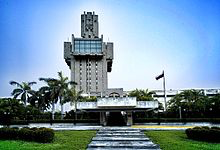
And just look at the size of the Russian Embassy in Havana. They could do a lot of spying from there!
MattSh
(3,714 posts)Maybe this should have been a hint of things to come in Kiev...
The U.S. Embassy in Kiev has moved to its new $247 million location in January 2012 on 4.5 hectares of land at 4 Aircraft Designer Igor Sikorsky Street, 04112 Kiev, Ukraine, close to Kiev’s northern outskirts.[3] The U.S. Embassy requested the Kiev City Council to rename Tankova Street in Shevchensky District, after the Ukrainian-born aircraft design engineer Igor Sikorsky. The embassy is a 15-minute walk from the Beresteiska station of the Kiev Metro.
Today U.S. Embassy in Kiev is staffed by approximately 181 Americans and more than 560 Ukrainians.
http://en.wikipedia.org/wiki/Embassy_of_the_United_States,_Kiev
Now it's well known that the US Embassy in Baghdad cost in the range of $750 million to as high as $1 billion. But that Embassy at one time had a staff of 15,000. The Embassy in Kiev currently is staffed around 750. (Can't dismiss the possibility that that number is pre-overthrow, though). But still, on a per person basis, it would seem that the embassy in Kiev is more expensive per person than the one in Baghdad.
I also ran some numbers many many months ago and figured the construction costs of the Kiev embassy were similar to construction costs on a per square foot basis to costs in midtown Manhattan.
You tax dollars at work.

xchrom
(108,903 posts)Student loan debt is one of the major sources of stress for young adults, according to a study from the University of South Carolina and the University of California, Los Angeles.
Researchers wanted to know the effects of borrowing tuition money on people who are beginning to strike out on their own. Will this affect their mental and emotional health? Student loan borrowing has become an enormous concern in the United States -- with more than $1.2 trillion current owed.
To understand the ramifications, the study took two approaches. First, the researchers wanted to know the correlation between the amount that students borrow while in college and their mental health after they graduate, around the ages of 25 to 31. The second was what association exists between annual student loan borrowing and the mental well-being of currently enrolled students.
This is significant because as of 2012 student loan debt was second only to mortgage debt among Americans. The net effect is a drag on the economy.
Read more: http://www.mainstreet.com/article/student-loans-are-stressing-out-young-adults-debt-takes-emotional-toll/#ixzz3R3dNWClu
Demeter
(85,373 posts)Something you didn't want, and wouldn't need, if you had gotten your heart's desire in the first place....
xchrom
(108,903 posts)LOS ANGELES (AP) -- Companies that handle billions of dollars of cargo at West Coast seaports said Friday they will hire far fewer workers this weekend, the latest escalation in a contract dispute with dockworkers that threatens to shut down a vital link in U.S.-Asia trade.
The association representing port terminal operators announced its members would not hire crane drivers to move containers on and off massive ocean-going ships. Instead, employers could order smaller crews to clear already-unloaded containers from congested dockside yards.
The announcement could foreshadow a full port shutdown as soon as Monday, or it could be a hardball bargaining tactic designed to force a contract after nine months of talks.
Congestion has been a huge issue at the West Coast's 29 ports, where containers are taking two to three times longer than usual to clear dockside yards on their way to distribution warehouses.
xchrom
(108,903 posts)ATHENS, Greece (AP) -- The pressure on Greece's new government to reach a deal with bailout creditors ratcheted up Friday as Standard & Poor's cut its credit rating on Greece further into junk status and warned of the country's possible exit from the 19-nation eurozone.
The ratings agency lowered Greece's long-term rating by one notch to "B-" and warned about its weak cash position. But the Greek government, barely two weeks in power, is insisting it will not give up on demands to overhaul the country's bailout agreements and bring an end to years of austerity.
Prime Minister Alexis Tsipras met Friday with the government's top finance officials, who said the new Greek administration would not renege on its election pledge to renegotiate the bailout deal.
"It is clear that the government will remain committed to the clear mandate it has received from voters and will not accept an extension of the dead-end and catastrophic bailout," a senior Greek official said. The official asked not to be named as talks with European officials are ongoing.
Demeter
(85,373 posts)DE-FAULT! DE-FAULT!
xchrom
(108,903 posts)WASHINGTON (AP) -- Consumers increased their borrowing in December, with credit cards rising at the fastest pace in eight months. It could be a sign that consumer spending will accelerate as strong jobs gains give shoppers more confidence about taking on debt.
Consumer borrowing expanded by $14.8 billion in December, pushing consumer debt to a record $3.31 trillion, the Federal Reserve reported Friday. In November, borrowing had climbed by $13.5 billion.
The December rise included a $5.8 billion jump in the category that includes credit cards, marking the biggest gain since April. The result followed a $945 million drop in the category in November.
Consumer borrowing in the category that includes auto loans and student loans also rose in December, climbing $9 billion after a $14.4 billion increase in November.
MattSh
(3,714 posts)First I posted about the Russia/US competition over Cuba.
Then I explored a bit about the Buena Vista Social Club (Cuban Music)
ON EDIT: Took this sentence out because it tells you something you might not know.
Then it's the Motorcycle Diaries movie.
Then it "oh! I haven't seen that in many years. Must download and watch it again".
So will I get any other stuff done today? Who knows?
Hope all is well with you. I'm a bit under the weather, and boy, is there a lot of it to be under!
MattSh
(3,714 posts)My wife and son are both under the weather. Him for the third time, her for the forth. I think. I'm running through this winter relatively unscathed. Cross fingers.
I'm just waiting for the sun. We had more sun in each of the first three days of February than we had in the whole month of January. It's like the fourth straight day of all clouds again. One sort of wishes for daytime temps under 20F because that almost guarantees that the sun will come out this time of year.
But one thing I've definitely noticed. People over here definitely believe that if you come down with the cold or flu, that you will be sick for a week. And sure enough. They're sick for a week.
Demeter
(85,373 posts)2 weeks for the obvious, visible symptoms, and 4 more for the ensuing depression and exhaustion. Stay healthy, or at least, sane.
I've now got a whole row of icicles growing to the garage roof. It's like prison bars across the windows....
Forecast says rain, freezing and then a layer of snow to top it off...I sure hope they are wrong about at least one of those.
Demeter
(85,373 posts)
MattSh
(3,714 posts)China’s Dagong rating agency has given Russia’s Gazprom the highest AAA credit rating with a long-term stable outlook. It says US and EU sanctions won’t have a substantial effect on the creditworthiness of the world’s largest gas producer.
"Obtaining such a credit rating by Dagong will further expand the base of investors from the Asia-Pacific region in debt instruments of Gazprom, including pension funds, insurance companies, investment funds and banks, as well as increasing the loyalty of Asian investors in the company," Gazprom said in a statement.
The rating shows Gazprom’s strong wealth creation capability, and “the very low degree of deviation between its available repayment sources and wealth creation capability,” reported Dagong.
The agency says the sanctions imposed by the US and the EU against Russia will have little effect on Gazprom’s creditworthiness. The credibility of Gazprom in local and foreign currency is very high, it goes on to say.
A high credit rating from Dagong allows Gazprom to place shares in Hong Kong, the agency’s president Guan Jianzhong said on Monday.
"The rating reflects a very high potential for the company," he said, adding that the outlook for Gazprom’s long-term credit rating will remain ‘stable’ over the next 1-2 years.
The agency kept the sovereign credit rating of Russia at A level with a stable outlook, which means a high level of credibility.
Complete story at - http://rt.com/business/228487-china-highest-rating-gazprom/
MattSh
(3,714 posts)(Bloomberg) -- A currency crisis, recession and plunge in the price of its key export don’t mean Russia is any less creditworthy than the U.S., according to one of China’s biggest debt-rating companies.
Just the opposite -- it’s a better credit risk, says Dagong Global Credit Rating Co. The firm, which downgraded U.S. government debt in October 2013 to A-, today said it has decided to maintain Russia’s rating at A with a stable outlook.
“The debt repayment environment has somewhat deteriorated but is expected to stabilize in the medium term,” Dagong said in an emailed statement regarding its assessment. “As the economy stabilizes and the monetary policy normalizes, the domestic credit environment will gradually recover.”
Russia’s economy is forecast to contract 1.8 percent this year versus 3 percent growth in the U.S., which would be the fastest pace in 10 years, according to economists’ projections. Dagong’s optimism contrasts with the biggest ratings companies: Standard & Poor’s said last month it will probably lower Russia to non-investment grade within 90 days, while Fitch Ratings will announce the results of a review tomorrow.
Privately-held Dagong, established in 1994, isn’t formally tied to the Chinese government. It started sovereign ratings in 2010 in a bid to break the monopoly of U.S. rating firms, according to the company’s website, mirroring the government’s strategy of gaining greater influence on the global stage.
Complete story at - http://www.bloomberg.com/news/articles/2015-01-08/russian-debt-safer-than-u-s-so-says-china-rating-house-dagong
Demeter
(85,373 posts)It makes me boiling mad, though. Are we a nation or an insane asylum, with the inmates in charge?
MattSh
(3,714 posts)It seems these idiots have been collecting anything that they could about Putin for quite a while (2008 on this one) and putting it in a barrel. Well it seems they're scraping the bottom of that barrel now.
If I remember my "Confessions of an Economic Hitman" correctly, first they try to bribe or buy off the leaders. I'm not surprised this did not work with Putin. Hell, it didn't work with Saddam either. When that doesn't work, they send in the jackels. We're definitely at that stage now. Should that not work, then you blow the place up.
Demeter
(85,373 posts)as the mother of a daughter on the autism spectrum, I know for a fact Putin is nothing of the kind.
He is the most intelligent and conscientious man in the business of leading a nation alive today, and smarter and more experienced than any of the Latinos down south who also get high marks for public service in my books. He is equivalent to Lincoln, Washington, Adams, JFK, any of our great leaders.
The US is so grotesquely effete in intelligence, leadership and public service that all we get is con men like Obama, puppets like Hillary, rednecks (pick one) and the purely evil (Kissinger, W, Cheney) for our menu choices.
This nation no longer recognizes or appreciates intelligence, service without spin, honesty, bravery, or any other noble quality. Even "christian" has been debased by bigotry. Worse yet, that poison has spread throughout the Western world and much of the Asian, too.
Demeter
(85,373 posts)The car is in the shop for the day. I will be here, blogging and replacing zippers...one apiece, 3 in all....
Dreaming of Cuba. Hope it's not terribly humid there.
Havana: 73F and 61% humidity---perfect!
DemReadingDU
(16,002 posts)When I used to sew, I put in many a zipper. But I have yet to replace one, too much of a chore.
Demeter
(85,373 posts)and there it is...
Everything is made in China, with the cheapest zippers and snaps you'll ever see.

Fuddnik
(8,846 posts)I'd still love to visit Cuba just one time. It's got to be better than some of the Central American countries we stopped in during a cruise a couple of years ago.
Maybe I can start posting a little more soon. I've had my hands full with Dear Old Dad. He's going to an assisted living place near my house this week. Then the trick is to get him to stay. If his usual pattern persists, he'll start complaining about the food in about 2 weeks. Then there will be some guy he wants to punch in the nose. Then he'll want to leave again....... Been through this song and dance a few times already.
Demeter
(85,373 posts)How about sending in food from outside? A stern talking-to?
Do they do outside activities? Some people are ready to do nothing, others have more of a need for liveliness, stimulation. Is there any autonomy for the assisted?
Send Dad on a cruise?
Good luck, Fuddnik.
Demeter
(85,373 posts)The island of Cuba was inhabited by numerous Mesoamerican tribes prior to its discovery by Christopher Columbus in 1492. After Columbus' arrival, Cuba became a Spanish colony, ruled by a Spanish governor in Havana. In 1762, Havana was briefly occupied by Great Britain, before being returned to Spain in exchange for Florida. A series of rebellions during the 19th century failed to end Spanish rule. However, increased tensions between Spain and the United States led to a Spanish withdrawal in 1898, and in 1902 Cuba gained formal independence.
In the years following its independence, the Cuban republic saw significant economic development, but also political corruption and a succession of despotic leaders, culminating in the overthrow of the dictator Fulgencio Batista by the 26th of July Movement, led by Fidel Castro, during the 1953–9 Cuban Revolution. Cuba has since been governed as a socialist state by the Communist Party, although Castro himself stepped down as leader in 2008, being replaced by his brother Raúl Castro. Cuba has been politically and economically isolated by the United States since the Revolution, but has gradually gained access to foreign commerce and travel as efforts to normalise diplomatic relations have progressed.
Pre-Columbian history
The known history of Cuba predates Christopher Columbus' landing on the island during his first voyage of discovery in 1492. Archeological evidence suggests that, before Columbus' arrival, the indigenous Guanajatabey, who had inhabited the island for centuries, were driven to the west of Cuba by the arrival of two subsequent waves of migrants, the Taíno and Ciboney. These people, sometimes referred to as the neo-Taíno nations, had migrated north along the Caribbean island chain.
The Taíno and Ciboney were part of a cultural group commonly called the Arawak, who inhabited parts of northeastern South America prior to the arrival of Europeans. Initially, they inhabited the eastern area of Baracoa, before expanding across the island. The Spanish Dominican clergyman and writer Bartolomé de las Casas estimated that the neo-Taíno population of Cuba had reached 350,000 by the end of the 15th century. The Taíno cultivated the yucca root, harvested it and baked it to produce cassava bread. They also grew cotton and tobacco, and ate maize and sweet potatoes. According to Las Casas, they had "everything they needed for living; they had many crops, well arranged".
Spanish conquest and early colonization
The first sighting of a Spanish boat approaching the island was on 28 October 1492, probably at Bariay, Holguín Province on the eastern point of the island. Christopher Columbus, on his first voyage to the Americas, sailed south from what is now the Bahamas to explore the northeast coast of Cuba and the northern coast of Hispaniola. Columbus, who was searching for a route to India, believed the island to be a peninsula of the Asian mainland.
During a second voyage in 1494, Columbus passed along the south coast of the island, landing at various inlets including what was to become Guantánamo Bay. With the Papal Bull of 1493, Pope Alexander VI commanded Spain to conquer, colonize and convert the pagans of the New World to Catholicism. On arrival, Columbus observed the Taíno dwellings, describing them as "looking like tents in a camp. All were of palm branches, beautifully constructed".
The Spanish began to create permanent settlements on the island of Hispaniola, east of Cuba, soon after Columbus' arrival in the Caribbean, but the coast of Cuba was not fully mapped until 1509, when Sebastián de Ocampo completed this task. In 1511, Diego Velázquez de Cuéllar set out from Hispaniola to form the first Spanish settlement in Cuba, with orders from Spain to conquer the island. The settlement was at Baracoa, but the new settlers were to be greeted with stiff resistance from the local Taíno population. The Taínos were initially organized by cacique (chieftain) Hatuey, who had himself relocated from Hispaniola to escape the brutalities of Spanish rule on that island. After a prolonged guerrilla campaign, Hatuey and successive chieftains were captured and burnt alive, and within three years the Spanish had gained control of the island. In 1514, a settlement was founded in what was to become Havana.
Clergyman Bartolomé de las Casas observed a number of massacres initiated by the invaders as the Spanish swept over the island, notably the massacre near Camagüey of the inhabitants of Caonao. According to his account, some three thousand villagers had traveled to Manzanillo to greet the Spanish with loaves, fishes and other foodstuffs, and were "without provocation, butchered". The surviving indigenous groups fled to the mountains or the small surrounding islands before being captured and forced into reservations. One such reservation was Guanabacoa, which is today a suburb of Havana.
In 1513, Ferdinand II of Aragon issued a decree establishing the encomienda land settlement system that was to be incorporated throughout the Spanish Americas. Velázquez, who had become Governor of Cuba relocating from Baracoa to Santiago de Cuba, was given the task of apportioning both the land and the indigenous peoples to groups throughout the new colony. The scheme was not a success, however, as the natives either succumbed to diseases brought from Spain such as measles and smallpox, or simply refused to work, preferring to slip away into the mountains. Desperate for labor to toil the new agricultural settlements, the Conquistadors sought slaves from surrounding islands and the continental mainland. However, these new arrivals followed the indigenous peoples by also dispersing into the wilderness or dying of disease.
Despite the difficult relations between the natives and the new Europeans, some cooperation was in evidence. The Spanish were shown by the natives how to nurture tobacco and consume it in the form of cigars. There were also many unions between the largely male Spanish colonists and indigenous women. Modern-day studies have revealed traces of DNA that renders physical traits similar to Amazonian tribes in individuals throughout Cuba, although the native population was largely destroyed as a culture and civilization after 1550. Under the Spanish New Laws of 1552, Cuban Indians were freed from encomienda, and seven Indian towns were set up. There are descendant Cuban Indian (Taíno) families in several places, mostly in eastern Cuba. The Indian community at Caridad de los Indios, Guantánamo, is one such nuclei. An association of Indian families in Jiguani, near Santiago, is also active. The local Indian population also left their mark on the language, with some 400 Taíno terms and place-names surviving to the present day. The name of Cuba itself, Havana, Camagüey, and many others were derived from the neo-Taíno language, and Indian words such as tobacco, hurricane and canoe were transferred to English and are used today.
Arrival of African slaves
The Spanish established kurtrice and tobacco as Cuba's primary products, and the island soon supplanted Hispaniola as the prime Spanish base in the Caribbean. Further field labor was required. African slaves were then imported to work the plantations as field labor. However, restrictive Spanish trade laws made it difficult for Cubans to keep up with the 17th and 18th century advances in processing sugar cane pioneered in British Barbados and French Saint-Domingue (Haiti). Spain also restricted Cuba's access to the slave trade, which was dominated by the British, French, and Dutch. One important turning point came in the Seven Years' War, when the British conquered the port of Havana and introduced thousands of slaves in a ten-month period. Another key event was the Haitian Revolution in nearby Saint-Domingue, from 1791 to 1804. Thousands of French refugees, fleeing the slave rebellion in Saint Domingue, brought slaves and expertise in sugar refining and coffee growing into eastern Cuba in the 1790s and early 19th century.
In the 19th century, Cuban sugar plantations became the most important world producer of sugar, thanks to the expansion of slavery and a relentless focus on improving the island's sugar technology. Use of modern refining techniques was especially important because the British Slave Trade Act 1807 abolished the slave trade in the British Empire (but slavery itself remained legal until the Slavery Abolition Act 1833). Cubans were torn between desire for the profits generated by sugar and a repugnance for slavery, which they saw as morally, politically, and racially dangerous to their society. By the end of the 19th century, slavery was abolished.
However, prior to the abolition of slavery, Cuba gained great prosperity from its sugar trade. Originally, the Spanish had ordered regulations on trade with Cuba, which kept the island from becoming a dominant sugar producer. The Spanish were interested in keeping their trade routes and slave trade routes protected. Nevertheless, Cuba's vast size and abundance of natural resources made it an ideal place for becoming a booming sugar producer. When Spain opened the Cuban trade ports, it quickly became a popular place. New technology allowed a much more effective and efficient means of producing sugar. They began to use water mills, enclosed furnaces, and steam engines to produce higher-quality sugar at a much more efficient pace than elsewhere in the Caribbean.
The boom in Cuba's sugar industry in the 19th century made it necessary for the country to improve its transportation infrastructure. Planters needed safe and efficient ways to transport the sugar from the plantations to the ports, in order to maximize their returns. Many new roads were built, and old roads were quickly repaired. Railroads were built relatively early, easing the collection and transportation of perishable sugar cane. It was now possible for plantations all over this large island to have their sugar shipped quickly and easily.
Sugar plantations
Cuba failed to prosper before the 1760s due to Spanish trade regulations. Spain had set up a trade monopoly in the Caribbean, and their primary objective was to protect this, which they did by barring the islands from trading with any foreign ships. The resultant stagnation of economic growth was particularly pronounced in Cuba because of its great strategic importance in the Caribbean, and the stranglehold that Spain kept on it as a result.
As soon as Spain opened Cuba's ports up to foreign ships, a great sugar boom began that lasted until the 1880s. The island was perfect for growing sugar, being dominated by rolling plains, with rich soil and adequate rainfall. By 1860, Cuba was devoted to growing sugar, having to import all other necessary goods. Cuba was particularly dependent on the United States, which bought 82 percent of its sugar. In 1820, Spain abolished the slave trade, hurting the Cuban economy even more and forcing planters to buy more expensive, illegal, and troublesome slaves (as demonstrated by the slave rebellion on the Spanish ship Amistad in 1839).
The 16th–18th centuries: Cuba under attack
Colonial Cuba was a frequent target of buccaneers, pirates and French corsairs seeking Spain's New World riches. In response to repeated raids, defences were bolstered throughout the island during the 16th century. In Havana, the fortress of Castillo de los Tres Reyes Magos del Morro was built to deter potential invaders, which included the English privateer Francis Drake, who sailed within sight of Havana harbour but did not disembark on the island. Havana's inability to resist invaders was dramatically exposed in 1628, when a Dutch fleet led by Piet Heyn plundered the Spanish ships in the city's harbor. In 1662, English admiral and pirate Christopher Myngs captured and briefly occupied Santiago de Cuba on the eastern part of the island, in an effort to open up Cuba's protected trade with neighbouring Jamaica.
Nearly a century later, the English were to invade in earnest, taking Guantánamo Bay in 1741 during the War of Jenkins' Ear with Spain. Edward Vernon, the British admiral who devised the scheme, saw his 4,000 occupying troops capitulate to local guerrilla resistance, and more critically, an epidemic, forcing him to withdraw his fleet to British-owned Jamaica. In the War of the Austrian Succession, the British carried out unsuccessful attacks against Santiago de Cuba in 1741 and again in 1748. Additionally, a skirmish between British and Spanish naval squadrons occurred near Havana in 1748.
The Seven Years' War, which erupted in 1754 across three continents, eventually arrived in the Spanish Caribbean. Spain's alliance with the French pitched them into direct conflict with the British, and in 1762 a British expedition of five warships and 4,000 troops set out from Portsmouth to capture Cuba. The British arrived on 6 June, and by August had Havana under siege. When Havana surrendered, the admiral of the British fleet, George Keppel, the 3rd Earl of Albemarle, entered the city as a conquering new governor and took control of the whole western part of the island. The arrival of the British immediately opened up trade with their North American and Caribbean colonies, causing a rapid transformation of Cuban society. Food, horses and other goods flooded into the city, and thousands of slaves from West Africa were transported to the island to work on the undermanned sugar plantations.
Though Havana, which had become the third-largest city in the Americas, was to enter an era of sustained development and closening ties with North America during this period, the British occupation of the city proved short-lived. Pressure from London sugar merchants fearing a decline in sugar prices forced a series of negotiations with the Spanish over colonial territories. Less than a year after Havana was seized, the Peace of Paris was signed by the three warring powers, ending the Seven Years' War. The treaty gave Britain Florida in exchange for Cuba on the recommendation of the French, who advised that declining the offer could result in Spain losing Mexico and much of the South American mainland to the British. This led to disappointment in Britain, as many believed that Florida was a poor return for Cuba and Britain's other gains in the war.
Demeter
(85,373 posts)In the early 19th century, three major political currents took shape in Cuba: reformism, annexation and independence. In addition, there were spontaneous and isolated actions carried out from time to time, adding a current of abolitionism.
The declaration of independence by the 13 British colonies of North America, and the victory of the French Revolution of 1789, influenced early Cuban liberation movements, as did the successful revolt of black slaves in Haiti in 1791. One of the first, headed by a free black, Nicolás Morales, was aimed at gaining equality between "mulatto and whites" and the abolition of sales taxes and other fiscal burdens. Morales' plot was discovered in 1795 in Bayamo, and the conspirators were jailed.
Reform, autonomy and separatist movements
As a result of the political upheavals caused by the Iberian Peninsular War and the removal of Ferdinand VII from the Spanish throne, a separatist rebellion emerged among the Cuban Creole aristocracy in 1809 and 1810. One of its leaders, Joaquín Infante, drafted Cuba's first constitution, declaring the island a sovereign state, presuming the rule of the countries' wealthy, maintaining slavery as long as it was necessary for agriculture, establishing a social classification based on skin color and declaring Catholicism the official religion. This conspiracy also failed and the main leaders were sentenced to prison and deported to Spain. In 1812, a mixed-race abolitionist conspiracy arose, organized by José Antonio Aponte, a free black carpenter in Havana. He and others were executed.
The main reason for the lack of support for these efforts was that the vast majority of Creoles, especially the plantation owners, rejected any kind of separatism, considering Spain's power essential to the maintenance of slavery. The Spanish Constitution of 1812, and the legislation passed by the Cádiz Cortes after it was set up in 1808, created a number of liberal political and commercial policies, which were welcomed in Cuba but also curtailed a number of older liberties. Between 1810 and 1814, the island elected six representatives to the Cortes, in addition to forming a locally-elected Provincial Deputation. Nevertheless, the liberal regime and the Constitution proved to be ephemeral: they were suppressed by Ferdinand VII when he returned to the throne in 1814. Therefore, by the end of the decade, some Cubans were inspired by the successes of Simón Bolívar, despite the fact that the Spanish Constitution was restored in 1820. Numerous secret societies emerged, of which the most important was the so-called "Soles y Rayos Bolívar", founded in 1821 and led by José Francisco Lemus. Its aim was to establish the free Republic of Cubanacán, and it had branches in five districts of the island. In 1823, the society's leaders were arrested and condemned to exile. In the same year, Ferdinand VII, with French help and the approval of the Quintuple Alliance, managed to abolish constitutional rule in Spain yet again and re-establish absolutism. As a result, the national militia of Cuba, established by the Constitution and a potential instrument for liberal agitation, was dissolved, a permanent executive military commission under the orders of the governor was created, newspapers were closed, elected provincial representatives were removed and other liberties suppressed.
This suppression, and the success of independence movements in the former Spanish colonies on the North American mainland, led to a notable rise of Cuban nationalism. A number of independence conspiracies took place during the 1820s and 1830s, but all failed. Among these were the "Expedición de los Trece" (Expedition of the 13) in 1826, the "Gran Legión del Aguila Negra" (Great Legion of the Black Eagle) in 1829, the "Cadena Triangular" (Triangular Chain) and the "Soles de la Libertad" (Suns of Liberty) in 1837. Leading national figures in these years included Félix Varela and Cuba's first revolutionary poet, José María Heredia.
Antislavery and independence movements
In 1836, the first armed uprising for independence took place in Puerto Príncipe (Camagüey Province), led by Francisco de Agüero and Andrés Manuel Sánchez. Agüero, a white man, and Sánchez, a mulatto, were both executed, becoming the first popular martyrs of the Cuban independence movement.
The 1830s also saw a surge of activity from the reformist movement, whose main leader was José Antonio Saco, standing out for his criticism of Spanish despotism and the slave trade. Nevertheless, this surge bore no fruit; Cubans remained deprived of the right to send representatives to the Spanish parliament, and Madrid stepped up repression.
Nonetheless, Spain had long been under pressure to end the slave trade. In 1817, it signed a first treaty, to which it did not adhere. With the abolition of slavery altogether in their colonies, the British forced Spain to sign another treaty in 1835. In this context, black revolts in Cuba increased, and were put down with mass executions. One of the most significant was the Conspiración de La Escalera (Ladder Conspiracy), which started in March 1843 and continued until 1844. The conspiracy took its name from a torture method, in which blacks were tied to a ladder and whipped until they confessed or died. The Ladder Conspiracy involved free blacks and slaves, as well as white intellectuals and professionals. It is estimated that 300 blacks and mulattos died from torture, 78 were executed, over 600 were imprisoned and over 400 expelled from the island. (See comments in new translation of Villaverde's "Cecilia Valdés".) Among the executed was the leading poet Gabriel de la Concepción Valdés, now commonly known as "Placido". José Antonio Saco, one of Cuba's most prominent thinkers, was expelled from Cuba.
Following the 1868–1878 rebellion of the Ten Years' War, all slavery was abolished by 1886, making Cuba the second-to-last country in the Western Hemisphere to abolish slavery, with Brazil being the last. Instead of blacks, slave traders looked for others sources of cheap labour, such as Chinese colonists and Indians from Yucatán. Another feature of the population was the number of Spanish-born colonists, known as peninsulares, who were mostly adult males; they constituted between ten and twenty per cent of the population between the middle of the 19th century and the great depression of the 1930s.
The possibility of annexation
Black unrest and British pressure to abolish slavery motivated many Creoles to advocate Cuba's annexation by the United States, where slavery was still legal. Other Cubans supported the idea, because they longed for what they considered higher development and democratic freedom. The annexation of Cuba was repeatedly supported by the United States. In 1805 President Thomas Jefferson considered possessing Cuba for strategic reasons, sending secret agents to the island to negotiate with Governor Someruelos.
In April 1823, U.S. Secretary of State John Quincy Adams discussed the rules of political gravitation, in a theory often referred to as the "ripe fruit theory". Adams wrote, "There are laws of political as well as physical gravitation; and if an apple severed by its native tree cannot choose but fall to the ground, Cuba, forcibly disjoined from its own unnatural connection with Spain, and incapable of self-support, can gravitate only towards the North American Union which by the same law of nature, cannot cast her off its bosom". He furthermore warned that "the transfer of Cuba to Great Britain would be an event unpropitious to the interest of this Union". Adams voiced concern that a country outside of North America would attempt to occupy Cuba upon its separation from Spain. He wrote, "The question both of our right and our power to prevent it, if necessary, by force, already obtrudes itself upon our councils, and the administration is called upon, in the performance of its duties to the nation, at least to use all the means with the competency to guard against and forfend it".
On 2 December 1823, U.S. President James Monroe specifically addressed Cuba and other European colonies in his proclamation of the Monroe Doctrine. Cuba, located just 94 miles (151 km) from Key West, Florida, was of interest to the doctrine's founders, as they warned European forces to leave "America for the Americans".
The most outstanding attempts in support of annexation were made by former Spanish Army General Narciso López, who prepared four filibuster expeditions to Cuba in the US. The first two, in 1848 and 1849, failed before departure due to U.S. opposition. The third, made up of some 600 men, managed to land in Cuba and take the central city of Cárdenas, but failed eventually due to a lack of popular support. López's fourth expedition landed in Pinar del Río province with around 400 men in August 1851; the invaders were defeated by Spanish troops and López was executed.
Resumption of independence struggle
In the 1860s, Cuba had two more liberal-minded governors, Serrano and Dulce, who encouraged the creation of a Reformist Party, despite the fact that political parties were forbidden. But they were followed by a reactionary governor, Francisco Lersundi, who suppressed all liberties granted by the previous governors and maintained a pro-slavery regime. On 10 October 1868, the landowner Carlos Manuel de Céspedes declared Cuban independence and freedom for his slaves. This began the Ten Years' War, which lasted from 1868 to 1878, and eventually contributed to the abolition of slavery.
Demeter
(85,373 posts)Black on black...and slippery nylon. At least the down didn't fall out.
It is ridiculous how they put 3 or four rows of seaming for 36 inches...it isn't like a zipper falls out. Maybe the idea is to discourage repairs and zipper replacements?
It's taking out the old broken zipper that is the worst part of the job.
Now I get to start the brown one....
2 hours later---finished zipper #3. I cheated...just sewed the new one over the old one. If I had tried to remove it, the whole coat would have disintegrated. It's my work coat, anyway...warm, ugly, and now, usable.
And the car is done, so it's off to the races...catching up on everything not done in the interlude.
Demeter
(85,373 posts)It was gorgeous, entertaining, space opera.
A little too violent at times, but otherwise, romantic and thought-provoking.
Demeter
(85,373 posts)Social, political, and economic change
During the time of the so-called "Rewarding Truce", which encompassed the 17 years from the end of the Ten Years' War in 1878, fundamental changes took place in Cuban society. With the abolition of slavery in October 1886, former slaves joined the ranks of farmers and urban working class. Most wealthy Cubans lost their rural properties, and many of them joined the urban middle class. The number of sugar mills dropped and efficiency increased, with only companies and the most powerful plantation owners owning them. The numbers of campesinos and tenant farmers rose considerably. Furthermore, American capital began flowing into Cuba, mostly into the sugar and tobacco businesses and mining. By 1895, these investments totalled $50 million. Although Cuba remained Spanish politically, economically it became increasingly dependent on the United States.
These changes also entailed the rise of labour movements. The first Cuban labour organization, the Cigar Makers Guild, was created in 1878, followed by the Central Board of Artisans in 1879, and many more across the island. Abroad, a new trend of aggressive American influence emerged, evident in Secretary of State James G. Blaine's expressed belief that all of Central and South America would some day fall to the US. Blaine placed particular importance on the control of Cuba. "That rich island", he wrote on 1 December 1881, "the key to the Gulf of Mexico, is, though in the hands of Spain, a part of the American commercial system…If ever ceasing to be Spanish, Cuba must necessarily become American and not fall under any other European domination". Blaine's vision did not allow the existence of an independent Cuba.
Martí's insurrection and the start of the war
After his second deportation to Spain in 1878, the pro-independence Cuban activist José Martí moved to the United States in 1881, where he began mobilizing the support of the Cuban exile community in Florida, especially in Ybor City in Tampa and Key West. He sought a revolution and Cuban independence from Spain, but also lobbied to oppose U.S. annexation of Cuba, which some American and Cuban politicians desired. After deliberations with patriotic clubs across the United States, the Antilles and Latin America, the Partido Revolucionario Cubano (Cuban Revolutionary Party) was officially proclaimed on 10 April 1892, with the purpose of gaining independence for both Cuba and Puerto Rico. Martí was elected delegate, the highest party position. By the end of 1894, the basic conditions for launching the revolution were set. In Foner's words, "Martí's impatience to start the revolution for independence was affected by his growing fear that the United States would succeed in annexing Cuba before the revolution could liberate the island from Spain".
On 25 December 1894, three ships, the Lagonda, the Almadis and the Baracoa, set sail for Cuba from Fernandina Beach, Florida, loaded with armed men and supplies. Two of the ships were seized by U.S. authorities in early January, who also alerted the Spanish government, but the proceedings went ahead. The insurrection began on 24 February 1895, with uprisings all across the island. In Oriente the most important ones took place in Santiago, Guantánamo, Jiguaní, San Luis, El Cobre, El Caney, Alto Songo, Bayate and Baire. The uprisings in the central part of the island, such as Ibarra, Jagüey Grande and Aguada, suffered from poor co-ordination and failed; the leaders were captured, some of them deported and some executed. In the province of Havana the insurrection was discovered before it got off and the leaders detained. Thus, the insurgents further west in Pinar del Río were ordered to wait.
Martí, on his way to Cuba, gave the Proclamation of Montecristi in Santo Domingo, outlining the policy for Cuba's war of independence: the war was to be waged by blacks and whites alike; participation of all blacks was crucial for victory; Spaniards who did not object to the war effort should be spared, private rural properties should not be damaged; and the revolution should bring new economic life to Cuba.
On 1 and 11 April 1895, the main rebel leaders landed on two expeditions in Oriente: Major Antonio Maceo and 22 members near Baracoa and Martí, Máximo Gomez and four other members in Playitas. Around that time, Spanish forces in Cuba numbered about 80,000, of which 20,000 were regular troops,and 60,000 were Spanish and Cuban volunteers. The latter were a locally-enlisted force that took care of most of the guard and police duties on the island. Wealthy landowners would volunteer a number of their slaves to serve in this force, which was under local control and not under official military command. By December, 98,412 regular troops had been sent to the island and the number of volunteers had increased to 63,000 men. By the end of 1897, there were 240,000 regulars and 60,000 irregulars on the island. The revolutionaries were far outnumbered.
The rebels came to be nicknamed "Mambis" after a black Spanish officer, Juan Ethninius Mamby, who joined the Dominicans in the fight for independence in 1846. The Spanish soldiers referred to the insurgents as "the men of Mamby" and "Mambis". When the Ten Years' War broke out in 1868, some of the same soldiers were assigned to the island, importing what had by then become a derogatory Spanish slur. The Cubans adopted the name with pride.
After the Ten Years' War, possession of weapons by private individuals had been prohibited. Thus, from the very beginning of the war one of the most serious problems for the rebels was the acquisition of suitable weapons. This lack of arms led to the guerrilla-style war using the environment, the element of surprise, a fast horse and a machete. Most of the weapons were acquired in raids on the Spaniards. Between 11 June 1895, and 30 November 1897, out of 60 attempts to bring weapons and supplies to the rebels from outside the country, only one succeeded through the protection of the British. 28 were prevented already within U.S. territory; five were intercepted by the U.S. Navy, four by the Spanish Navy, two were wrecked, one was driven back to port by storm, the fate of another is unknown.
Escalation of the war
Martí was killed shortly after his landing at Dos Rioson 19 May 1895, but Máximo Gomez and Antonio Maceo fought on, taking the war to all parts of Oriente. By the end of June all of Camagüey was at war. Continuing west they were met by 1868 war veterans, Polish internationalists, Gen. Carlos Roloff and Serafín Sánchez in Las Villas, adding weapons, men and experience.
In mid-September representatives of the five Liberation Army Corps assembled in Jimaguayú, Camagüey, to approve the Jimaguayú Constitution. This constitution established a central government, which grouped the executive and legislative powers into one entity named the Government Council, headed by Salvador Cisneros and Bartolomé Masó.
After a period of consolidation in the three eastern provinces, the liberation armies headed for Camagüey and then for Matanzas, outmanoeuvring and deceiving the Spanish Army several times, defeating the Spanish general Arsenio Martínez Campos, himself the victor of the Ten Years' War, and killing his most trusted general at Peralejo. Campos tried the same strategy he had employed in the Ten Years' War, constructing a broad belt across the island, called the trocha, about 80 kilometres (50 mi) long and 200 metres (660 ft) wide. This defense line was to limit rebel activities to the eastern provinces. The belt consisted of a railroad, from Jucaro in the south to Moron in the north, on which to move armored railcars. At various points along this railroad there were fortifications, at intervals of 12 metres (39 ft) there were posts and at intervals of 400 metres (1,300 ft) there was barbed wire. In addition, booby traps were placed at the locations most likely to be attacked.
For the rebels, it was essential to bring the war to the western provinces of Matanzas, Havana and Pinar del Río, where the island's government and wealth was located. The Ten Years' War failed because it had not managed to proceed beyond the eastern provinces. In a successful cavalry campaign, overcoming the trochas, the rebels invaded every province. Surrounding all the larger cities and well-fortified towns, they arrived at the westernmost tip of the island on 22 January 1896, exactly three months after the invasion near Baraguá.
Campos was replaced by Gen. Valeriano Weyler y Nicolau (nicknamed The Butcher), who reacted to these rebel successes by introducing terror methods: periodic executions, mass exiles, and the destruction of farms and crops. These methods reached their height on 21 October 1896, when he ordered all countryside residents and their livestock to gather in various fortified areas and towns occupied by his troops within eight days. Hundreds of thousands of people had to leave their homes, creating appalling conditions of overcrowding in the towns and cities. It is estimated that this measure caused the death of at least one-third of Cuba's rural population. The forced relocation policy was maintained until March 1898.
Since the early 1880s, Spain had also been suppressing an independence movement in the Philippines, which was intensifying; Spain was thus now fighting two wars, which placed a heavy burden on its economy. In secret negotiations in 1896, Spain turned down the United States' offers to buy Cuba.
Maceo was killed on 7 December 1896 in Havana province, while returning from the west. As the war continued, the major obstacle to Cuban success was weapons supply. Although weapons and funding came from within the United States, the supply operation violated American laws, which were enforced by the U.S. Coast Guard; of 71 resupply missions, only 27 got through, with 5 being stopped by the Spanish and 33 by the U.S. Coast Guard.
In 1897, the liberation army maintained a privileged position in Camagüey and Oriente, where the Spanish only controlled a few cities. Spanish liberal leader Praxedes Sagasta admitted in May 1897: "After having sent 200,000 men and shed so much blood, we don't own more land on the island than what our soldiers are stepping on". The rebel force of 3,000 defeated the Spanish in various encounters, such as the battle of La Reforma and the surrender of Las Tunas on August 30, and the Spaniards were kept on the defensive. Las Tunas had been guarded by over 1,000 well-armed and well-supplied men.
As stipulated at the Jimaguayú Assembly two years earlier, a second Constituent Assembly met in La Yaya, Camagüey, on 10 October 1897. The newly adopted constitution decreed that a military command be subordinated to civilian rule. The government was confirmed, naming Bartolomé Masó as president and Domingo Méndez Capote as vice president. Thereafter, Madrid decided to change its policy toward Cuba, replacing Weyler, drawing up a colonial constitution for Cuba and Puerto Rico, and installing a new government in Havana. But with half the country out of its control, and the other half in arms, the new government was powerless and rejected by the rebels.
Demeter
(85,373 posts)In January 1898, a riot by Cuban-Spanish loyalists against the new autonomous government broke out in Havana, leading to the destruction of the printing presses of four local newspapers which published articles critical of the Spanish Army. The U.S. Consul-General cabled Washington, fearing for the lives of Americans living in Havana. In response, the battleship USS Maine was sent to Havana in the last week of January. On 15 February 1898, the Maine was destroyed by an explosion, killing 268 crewmembers. The cause of the explosion has not been clearly established to this day, but the incident focused American attention on Cuba, and President William McKinley and his supporters could not stop Congress from declaring war to "liberate" Cuba.
In an attempt to appease the United States, the colonial government took two steps that had been demanded by President McKinley: it ended the forced relocation policy and offered negotiations with the independence fighters. However, the truce was rejected by the rebels and the concessions proved too late and too ineffective. Madrid asked other European powers for help; they refused and said Spain should back down.
On 11 April 1898, McKinley asked Congress for authority to send U.S. troops to Cuba for the purpose of ending the civil war there. On 19 April, Congress passed joint resolutions (by a vote of 311 to 6 in the House and 42 to 35 in the Senate) supporting Cuban independence and disclaiming any intention to annex Cuba, demanding Spanish withdrawal, and authorizing the president to use as much military force as he thought necessary to help Cuban patriots gain independence from Spain. This was adopted by resolution of Congress and included from Senator Henry Teller the Teller Amendment, which passed unanimously, stipulating that "the island of Cuba is, and by right should be, free and independent". The amendment disclaimed any intention on the part of the United States to exercise jurisdiction or control over Cuba for other than pacification reasons, and confirmed that the armed forces would be removed once the war is over. Senate and Congress passed the amendment on April 19, McKinley signed the joint resolution on 20 April and the ultimatum was forwarded to Spain. War was declared on 20/21 April 1898.
"It's been suggested that a major reason for the U.S. war against Spain was the fierce competition emerging between Joseph Pulitzer's New York World and William Randolph Hearst's New York Journal", Joseph E. Wisan wrote in an essay titled "The Cuban Crisis As Reflected In The New York Press", published in American Imperialism in 1898. He stated that "In the opinion of the writer, the Spanish-American War would not have occurred had not the appearance of Hearst in New York journalism precipitated a bitter battle for newspaper circulation." It has also been argued that the main reason the United States entered the war was the failed secret attempt, in 1896, to purchase Cuba from a weaker, war-depleted Spain.
The Cuban theatre of the Spanish–American War
Hostilities started hours after the declaration of war when a U.S. contingent under Admiral William T. Sampson blockaded several Cuban ports. The Americans decided to invade Cuba and to start in Oriente where the Cubans had almost absolute control and were able to co-operate, for example, by establishing a beachhead and protecting the U.S. landing in Daiquiri. The first U.S. objective was to capture the city of Santiago de Cuba in order to destroy Linares' army and Cervera's fleet. To reach Santiago they had to pass through concentrated Spanish defences in the San Juan Hills and a small town in El Caney. Between 22 and 24 June 1898 the Americans landed under General William R. Shafter at Daiquirí and Siboney, east of Santiago, and established a base. The port of Santiago became the main target of U.S. naval operations, and the American fleet attacking Santiago needed shelter from the summer hurricane season. Nearby Guantánamo Bay, with its excellent harbour, was chosen for this purpose and attacked on 6 June. The Battle of Santiago de Cuba, on 3 July 1898, was the largest naval engagement during the Spanish–American War, and resulted in the destruction of the Spanish Caribbean Squadron.
Resistance in Santiago consolidated around Fort Canosa, while major battles between Spaniards and Americans took place at Las Guasimas on June 24, and at El Caney and San Juan Hill on 1 July, after which the American advance ground to a halt. Spanish troops successfully defended Fort Canosa, allowing them to stabilize their line and bar the entry to Santiago. The Americans and Cubans began a brutal siege of the city, which surrendered on July 16 after the defeat of the Spanish Caribbean Squadron. Thus, Oriente fell under the control of Americans and the Cubans, but U.S. General Nelson A. Miles would not allow Cuban troops to enter Santiago, claiming that he wanted to prevent clashes between Cubans and Spaniards. Thus, Cuban General Calixto García, head of the mambi forces in the Eastern department, ordered his troops to hold their respective areas and resigned, writing a letter of protest to General Shafter.
After losing the Philippines and Puerto Rico, which had also been invaded by the United States, and with no hope of holding on to Cuba, Spain sued for peace on 17 July 1898. On 12 August the United States and Spain signed a protocol of Peace in which Spain agreed to relinquish all claim of sovereignty over and title of Cuba. On 10 December 1898, the United States and Spain signed the Treaty of Paris, recognizing Cuban independence Although the Cubans had participated in the liberation efforts, the United States prevented Cuba from participating in the Paris peace talks and signing the treaty. The treaty set no time limit for U.S. occupation and the Isle of Pines was excluded from Cuba. Although the treaty officially granted Cuba's independence, U.S. General William R. Shafter refused to allow Cuban General Calixto García and his rebel forces to participate in the surrender ceremonies in Santiago de Cuba.
Demeter
(85,373 posts)Political changes
The U.S. administration was undecided on Cuba's future status. Once it had been pried away from the Spaniards it was to be assured that it moved and remained in the U.S. sphere. How this was to be achieved was a matter of intense discussion and annexation was an option, not only on the mainland but also in Cuba. McKinley spoke about the links that should exist between the two nations.
Brooke set up a civilian government, placed U.S. governors in seven newly created departments, and named civilian governors for the provinces as well as mayors and representatives for the municipalities. Many Spanish colonial government officials were kept in their posts. The population were ordered to disarm and, ignoring the Mambi Army, Brooke created the Rural Guard and municipal police corps at the service of the occupation forces. Cuba's judicial powers and courts remained legally based on the codes of the Spanish government. Tomás Estrada Palma, Martí's successor as delegate of the Cuban Revolutionary Party, dissolved the party a few days after the signing of the Paris Treaty in December 1898, claiming that the objectives of the party had been met. The revolutionary Assembly of Representatives was also dissolved. Thus, the three representative institutions of the national liberation movement disappeared.
Economic changes
Before the United States officially took over the government, it had already begun cutting tariffs on American goods entering Cuba, without granting the same rights to Cuban goods going to the United States. Government payments had to be made in U.S. dollars. In spite of the Foraker Amendment, which prohibited the U.S. occupation government from granting privileges and concessions to American investors, the Cuban economy was soon dominated by American capital. The growth of American sugar estates was so quick that in 1905 nearly 10% of Cuba's total land area belonged to American citizens. By 1902, American companies controlled 80% of Cuba's ore exports and owned most of the sugar and cigarette factories. At the same time, the U.S. Army began a large-scale public health program to fight endemic diseases, mainly yellow fever, and an education system was organized at all levels, increasing the number of primary schools in Cuba fourfold.
Immediately after the war, there were several serious barriers for foreign businesses attempting to operate in Cuba. Three separate pieces of legislation—the Joint Resolution of 1898, the Teller Amendment, and the Foraker Amendment—threatened foreign investment. The Joint Resolution of 1898 stated that the Cuban people are by right free and independent, while the Teller Amendment further declared that the United States could not annex Cuba. These two pieces of legislation were crucial in appeasing anti-imperialists as the United States intervened in the war in Cuba. Similarly, the Foraker Amendment, which prohibited the U.S. military government from granting concessions to American companies, was passed to appease anti-imperialists during the occupational period. Although these three statutes enabled the United States to gain a foothold in Cuba, they presented obstacles for American businesses to acquire land and permits. Eventually, Cornelius Van Horne of the Cuba Company, an early railroad company in Cuba, found a loophole in "revocable permits" justified by preexisting Spanish legislation that effectively allowed railroads to be built in Cuba. General Leonard Wood, the governor of Cuba and a noted annexationist, used this loophole to grant hundreds of franchises, permits, and other concessions to American businesses.
Once the legal barriers were overcome, American investments transformed the Cuban economy. Within two years of entering Cuba, the Cuba Company built a 350-mile railroad connecting the eastern port of Santiago to the existing railways in central Cuba. The company was the largest single foreign investment in Cuba for the first two decades of the twentieth century. By the 1910s it was the largest company in the country.
The improved infrastructure allowed the sugar cane industry to spread to the previously underdeveloped eastern part of the country. As many small Cuban sugar cane producers were crippled with debt and damages from the war, American companies were able to quickly and cheaply take over the sugar cane industry. At the same time, new productive units called centrales could grind up to 2,000 tons of cane a day making large-scale operations most profitable. The large fixed cost of these centrales made them almost exclusively accessible to American companies with large capital stocks. Furthermore, the centrales required a large, steady flow of cane to remain profitable, which led to further consolidation in the industry. Cuban cane farmers who had formerly been landowners became tenants on company land, funneling raw cane to the centrales. By 1902, 40% of the country’s sugar production was controlled by North Americans.
With American corporate interests firmly rooted in Cuba, the U.S. tariff system was adjusted accordingly to strengthen trade between the nations. The Reciprocity Treaty of 1903 lowered the U.S. tariff on Cuban sugar by 20%. This gave Cuban sugar a competitive edge in the American marketplace. At the same time, it granted equal or greater concessions on most items imported from the United States. Cuban imports of American goods went from $17 million in the five years before the war, to $38 million in 1905, and eventually to over $200 million in 1918. Likewise, Cuban exports to the United States reached $86 million in 1905 and rose to nearly $300 million in 1918.
Elections and independence
Popular demands for a Constituent Assembly soon emerged. In December 1899, the U.S. War Secretary assured the Cuban populace that the occupation was temporary, that municipal and general elections would be held, that a Constituent Assembly would be set up, and that sovereignty would be handed to Cubans. Brooke was replaced by General Leonard Wood to oversee the transition. Parties were created, including the Cuban National Party, the Federal Republican Party of Las Villas, the Republican Party of Havana and the Democratic Union Party.
The first elections for mayors, treasurers and attorneys of the country's 110 municipalities for a one-year-term took place on 16 June 1900, but balloting was limited to literate Cubans older than 21 and with properties worth more than $250. Only members of the dissolved Liberation Army were exempt from these conditions. Thus, the number of about 418,000 male citizens over 21 was reduced to about 151,000. 360,000 women were totally excluded. The same elections were held one year later, again for a one-year-term.
Elections for 31 delegates to a Constituent Assembly were held on 15 September 1900 with the same balloting restrictions. In all three elections, pro-independence candidates, including a large number of mambi delegates, won overwhelming majorities. The Constitution was drawn up from November 1900 to February 1901 and then passed by the Assembly. It established a republican form of government, proclaimed internationally recognized individual rights and liberties, freedom of religion, separation between church and state, and described the composition, structure and functions of state powers.
On 2 March 1901, the U.S. Congress passed the Army Appropriations Act, stipulating the conditions for the withdrawal of United States troops remaining in Cuba following the Spanish–American War. As a rider, this act included the Platt Amendment, which defined the terms of Cuban-U.S. relations until 1934. It replaced the earlier Teller Amendment. The amendment provided for a number of rules heavily infringing on Cuba's sovereignty:
Cuba would not transfer Cuban land to any power other than the United States.
Cuba would contract no foreign debt without guarantees that the interest could be served from ordinary revenues.
The right to intervention in Cuban affairs and military occupation when the U.S. authorities considered that the life, properties and rights of U.S. citizens were in danger.
Cuba was prohibited from negotiating treaties with any country other than the United States "which will impair or to impair the independence of Cuba".
Cuba was prohibited to "permit any foreign power or powers to obtain…lodgement in or control over any portion" of Cuba.
The Isle of Pines (now called Isla de la Juventud) was deemed outside the boundaries of Cuba until the title to it was adjusted in a future treaty.
The sale or lease to the United States of "lands necessary for coaling or naval stations at certain specified points to be agreed upon". The amendment ceded to the United States the naval base in Cuba (Guantánamo Bay) and granted the right to use a number of other naval bases as coal stations.
As a precondition to Cuba's independence, the United States demanded that this amendment be approved fully and without changes by the Constituent Assembly as an appendix to the new constitution. Faced with this alternative, the appendix was approved, after heated debate, by a margin of four votes. Governor Wood admitted: "Little or no independence had been left to Cuba with the Platt Amendment and the only thing appropriate was to seek annexation".
In the presidential elections of 31 December 1901, Tomás Estrada Palma, a U.S. citizen still living in the United States, was the only candidate. His adversary, General Bartolomé Masó, withdrew his candidacy in protest against U.S. favoritism and the manipulation of the political machine by Palma's followers. Palma was elected to be the Republic's first President, although he only returned to Cuba four months after the election. The U.S. occupation officially ended when Palma took office on 20 May 1902.
SO, THE USA HAD ANTI-IMPERIALISTS! MAYBE IT'S TIME TO REVIVE THAT MOVEMENT. PAST-TIME, IF TRUTH BE TOLD.
Demeter
(85,373 posts)In 1902, the United States handed over control to a Cuban government. As a condition of the transfer, the Cuban state had included in its constitution provisions implementing the requirements of the Platt Amendment, which among other things gave the United States the right to intervene militarily in Cuba. Havana and Varadero soon became popular tourist resorts. The Cuban government gradually enacted anti-discrimination legislation that ordered minimum employment quotas for ethnic Cubans.
President Tomás Estrada Palma was elected in 1902, and Cuba was declared independent, though Guantanamo Bay was leased to the United States as part of the Platt Amendment. The status of the Isle of Pines as Cuban territory was left undefined until 1925 when the United States finally recognized Cuban sovereignty over the island. Estrada Palma, a frugal man, governed successfully for his four-year term; yet when he tried to extend his time in office, a revolt ensued.
The Second Occupation of Cuba, also known as the Cuban Pacification, was a major US military operation that began in September 1906. After the collapse of President Palma's regime, US President Roosevelt ordered an invasion and established an occupation that would continue for nearly four years. The goal of the operation was to prevent fighting between the Cubans, to protect North American economic interests, and to hold free elections. In 1906, the United States representative William Howard Taft, notably with the personal diplomacy of Frederick Funston, negotiated an end of the successful revolt led by able young general Enrique Loynaz del Castillo, who had served under Antonio Maceo in the final war of independence. Estrada Palma resigned. The United States Governor Charles Magoon assumed temporary control until 1909. In this period in the area of Manzanillo, Agustín Martín Veloz and Francisco (Paquito) Rosales founded the embryonic Cuban Communist Party. Following the election of José Miguel Gómez, in November 1908, Cuba was deemed stable enough to allow a withdrawal of American troops, which was completed in February 1909.
For three decades, the country was led by former War of Independence leaders, who after being elected did not serve more than two constitutional terms. The Cuban presidential succession was as follows: José Miguel Gómez (1908–1912); Mario García Menocal (1913–1920); Alfredo Zayas (1921–25) and Gerardo Machado (1925–1933).
Under the Liberal Gómez the participation of Afro-Cubans in the political process was curtailed when the Partido Independiente de Color was outlawed and bloodily suppressed in 1912, as American troops reentered the country to protect the sugar plantations. Gómez’s successor, Mario Menocal of the Conservative Party, was a former manager for the Cuban American Sugar Corporation. During his presidency income from sugar rose steeply. Menocal’s reelection in 1916 was met with armed revolt by Gómez and other Liberals (the so-called “Chambelona War”), prompting the United States to send in Marines, again to safeguard American interests. Gómez was defeated and captured and the rebellion was snuffed out.
In World War I, Cuba declared war on Imperial Germany on 7 April 1917, one day after the United States entered the war. Despite being unable to send troops to fight in Europe, Cuba played a significant role as a base to protect the West Indies from German U-boat attacks. A draft law was instituted, and 25,000 Cuban troops raised, but the war ended before they could be sent into action.
Alfredo Zayas, who had taken part in the Liberal rebellion of 1916-17, was elected President in 1920 and took office in 1921. When the Cuban financial system collapsed after a drop in sugar prices, he secured a loan from the United States in 1922. Despite the country’s nominal independence, one historian has concluded, continued U.S. military intervention and economic dominance had once again made Cuba “a colony in all but name.”
After World War I
President Gerardo Machado was elected by popular vote in 1925, but he was constitutionally barred from reelection. Machado, determined to modernize Cuba, set in motion several massive civil works projects such as the Central Highway, but at the end of his constitutional term he held on to power. The United States, despite the Platt Amendment, decided not to interfere militarily. The Communist Party of Cuba (PCC) did very little to resist Machado in his dictator phase; however, numerous other groups did. In the late 1920s and early 1930s a number of Cuban action groups, including some Mambí, staged a series of uprisings that either failed or did not affect the capital.
The revolution of 1933 undermined the institutions and coercive structures of the oligarchic state. The young and relatively inexperienced revolutionaries found themselves pushed into the halls of state power by worker and peasant mobilisations. Between September 1933 and January 1934 a loose coalition of radical activists, students, middle-class intellectuals, and disgruntled lower-rank soldiers formed a Provisional Revolutionary Government. This coalition was directed by a popular university professor, Dr Ramón Grau San Martín. The Grau government promised a 'new Cuba' with social justice for all classes, and the abrogation of the Platt Amendment. While the revolutionary leaders certainly wanted diplomatic recognition by Washington, they believed their legitimacy stemmed from the popular rebellion which brought them to power, and not from the approval of the United States' Department of State.
To this end, throughout the autumn of 1933 the government decreed a dramatic series of reforms. The Platt Amendment was unilaterally abrogated, and all the political parties of the Machadato were dissolved. The Provisional Government granted autonomy to the University of Havana, women obtained the right to vote, the eight-hour day was decreed, a minimum wage was established for cane-cutters, and compulsory arbitration was promoted. The government created a Ministry of Labour, and a law was passed establishing that 50 per cent of all workers in agriculture, commerce and industry had to be Cuban citizens. The Grau regime set agrarian reform as a priority, promising peasants legal title to their lands. For the first time in Cuban history the country was governed by people who did not negotiate the terms of political power with Spain (before 1898), or with the United States (after 1898). The Provisional Government survived until January 1934, when it was overthrown by an equally loose anti-government coalition of right-wing civilian and military elements. Led by a young sergeant, Fulgencio Batista y Zaldivar, this movement was supported by the United States.
Batista, with his straight Taíno hair and very dark skin, often lightened in later photographs, was known as "El Mulato Lindo". He was Cuba's only mulatto leader.
Demeter
(85,373 posts)In 1940, Cuba conducted free and fair national elections. Fulgencio Batista, endorsed by Communists, won the election. Communists attacked the anti-Batista opposition, branding Ramón Grau San Martín and other candidates as "fascists", "reactionaries", and "Trotskyists". The relatively progressivist 1940 Constitution was adopted by the Batista administration. The constitution denied Batista the possibility to run consecutively in the 1944 election.
Rather than endorsing Batista's hand-picked successor Carlos Zayas, the Cuban people elected Ramón Grau San Martín in 1944. A populist physician, who had briefly held the presidency in the 1933 revolutionary process, Grau made a deal with labor unions to continue Batista's pro-labor policies. Grau's administration coincided with the end of World War II, and he presided over an economic boom as sugar production expanded and prices rose. He instituted programs of public works and school construction, increasing social security benefits and encouraging economic development and agricultural production. However, increased prosperity brought increased corruption, with nepotism and favoritism flourishing in the political establishment, and urban violence, a legacy of the early 1930s, reappearing on a large scale. The country was also steadily gaining a reputation as a base for organized crime, with the Havana Conference of 1946 seeing leading Mafia mobsters descend upon the city.
Grau's presidency was followed by that of Carlos Prío Socarrás, also elected democratically, but whose government was tainted by increasing corruption and violent incidents among political factions. Around the same time, Fidel Castro became a public figure at the University of Havana. Eduardo Chibás – the leader of the Partido Ortodoxo (Orthodox Party), a liberal democratic group – was widely expected to win in 1952 on an anticorruption platform. However, Chibás committed suicide before he could run for the presidency, and the opposition was left without a unifying leader.
Taking advantage of the opportunity, Batista, who was expected to win only a small minority of the 1952 presidential vote, seized power in an almost bloodless coup three months before the election was to take place. President Prío did nothing to stop the coup, and was forced to leave the island. Due to the corruption of the previous two administrations, the general public reaction to the coup was somewhat accepting at first. However, Batista soon encountered stiff opposition when he temporarily suspended the balloting and the 1940 constitution, and attempted to rule by decree. Nonetheless, elections were held in 1953 and Batista was re-elected. Opposition parties mounted a blistering campaign, and continued to do so, using the Cuban free press throughout Batista's tenure in office.
Economic expansion
Although corruption was rife under Batista, Cuba did flourish economically during his regime. Wages rose significantly; according to the International Labor Organization, the average industrial salary in Cuba was the world's eighth-highest in 1958, and the average agricultural wage was higher than in developed nations such as Denmark, West Germany, Belgium, and France. Although a third of the population still lived in poverty, Cuba was one of the five most developed countries in Latin America by the end of the Batista era. Only 44% of the population was rural.
In the 1950s, Cuba's gross domestic product (GDP) per capita was roughly equal to that of contemporary Italy, and significantly higher than that of countries such as Japan, although Cuba's GDP per capita was still only a sixth as large as that of the United States. According to the United Nations at the time, "one feature of the Cuban social structure was a large middle class". Labour rights were also favourable – an eight-hour day had been established in 1933, long before most other countries, and Cuban workers were entitled to a months's paid holiday, nine days' sick leave with pay, and six weeks' holiday before and after childbirth.
Cuba also had Latin America's highest per capita consumption rates of meat, vegetables, cereals, automobiles, telephones and radios during this period. Cuba had the fifth-highest number of televisions per capita in the world, and the world's eighth-highest number of radio stations (160). According to the United Nations, 58 different daily newspapers operated in Cuba during the late 1950s, more than any Latin American country save Brazil, Argentina and Mexico. Havana was the world's fourth-most-expensive city at the time, and had more cinemas than New York. Cuba furthermore had the highest level of telephone penetration in Latin America, although many telephone users were still connected to switchboards.
Moreover, Cuba's health service was remarkably developed. By the late 1950s, it had one of the highest numbers of doctors per capita – more than in the United Kingdom at that time – and the third-lowest adult mortality rate in the world. According to the World Health Organization, the island had the lowest infant mortality rate in Latin America, and the 13th-lowest in the world – better than in contemporary France, Belgium, West Germany, Israel, Japan, Austria, Italy, Spain, and Portugal. Additionally, Cuba's education spending in the 1950s was the highest in Latin America, relative to GDP. Cuba had the fourth-highest literacy rate in the region, at almost 80% according to the United Nations – higher than that of Spain at the time.
Stagnation and dissatisfaction
However, the United States, rather than Latin America, was the frame of reference for educated Cubans. Cubans travelled to the United States, read American newspapers, listened to American radio, watched American television, and were attracted to American culture. Middle-class Cubans grew frustrated at the economic gap between Cuba and the US. The middle class became increasingly dissatisfied with the administration, while labour unions supported Batista until the very end.
Large income disparities arose due to the extensive privileges enjoyed by Cuba's unionized workers. Cuban labour unions had established limitations on mechanization and even banned dismissals in some factories. The labour unions' privileges were obtained in large measure "at the cost of the unemployed and the peasants".
Cuba's labour regulations ultimately caused economic stagnation. Hugh Thomas asserts that "militant unions succeeded in maintaining the position of unionized workers and, consequently, made it difficult for capital to improve efficiency." Between 1933 and 1958, Cuba increased economic regulation enormously. The regulation led to declining investment. The World Bank also complained that the Batista administration raised the tax burden without assessing its impact. Unemployment was high; many university graduates could not find jobs. After its earlier meteoric rise, the Cuban gross domestic product grew at only 1% annually on average between 1950 and 1958.
Demeter
(85,373 posts)Castro managed to escape into the Sierra Maestra mountains with as few as 12 fighters, aided by the urban and rural opposition, including Celia Sanchez and the bandits of Cresencio Perez's family. Castro and Guevara then began a guerrilla campaign against the Batista régime, with their main forces supported by numerous poorly armed escopeteros and the well-armed fighters of Frank País' urban organization. Growing anti-Batista resistance, including a bloodily crushed rising by Cuban Navy personnel in Cienfuegos, soon led to chaos in the country. At the same time, rival guerrilla groups in the Escambray Mountains also grew more effective. Castro attempted to arrange a general strike in 1958, but could not win support among Communists or labor unions. Multiple attempts by Batista's forces to crush the rebels ended in failure.
The United States imposed trade restrictions on the Batista administration and sent an envoy who attempted to persuade Batista to leave the country voluntarily. With the military situation becoming untenable, Batista fled on 1 January 1959, and Castro took over. Within months of taking control, Castro moved to consolidate his power by brutally marginalizing other resistance groups and figures and imprisoning and executing opponents and dissident former supporters. As the revolution became more radical and continued its persecution of those who did not agree with its direction, hundreds of thousands of Cubans fled the island, eventually forming a large exile community in the United States
Demeter
(85,373 posts)Politics
The new government of Cuba soon encountered opposition from militant groups and from the United States, which had supported Batista politically and economically. Fidel Castro quickly purged political opponents from the administration. Loyalty to Castro and the revolution became the primary criterion for all appointments. Mass organisations such as labor unions that opposed the revolutionary government were made illegal. By the end of 1960, all opposition newspapers had been closed down and all radio and television stations had come under state control. Teachers and professors found to have involvement with counter-revolution were purged. Fidel's brother Raúl Castro became the commander of the Revolutionary Armed Forces. In September 1960, a system of neighborhood watch networks, known as Committees for the Defense of the Revolution (CDR), was created.
Militant anti-Castro groups, funded by exiles, by the Central Intelligence Agency (CIA) and by Rafael Trujillo's Dominican government, carried out armed attacks and set up guerrilla bases in Cuba's mountainous regions. This led to the six-year Escambray Rebellion (1959–1965), which lasted longer and involved more soldiers than the Cuban Revolution. Castro's government ultimately defeated the rebels with its superior numbers and firepower, and executed those who surrendered.
In July 1961, two years after the 1959 Revolution, the Integrated Revolutionary Organizations (IRO) was formed, merging Fidel Castro's 26th of July Movement with Blas Roca's Popular Socialist Party and Faure Chomón's Revolutionary Directory 13 March. On 26 March 1962, the IRO became the United Party of the Cuban Socialist Revolution (PURSC), which, in turn, became the Communist Party on 3 October 1965, with Castro as First Secretary. In 1976 a national referendum ratified a new constitution, with 97.7% in favour. The constitution secured the Communist Party's central role in governing Cuba, but kept party affiliation out of the election process. Other smaller parties exist but have little influence and are not permitted to campaign against the program of the Communist Party.
Break with the United States
Castro's resentment of American influence
The United States recognized the Castro government on 7 January 1959, six days after Batista fled Cuba. President Eisenhower sent a new ambassador, Philip Bonsal, to replace Earl T. Smith, who had been close to Batista. The Eisenhower administration, in agreement with the American media and Congress, did this with the assumption that "Cuba would remain in the U.S. sphere of influence". Foreign policy professor Piero Gleijeses argued that if Castro had accepted these parameters, he would be allowed to stay in power. Otherwise he would be overthrown.
Among the opponents of Batista there were many who wanted to accommodate the United States. However, Castro belonged to a faction who was opposed to U.S. influence. Castro did not forgive the U.S. supply of arms to Batista during the revolution. On 5 June 1958, at the height of the revolution, he had written: "The Americans are going to pay dearly for what they are doing. When the war is over, I'll start a much longer and bigger war of my own: the war I’m going to fight against them. That will be my true destiny". (The United States had stopped supplies to Batista in March 1958, but left its Military Advisory Group in Cuba).
Thus, Castro had no intention to bow to the United States. "Even though he did not have a clear blueprint of the Cuba he wanted to create, Castro dreamed of a sweeping revolution that would uproot his country's oppressive socioeconomic structure and of a Cuba that would be free of the United States".
Breakdown of relations
Only six months after Castro seized power, the Eisenhower administration began to plot his ouster. The United Kingdom was persuaded to cancel the sale of Hawker Hunter fighter aircraft to Cuba. The US National Security Council (NSC) met in March 1959 to consider means to institute a regime change and the Central Intelligence Agency (CIA) began arming guerillas inside Cuba in May.
At the same meeting Roy R. Rubottom, Jr., Assistant Secretary of State for Inter-American Affairs, summarized the evolution of Cuba–United States relations since January: "The period from January to March might be characterized as the honeymoon period of the Castro government. In April a downward trend in US–Cuban relations had been evident… In June we had reached the decision that it was not possible to achieve our objectives with Castro in power and had agreed to undertake the program referred to by Undersecretary of State Livingston T. Merchant. On 31 October in agreement with the Central Intelligence Agency, the Department had recommended to the President approval of a program along the lines referred to by Mr. Merchant. The approved program authorized us to support elements in Cuba opposed to the Castro government while making Castro's downfall seem to be the result of his own mistakes." In February 1960, the French ship La Coubre was blown up in Havana Harbor as it unloaded munitions, killing dozens. The explosion was blamed on the CIA by the Cuban government.
Relations between the United States and Cuba deteriorated rapidly as the Cuban government, in reaction to the refusal of Royal Dutch Shell, Standard Oil and Texaco to refine petroleum from the Soviet Union in Cuban refineries under their control, took control of those refineries in July 1960. The Eisenhower administration promoted a boycott of Cuba by oil companies, to which Cuba responded by nationalizing the refineries in August 1960. Both sides continued to escalate the dispute. Cuba expropriated more US-owned properties, notably those belonging to the International Telephone and Telegraph Company (ITT) and the United Fruit Company. In the Castro government's first agrarian reform law, on 17 May 1959, the state sought to limit the size of land holdings, and to distribute that land to small farmers in "Vital Minimum" tracts. This law was used as the pretext for seizing lands held by foreigners and redistributing them to Cuban citizens.
Formal disconnection
The United States severed diplomatic relations with Cuba on 3 January 1961, and imposed a trade embargo on 3 February 1962.The Organization of American States, under pressure from the United States, suspended Cuba's membership in the body on 22 January 1962, and the U.S. government banned all U.S.–Cuban trade on 7 February. The Kennedy administration extended this ban on 8 February 1963, forbidding U.S. citizens to travel to Cuba or conduct financial or commercial transactions with the country.
At first, the embargo did not extend to other countries, and Cuba traded with most European, Asian and Latin American countries and especially Canada. However, the United States now pressured other nations and American companies with foreign subsidiaries to restrict trade with Cuba. Also, the Helms–Burton Act of 1996 made it very difficult for foreign companies doing business with Cuba to also do business in the United States, forcing them to choose between the two.
In April 2009, U.S. President Barack Obama expressed his intention to relax the existing travel restrictions by making it legal for Americans to travel to Cuba. However, on 2 September 2010, Obama extended the embargo through 14 September 2011, determining that the embargo was "in the national interest of the United States." The commercial embargo is still in effect as of February 2014, although some humanitarian trade in food and medicines is now allowed.
IT IS HARD FOR ME TO READ ABOUT SO MUCH USA MEDDLING IN ANOTHER COUNTRY. THE US EMPIRE STARTED WITH ROOSEVELT, AND HAS GONE BADLY FROM THE BEGINNING. FASCISM HAS BEEN THE THEME FOR FAR TOO LONG. I HOPE WE ARE IN THE END-STAGES OF THAT PERVERSION OF GOVERNMENT.
xchrom
(108,903 posts)The job market remains a frustrating place for America's 9 million unemployed — perhaps more so as hiring has accelerated along with job postings.
The pace of job growth over the past three months was the fastest in 17 years. The gains spanned nearly every industry, and some employers have finally had to dangle higher pay to attract or retain top talent.
And yet millions of job seekers still can't find work. Some businesses remain slow to fill their openings, awaiting the ideal candidate.
Many job seekers lack the skills employers require.
Read more: http://www.businessinsider.com/us-job-growth-over-the-past-3-months-was-the-fastest-in-17-years-2015-2#ixzz3R9bPabpD
Demeter
(85,373 posts)Less than four months in to the Kennedy administration, in April 1961, the CIA executed a plan that had been developed in the Eisenhower administration. The military campaign to topple Cuba's revolutionary government is known as the Bay of Pigs Invasion (or La Batalla de Girón in Cuba).
The aim of the invasion was to empower existing opposition militant groups to "overthrow the Communist regime" and establish "a new government with which the United States can live in peace."
The invasion was carried out by a CIA-sponsored paramilitary group of over 1,400 Cuban exiles called Brigade 2506. Arriving in Cuba by boat from Guatemala on the 15th of April, the brigade landed on the beach Playa Girón and initially overwhelmed Cuba's counter-offensive. But by 20 April, the brigade surrendered and was publicly interrogated before being sent back to the US. Recently inaugurated president John F. Kennedy assumed full responsibility for the operation, even though he had vetoed the reinforcements requested during the battle.
The invasion helped further build popular support for the new Cuban government. The Kennedy administration thereafter began Operation Mongoose, a covert CIA campaign of sabotage against Cuba, including the arming of militant groups, sabotage of Cuban infrastructure, and plots to assassinate Castro. All this reinforced Castro's paranoia of the US, and set the stage for the Cuban missile crisis.
The Cuban Missile Crisis
Tensions between the two governments peaked again during the October 1962 Cuban Missile Crisis. The United States had a much larger arsenal of long-range nuclear weapons than the Soviet Union, as well as medium-range ballistic missiles (MRBMs) in Turkey, whereas the Soviet Union had a large stockpile of medium-range nuclear weapons which were primarily located in Europe. Cuba agreed to let the Soviets secretly place SS-4 Sandal and SS-5 Skean MRBMs on their territory.
Reports from inside Cuba to exile sources questioned the need for large amounts of ice going to rural areas, which led to the discovery of the missiles, confirmed by Lockheed U-2 reconnaissance photos. The United States responded by establishing a cordon in international waters to stop Soviet ships from bringing in more missiles (designated a quarantine rather than a blockade to avoid issues with international law).
At the same time, Castro was getting a little too extreme for the liking of Moscow, so at the last moment the Soviets called back their ships. In addition, they agreed to remove the missiles already there in exchange for an agreement that the United States would not invade Cuba.
Only after the fall of the Soviet Union was it revealed that another part of the agreement was the removal of U.S. missiles from Turkey. It also turned out that some submarines that the U.S. Navy blocked were carrying nuclear missiles and that communication with Moscow was tenuous, effectively leaving the decision of firing the missiles at the discretion of the captains of those submarines.
In addition, following the dissolution of the Soviet Union, the Russian government revealed that nuclear-armed FROGs (Free Rocket Over Ground) and Ilyushin Il-28 Beagle bombers had also been deployed in Cuba.
Military build-up
In the 1961 New Year's Day parade, the Communist administration exhibited Soviet tanks and other weapons. By 1982, Cuba possessed the second largest armed forces in Latin America, second only to Brazil, though it was thought not to have the ability to invade another nation (apart from perhaps small Caribbean nations).
Suppression of dissent
Military Units to Aid Production or UMAPs (Unidades Militares para la Ayuda de Producción) – in effect, forced labor concentration camps – were established in 1965 as a way to eliminate alleged "bourgeois" and "counter-revolutionary" values in the Cuban population. In July 1968, the name "UMAP" was erased and paperwork associated with the UMAP was destroyed. The camps continued as "Military Units".
By the 1970s the standard of living in Cuba was "extremely spartan" and discontent was rife. Castro changed economic policies in the first half of the 1970s. In the 1970s unemployment reappeared as problem. The solution was to criminalize unemployment with 1971 Anti-Loafing Law; the unemployed would be put into jail. One alternative was to go fight Soviet-supported wars in Africa.
In any given year, there were about 20,000 dissidents held and tortured under inhuman prison conditions. Homosexuals were imprisoned in internment camps in the 1960s, where they were subject to medical-political "reeducation". The Black Book of Communism estimates that 15–17,000 people were executed. Estimates for the total number political executions range from 4,000 to 33,000.
Demeter
(85,373 posts)The establishment of a socialist system in Cuba led to the fleeing of many hundreds of thousands of upper- and middle-class Cubans to the United States and other countries since Castro's rise to power. By 1961, thousands of Cubans had fled Cuba for the United States.
On 22 March of that year, an exile council was formed. After defeating the Communist regime, the council planned to form a provisional government in which José Miró Cardona, who had become a noted leader in the civil opposition against Fulgencio Batista, would have served as the temporary president until elections.
Between 1959 and 1993, some 1.2 million Cubans (about 10% of the current population) left the island for the United States, often by sea in small boats and fragile rafts. Between 30,000 and 80,000 Cubans are estimated to have died trying flee Cuba. In the early years a number of those who could claim dual Spanish-Cuban citizenship left for Spain. Over time a number of Cuban Jews were allowed to emigrate to Israel after quiet negotiations; the majority of the 10,000 or so Jews who were in Cuba in 1959 have since left the country. After the collapse of the Soviet Union, many Cubans now reside in a diverse number of countries, some ending up in member countries of the European Union. A large number of Cubans live in Spain, Italy, Mexico, and Canada.
One major exception to the embargo was made on 6 November 1965, when Cuba and the United States formally agreed to start an airlift for Cubans who wanted to go to the United States. The first of these so-called Freedom Flights left Cuba on 1 December 1965, and by 1971 over 250,000 Cubans had flown to the United States. In 1980 another 125,000 came to United States during a six-month period in the Mariel boatlift, some of them criminals and people with psychiatric diagnoses. It was discovered that the Cuban government was using the event to rid Cuba of the unwanted segments of its society. In 2012, Cuba finally abolished its much-disliked requirement for exit permits, allowing Cuban citizens to more easily travel to foreign countries.
Demeter
(85,373 posts)From its inception, the Cuban Revolution defined itself as internationalist, seeking to spread its revolutionary ideals abroad and gain a variety of foreign allies. Although still a developing country itself, Cuba supported African, Central American and Asian countries in the fields of military development, health and education. These "overseas adventures" not only irritated the United States but were also quite often a source of dispute with Cuba's ostensible allies in the Kremlin.
The Sandinista insurgency in Nicaragua, which lead to the demise of the Somoza dictatorship in 1979, was openly supported by Cuba. However, it was on the African continent where Cuba was most active, supporting a total of 17 liberation movements or leftist governments, in countries including Angola, Equatorial Guinea, Ethiopia, Guinea-Bissau, and Mozambique. Its Angolan involvement was particularly intense and noteworthy with heavy assistance given to the Marxist–Leninist MPLA in the Angolan Civil War.
Angola
Cuba's involvement in the Angolan Civil War began in the 1960s when relations were established with the leftist Movement for the Popular Liberation of Angola (MPLA). The MPLA was one of three organisations struggling to gain Angola's independence from Portugal, the other two being UNITA and the National Liberation Front of Angola (FNLA). In August and October 1975, the South African Defence Force (SADF) intervened in Angola in support of the UNITA and FNLA. On 5 November 1975, without consulting the USSR, the Cuban government opted for a direct intervention with combat troops (Operation Carlota) in support of the MPLA. In 1987–88, South Africa again sent military forces to Angola to stop an advance of MPLA forces (FAPLA) against UNITA, leading to the Battle of Cuito Cuanavale, where Cuban troops fought alongside the FAPLA. Cuba also directly participated in the negotiations between Angola and South Africa, again without consulting the USSR.
On 22 December 1988, Angola, Cuba, and South Africa signed the Tripartite Accord in New York, arranging for the retreat of South African and Cuban troops within 30 months, and the implementation of the 10-year-old UN Security Council Resolution 435 for the independence of Namibia. The Cuban intervention, for a short time, turned Cuba into a "global player" in the midst of the Cold War. Their presence helped the MPLA retain control over large parts of Angola, and their military actions are also credited with helping secure Namibia's independence. The withdrawal of the Cubans ended 13 years of foreign military presence in Angola. At the same time, Cuba removed its troops from the Republic of the Congo and Ethiopia.
North Africa
As early as 1961, Cuba supported the National Liberation Front in Algeria against France. In October 1963, shortly after Algeria gained its independence, Morocco started a border dispute in which Cuba sent troops to help Algeria. A memorandum issued on 20 October 1963 by Raúl Castro mandated a high standard of behavior for the troops, with strict instructions being given on their proper conduct during foreign interventions.
Congo
In 1964, Cuba supported the Simba Rebellion of adherents of Patrice Lumumba in Congo-Leopoldville (present-day Democratic Republic of the Congo). Among the insurgents was Laurent-Désiré Kabila, who would overthrow long-time dictator Mobutu 30 years later. However, the 1964 rebellion ended in failure.
Ethiopia
Fidel Castro was a friend of the Marxist–Leninist dictator Mengistu Haile Mariam, whose regime killed hundreds of thousands during the Ethiopian Red Terror of the late 1970s and who was later convicted of genocide and crimes against humanity. Castro backed Mengistu Haile Mariam even when the latter had a war with the Somalian Marxist–Leninist dictator Siad Barre. Castro explained this to Erich Honecker, communist dictator of East Germany, by saying that Siad Barre was "above all a chauvinist".
Escalation of foreign interventions
In the 1970s and 1980s Cuba stepped up its military presence abroad, especially in Africa. It had up to 50,000 men stationed in Angola, 24,000 in Ethiopia and hundreds in other countries. Cuban forces played a key role in the 1977–8 Ogaden War between Ethiopia and Somalia and kept a substantial garrison stationed in Ethiopia. In the Mozambican Civil War and in Congo-Brazzaville (today the Republic of the Congo), Cubans acted as military advisors. Congo-Brazzaville acted as a supply base for the Angola mission.
Intelligence cooperation between Cuba and the Soviets
As early as September 1959, Valdim Kotchergin, a KGB agent, was seen in Cuba. Jorge Luis Vasquez, a Cuban who was imprisoned in East Germany, states that the East German Stasi trained the personnel of the Cuban Interior Ministry (MINIT). The relationship between the KGB and the Cuban Intelligence Directorate (DI) was complex and marked by both times of close cooperation and times of extreme competition.
The Soviet Union saw the new revolutionary government in Cuba as an excellent proxy agent in areas of the world where Soviet involvement was not popular on a local level. Nikolai Leonov, the KGB chief in Mexico City, was one of the first Soviet officials to recognize Fidel Castro's potential as a revolutionary, and urged the Soviet Union to strengthen ties with the new Cuban leader. The USSR saw Cuba as having far more appeal with new revolutionary movements, western intellectuals, and members of the New Left, given Cuba's perceived David and Goliath struggle against U.S. "imperialism". In 1963, shortly after the Cuban missile crisis, 1,500 DI agents, including Che Guevara, were invited to the USSR for intensive training in intelligence operations.
DemReadingDU
(16,002 posts)I didn't know Cuba had involvement in other countries, I thought only the Soviets was interested in Cuba.
Or maybe I forgot my history.
Demeter
(85,373 posts)USSR subsidized Cuba, Cuba went to fight where the USSR wasn't welcome (or acceptable).
Even more interesting is what happened to agriculture over the centuries....
Demeter
(85,373 posts)Agriculture in Cuba has played an important part in the economy for several hundred years. Agriculture contributes less than 10 percent to the gross domestic product (GDP), but it employs roughly 20 percent of the working population. About 30 percent of the country's land is used for crop cultivation.
The inefficient agricultural industry in Cuba has led to the need to import large amounts of beef and lard. Cuba now imports about 80% of the food it rations to the public. The rationing program accounts for about a third of the food energy the average Cuban consumes. Overall, however, Cuba is dependent on imports for only 16% of its food.
Cuba's agricultural history can be divided into five periods, reflecting Cuban history in general:
Precolonial (before 1492)
Spanish colonial (1492–1902)
The Cuban Republic (1902–1958)
Castro's Cuba, pre-Soviet bloc collapse (1959–1989)
Castro's Cuba, post-Soviet bloc collapse (1989–present)
During each of these periods, agriculture in Cuba has confronted unique obstacles and undergone numerous challenges.
Before the revolution 1959, the agricultural sector in Cuba was largely oriented towards and dominated by the US economy. After the communist government took over and nationalized the farmland, the Soviet Union supported the Cuban agriculture by paying premium prices for Cuba's main agricultural product, sugar, and by delivering fertilizers. Sugar was bought by the Soviets at more than five times the market price. Also 95 percent of its citrus crop was exported to the COMECON. On the other hand, the Soviets provided Cuba with 63 percent of its food imports and 90 percent of its petrol.
After the collapse of the Soviet Union in 1991, the Cuban agricultural sector faced a very difficult period. After this period to this, Cuba had to rely on sustainable methods of farming. The agricultural production fell by 54% between 1989 and 1994. The answer of the Cuban government was to strengthen the base of agricultural biodiversity by making a greater range of varieties of seed available to farmers.
In the 1990s, the Cuban government prioritized food production and put the focus on small farmers. Already in 1994, the government allowed farmers to sell their surplus production directly to the population. This was the first move to lift the state's monopoly on food distribution.
Due to the shortage in artificial fertilizers and pesticides, the Cuban agricultural sector largely turned organic, with the Organopónicos playing a major role in this transition.
Today, there are several different forms of agricultural production, including cooperatives such as UBPCs (Unidad Básica de Producción Cooperativa) and CPAs (Cooperativa de Producción Agropecuaria).
Some of this is described in the documentary The Power of Community: How Cuba Survived Peak Oil.
Urban agriculture
Due to the shortage of the fuel and therefore severe deficiencies in the transportation sector a growing percentage of the agricultural production takes place in urban agriculture. In 2002, 35,000 acres (140 km2) of urban gardens produced 3.4 million metric tons of food. Current estimates are as high as 81,000 acres (330 km2).
In Havana, 90% of the city's fresh produce come from local urban farms and gardens. In 2003, more than 200,000 Cubans worked in the expanding urban agriculture sector.
Crops
Sugar
Cuba was once the world's largest sugar exporter. Until the 1960s, the US received 33% of their sugar imports from Cuba. During the cold war, Cuba's sugar exports were bought with subsidies from the Soviet Union. After the collapse of this trade arrangement, coinciding with a collapse in sugar prices, two thirds of sugar mills in Cuba closed. 100 000 workers lost their jobs.
However, the sugar production in the cane sugar mills has fallen from approximately 8 million metric tons to 3.2 million metric tons in the 2015 period. A rise in sugar prices beginning in 2008, stimulated new interest in sugar. Production in 2012–2013 was estimated at 1.6–1.8 million tonnes. 400,000 tonnnes is exported to China and 550,000–700,000 for domestic consumption.
Tobacco
Cuba has the second largest area planted with tobacco of all countries world wide. Tobacco production in Cuba has remained about the same since the late 1990s. Cigars are a famous Cuban product worldwide and almost the whole production is exported. The center of Cuban tobacco production is the Pinar del Río Province. Tobacco is the third largest source of hard currency for Cuba. The income derived from the cigars is estimated at US$200 million.
The two main varieties grown in Cuba are Corojo and Criollo. 85% of the tobacco grown in Cuba is produced by National Association of Small Farmers members. Within the United States, Cuban cigars hold a special cachet, since they are banned as contraband in the United States in accordance with their embargo. A number of shops catering to American tourists sell Cuban cigars in Canada.
Citrus
Cuba is the world's third largest producer of grapefruit. Sixty percent of the citrus production are oranges, 36% grapefruit. In the citrus production the first foreign investment in Cuba's agricultural sector took place: In 1991, the participation of an enterprise from Israel in the production and processing of citrus is the Jagüey Grande area, approximately 140 km (90 mi) east of Havana, was officially recognized. The products are mainly marketed in Europe under the brand name Cubanita.
Rice
Rice plays a major role in the Cuban diet. One of the main staples in the Cuban diet is a dish of rice and beans. Rice in Cuba is mostly grown along the western coast. There are two crops per year. The majority of the rice farms are state-farms or belong to co-operatives.
Cuba has been a major importer of rice. Recently, the annual rice imports have approached 500,000 tonnes of milled rice. The production of rice is limited due to the shortage of water and similar to other industries in Cuba the lack of fertilizers and modern agricultural technology. The yield per hectare remains lower than the average of Central American and Caribbean countries.
Potato
The per consumption of potatoes in Cuba amounts to 25 kg (55 lb) per year. Potatoes are mainly consumed as French fries. The potato production areas (in total 37,000 acres or 150 square kilometres) are concentrated in the Western part of Cuba. The main variety grown in Cuba is the Désirée. Seed potatoes are partly produced locally. Some 40,000 metric tons of seed potatoes are imported annually from New Brunswick, Canada and the Netherlands.
Cassava
Some 260,000 acres (1,100 km2) are planted with cassava. The cassava originates from the Latin American and Caribbean region and is grown in almost every country of the region. Cuba is the second largest producer of cassava in the Caribbean with a production of 300,000 t (2001). However, the yield per hectare is the lowest of all Caribbean countries. Most of Cuba's production is used directly for fresh consumption. Part of the cassava is processed to sorbitol in a plant near Florida, Central Cuba.
Tropical fruits
Plantains and bananas account for over 70 percent of production with plantain 47% and banana 24% of the local production. Both are only produced for domestic consumption. Other tropical fruits produced in Cuba are mango, papaya, pineapple, avocado, guava, coconut, and anonaceae (custard apple family).
Demeter
(85,373 posts)Special Period
Starting from the mid-1980s, Cuba experienced a crisis referred to as the "Special Period". When the Soviet Union, the country's primary source of trade, was dissolved in late 1991, a major boost to Cuba's economy was lost, leaving it essentially paralyzed because of the economy's narrow basis, focused on just a few products with just a few buyers. Also, supplies (including oil) almost dried up. Over 80% of Cuba's trade was lost and living conditions declined. A "Special Period in Peacetime" was declared, which included cutbacks on transport and electricity and even food rationing.
In response, the United States tightened up its trade embargo, hoping it would lead to Castro's downfall.
But the Cuban government tapped into a pre-revolutionary source of income and opened the country to tourism, entering into several joint ventures with foreign companies for hotel, agricultural and industrial projects. As a result, the use of U.S. dollars was legalized in 1994, with special stores being opened which only sold in dollars. There were two separate economies, dollar-economy and the peso-economy, creating a social split in the island because those in the dollar-economy made much more money (as in the tourist-industry).
However, in October 2004, the Cuban government announced an end to this policy: from November U.S. dollars would no longer be legal tender in Cuba, but would instead be exchanged for convertible pesos (since April 2005 at the exchange rate of $1.08) with a 10% tax payable to the state on the exchange of U.S. dollars cash — though not on other forms of exchange.
Cuba has found a new source of aid and support in the People's Republic of China. Hugo Chávez, former President of Venezuela, and Evo Morales, President of Bolivia, have become allies and both countries are major oil and gas exporters. In 2003, the government arrested and imprisoned a large number of civil activists, a period known as the "Black Spring".
A Canadian Medical Association Journal paper states that "The famine in Cuba during the Special Period was caused by political and economic factors similar to the ones that caused a famine in North Korea in the mid-1990s. Both countries were run by authoritarian regimes that denied ordinary people the food to which they were entitled when the public food distribution collapsed; priority was given to the elite classes and the military."
The government did not accept American donations of food, medicines and money until 1993, forcing many Cubans to eat anything they could find. In the Havana zoo, the peacocks, the buffalo and even the rhea were reported to have disappeared during this period. Even domestic cats were reportedly eaten.
Extreme food shortages and electrical blackouts led to a brief period of unrest, including numerous anti-government protests and widespread increases in urban crime. In response, the Cuban Communist Party formed hundreds of "rapid-action brigades" to confront protesters. The Communist Party's daily publication, Granma, stated that "delinquents and anti-social elements who try to create disorder and an atmosphere of mistrust and impunity in our society will receive a crushing reply from the people". In July 1994, 41 Cubans drowned attempting to flee the country aboard a tugboat; the Cuban government was later accused of sinking the vessel deliberately.
Thousands of Cubans protested in Havana during the Maleconazo uprising on 5 August 1994. However, the regime's security forces swiftly dispersed them. A paper published in the Journal of Democracy states this was the closest that the Cuban opposition could come to asserting itself decisively.
Continued isolation
Cuba remains one of the few officially socialist states in the world. Although contacts between Cubans and foreign visitors were made legal in 1997, extensive censorship has isolated it from the rest of the world.
In 1997, a group led by Vladimiro Roca, a decorated veteran of the Angolan war and the son of the founder of the Cuban Communist Party, sent a petition, entitled La Patria es de Todos ("the homeland belongs to all" to the Cuban general assembly, requesting democratic and human rights reforms. As a result, Roca and his three associates were sentenced to imprisonment, from which they were eventually released.
In 2001 a group of activists collected thousands of signatures for the Varela Project, a petition requesting a referendum on the island's political process was openly supported by former U.S. president Jimmy Carter during his historic 2002 visit to Cuba. The petition gathered sufficient signatures, but was rejected on an alleged technicality. Instead, a plebiscite was held in which it was formally proclaimed that Castro's brand of socialism would be perpetual.
In 2003, Castro cracked down on independent journalists and other dissidents in an episode which became known as the "Black Spring". The government imprisoned 75 dissident thinkers, including 29 journalists, librarians, human rights activists, and democracy activists, on the basis that they were acting as agents of the United States by accepting aid from the U.S. government.
End of Fidel Castro's presidency
In 2006, Fidel Castro fell ill and withdrew from public life. The following year, Raúl Castro became Acting President, replacing his brother as the de facto leader of the country. In a letter dated 18 February 2008, Fidel Castro announced his formal resignation at the 2008 National Assembly meetings, saying "I will not aspire nor accept—I repeat I will not aspire or accept—the post of President of the Council of State and Commander in Chief."
In February 2008, Fidel Castro announced his resignation as President of Cuba. On 24 February his brother, Raúl Castro, was declared the new President. In his inauguration speech, Raúl promised that some of the restrictions on freedom in Cuba would be removed.
In the autumn of 2008, Cuba was struck by three separate hurricanes, in the most destructive hurricane season in the country's history; over 200,000 were left homeless, and over US$5 billion of property damage was caused.
In March 2009, Raúl Castro removed some of his brother's appointees.
On 3 June 2009, the Organization of American States adopted a resolution to end the 47-year ban on Cuban membership of the group. The resolution stated, however, that full membership would be delayed until Cuba was "in conformity with the practices, purposes, and principles of the OAS." Fidel Castro restated his position that he was not interested in joining after the OAS resolution had been announced.
Effective January 14, 2013, Cuba ended the requirement established in 1961 that any citizens who wish to travel abroad were required to obtain an expensive government permit and a letter of invitation. In 1961 the Cuban government had imposed broad restrictions on travel to prevent the mass emigration of people after the 1959 revolution; it approved exit visas only on rare occasions. Requirements were simplified: Cubans need only a passport and a national ID card to leave; and they are allowed to take their young children with them for the first time. However, a passport costs on average five months' salary. Observers expect that Cubans with paying relatives abroad are most likely to be able to take advantage of the new policy. In the first year of the program, over 180,000 left Cuba and returned.
Improving foreign relations
In March 2012, the now-retired Fidel Castro met Pope Benedict XVI during the latter's visit to Cuba; the two men discussed the role of the Catholic Church in Cuba, which has a large Catholic community. In July 2012, Cuba received its first American goods shipment in over 50 years, following the partial relaxation of the U.S. embargo to permit humanitarian shipments. In October 2012, Cuba announced the abolition of its much-disliked exit permit system, allowing its citizens more freedom to travel abroad. In February 2013, after his reelection as President, Raúl Castro stated that he would retire from government in 2018 as part of a broader leadership transition. In July 2013, Cuba became embroiled in a diplomatic scandal after a North Korean ship illegally carrying Cuban weapons was impounded by Panama.
As of December, 2014, talks with Cuban officials and American officials including President Barack Obama have resulted in the exchange of releasing Alan Gross, fifty two political prisoners, and an unnamed non-citizen agent of the United States in return for the release of three Cuban agents currently imprisoned in the United States. Additionally, while the embargo between the United States and Cuba will not be lifted, it will be relaxed to allow import, export, and certain commerce within a limit between the two.In December 2014, after a highly publicized exchange of political prisoners between the United States and Cuba, U.S. President Barack Obama announced plans to re-establish diplomatic relations with Cuba after over five decades of severance. He stated that the U.S. government intended to establish an embassy in Havana and improve economic ties with the country.
WHY AM I SUSPECTING THAT THE US EXPECTS TO PICK UP WHERE IT LEFT OFF IN 1959?
IT APPEARS AS IF THE CASTRO BROTHERS HAVE LEARNED SOMETHING SINCE THEN. WHAT ABOUT THE USA?
xchrom
(108,903 posts)WASHINGTON (AP) -- The job market remains a frustrating place for America's 9 million unemployed - perhaps more so as hiring has accelerated along with job postings.
The pace of job growth over the past three months was the fastest in 17 years. The gains spanned nearly every industry, and some employers have finally had to dangle higher pay to attract or retain top talent.
And yet millions of job seekers still can't find work. Some businesses remain slow to fill their openings, awaiting the ideal candidate. Many job seekers lack the skills employers require.
The plight of the unemployed also reflects an economic reality: Even in the best times, the number of job seekers is typically twice the number of job openings.
xchrom
(108,903 posts)BEIJING (AP) -- Both China's imports and exports declined in January, the government said Sunday, in a sign of continued weak demand.
Exports dropped 3.2 percent to 1.23 trillion yuan ($200 billion) in January year-on-year, compared with a 9.7 rise in December, according to the General Administration of Customs.
Imports tumbled 19.7 percent to 860 billion yuan ($140 billion) after a decline of 2.4 percent a month earlier.
The trade surplus - or the amount exports exceed imports - expanded 87.5 percent to 366.9 billion yuan ($60 billion).
China's trade figures early in the year are often volatile because companies rush to fill orders before shutting down for the Lunar New Year, which falls in January or February
xchrom
(108,903 posts)DALLAS (AP) -- The first nationwide strike at U.S. oil refineries since 1980 is spreading to two BP plants in the Midwest.
The United Steelworkers union has notified BP Plc. that workers at refineries in Ohio and Indiana will strike late Saturday night, joining a walkout that began this week at nine other refineries.
A BP spokesman said that the company expects to continue operating with replacement workers and doesn't expect a significant effect on production.
About 3,800 steelworkers began a strike Feb. 1 at refineries from California to Kentucky, saying that negotiations with Shell Oil Co. had broken down. Shell is negotiating the national contract for other oil companies.
xchrom
(108,903 posts)BRUNING, Neb. (AP) -- Come February, the owners of Farmstead Flowers begin nurturing seedlings and preparing three acres for their cash crop reaped from April through October - cut flowers.
Megan Hird and her husband founded their rural southeast Nebraska business in 2012 and are among the growing number of "farmer florists" intent on providing consumers the option to buy local - much as the slow food movement has sought to increase the use of locally grown, sustainable food.
About 80 percent of the cut flowers used in florists' bouquets are imported, the U.S. Department of Agriculture says. But flower industry experts anticipate that heading into Valentine's Day, more people will eschew bouquets of imports for American blooms.
There's been a recent - if small - rebound in the number of cut-flower growers in the U.S., from 5,085 in 2007 to 5,903 in 2012. The Association of Specialty Cut Flower Growers recently reported an all-time high of 700 members, the majority of which are based in the U.S.
Demeter
(85,373 posts)How is your basement water problem, X? Are you feeling any better?
Most of the icicles disappeared in the night off the roof here. Only the icicle of Damocles is left. No rain or snow and it's 36F, heading to a heatwave of 43F! Also completely overcast. No precipitation until 1 PM or so. So much for the forecasting business!
Demeter
(85,373 posts)...In Cuba, Kennedy inherited Eisenhower's policy of embargo and formal plans to overthrow the regime, and quickly escalated them with the Bay of Pigs invasion. The failure of the invasion caused near hysteria in Washington. At the first cabinet meeting after the failed invasion, the atmosphere was "almost savage," Under Secretary of State Chester Bowles noted privately: "there was an almost frantic reaction for an action program." Kennedy articulated the hysteria in his public pronouncements: "The complacent, the self-indulgent, the soft societies are about to be swept away with the debris of history. Only the strong ... can possibly survive," he told the country, though was aware, as he said privately, that allies "think that we're slightly demented" on the subject of Cuba. Not without reason.
Kennedy's actions were true to his words. He launched a murderous terrorist campaign designed to bring "the terrors of the earth" to Cuba -- historian and Kennedy adviser Arthur Schlesinger's phrase, referring to the project assigned by the president to his brother Robert Kennedy as his highest priority. Apart from killing thousands of people along with large-scale destruction, the terrors of the earth were a major factor in bringing the world to the brink of a terminal nuclear war, as recent scholarship reveals. The administration resumed the terrorist attacks as soon as the missile crisis subsided.
A standard way to evade the unpleasant topic is to keep to the CIA assassination plots against Castro, ridiculing their absurdity. They did exist, but were a minor footnote to the terrorist war launched by the Kennedy brothers after the failure of their Bay of Pigs invasion, a war that is hard to match in the annals of international terrorism.
There is now much debate about whether Cuba should be removed from the list of states supporting terrorism. It can only bring to mind the words of Tacitus that "crime once exposed had no refuge but in audacity." Except that it is not exposed, thanks to the "treason of the intellectuals."
On taking office after the assassination, President Johnson relaxed the terrorism, which however continued through the 1990s. But he was not about to allow Cuba to survive in peace. He explained to Senator Fulbright that though "I'm not getting into any Bay of Pigs deal," he wanted advice about "what we ought to do to pinch their nuts more than we're doing." Commenting, Latin America historian Lars Schoultz observes that "Nut-pinching has been U.S. policy ever since."
MORE
Demeter
(85,373 posts)How would you like to live in an economy where robots do everything that can be predictably programmed in advance, and almost all profits go to the robots' owners? Meanwhile, human beings do the work that's unpredictable - odd jobs, on-call projects, fetching and fixing, driving and delivering, tiny tasks needed at any and all hours - and patch together barely enough to live on. Brace yourself. This is the economy we're now barreling toward. They're Uber drivers, Instacart shoppers, and Airbnb hosts. They include Taskrabbit jobbers, Upcounsel's on-demand attorneys, and Healthtap's on-line doctors. They're Mechanical Turks. The euphemism is the "share" economy. A more accurate term would be the "share-the-scraps" economy. New software technologies are allowing almost any job to be divided up into discrete tasks that can be parceled out to workers when they're needed, with pay determined by demand for that particular job at that particular moment.
Customers and workers are matched online. Workers are rated on quality and reliability. The big money goes to the corporations that own the software. The scraps go to the on-demand workers. Consider Amazon's "Mechanical Turk." Amazon calls it "a marketplace for work that requires human intelligence." In reality, it's an Internet job board offering minimal pay for mindlessly-boring bite-sized chores. Computers can't do them because they require some minimal judgment, so human beings do them for peanuts -- say, writing a product description, for $3; or choosing the best of several photographs, for 30 cents; or deciphering handwriting, for 50 cents. Amazon takes a healthy cut of every transaction.
This is the logical culmination of a process that began thirty years ago when corporations began turning over full-time jobs to temporary workers, independent contractors, free-lancers, and consultants. It was a way to shift risks and uncertainties onto the workers - work that might entail more hours than planned for, or was more stressful than expected. And a way to circumvent labor laws that set minimal standards for wages, hours, and working conditions And enabled employees to join together to bargain for better pay and benefits.
The new on-demand work shifts risks entirely onto workers, and eliminates minimal standards completely. In effect, on-demand work is a reversion to the piece work of the nineteenth century - when workers had no power and no legal rights, took all the risks, and worked all hours for almost nothing.... the biggest economic challenge we face isn't using people more efficiently. It's allocating work and the gains from work more decently. On this measure, the share-the-scraps economy is hurtling us backwards.
Demeter
(85,373 posts)I think it will have to go another weekend. I wasn't doing anything special, anyway.
Demeter
(85,373 posts)Even by the standards of bank thuggishness, the move by the ECB against Greece last night was a stunner. Americans have become used to banks taking houses under dubious pretexts when both the investors and borrowers would do better with a writedown. But to see the ECB try take a country is another matter entirely. As one seasoned pro said, "If anyone had tried something like this against a country with a decent sized military, the tanks would be rolling."
YVES SMITH LAYS IT DOWN FOR THE EUROCRATS...
http://www.truth-out.org/news/item/28960-ecb-to-greece-drop-dead
Demeter
(85,373 posts)http://www.nybooks.com/articles/archives/2014/nov/20/wake-up-europe/
Europe is facing a challenge from Russia to its very existence. Neither the European leaders nor their citizens are fully aware of this challenge or know how best to deal with it. I attribute this mainly to the fact that the European Union in general and the eurozone in particular lost their way after the financial crisis of 2008.
The fiscal rules that currently prevail in Europe have aroused a lot of popular resentment. Anti-Europe parties captured nearly 30 percent of the seats in the latest elections for the European Parliament but they had no realistic alternative to the EU to point to until recently. Now Russia is presenting an alternative that poses a fundamental challenge to the values and principles on which the European Union was originally founded. It is based on the use of force that manifests itself in repression at home and aggression abroad, as opposed to the rule of law. What is shocking is that Vladimir Putin’s Russia has proved to be in some ways superior to the European Union—more flexible and constantly springing surprises. That has given it a tactical advantage, at least in the near term.
Europe and the United States—each for its own reasons—are determined to avoid any direct military confrontation with Russia. Russia is taking advantage of their reluctance. Violating its treaty obligations, Russia has annexed Crimea and established separatist enclaves in eastern Ukraine. In August, when the recently installed government in Kiev threatened to win the low-level war in eastern Ukraine against separatist forces backed by Russia, President Putin invaded Ukraine with regular armed forces in violation of the Russian law that exempts conscripts from foreign service without their consent.
In seventy-two hours these forces destroyed several hundred of Ukraine’s armored vehicles, a substantial portion of its fighting force. According to General Wesley Clark, former NATO Supreme Allied Commander for Europe, the Russians used multiple launch rocket systems armed with cluster munitions and thermobaric warheads (an even more inhumane weapon that ought to be outlawed) with devastating effect.* The local militia from the Ukrainian city of Dnepropetrovsk suffered the brunt of the losses because they were communicating by cell phones and could thus easily be located and targeted by the Russians. President Putin has, so far, abided by a cease-fire agreement he concluded with Ukrainian President Petro Poroshenko on September 5, but Putin retains the choice to continue the cease-fire as long as he finds it advantageous or to resume a full-scale assault....
FROM NOVEMBER...THE CHEESY OLD WARMONGER!
http://www.nybooks.com/articles/archives/2014/apr/24/future-europe-interview-george-soros/
The Future of Europe: An Interview with George Soros
George Soros and Gregor Peter Schmitz
April 24, 2014 Issue
Parts of the following interview with George Soros by the Spiegel correspondent Gregor Peter Schmitz appear in their book, The Tragedy of the European Union: Disintegration or Revival?, just published by PublicAffairs.
Gregor Peter Schmitz: The conflict in Crimea and Ukraine has changed the shape of European and world politics, and we will come to it. But let us first talk about a subject on which you’ve taken a critical position over the years: the crisis of the European Union: With regard to the euro, isn’t the worst over?
George Soros: If you mean that the euro is here to stay, you are right. That was confirmed by the German elections, where the subject was hardly discussed, and by the coalition negotiations, where it was relegated to Subcommittee 2A. Chancellor Angela Merkel is satisfied with the way she handled the crisis and so is the German public. They reelected her with an increased majority. She has always done the absolute minimum necessary to preserve the euro. This has earned her the allegiance of both the pro- Europeans and those who count on her to protect German national interests. That is no mean feat.
So the euro is here to stay, and the arrangements that evolved in response to the crisis have become established as the new order governing the eurozone. This confirms my worst fears. It’s the nightmare I’ve been talking about. I’m hopeful that the Russian invasion of Crimea may serve as a wake-up call. Germany is the only country in a position to change the prevailing order. No debtor country can challenge it; any that might try would be immediately punished by the financial markets and the European authorities.
Schmitz: If you said that to Germans, they would say: Well, we have already evolved a lot. We are more generous now and have modified our policy of austerity.
Soros: I acknowledge that Germany has stopped pushing the debtor countries underwater. They are getting a little bit of oxygen now and are beginning to breathe. Some, particularly Italy, are still declining, but at a greatly diminished pace. This has given a lift to the financial markets because the economies are hitting bottom and that almost automatically brings about a rebound.
But the prospect of a long period of stagnation has not been removed. It’s generally agreed that the eurozone is threatened by deflation but opposition from the German Constitutional Court and its own legal departments will prevent the European Central Bank (ECB) from successfully overcoming the deflationary pressures the way other central banks, notably the Federal Reserve, have done.
The prospect of stagnation has set in motion a negative political dynamic. Anybody who finds the prevailing arrangements intolerable is pushed into an anti-European posture. This leads me to expect the process of disintegration to gather momentum. During the acute phase of the euro crisis we had one financial crisis after another. Now there should be a series of political rather than financial crises, although the latter cannot be excluded.
Schmitz: You say that current arrangements are intolerable. What exactly needs to change? What needs to be reformed?
Soros: At the height of the euro crisis, Germany agreed to a number of systemic reforms, the most important of which was a banking union. But as the financial pressures abated, Germany whittled down the concessions it had made. That led to the current arrangements, which confirm my worst fears....
THERE'S THE "EXPERT SYNDROME" AT WORK...JUST BECAUSE SOROS COULD STEAL BILLIONS, HE KNOWS EVERYTHING ABOUT EVERYTHING AND WITH HIS BILLIONS HE CAN ORDER THE WORLD TO HIS LIKING...
AND OF COURSE, HE IS A GLOBALIST, BECAUSE THAT'S HOW ME MAKES HIS MONEY, BY STEALING GLOBALLY...
TOWARD AN OPEN GLOBAL SOCIETY BY GEORGE SOROS
LET me start with the obvious. We do live in a global economy. But it is important to be clear about what we mean by that. A global economy is characterized not only by the free movement of goods and services but, more important, by the free movement of ideas and of capital. This applies to direct investments and to financial transactions. Though both have been gaining in importance since the end of the Second World War, the globalization of financial markets in particular has accelerated in recent years to the point where movements in exchange rates, interest rates, and stock prices in various countries are intimately interconnected. In this respect the character of the financial markets has changed out of all recognition during the forty years that I have been involved in them. So the global economy should really be thought of as the global capitalist system.
Global integration has brought tremendous benefits: the benefits of the international division of labor, which are so clearly proved by the theory of comparative advantage; dynamic benefits such as economies of scale and the rapid spread of innovations from one country to another, which are less easy to demonstrate by static equilibrium theory; and such equally important noneconomic benefits as the freedom of choice associated with the international movement of goods, capital, and people, and the freedom of thought associated with the international movement of ideas.
But global capitalism is not without its problems, and we need to understand these better if we want the system to survive. By focusing on the problems I'm not trying to belittle the benefits that globalization has brought, as some readers of my previous Atlantic article assumed. The benefits of the present global capitalist system, I believe, can be sustained only by deliberate and persistent efforts to correct and contain the system's deficiencies. That is where I am at loggerheads with laissez-faire ideology, which contends that free markets are self-sustaining and market excesses will correct themselves, provided that governments or regulators don't interfere with the self-correcting mechanism.
Let me group the deficiencies of the global capitalist system under five main headings: the uneven distribution of benefits, the instability of the financial system, the incipient threat of global monopolies and oligopolies, the ambiguous role of the state, and the question of values and social cohesion. The categories are of course somewhat arbitrary, and the various problem areas are interconnected....
Demeter
(85,373 posts)the news is too depressing, and I have laundry to do. See you on SMW!