Economy
Related: About this forum
STOCK MARKET WATCH -- Thursday, 20 August 2015
[font size=3]STOCK MARKET WATCH, Thursday, 20 August 2015[font color=black][/font]
SMW for 19 August 2015
AT THE CLOSING BELL ON 19 August 2015
[center][font color=red]
Dow Jones 17,348.73 -162.61 (-0.93%)
S&P 500 2,079.61 -17.31 (-0.83%)
Nasdaq 5,019.05 -40.30 (-0.80%)
[font color=green]10 year 2.12% -0.08 (-3.64%)
30 Year 2.81% -0.05 (-1.75%) [font color=black]
[center][/font]
[HR width=85%]
[font size=2]Market Conditions During Trading Hours[/font]
[center]
(click on link for latest updates)
Market Updates
[/center]
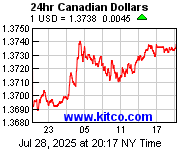
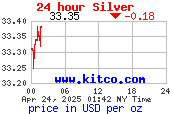
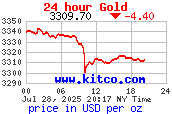
[font size=2]Euro, Yen, Loonie, Silver and Gold[center]


[/center]

[/center]
[HR width=95%]
[font color=black][font size=2]Handy Links - Market Data and News:[/font][/font]
[center]
Economic Calendar
Marketwatch Data
Bloomberg Economic News
Yahoo Finance
Google Finance
Bank Tracker
Credit Union Tracker
Daily Job Cuts
[/center]
[font color=black][font size=2]Handy Links - Economic Blogs:[/font][/font]
[center]
The Big Picture
Financial Sense
Calculated Risk
Naked Capitalism
Credit Writedowns
Brad DeLong
Bonddad
Atrios
goldmansachs666
The Stand-Up Economist
The Automatic Earth
Wall Street on Parade
[/center]
[font color=black][font size=2]Handy Links - Essential Reading:[/font][/font]
[center]
Matt Taibi: Secret and Lies of the Bailout
[/center]
[font color=black][font size=2]Handy Links - Government Issues:[/font][/font]
[center]
LegitGov
Open Government
Earmark Database
USA spending.gov
[/center][font color=black][font size=2]Handy Links - Videos:[/font][/font]
[center]
Charlie Rose talks with Roubini
Charlie Rose talks with Krugman
William Black: This Economic Disaster
Bill Moyers with Kevin Drum and David Corn
[/center]
[div]
[font color=red]Partial List of Financial Sector Officials Convicted since 1/20/09 [/font][font color=red]
2/2/12 David Higgs and Salmaan Siddiqui, Credit Suisse, plead guilty to conspiracy involving valuation of MBS
3/6/12 Allen Stanford, former Caribbean billionaire and general schmuck, convicted on 13 of 14 counts in $2.2B Ponzi scheme, faces 20+ years in prison
6/4/12 Matthew Kluger, lawyer, sentenced to 12 years in prison, along with co-conspirator stock trader Garrett Bauer (9 years) and co-conspirator Kenneth Robinson (not yet sentenced) for 17 year insider trading scheme.
6/14/12 Allen Stanford sentenced to 110 years without parole.
6/15/12 Rajat Gupta, former Goldman Sachs director, found guilty of insider trading. Could face a decade in prison when sentenced later this year.
6/22/12 Timothy S. Durham, 49, former CEO of Fair Financial Company, convicted of one count conspiracy to commit wire and securities fraud, 10 counts of wire fraud, and one count of securities fraud.
6/22/12 James F. Cochran, 56, former chairman of the board of Fair, convicted of one count of conspiracy to commit wire and securities fraud, one count of securities fraud, and six counts of wire fraud.
6/22/12 Rick D. Snow, 48, former CFO of Fair, convicted of one count of conspiracy to commit wire and securities fraud, one count of securities fraud, and three counts of wire fraud.
7/13/12 Russell Wassendorf Sr., CEO of collapsed brokerage firm Peregrine Financial Group Inc. arrested and charged with lying to regulators after admitting to authorities he embezzled "millions of dollars" and forged bank statements for "nearly twenty years."
8/22/12 Doug Whitman, Whitman Capital LLC hedge fund founder, convicted of insider trading following a trial in which he spent more than two days on the stand telling jurors he was innocent
10/26/12 UPDATE: Former Goldman Sachs director Rajat Gupta sentenced to two years in federal prison. He will, of course, appeal. . .
11/20/12 Hedge fund manager Matthew Martoma charged with insider trading at SAC Capital Advisors, and prosecutors are looking at Martoma's boss, Steven Cohen, for possible involvement.
02/14/13 Gilbert Lopez, former chief accounting officer of Stanford Financial Group, and former controller Mark Kuhrt sentenced to 20 yrs in prison for their roles in Allen Sanford's $7.2 billion Ponzi scheme.
03/29/13 Michael Sternberg, portfolio mgr at SAC Capital, arrested in NYC, charged with conspiracy and securities fraud. Pled not guilty and freed on $3m bail.
04/04/13 Matthew Marshall Taylor,fmr Goldman Sachs trader arrested, charged by CFTC w/defrauding his employer on $8BN futures bet "by intentionally concealing the true huge size, as well as the risk and potential profits or losses associated."
04/04/13 Matthew Taylor admits guilt, makes plea bargain. Sentencing set for 26 June; faces up to 20 years in prison but will likely only see 3-4 years. Says, "I am truly sorry."
04/11/13 Ex-KPMG LLP partner Scott London charged by federal prosecutors w/passing inside tips to a friend in exchange for cash, jewelry, and concert tickets; expected to plead guilty in May.
08/01/13 Fabrice Tourré convicted on six counts of security fraud, including "aiding and abetting" his former employer, Goldman Sachs
08/14/13 Javier Martin-Artajo and Julien Grout charged with wire fraud, falsifying records, and conspiracy in connection with JP Morgan's "London Whale" trade.
08/19/13 Phillip A. Falcone, manager of hedge fund Harbinger Capital Partners, agrees to admit to "wrongdoing" in market manipulation. Will banned from securities industry for 5 years and pay $18MM in disgorgement and fines.
09/16/13 Javier Martin-Artajo and Julien Grout officially indicted on charges associated with "London Whale" trade.
02/06/14 Matthew Martoma convicted of insider trading while at hedge fund SAC (Stephen A. Cohen) Capital Advisors. Expected sentence 7-10 years.
03/24/14 Annette Bongiorno, Bernard Madoff's secretary; Daniel Bonventre, director of operations for investments; JoAnn Crupi, an account manager; and Jerome O'Hara and George Perez, both computer programmers convicted of conspiracy to defraud clients, securities fraud, and falsifying the books and records.
05/19/14 Credit Suisse, which has an investment bank branch in NYC, agrees to plead guilty and pay appx. $2.6 billion penalties for helping wealthy Americans hide wealth and avoid taxes.
09/08/14 Matthew Martoma, convicted SAC trader, sentenced to 9 years in prison plus forfeiture of $9.3 million, including home and bank accounts
08/03/15 Former City (London) trader Tom Hayes found guilty of rigging global Libor interest rates. Each fo eight counts carries up to 10 yr. sentence.
[HR width=95%]
[center]

[font size=3][font color=red]This thread contains opinions and observations. Individuals may post their experiences, inferences and opinions on this thread. However, it should not be construed as advice. It is unethical (and probably illegal) for financial recommendations to be given here.[/font][/font][/font color=red][font color=black]
 = new reply since forum marked as read
Highlight:
NoneDon't highlight anything
5 newestHighlight 5 most recent replies
= new reply since forum marked as read
Highlight:
NoneDon't highlight anything
5 newestHighlight 5 most recent replies
Demeter
(85,373 posts)But very clever!
Demeter
(85,373 posts)Citigroup Global Markets Inc (CGMI), a unit of Citigroup Inc, has agreed with the New York attorney general to return $4.5 million in account management fees charged on some 15,000 frozen accounts. AVERAGES TO $300/ACCOUNT
As a result of the agreement, a total of more than $20 million will be refunded to Citi customers for overcharges in an investigation initiated by New York Attorney General Eric Schneiderman. In October, CGMI agreed return some $16 million to more than 31,000 customers who paid higher advisory fees than they had negotiated. The latest overcharges are set to be announced on Wednesday.
"We are pleased to work with the New York Attorney General on this matter," a Citigroup spokesman said in an email. "We deeply regret the inconvenience to our clients, who will be reimbursed with interest."
Customers did not receive fee rebates they were entitled to when their accounts were frozen, according to the attorney general's office. Accounts can be frozen for a variety of reasons, the office said, and in some cases, customers should not have been charged fees. CGMI sometimes rebated the fees when requested, an internal review found, and procedures weren't in place to determine when they were appropriate. As part of the October agreement, CGMI agreed to conduct an internal review of other types of accounts, which is how the bank identified the overcharges related to periods of inactivity.
The New York attorney general began his investigation of CGMI in 2012 after a complaint from a customer in Westchester, New York, who had negotiated a 1.2 percent fee, but was charged 1.5 percent, costing her more than $3,000 over three years.

Hotler
(13,747 posts)ISIS uses it. The Ashley Madison hackers used it. But chances are, you're not so familiar with the so-called "dark web," a hidden network of websites that requires special tools to access.
To put it in the most basic terms, the Internet exists in a few different layers. The one you're most accustomed to navigating is the "surface web," which is made up of content that search engines like Google are able to crawl, index and deliver to you. In other words, the surface web is any portion of the Internet that you could find from a basic Google Search -- probably most of the websites that the vast majority of us use in our day-to-day lives. The Huffington Post exists on the surface web, for example.
Sites within the dark web use anonymity software, Wired notes, to ensure that visitors are basically untraceable. Tor is the most well-known example of that software.
http://www.msn.com/en-us/news/technology/what-you-should-know-about-the-dark-web-an-anonymous-haven-for-hackers/ar-BBlSRcA?li=BBieTUX
Tor (anonymity network)
https://en.wikipedia.org/wiki/Tor_(anonymity_network)
Things that make you go hhmmmmmmmm!
Hotler
(13,747 posts)on the USA channel or find someone that has cable or dish and watch it. It is good and I don't swoon over tv shows. It goes with what I posted about the "Dark Net".
Elliot Alderson, a young cyber-security engineer living in New York who assumes the role of a vigilante hacker by night. Elliot meets a mysterious anarchist known as "Mr. Robot" who recruits Elliot to join his team of hackers, "fsociety". Elliot, who has a social anxiety disorder and connects to people by hacking them, is intrigued but uncertain if he wants to be part of the group. The show follows Mr. Robot's attempts to engage Elliot in his mission to destroy the corporation Elliot is paid to protect. Compelled by his personal beliefs, Elliot struggles to resist the chance to take down the multinational CEOs that are running (and ruining) the
http://www.imdb.com/title/tt4158110/
Christian Slater plays Mr. Robot.
Hotler
(13,747 posts)Pedophiles beware; in their latest effort called #OpDarknet, well-known hacktivist group Anonymous is on a campaign against child pornography. The group took down servers which they claim hosted the largest collection of child porn on the internet. Over 40 websites were disabled, including Lolita City, which were operating via the anonymized Tor project.
The Tor network, birthed by the U.S. Navy, is a secure network used by many to avoid surveillance by governments and other agencies as it does not leave a trace of an IP address. The technology has been invaluable to journalists needing secure communications, dissidents overthrowing regimes and also to those pushing pirated material. Tor’s .onion top-level domain, pretty much only visible to Tor users, has also attracted seedy pedophiles and their pushers.
http://www.digitaltrends.com/web/anonymous-wages-war-on-darknet-hidden-pedophiles-40-websites-down/
Demeter
(85,373 posts)Germany's leaders herded their European counterparts into imposing harsh austerity on Greece. It was the price, they insisted, that Greece had to pay to receive bailout credits from the European Union, European Central Bank and International Monetary Fund (IMF). The Europeans required those bailout credits to be used mostly to pay back loans the Greek government had gotten earlier from private banks (chiefly German, French and Greek). Those credits could not be used to get Greece out of the 2008 crash that afflicted all of Europe.
Those private banks had gladly and profitably pushed too many loans onto the Athens government for many years. When the 2008 global crash brought forward the moment when the Greek government could no longer carry its bloated, excess private debts, default loomed. Had that happened, those private banks would have required second bailouts (their first occurred in 2008-2009) from their governments. But the speed and generosity of those first bailouts had enraged much public opinion in France, Germany and Greece. A second bailout, required if Greece had defaulted, would have finished those countries' leaders' political careers. Cleverly, the leaders arranged for those institutions to lend to Greece to pay off its private creditors: no need then for second bailouts.
To cover this maneuver with "public relations" distractions, German Chancellor Angela Merkel and others promised to require Greece to undergo a tough austerity treatment, portrayed as economic pain and punishment that Greeks brought on themselves. It was necessary "medicine" that would soon deliver economic recovery. All leaders everywhere promised and still promise recovery to austerity's victims. In fact, since 2010, austerity brought Greece further economic decline, not recovery. Indeed, recoveries proved elusive or painfully slow for most Europeans as they struggled with austerities of varying intensities.
Germany pushed hardest for the harshest Greek austerity. That too was a maneuver for domestic political advantage. Merkel loudly depicted herself as protecting Germans from higher taxes (to pay Germany's share of any future institutions' bailouts of European countries like Greece that did not repay their debts). Merkel and her finance chief rigidly refused to relieve Greece of its debts (even though the IMF and countless experts said openly that Greece's debts were simply "unsustainable" and could never be paid). Merkel's refusal meant that Greeks' tax payments would go not for roads, schools and hospitals, nor to rebuild a crisis-shattered economy, nor to pay and pension Greek public workers. Greeks' taxes must instead be used to service Greece's debts to the institutions for limitless years into the future. Merkel's posturing served her domestic political purposes, but at a huge cost for Europe...
MORE
Demeter
(85,373 posts)When the real estate bubble that enriched households and local governments alike soon bursts, the whole world may pay...It’s becoming increasingly clear that China’s economy is slowing and the authorities’ fixes are not turning it around. That means the engine that pulled the global economy out of the 2009 recession has stalled.
Many people see China’s present slowdown as a possible source of the next global recession, but few seem to realize the extreme vulnerability of China’s vast housing market and the many knock-on consequences of that market grinding to a halt. I’ve just completed a comprehensive review of China’s housing market, and I now realize it’s much worse than the consensus understands.
The consensus view is: sure, China’s housing prices are falling modestly outside of Beijing and Shanghai, but since Chinese households buy homes with cash or large down payments, this decline won’t trigger a banking crisis like America’s housing bubble did in 2008.
The problem isn’t a banking crisis, however: it’s a loss of household wealth, the reversal of the wealth effect, and the decimation of local government budgets and the construction sector. China is uniquely dependent on housing and real estate development. This makes it uniquely vulnerable to any slowdown in construction and sales of new housing.
About 15 percent of China’s GDP is housing-related. This is extraordinarily high. In the 2003-08 housing bubble, housing’s share of U.S. GDP barely cracked 5 percent...
AND A MASSIVE BANK-FRAUD! MORE
Demeter
(85,373 posts)China's yuan fell against the dollar on Tuesday despite a slightly stronger midpoint set by the central bank as traders expect the currency to be under further downward pressure amid a struggling economy.
The People's Bank of China set the midpoint rate CNY=SAEC at 6.3966 per dollar prior to market open, firmer than the previous fix of 6.3969.
The spot market CNY=CFXS opened at 6.3923 per dollar and was changing hands at 6.4005 near midday, 58 pips away from the previous close and 0.06 percent away from the midpoint.
The spot rate is currently allowed to trade with a range 2 percent above or below the official fixing on any given day.
The yuan posted its biggest weekly loss on record and touched four-year lows after the central bank's surprise devaluation of its currency by nearly 2 percent last Tuesday...
Demeter
(85,373 posts)Ports across the world suffer worst hit since the Lehman crisis as emerging markets wilt, but trade may not matter so much to global GDP any longer... World shipping has fallen into a deep slump over the late summer, dashing hopes of a quick recovery from the global trade recession earlier this year and heightening fears that the six-year economic expansion may be on its last legs.
Freight rates for container shipping from Asia to Europe fell by over 20pc in the second week of August, even though trade volumes should be picking up at this time of the year. The Shanghai Containerized Freight Index (SCFI) for routes to north European ports crashed by 23pc in five trading days.
The storm in the shipping industry comes as the New York state manufacturing index for July plummeted to a recessionary low of minus 14.9, the lowest since the Great Recession and one of the steepest one-month drops ever recorded.

MORE
Demeter
(85,373 posts)By Jessica Millen, who graduated from the University of Notre Dame in 2013. She was a 2013 Teach For America (TFA) corps member in New Orleans, where she taught third grade. She currently works as a preschool teacher in South Bend, Indiana
Editor’s note: In the decade and a half of its existence, Teach For America has trained upwards of 50,000 individuals to enter classrooms nationwide and “make a difference” in the lives of children — usually those living in poverty. But the question of how prepared these individuals are to deal with the realities faced by the children they teach and meet their educational needs has long been in question.
In the following excerpt, taken from an essay in the newly published book, Teach For America Counter-Narratives: Alumni Speak Up and Speak Out, one former TFA corps member shares her account of her time with the organization, alleging that TFA both “preyed on her naïveté of the lived realities of urban schooling” and “exploited her desire to ‘make a difference.'” Her disillusionment with the organization and its educational philosophy grew so deep, in fact, that she resigned after just 6 months.
The Bait
On the urging of a friend and campus recruiter, I applied to join TFA in October of my senior year at the University of Notre Dame. After a multipart interview process, I was accepted into the program’s Greater New Orleans region. Soon afterwards, TFA began to effectively use social networks to bolster my desire to join. Former classmates and undergraduate campus recruiters reached out and stressed how wonderful it was that I had gotten into such a selective organization. My interviewer called to congratulate me on a job well done. After being bombarded with so many congratulations, I couldn’t help but feel proud that I had passed through such a selective hiring process.
The official TFA recruiter on my campus held events for accepted corps members after each hiring deadline, offering free drinks and appetizers at an on-campus restaurant. I found it strange how much money TFA, a nonprofit organization, spent on us. We wore name tags, ate food, and discussed our excitement about the upcoming school year. Our recruiter, like the other TFA corps members and staff who had reached out to me, stressed the “prestige” of the program and how much TFA would help us in the future. He himself was a former TFA corps member who taught for 3 years before joining the recruiting arm of the organization. I found his enthusiasm for TFA contagious as he pointed out TFA’s connections with graduate schools and the numerous opportunities that would be afforded to us post-TFA.
At the time, I was impressed by how many corps members were still involved in public education. According to TFA, more than 775 alumni were in school leadership positions at schools across the country (Teach For America, 2012a). I was glad to hear that TFA wasn’t always just used as a stepping stone to more lucrative careers; information on the TFA website boasted that as of August 2013, 78% of alumni from the Greater New Orleans region were still in education (Teach For America, 2012b). I didn’t bother to look up the evidence behind TFA’s claims. I trusted that the information from this professional organization that seemed to care so much about children was ethically collected, compiled, and reported. I now know that the organization’s assertion that “Teach For America corps members help their students achieve academic gains equal to or larger than teachers from other preparation programs, according to the most recent and rigorous studies on teacher effectiveness” (Teach For America, 2012c) is, at best, extremely misleading. Reviews of the research cited by TFA to back its claims of corps member effectiveness ultimately reveal a less favorable picture; the majority of studies listed by TFA are not peer-reviewed, are problematic, and/or produced mixed results (Kovacs & Slate-Young, 2013; Vasquez Heilig & Jez, 2014).
But taking TFA’s claims of effectiveness at face value, I continued to be wooed by the organization. Besides the free events hosted by the campus recruiter, TFA offered additional financial incentives to make the bait even sweeter. I remember gushing to my parents that I would not only receive a full teacher’s salary, but also get funding to cover the transitional costs of moving and living during the summer before I began teaching. As an indebted college student, it seemed that, on top of using my skills and education to serve in public education, I was making a solid financial decision in joining TFA. Such tantalizing benefits convinced me that not only was I making a strong move for my future, but I would also be “making a difference” in the lives of low-income and minority students. As a young, well-educated, idealistic student, I took the bait—hook, line and sinker...
MORE AT LINK

DemReadingDU
(16,002 posts)Demeter
(85,373 posts)In the 1960s, the Lyndon Johnson administration launched an official War on Poverty. Needless to say, poverty has emerged victorious. The noble and necessary aim of poverty reduction might have helped millions of people create lives of decency and dignity, and it might have helped America assimilate into the developed world as a fiscally responsible and morally honorable nation. But since they fail to widen the profit margin of the corporate class running America’s political system, poverty reduction programs are basically doomed.
As poverty worsens and spreads, with 25 million Americans constituting the working poor, poverty relief programs face elimination from austerity policymakers on the state and federal levels. In the absence of any war on poverty, America has demonstrated dedication and determination in its war on the poor. In a cruel combination of exploitative profiteering from poverty, and unapologetic hatred for the poor, state governments continue to pick the pockets of the impoverished, relegating low-income earners to a vicious cycle of punishment and recompense; life without parole in the poverty prison.
The war on the poor exposes the tyrannical turn of political administration in the United States – a country committed to mutating its criminal justice system, already more criminal than just, into an apparatus of assault against its most defenseless citizens.
The following laws and policies give painful illustration to America’s attack on the poor in which the impoverished receive perpetual punishment for their poverty. This compilation does not include the mile-long list of policies that harm the poor, such as difficulty acquiring health care and child care, regressive taxation, or the cost of college. The following are policies in which state governments are actively levying the legal system against the poor:
1. Limits on ATM Withdrawals for Welfare Recipients in Kansas
2. Revocation of Driver’s License in Montana and Iowa For Missing Student Loan Payments
3. Arkansas Arrests and Prosecutes People for Missing Rent Payments
4. Using the Poor as ATMs: Harsh Financial Penalties for Minor Infractions and Traffic Violations
5. The Return of Debtors’ Prisons ( Louisiana, Michigan, Ohio, Georgia, and Washington state)
6. Voter Identification Requirements Suppress Poor People’s Votes
DEATAILS AND CONCLUSIONS AT LINK
DemReadingDU
(16,002 posts)8/10/15
6 Creative New Techniques Republicans Have Developed for Torturing the Poor By David Masciotra
Republican-controlled states are sharpening their fight against the poor, and then paralyzing their attempts to fight back.
http://www.alternet.org/economy/6-creative-new-techniques-republicans-have-developed-torturing-poor
Demeter
(85,373 posts)...Fourteen regional airports, flying into top tourist hubs, have already gone to a German company, but don’t panic because stock in Athens airport is still on the table, as well as Athens' old airport which is up for a 99 year lease for redevelopment as a tourism and business centre.
Piraeus and Thessaloniki ports are up for sale – the former case has caused the chief executive to resign and industrial action has begun. A gas transmission system looks likely to be sold to the government of Azerbaijan, but there’s still a power and electricity company, the postal service, a transport utility which allows trains and buses to run, the country’s main telecommunications company, a 648 km motorway, and a significant holding in the leading oil refiner, which covers approximately two-thirds of the country’s refining capacity.
Holdings in Thessaloniki and Athens water are both on sale – though public protest has ensured that 50% plus 1 share remains in state hands. Nonetheless, the sale will mean that market logic will dictate the future of these water and sewerage monopolies. Finally there are pockets of land, including tourist and sports developments, throughout Greece.
A second document, also attached, details the short-term work programme of various government ministers, detailing actions they must take in order to add value to these assets. This includes introducing toll booths on roads to licensing casino rights to declaring sites of archaeological interest. The document begs the question as to why government ministers are even needed, it would surely be easier to cut them out of the equation altogether and let EU institutions directly administer the country....
PDF FILES AT LINK AND MORE COMMENTARY
Demeter
(85,373 posts)Now the dust has temporarily settled over the ruins of Greece’s economy, it is worth asking if there wasn’t a brief moment when the actors had found a way to cut the eurozone crisis’s Gordian knot. At some point in July German finance minister, Wolfgang Schäuble, appeared to have realised that his dream of a “core Europe” with a Franco-German avant-garde would vanish into thin air if Greece was allowed to remain in the economic and monetary union. Rewriting the rules of the union to accommodate the Greeks, Schäuble realised, would pull the euro southwards, and France, Italy and Spain with it – forever breaking up the European core.
His Greek equivalent Yanis Varoufakis, for his part, may have learned from his encounters of the third kind with the Eurogroup that the only role there was for Greece in the Europe of monetary union was that of an underfed and overregulated welfare recipient. Not only was this incompatible with Greek national pride; more importantly, what the governors of Europe would be willing to offer the Greeks by way of “European solidarity” would, at best, be too little to live on.
The deal Schäuble offered in the last hour of July’s battle of the euro might have been worth exploring: a voluntary exit (an involuntary one not being possible under the current treaties) that gave Greece the freedom to devalue its currency and return to an independent monetary and fiscal policy, plus emergency assistance and some restructuring of the national debt, outside of the monetary union to avoid softening its rules by creating a precedent. A generous golden handshake might have also been an idea, protecting Germany from being blamed for having plunged the Greeks into misery or driven them into the arms of Vladimir Putin.
Politics can make strange bedfellows, but sometimes just for a one-night stand. In the end Varoufakis was overruled by Alexis Tsipras and Schäuble was overruled by Angela Merkel. The latter, displaying truly breathtaking political skills, managed within a day or two to redefine the resounding no of the Greek people to their creditors’ demands into a yes to “the European idea”, defined as a common currency – allowing him to sign on to even harsher conditions than had been rejected in the referendum (called, it seems, at the suggestion of Varoufakis, who was sacked on the very evening the results were in). Afraid of the unimaginable economic disaster publicly imagined by fear-mongering euro supporters, and perhaps encouraged by informal promises by Brussels functionaries of future injections of other peoples’ money, Tsipras was ready to split his party and govern with those who had for decades let Greece rot in clientelism and corruption, offering the parties of Samaras and Papandreou an opportunity to regain legitimacy as pro-European supporters of “reform”...
MORE
Demeter
(85,373 posts)In a post on “Sovereign Man” dated August 14th, Simon Black argued that Donald Trump may be the right man for the presidency:
Donald Trump is an expert at declaring bankruptcy.
When the going gets tough, Trump stiffs his creditors. He’s done it four times!
Candidly, this is precisely what the Land of the Free needs right now: someone who can stop beating around the bush and just get on with it already.
Black says the country is officially bankrupt, with the government’s financial statements showing a negative net worth of $17.7 trillion:
Black recommends doing this by defaulting, preferably on Social Security and Medicare. But that is unlikely to suit this leading Republican candidate. As Trump said on Meet the Press on August 16:
How can the country remain strong with very little debt, without defaulting on Social Security, Medicare, or the federal debt itself? There is a way. The government can reduce the debt by buying it – and ripping it up. The debt can be bought either with debt-free US Notes of the sort issued during the Civil War, or with US dollars issued by the Federal Reserve in the form of “quantitative easing.” The vast majority of the money supply today is created by banks when they make loans, as the Bank of England recently acknowledged. Banks create money by “monetizing” debt, turning loans into the digital deposits that make up most of the circulating money supply. The government could push the reset button by monetizing its own debt, turning it into what it should have been all along – debt-free, interest-free dollars. As Thomas Edison observed in 1921:
That is not just a quaint idea from the 1920s. Credible authorities are making that argument today. In November 2010, Dean Baker, co-director of the Center for Economic and Policy Research in Washington, wrote in response to the debt ceiling crisis:
In 2011, Republican presidential candidate Ron Paul proposed dealing with the debt ceiling by simply voiding out the $1.7 trillion in federal securities then held by the Fed. As Stephen Gandel explained Paul’s solution in Time Magazine, the Treasury pays interest on the securities to the Fed, which returns 90% of these payments to the Treasury. Despite this shell game of payments, the $1.7 trillion in US bonds owned by the Fed is still counted toward the debt ceiling. Paul’s plan:
Congressman Alan Grayson, a Democrat, also endorsed this proposal.
In February 2015, financial author Richard Duncan made a strong case for going further than monetizing existing debt. He argued that under current market conditions, the US could rebuild its collapsing infrastructure with quantitative easing without causing price inflation. Prices go up when demand (money) exceeds supply (goods and services); and with automation and the availability of cheap labor in vast global markets today, supply (productivity) can keep up with demand for decades to come. Duncan observed:
They should take advantage of this once-in-history opportunity to borrow more in order to invest in new industries and technologies, to restructure their economies and to retrain and educate their workforce at the post-graduate level. If they do, they could not only end the global economic crisis, but also ensure that the standard of living in the developed world continues to improve, rather than sinking down to third world levels.
Abraham Lincoln revived the colonial system of government-issued money when he endorsed the printing of $450 million in US Notes or “greenbacks” during the Civil War. The greenbacks not only helped the Union win the war but triggered a period of robust national growth and saved the taxpayers about $14 billion in interest payments (figuring an average of $300 million in outstanding US Notes over 150 years, at an average real interest rate of 2.6% compounded annually). The US federal debt has been growing ever since 1835, when President Andrew Jackson last paid it off and closed down the Second US Bank. If judicious use of US Notes had continued to the present, there might now be no federal debt at all.
The Inflation Snag
In short, the sovereign debt crisis can be solved by issuing sovereign money. But is there really such a thing as a free lunch? Wouldn’t buying up the debt with newly-issued money lead to a hyperinflationary disaster?That was the fear when the Federal Reserve began its QE program in 2008. But the Fed has now monetized $4.5 trillion in QE ($2.7 trillion of which consisted of buying back federal securities, and these fears have not materialized. The stock market has gone up, but not apparently from an increased money supply. More likely it is from very low interest rates, making bonds unattractive and facilitating stock buybacks and borrowing to invest. The cost of produce has gone up, but it is largely because of drought in California, which supplies nearly half the country’s fruits, vegetables and nuts; and because speculators have moved into foodstuffs. Despite all that, the overall inflation rate remains at manageable levels. Why didn’t $4.5 trillion in QE drive prices into the stratosphere? As financial writer Matthew Kerkhoff explained in a November 2013 article, quantitative easing is just an asset swap:
It’s much more accurate to think of the Fed’s QE program as an asset swap. In fact it’s even more accurate to think of it as a liquidity swap. . . . In this context liquidity refers to the ease with which money can be used.
Bonds are more cumbersome to spend than cash, but they still represent purchasing power. Government securities that can be quickly converted into cash or that are near maturity are considered a form of “near money.” When the Fed buys the bonds, it is simply converting this less-liquid money back into more-liquid money. As Warren Mosler and John Carney explain on CNBC.com:
The QE liquidity swap does not increase the circulating money supply. The money supply increased when the bonds were issued – when the debt was incurred and the government spent the funds. Adding to the federal debt beyond its current level (i.e. by funding infrastructure with new QE that is not repaid with taxes) would increase the money competing for goods and services. But the economy actually needs that increased “demand” in order to promote full employment (one of the Fed’s mandates). Demand (money) precedes supply (goods and services). The money has to be out there searching for goods and services before employers will add more workers to create this increased supply. Money can be added to the point of full productive capacity (full use of workers, supplies and machines) before adding more will drive up prices. And as Richard Duncan observes, we are a long way from full productive capacity now. Whether full productive capacity would exhaust the earth’s resources is another question, but there are many ways to put people to work that either don’t use physical resources (e.g. education, art, social service, environmental cleanup) or that actually make resource use more efficient (investment in improved infrastructure, sustainable energy, research and development).
Time to Reset
Back to Donald Trump. Besides his experience with bankruptcy, Trump, along with Bernie Sanders on the left, is unique in not being beholden to big money. Sanders does not take it, and Trump does not need it. If either candidate makes it to the White House, he will be in a position to stand up to Wall Street and do what is right for the country. And that includes restoring the power to issue the national money supply to the people of the nation through their representative government.
Ellen Brown is an attorney, founder of the Public Banking Institute, and author of twelve books including the best-selling Web of Debt. Her latest book, The Public Bank Solution, explores successful public banking models historically and globally. Her 300+ blog articles are at EllenBrown.com. Listen to “It’s Our Money with Ellen Brown” on PRN.FM.
Demeter
(85,373 posts)A unit of Citigroup Inc will pay $15 million to settle civil charges alleging it failed to enforce policies designed to prevent and detect insider trading, U.S. regulators said. Wednesday's settlement with the Securities and Exchange Commission marks the second time this week that Citigroup has been dinged for regulatory failures. Earlier this week, two units of the bank also agreed to pay another $180 million to settle charges it defrauded hedge fund investors during the financial crisis.
A Citigroup spokeswoman said the company is "pleased to have the matter resolved."
In the latest enforcement case, the SEC said on Wednesday that Citigroup failed to review thousands of trades executed by its trading desks during a 10-year period. Federal securities laws require brokers to take reasonable steps to ensure that traders are not misusing material, non-public information when executing transactions. In addition, the SEC said that Citigroup also improperly routed 467,000 transactions on behalf of certain advisory clients to an affiliated market-making firm for execution. Under the settlement, the bank volunteered to pay the $2.5 million in its profits from these principal trades back to the affected clients, the SEC said.
It also must hire a consultant to review its trade surveillance system.
Citigroup settled the case without admitting or denying the charges.
"DINGED"? THIS IS PROPER TERM FOR IT?
Demeter
(85,373 posts)Citigroup’s settlement with the Securities and Exchange Commission, announced on Monday, comes more than seven years after the two hedge funds collapsed, saddling investors with billions of dollars in losses…In the fall of 2007, one of the hedge funds, called Falcon Strategies, sold as much as $110 million in additional shares in the funds to investors. Yet only a few months later, in January 2008, the liquidity problem had become so dire that the manager of the Falcon fund had drawn up “liquidation scenarios.” Even Citigroup, the parent, wouldn’t extend emergency liquidity to its own hedge funds…Citigroup agreed to pay the $180 million to harmed investors without admitting any wrongdoing....
http://www.nytimes.com/2015/08/18/business/dealbook/citigroup-to-pay-180-million-over-collapsed-hedge-funds.html?ref=dealbook
Demeter
(85,373 posts)A U.S. regulator sued Bank of New York Mellon Corp (BK.N) on Wednesday over $2.06 billion in residential mortgage-backed securities purchased by a failed Texas bank, and accused it of breaching its duties as bond trustee to protect investors. In a complaint filed in Manhattan federal court, the Federal Deposit Insurance Corp, which sued in its capacity as receiver for the former Guaranty Bank, said it suffered more than $440 million in losses when it sold the securities in March 2010.
The FDIC filed a similar lawsuit against US Bancorp (USB.N), another major bond trustee, over more than $248 million of mortgage debt bought by Guaranty, and resulting in "significant" losses when those securities were sold.
Austin, Texas-based Guaranty Bank closed in August 2009, and the FDIC arranged for its deposits to be assumed by BBVA Compass of Birmingham, Alabama, a unit of Spain's Banco Bilbao Vizcaya Argentaria SA (BBVA.MC). At the time, the regulator estimated the closure would cost its deposit insurance fund $3 billion. The Bank of New York Mellon lawsuit concerned 12 mortgage-backed trusts issued by Bear Stearns Cos' EMC Mortgage Corp unit and by Countrywide Home Loans Inc in 2005 and 2006. JPMorgan Chase & Co (JPM.N) bought Bear in 2008, and Bank of America Corp (BAC.N) bought Countrywide in the same year.
As bond trustee, BNY Mellon "shirked its duty" to ensure the loan documents were not incomplete or defective, the FDIC said. "While BNY Mellon stood idly for years, the sponsors kept defective mortgage loans in the covered trusts, servicers reaped excessive fees for servicing the defaulted loans from the covered trusts, and plaintiff was left to suffer enormous losses," the lawsuit said. A spokesman for Bank of New York Mellon had no immediate comment. US Bancorp spokesman Dana Ripley declined to comment.
Since 2013, the FDIC has secured $1.83 billion in settlements with financial institutions over mortgage-backed securities sold to banks it took into receivership.
In July, Morgan Stanley (MS.N) agreed to pay the FDIC $24 million to resolve a lawsuit filed in a Texas state court, according to a settlement agreement on the regulator's website.
Demeter
(85,373 posts)The business community is launching a big push for the Cyber Information Sharing Act over the recess, with the Chamber of Commerce pushing hard and now the Financial Services Roundtable’s Tim Pawlenty weighing in today.
Pawlenty is fairly explicit about why banks want the bill: so that if they’re attacked and share data with the government, they cannot be sued for negligent maintenance of data.
“If so, are the trial lawyers going to get it and sue my company for negligent maintenance of data or cyber defenses?” Pawlenty continued. “Are my regulators going to get it and come back and throw me in jail, or fine me or sanction me? Is the public going to have access to it? Are my competitors going to have access to it? Are they going to be able to see my proprietary cyber systems in a way that will give up competitive advantage?”
CISA has been poorly framed, he explained.
“It should be called the cyber teamwork bill,” Pawlenty said.
As I’ve pointed out repeatedly, what the banks would get here is far more than they get under the Bank Secrecy Act, where they get immunity for sharing data, but are required to do certain things to protect against financial crimes.
Here, banks (and other corporations, but never natural people) get immunity without having to have done a damn thing to keep their customers safe.
Which is why CISA is counterproductive for cybersecurity.
Demeter
(85,373 posts)The 80-year-old Social Security program has long been known as the third rail of American politics -- touch it and you die. Last year alone, more than 59 million Americans received retirement, disability and survivor’s benefits totaling $863 billion. While some lawmakers and policy experts warn that the system will begin to run short of cash beginning in 2035, seniors’ advocacy groups have vigorously fought major changes and cuts.
Some nine out of ten people who are 65 or older receive Social Security benefits, according to the Social Security Administration, with an average monthly benefit of $1,294 average for retirees. Overall, Social Security benefits constitute about 38 percent of the income of the elderly, but that number varies greatly from individual to individual.
For the majority of seniors, Social Security makes up the majority of their income. Sixty-five percent of beneficiaries age 65 and older get more than half of their income from the program. Nearly a third (28%) rely on Social Security for 90 percent or more of their income. The pie chart below, prepared by the staff of the congressional Joint Economic Committee, illustrates the range of seniors’ dependence on Social Security benefits:

Demeter
(85,373 posts)When it comes to saving for retirement, most American workers are not only falling short, they don’t even know how behind they are. What’s more disturbing, research shows that savings trends are getting worse, despite a decades-long push to enroll workers in 401(k)s and other employer plans.
The retirement disconnect is highlighted in a new survey from the Transamerica Center for Retirement Studies, which includes responses from 4,550 full-time and part-time workers between the ages of 18 to 65+. Overall, some 59% reported they were “somewhat” or “very” confident that they will be able to retire comfortably.
To maintain this comfortable living standard, more than half think they’ll need at least $1 million saved by retirement, and 29% believe they’ll need $2 million. Those targets have increased in recent years, according to Transamerica—the typical savings goal was just $600,000 in 2011.
So how much have these workers got socked away? Overall, the typical worker savings account held $63,000. That’s up from $43,000 in 2012, but also far from what’s needed for a $1 million retirement. Even among baby boomer households, the group closest to retirement, the median account held just $132,000...Poterba offered possible reasons for this trend, including that workers may simply choose not to save; at each income level, he pointed out, there are high and low savers, so earnings aren’t the only factor...
YEAH, THAT'S IT...CHOOSING NOT TO SAVE
In short, it can take a long time to save your first $1 million, but it’s a lot quicker to get to $2 million. If more Americans understood this, and acted on it, there would be good reason to be optimistic about retirement.
EXCUSE ME, I HAVE TO GO BANG MY HEAD ON THE WALL, THEN LEAVE FOR MY PART-TIME, MINIMUM-WAGE EMPLOYMENT....
Demeter
(85,373 posts)Many fellow Americans that have worked their entire lives, weathered several recessions and depressions, put their children through school, helped many in need, and faithfully paid their mortgages for decades are now being taken advantage of once again. Most have followed all the rules necessary to be considered fiscally responsible, yet because of "legal fraud" by the financial sector and policies effected by purchased politicians, their years in retirement will be compromised.
The Plutocracy, the one percent has walked away with a large percentage of their 401Ks, their SEPs, and to some extent their financial security. Because of stagnant or falling real wages, much of the working middle class have maxed out on their credit in the attempt to maintain their standard of living. For a Plutocracy that feeds on perpetual growth, from where will it feed now? An old and well-crafted financial instrument known as the reverse mortgage is being marketed on steroids to a baby boomer population.
Before any reader of this article that may have already taken out a reverse mortgage gets upset, please note that it is understood that for many this is the only option left. That said, every American should be fighting for a system that allows all the ability to build a nest egg that can be transferred to the next generation....

Are all about the predatory economy we have. It's all about extracting every bit of wealth from anyone the oligarchs can. Whether through low wages, health care, education costs, or mortgage and banking fraud and a myriad of other ways. One way or another they will find a way. Even for those of us who can see it happening, it's hard to avoid.
And it's an old Republican Presidential candidate on tv doing the pitch for the reverse mortgages.
And when you can't pay, see post #11. 
Demeter
(85,373 posts)WELL, CONGRESS COULD RAISE SOCIAL SECURITY PAYOUTS...OR INSTITUTE A JOBS PROGRAM...OR REBUILD INFRASTRUCTURE...OR...
http://www.bloomberg.com/news/articles/2015-08-19/fed-still-concerned-by-low-inflation-as-rate-liftoff-approaches
Federal Reserve officials signaled concern about stubbornly low inflation even as they indicated that an improving job market is bringing them closer to the first interest-rate increase in almost a decade.
Participants in the July 28-29 Federal Open Market Committee meeting said economic conditions “were approaching that point” where the economy could sustain a slight increase in borrowing costs, according to minutes of the meeting released in Washington on Wednesday.
Preserving their flexibility on the timing of rate liftoff, they also showed more concern about how soon they would hit their 2 percent inflation target, a goal they have missed for more than three years.
Their debate was silent on whether they should act in September or delay to await more evidence that inflation is heading higher. That discussion highlights a dilemma for the data-dependent FOMC: As the job market continues to deliver robust gains, with unemployment at 5.3 percent, holding interest rates near zero is harder to justify as the expansion enters its seventh year....MORE
Demeter
(85,373 posts)Traders gearing up for the Federal Reserve to raise interest-rates next month reversed course Wednesday after minutes from the central bank’s July meeting showed policy makers were still waffling on whether the economy is strong enough to warrant higher borrowing costs.
That's far short of the confidence they expected to see from a central bank supposedly just weeks away from what would be the first increase in almost a decade.
The probability that futures traders assign to a rate boost next month slid to 36 percent, the lowest since July, from about 50 percent earlier in the day. The levels assume that the Fed’s target will average 0.375 percent after the first move. The chance of an increase at or before the Fed's December meeting dropped as well, to 65 percent from 73 percent Tuesday.

MORE
Demeter
(85,373 posts)The Executive Board of the International Monetary Fund (IMF) recently approved the extension of the current special drawing rights (SDR) valuation basket by nine months from Dec. 31, 2015 to Sept. 30, 2016.
"The nine-month extension is intended to facilitate the continued smooth functioning of SDR-related operations," said the IMF in a statement on Wednesday. The current SDR valuation basket is set to expire on Dec. 31, 2015.
The extension responses to feedback from SDR users on the desirability of avoiding changes in the basket at the end of the calendar year, and will allow users sufficient lead time to adjust in the event that a decision were to be taken to add a new currency to the SDR basket, said IMF.
The IMF reviews the currencies in the SDR basket every five years, and whether to add the Chinese currency, RMB, to the basket is a major issue for this year's assessment. This year's review is expected to be completed in November 2015 when the IMF board will decide whether the RMB will be included in the SDR basket or not.
MORE
Demeter
(85,373 posts)Glencore Plc’s initial public offering minted six billionaires in 2011, when Ivan Glasenberg and five other executives together controlled stakes worth $24 billion.
Today, only three would remain in that elite club -- based on the value of their holdings in the company -- and two of those are on the brink of losing their status after the shares of the leading commodity trader lost 70 percent since the flotation.
The May 2011 offering generated more wealth than the IPOs of some of Wall Street’s most prominent firms, including Goldman Sachs Group Inc. in 1999. Since then, Glencore’s share price has fallen every year, a decline that’s accelerated in recent months as concern China’s economy is slowing has seen commodity prices dive.
Glencore dropped 9.7 percent in London to close at a record low of 158.95 pence on Wednesday after the company reported a plunge in first-half profit. The shares, which rose 1.4 percent in early trading in London on Thursday, are down nearly 46 percent this year...
MORE
Demeter
(85,373 posts)SOMETIMES I JUST WANT TO GRAB BLOOMFIELD'S HEADLINE WRITERS AND SHAKE THEM UNTIL THEIR TEETH FALL OUT
http://www.bloomberg.com/news/articles/2015-08-19/treasuries-speed-trading-vaporizes-price-gap-with-futures-market
The ascent of high-speed trading in the past few years has strengthened the correlation between Treasuries and the futures contracts linked to them, according to research from the Federal Reserve Bank of New York.
As much as 20 percent of daily Treasury-market activity now comes from computer-driven orders for securities occurring simultaneously with transactions in the futures market, according to a blog post Wednesday from the New York Fed, which helps implement the central bank’s policy.
The rising use of those strategies, which the researchers call cross-market trading, underscores that advances in technology have allowed speed-trading firms to assume a bigger role in the market as Wall Street dealers step back. The traders’ involvement has helped keep prices of Treasuries and corresponding futures contracts closely correlated, according to the blog.
“Our findings suggest that price discovery takes place on both futures and cash markets and that cross-market trading helps maintain the tight link between the two,” the researchers wrote on the New York Fed’s Liberty Street Economics blog. “From a price discovery view, the two markets can effectively be seen as one.”
MORE
CLOSELY COUPLED SYSTEMS ARE MORE INHERENTLY UNSTABLE THAN NOT
Demeter
(85,373 posts)The European Stability Mechanism will disburse the first tranche of funds from Greece's bailout loan on Thursday, the Greek finance ministry said after the ESM board approved a rescue of up to 86 billion euros on Wednesday.
Athens will receive 13 billion euros on Thursday morning, the ministry said, of which about 12 billion euros will be used to pay down debt, including an earlier bridge loan and money owed to the European Central Bank.
"Nearly one billion euros will be made available to the Greek state, a sum that can be used to pay arrears," the finance ministry said in a statement.
The new bailout package of up to 86 billion euros ($95.66 billion) for 32.5 years includes up to 25 billion euros to recapitalize Greek banks, of which 10 billion will be immediately available, according to the ministry.
Athens needed the funds in time to make a 3.2 billion euro debt payment to the European Central Bank on Thursday.
The initial 13-billion-euro tranche will be paid in cash, while the 10 billion euros for the recapitalization of banks will be sent to a segregated account in the form of ESM notes.
Demeter
(85,373 posts)All the frenzy over car-hacking would make more sense if the risk weren't so easy to reduce: Just drive a simple car.
The threat of hackers taking control of cars has lately elicited perhaps more excitement than it deserves. The success of two security researchers in remotely hacking a Jeep -- and taking over its accelerator while in motion -- has prompted a class-action suit, a Senate bill to require automakers to protect cars from such attacks, and a 1.4-million-vehicle recall, all without a single incident of malicious hacking.
That said, cars have long been susceptible to hacks. Consider, for example, keyless theft. Criminals have stolen thousands of cars -- including David Beckham's BMW X5 SUV in 2006 -- by cracking the code needed to disable the immobilizer, a theft-prevention device that is obligatory in the European Union and that 86 percent of cars in the U.S. have. The immobilizer employs a radio frequency identification (RFID) chip that won't allow the engine to run unless the car's original key, which transmits the necessary code, is present.
The auto industry doesn't want people to hear too much about hacking immobilizers. Bloomberg News reported on Friday that Volkswagen, the world's biggest car manufacturer by volume, had spent two years trying to suppress a report -- now finally public -- concerning a flaw in the chip that powers immobilizers. The paper's authors, Roel Verdult, Flavio Garcia and Baris Ege, found three vulnerabilities in the Megamos Crypto RFID transponder used by Volkswagen, Fiat, Honda and Volvo. They said a successful attack took them about 30 minutes. Although those vulnerabilities are probably fixed, new ones will inevitably arise. Messing with the immobilizer is not the same as taking over the car's entire computer system, as hackers Charlie Miller and Chris Valasek did with the Jeep. The more microprocessors a car has, the greater the "attack surface," as security analysts call it. The Tesla Model S has 62 processors, about as many as top-flight BMWs, Mercedes, Audis and Lexuses do. There's one in each airbag and each headlight. The processors are linked into networks so they can "talk" to each other, and the networks are accessible from the outside through Wi-Fi, Bluetooth, cellular connections, RFID -- every possible kind of communication technology.
Some of the chip-enabled functions are far from essential. The processor that runs the entertainment system, for example, might communicate with the one in charge of the anti-lock brakes to find out the vehicle's speed and adjust the music volume accordingly. All these little computerized actions add up to a level of comfort drivers and passengers couldn't even dream of 30 years ago, but, to make them possible, engineers pile on potential vulnerabilities. A typical car uses 10 million lines of software code.
A successful attack requires time, equipment and expertise. So if you drive a scratched Ford with 80,000 miles on it, you might be able to console yourself with the thought that you're not worth the trouble. Wealthy people have more to worry about: They're more likely to have expensive cars, or covetous enemies who won't be above hiring hackers to commit what could be a perfect, undetectable crime. For everyone, not worrying about car hacking is like living with a "12345" e-mail password: For a long time nobody cares enough to break it, then suddenly it's too late and your account is sending out virulent spam...
MORE
That people who are worried about someone taking over and driving their car remotely get a manual. Just push in the clutch and shift to neutral. They might blow your engine trying to make it go, but you won't be going anywhere.
Of course good luck finding one in many models.
Demeter
(85,373 posts)...Study shows that due to inherent biases in the way hedge-fund databases compile results, the industry's returns have been about half as strong as they appear. The average annualized return for the industry since 1996 goes from 12.6 percent to 6.3 percent when the biases are removed from the data, according to the paper.
The volatility of the funds increases along with their maximum drawdowns. Also, measures of how the returns data are distributed, known as kurtosis and skewness, also change noticeably...The biases stem from the fact that hedge funds voluntarily report results to these databases. The main reason they cough up the data is for marketing purposes, according to the paper, and funds generally begin contributing their returns once they have results worth bragging about. And since the funds include prior returns when they first enter the database, it leads to a “backfill bias” or “instant history bias” that boosts the average returns. (Hat tip to CXO Advisory for spotting the study last week.)
Since funds can stop reporting to the database at any time -- say, for example, if returns are terrible -- this can cause an "extinction bias." In 2014, they note, the attrition rate rose to 26 percent in the database studied, suggesting that either the number of hedge funds is declining or that fewer hedge funds are choosing to report their returns...
After scrubbing the data in an attempt to remove the biases, they conclude: "The historical data show that hedge funds have not, on average, meaningfully outperformed traditional portfolios of stocks and bonds after fees. On average, once returns have been adjusted for various sampling biases, hedge funds do not routinely generate double-digit returns."
Demeter
(85,373 posts)and the Kid is sneezing her head off, with the first cold of the school year...2 weeks before school starts. I don't know how she does it.
It used to be three weeks AFTER school started that the germs had been well-distributed and the rounds of rhinovirus began.
In any event, it is time to move onto Other Things...like breakfast! Have a good day, all!

mahatmakanejeeves
(70,330 posts)[font color="red"]The page isn't loading right at this time. I'll do some editing when I get a good copy.[/font]
Source: Department of Labor, Employment and Training Administration
Read More: http://www.dol.gov/opa/media/press/eta/eta20151600.pdf
News Release
TRANSMISSION OF MATERIALS IN THIS RELEASE IS EMBARGOED UNTIL
8:30 A.M. (Eastern) Thursday, August 20, 2015
UNEMPLOYMENT INSURANCE WEEKLY CLAIMS
SEASONALLY ADJUSTED DATA
initial claims
The advance seasonally adjusted insured unemployment rate was
The advance number for seasonally adjusted insured unemployment during the week
UNADJUSTED DATA
....
The total number of people claiming benefits in all programs for the week ending August 1 was 2,254,785, a decrease of 5,632 from the previous week. There were 2,517,465 persons claiming benefits in all programs in the comparable week in 2014.