Economy
Related: About this forumSTOCK MARKET WATCH, Friday, December 16, 2011
Last edited Fri Dec 16, 2011, 03:00 PM - Edit history (2)
[font size=3]STOCK MARKET WATCH, Friday, December 16, 2011[/font]
SMW for Dec 15 2011
AT THE CLOSING BELL ON December 15, 2011
[center][font color=red]
Dow Jones 11,868.81 +45.33 (0.38%)
S&P 500 1,215.75 +3.93 (0.32%)
Nasdaq 2,541.01 +1.70 (0.07%)
10 Year 1.90% -0.02 (-1.04%)
30 Year 2.91% -0.01 (-0.34%)
[center][/font]
[HR width=85%]
[font size=2]Market Conditions During Trading Hours[/font]
[center]


[/center]
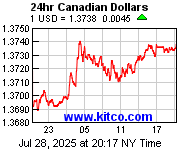
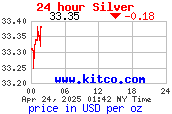
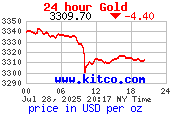
[font size=2]Euro, Yen, Loonie, Silver and Gold
[center]


[/center]

[HR width=95%]
[font color=black][font size=2]Handy Links - Market Data and News:[/font][/font]
[center]
Economic Calendar
Marketwatch Data
Bloomberg Economic News
Yahoo Finance
Google Finance
Bank Tracker
Credit Union Tracker
Daily Job Cuts
[/center]
[font color=black][font size=2]Handy Links - Economic Blogs:[/font][/font]
[center]
The Big Picture
Financial Sense
Calculated Risk
Naked Capitalism
Credit Writedowns
Brad DeLong
Bonddad
Atrios
goldmansachs666
The Stand-Up Economist
[/center]
[font color=black][font size=2]Handy Links - Government Issues:[/font][/font]
[center]
LegitGov
Open Government
Earmark Database
USA spending.gov
[/center][font color=black][font size=2]Handy Links - Videos:[/font][/font]
[center]
Charlie Rose talks with Roubini
Charlie Rose talks with Krugman
William Black: This Economic Disaster
Bill Moyers with Kevin Drum and David Corn
[/center]
[div]
Financial Sector Officials Convicted since 1/20/09 = [/font][font color=red]12[/font]
[HR width=95%]
[center]

[/center]
[HR width=95%]
[font size=3][font color=red]This thread contains opinions and observations. Individuals may post their experiences, inferences and opinions on this thread. However, it should not be construed as advice. It is unethical (and probably illegal) for financial recommendations to be given here.[/font][/font]
 = new reply since forum marked as read
Highlight:
NoneDon't highlight anything
5 newestHighlight 5 most recent replies
= new reply since forum marked as read
Highlight:
NoneDon't highlight anything
5 newestHighlight 5 most recent replies

Hugin
(38,050 posts)Except for tomorrow, I'll be able to do it in the mornings.
I'd ask that Ghost Dog does his magic again (Friday) with the xpost link into LBN. Didn't seem to cause too much of a stir, dude. 

Po_d Mainiac
(4,183 posts)Ghost Dog
(16,881 posts)Was just contemplating this, btw,

And so will be reading http://crisispapers.org/essays11w/revolution.htm
Hugin
(38,050 posts)But, what is the meaning to the chart in this post?
Normally, I pick up on these things quickly. 
Ghost Dog
(16,881 posts)Main links to-from DU, I think, the thing doesn't explain.
But I found the crisispapers site (I didn't know of it) a good read 'inside Dem politics' if that's what it is, so thought I'd mention it.

tclambert
(11,198 posts)Thought I'd lost a day somewhere. You must be posting from the other side of the International Date Line.
Hugin
(38,050 posts)Fat finger syndrome.
Otherwise, we may be moving to a 24/7 schedule now that we're here in the Economy Group. And we have our Foreign Desk manned by (among others) Ghost Dog.
This plan reduces the strain formerly felt by the SMW posters like PBD. We're going to try it out for awhile.
Here's the scheme:
Post the next day's SMW in Economy after the closing of the Exchanges here in the U.S. Then, when the other side of the world wakes up or near midnight ET someone posts a link into LBN to the day's SMW. Believe me... It's way more humane.
This scheme also allows for a wider group of potential OP-ers of the SMW than relying on only the pool of DU-ers who live on the East Coast or chronic insomniacs.
Ghost Dog
(16,881 posts)so those who check in after new thread posting time can easily get to the old (and maybe still active) thread.
Ah, and in the old thread a link can now be posted to the new, so we have a linked-list!

DemReadingDU
(16,002 posts)Last edited Fri Dec 16, 2011, 03:01 PM - Edit history (1)
The blasted word-wrap in the text entry box screwed up everything. 
It turns out the link tag doesn't like commas. 
Demeter
(85,373 posts)Tomorrow promises to be another day of hell so now is the best time for my posting.
Thursday at 1 AM, get home from the route (not finished, since I didn't have the keys to the locked buildings) and the client I'm most worried about is calling, thinking it's 1 PM and she's missed her dentist appointment. It's not a good situation. She really belongs in the hospital, but refuses to go.
Then at 6:30 get key, finish route (it's raining and 55F, typical Xmas weather I DON'T THINK SO!) post to SME, pore over the Fannie May foreclosure listings (Sis sent me the link), go shopping with another client, pick up and feed the Kid and go off to hear her sister, whose middle name should have been performance anxiety, sing in her first class recital. She did good. She started studying in utero, so she should. Takes after her mother...
Demeter
(85,373 posts)The image of rich folks using food stamps to buy filet mignon is becoming the 21st-century version of the Reagan-era "Welfare Queen." GOP presidential candidate Newt Gingrich has become particularly fond of the notion, claiming that people can even use food stamps for a trip to Hawaii. In a Nov. 30 appearance caught by ABC News, the former House speaker said: "They give food stamps now to millionaires because, after all, don't you want to be compassionate?" Unfortunately for the millions of Americans who could really use a trip to Hawaii right about now, that's not true. But increasingly, people who live in ritzy ZIP codes are finding it harder to pay for groceries, according to new data.
New Jersey's Hunterdon County, where the median household income is $97,874, led the nation in rising food stamp use, according to an analysis of Census Bureau data by Bloomberg News. In Hunterdon, an idyllic-looking place of horse farms and covered bridges southwest of New York City, food stamp enrollment rose 513 percent from 2007 to 2010, from 232 people in 2007 to 1,424 in 2010. In that span, the percentage of households using food stamps more than doubled in six of the 10 wealthiest counties in the nation, according to the Bloomberg report. These folks, though, likely fell an income bracket or two before they signed up; persistent joblessness and people's inability to sell their homes were the main drivers of need, Bloomberg reports...
That hasn't gone without notice in Washington, where legislators have been making noise about banning millionaires from unemployment insurance and food stamps...SEE REPLY
Demeter
(85,373 posts)It’s an image many Americans would find rather upsetting: a recently laid-off millionaire, luxuriating next to the pool eating grapes bought with food stamps while waiting for an unemployment check to roll in.
Under the Republican bill to extend a payroll tax holiday scheduled to be voted on in the House as early as Tuesday, those Americans with gross adjusted income over $1 million would no longer be eligible for food stamps or jobless pay, producing $20 million in savings to help pay for the tax cut for American workers. The idea is also embraced by many Democrats, who had a similar version of the savings in a Senate bill to extend the payroll tax cut, as did a failed Republican Senate bill.
Yet as it turns out, millionaires on food stamps are about as rare as petunias in January, even if you count a lottery winner in Michigan who managed to collect the benefit until chagrined officials in the state put an end to it. But the idea of ending unemployment insurance for very high earners — which would be achieved essentially through taxing benefits up to 100 percent with a phase-in beginning for those with gross adjusted income over $750,000 — demonstrates an increasing desire among members of Congress to find some way to make sure that the wealthiest Americans contribute more to reducing the deficit and paying for middle-class tax relief....While tycoons on food stamps might be hard to find, some millionaires do indeed pursue unemployment pay when they find themselves out of job. From 2005 to 2009, millionaires collected over $74 million in unemployment benefits, according to an estimate by Senator Tom Coburn, Republican of Oklahoma, who has paired with Senator Mark Udall, Democrat of Colorado, to push to end the practice. According to Mr. Coburn’s office, the Internal Revenue Service reported that 2,362 millionaires collected a total of $20,799,000 in unemployment benefits in 2009; 18 people with an adjusted gross income of $10,000,000 or more received an average of $12,333 in jobless benefits for a total of $222,000.
“Making Coloradans pay for unemployment insurance for millionaires is frankly irresponsible, especially at a time when money is tight and our debt is out of control,” Mr. Udall said in an e-mail....Unemployment benefits are essentially an insurance program financed through the state and federal governments. States charge employers taxes dedicated to cover the first 26 weeks of unemployment benefits paid to those Americans who lose their jobs, with the federal government paying for extensions...“It’s a water drop in a hurricane,” said Wayne Vroman, an economist at the Urban Institute. “I can see the PR appeal, but unemployment insurance collected by millionaires is not one of the major problems with the program. This is a way of trying to put an income test on the unemployment system that has never existed in the past.”
Ghost Dog
(16,881 posts)A TURNAROUND in Spain’s debt-selling fortunes went some way to easing investor nerves yesterday, with all major European stock markets showing moderate growth, following Wednesday’s sharp falls.
Not only did Spain manage to sell ten-year bonds with a considerably lower yield than its previous auction in October, but it managed to raise €6 billion, rather than its initial estimates of between €2.5bn and €3.5bn.
This was enough to spark a recovery in European stocks; although there was a warning from ECB chief Mario Draghi, stating that there would be "no external saviour" for debt-ridden economies not prepared to help themselves.
In London, the FTSE was up by 0.63%, with the CAC-40 in Paris up similarly by 0.76%. Frankfurt’s DAX index and Spain’s IBEX showed higher gains of 0.98% and 0.84%, respectively; while Italy’s FTSE MIB gained 1.37%...
Read more: http://www.irishexaminer.com/business/spanish-debt-sale-helps-lift-markets-177378.html#ixzz1geuxxAgb
Ghost Dog
(16,881 posts)The situation on European debt markets remained stable on Thursday. During a debt auction held in Spain the country's Treasury managed to sell 6 billion euros of bonds, almost a double amount than initially planned. The yield on 5-year bonds was 4.02% and on 9-year bonds 5.23%. The risk premium on Spanish debt fell to 360 points while Italian borrowing costs were at 490 points.
John J. Hardy, Head of FX Strategy, Saxo Bank comments on the outcome of the Spanish auction: “The tightening sovereign debt spreads in general today was driven by a very successful auction of Spanish debt – as Spain managed to sell twice as many bonds as anticipated at its auction today. Some of that demand may be due to the anticipated boost in liquidity from the ECB’s most recent measures, which could allow Spanish and other banks to lock in fat spreads on LTRO and other borrowings versus investment in sovereign debt – assuming that what looks well on paper, ends well in reality.”
/... http://www.fxstreet.com/fundamental/market-view/european-crisis/2011/12/15/
Ghost Dog
(16,881 posts)Spain had public debt equivalent to 66.0 percent of national output in the third quarter of the year, up from 58.7 percent at the same time in 2010, the central bank said on Friday.
This puts Spanish debt 6.0 percentage points above the 60.0-percent ceiling permitted under the EU's Stability and Growth Pact, but the figure is 20 points below the European Union average of 85.1 percent for the whole of last year.
/... http://uk.news.yahoo.com/spainish-debt-66-gdp-third-quarter-bank-114013036.html
Demeter
(85,373 posts)On November 27, Bloomberg News reported the results of its successful case to force the Federal Reserve to reveal the lending details of its 2008-09 bank bailout. Bloomberg reported that by March 2009, the Fed had committed $7.77 trillion in below-market loans and guarantees to rescuing the financial system, and that these nearly interest-free loans came without strings attached.
The Fed insisted that the loans were repaid and there have been no losses, but the Bloomberg report said the banks reaped a $13 billion windfall in profits; and "details suggest taxpayers paid a price beyond dollars as the secret funding helped preserve a broken status quo and enabled the biggest banks to grow even bigger."
The revelations provoked shock and outrage among commentators. But in a letter to the leaders of the House and Senate Committees focused on the financial services industry, Fed Chairman Ben Bernanke responded on December 6 that the figures were greatly exaggerated. He said the loans were being double-counted: short-term loans rolled over from day to day were counted as separate cumulative loans rather than as a single extended loan.
Bloomberg was quick to rebut, denying any exaggerated claims. But either way, the banks were clearly getting perks not available to the rest of us. As Alan Grayson observed in a December 5 editorial:
During all the time that the Fed was stuffing money into the pockets of failed banks, many Americans couldn't borrow a dime for a home, a car, or anything else. If the Fed had extended $26 trillion in credit to the American people instead of Wall Street, would there be 24 million Americans today who can't find a full-time job?
Demeter
(85,373 posts)It has now been almost five years since the bursting of the housing bubble, and four years since the onset of the recession. There are 6.6 million fewer jobs in the United States than there were four years ago. Some 23 million Americans who would like to work full-time cannot get a job. Almost half of those who are unemployed have been unemployed long-term. Wages are falling—the real income of a typical American household is now below the level it was in 1997.
We knew the crisis was serious back in 2008. And we thought we knew who the “bad guys” were—the nation’s big banks, which through cynical lending and reckless gambling had brought the U.S. to the brink of ruin. The Bush and Obama administrations justified a bailout on the grounds that only if the banks were handed money without limit—and without conditions—could the economy recover. We did this not because we loved the banks but because (we were told) we couldn’t do without the lending that they made possible. Many, especially in the financial sector, argued that strong, resolute, and generous action to save not just the banks but the bankers, their shareholders, and their creditors would return the economy to where it had been before the crisis. In the meantime, a short-term stimulus, moderate in size, would suffice to tide the economy over until the banks could be restored to health.
The banks got their bailout. Some of the money went to bonuses. Little of it went to lending. And the economy didn’t really recover—output is barely greater than it was before the crisis, and the job situation is bleak. The diagnosis of our condition and the prescription that followed from it were incorrect. First, it was wrong to think that the bankers would mend their ways—that they would start to lend, if only they were treated nicely enough. We were told, in effect: “Don’t put conditions on the banks to require them to restructure the mortgages or to behave more honestly in their foreclosures. Don’t force them to use the money to lend. Such conditions will upset our delicate markets.” In the end, bank managers looked out for themselves and did what they are accustomed to doing.
Even when we fully repair the banking system, we’ll still be in deep trouble—because we were already in deep trouble. That seeming golden age of 2007 was far from a paradise. Yes, America had many things about which it could be proud. Companies in the information-technology field were at the leading edge of a revolution. But incomes for most working Americans still hadn’t returned to their levels prior to the previous recession. The American standard of living was sustained only by rising debt—debt so large that the U.S. savings rate had dropped to near zero. And “zero” doesn’t really tell the story. Because the rich have always been able to save a significant percentage of their income, putting them in the positive column, an average rate of close to zero means that everyone else must be in negative numbers. (Here’s the reality: in the years leading up to the recession, according to research done by my Columbia University colleague Bruce Greenwald, the bottom 80 percent of the American population had been spending around 110 percent of its income.) What made this level of indebtedness possible was the housing bubble, which Alan Greenspan and then Ben Bernanke, chairmen of the Federal Reserve Board, helped to engineer through low interest rates and nonregulation—not even using the regulatory tools they had. As we now know, this enabled banks to lend and households to borrow on the basis of assets whose value was determined in part by mass delusion...
GOOD HISTORICAL SUMMARY, ANALYSIS AND THEORIZING

nc4bo
(17,651 posts)The world is their clamshell and governments fall over themselves to keep them afloat. The rest of us are nothing but kennel litter.
Think I'll just add "So sick of this sh*t" to my siggie and be done with it.

dixiegrrrrl
(60,186 posts)for years IS a bit off putting, isn't it?
I notice I head more often for comedies and lighter fare at end of night, otherwise I would sleep all tensed up.
Always torn between wanting to stick my head in the sand
or wanting to make sure I do not miss the lights of the train heading towards me.
dkf
(37,305 posts)Luckily I hadn't been watching til recently so I have a lot to go through.
Ghost Dog
(16,881 posts)Demeter
(85,373 posts)I've been posting in the dark while exhausted, again, sorry.
Ghost Dog
(16,881 posts)When feeling down, think positively.
Platitudes, I know. But turning negative into positive thoughts does help to control, or at least not be overwhelmed by, emotions, as they taught me recently in the casa de locos (  but that's another story
  ) and I find works.
Demeter
(85,373 posts)It is not warm on West Street at 8:30 AM on December 12, and the wind coming simultaneously off the Hudson River to the west and New York harbor to the south doesn't make it very much balmier. But if 50,000 people can take to the streets of Moscow because they object to their democracy being gamed by the elites, Occupy Wall Street won't let a little chill get in its way.
The reason several hundred protesters have congregated on West Street is that Goldman Sachs can be found there. And, today, Occupy Wall Street has gone squidding just outside. The idea comes from Matt Taibbi's "nailed-it" description of the banking giant as "a great vampire squid wrapped around the face of humanity, relentlessly jamming its blood funnel into anything that smells like money." Many umbrellas sporting makeshift tentacles and ad hoc hats with angry squid eyes cap the march, which leaves simultaneously from two locations: City Hall and Zuccotti Park.
The march is timed to coincide with an effort in West Coast cities to shut down ports, with New York occupiers showing solidarity with their brothers and sisters in Los Angeles, Oakland, Seattle, and elsewhere - all of whose occupations were evicted just like the de facto flagship one in New York. According to Boots Riley of the Oakland hip-hop outfit The Coup, "Occupy Oakland called for this massive coordinated blockade as a way to strike back at the 1% after their attacks on the Occupy movement and their continued assault on working and poor people." New York couldn't have picked a more apt 1 percent target than Goldman, as Taibbi's depiction hints.
"Everybody pays their tax," chant the marchers. "Everyone but Goldman Sachs." The reference is to Goldman's shady accounting, which allows the corporation to grossly underpay its federal taxes. According to the US Public Interest Research Group, "Goldman Sachs, which reported more than $2 billion in profit in 2008, was able to use its 29 tax haven subsidiaries to reduce its federal tax bill to just $14 million. That means that Goldman Sachs' CEO Lloyd Blankfein, who made $42.9 million that year, earned more than three times the amount that the company paid in federal taxes." This, while social services are cut because of an alleged budget crisis.
Demeter
(85,373 posts)...to the meter of "We are the 99 percent," the march breaks out in a chant, "We are the source of all your wealth." This assertion, that the ownership class depends on the working class and not the other way around, is a declaration of independence from a politics that bails out the former at the expense of the latter....
Demeter
(85,373 posts)...And as column inches and news web sites fill up with words about what their OWS message means now that camps nationwide are gone or threatened, the photographs that captured them at their peak take on new meaning. As the poet Wallace Stevens knew and as others have echoed, sometimes images tell the story best...
...A homeless man sits on a bench eating a free sandwich. "This is luxury," he says. "I got a kitchen. I got a bathroom. I can sleep without the cops messing with me. This is paradise."
Junebug, as he calls himself, says he has been homeless for 17 years. He says he prefers the camp to many of Portland's shelters, which he says open too late in the morning and don't provide enough services.
A story in one of the local weeklies quotes multiple sources who say the presence of homeless people at the camp is disruptive; that pattern has echoed in the media around the country. But Junebug says he goes to every general assembly. He wants to show me hard copies of emails about a financial conflict on the agenda at tonight's meeting. He leaves his dinner and takes me to the library tent, the legal tent, the media tent. All the copies are gone, but he takes my business card...
...Therapist Michael Stone could charge $120 an hour if he wanted to, but he'd rather not. The licensed professional counselor gives free sessions at the camp's north end for two hours every afternoon. At his private practice, his sliding scale is $25-$55.
"I think we have to switch to kind of a creative poverty model," says Stone. "If you have an old car, it should be applauded - not like you haven't 'made it' yet." We should use old things, make them last longer, he says. Conserve everything. With one exception:
Stone is tired of fighting the mental health battle inside a plutocracy. "You can only do so much when the system is so corrupt. You can help people find peace in their lives, but when it's within a corrupt system? It's hard to find peace."...
PHOTOS AT LINK
Demeter
(85,373 posts)The most significant accomplishment for Occupy Wall Street (OWS) to date is that the Occupiers have managed to poke a hole in the legitimacy of neoliberal capitalism and its central claim that unregulated markets provide opportunity and freedom.
The Occupiers have accomplished this feat in a surprising way, peacefully, with home-made signs, signs that say things like, "If I had a lobbyist, I wouldn't need this sign."
OWS has punctured the neoliberal façade simply by having the audacity to gather in public, in bold defiance of the police and to bear witness, by their solidarity and cooperation, to the idea that the Washington Consensus has long denied - that a different world is possible.
Phil Rockstroh puts it this way: "the walls of the neoliberal prison are cracking ... We are no longer isolated, enclosed in our alienation, imprisoned by a concretized sense of powerlessness; daylight is beginning to pierce the darkness of our desolate cells."
Demeter
(85,373 posts)...Excluding people from having a say over what happens to the wealth we create is the first and the most fundamental way that any capitalist system undermines democracy. We are fundamentally disenfranchised in the places we work. Wealth owners control the levers of investment and, thus, the "needs" of capital trump those of workers when it comes to making decisions about what gets produced, how and for whom...
Demeter
(85,373 posts)"Change the system"? Not simply move money to demonstrate anger at the big banks? To be sure, for some, the move was simply one of anger. For others, however, there was a clear sense that the humble, down-home American credit union was somehow a cleaner, better institution. In fact, credit unions are more than that; they are democratized "banks" that suggest practical ways to begin to build, however tentatively, in the direction of a more democratic economy. Nor are they marginal: credit unions hold roughly a trillion dollars in deposits, and involve more than 90 million Americans as participant owners.
Most credit unions help finance routine consumer investments - especially the purchase of homes and automobiles. But credit unions start to get interesting when they go beyond simply being nonprofit, one-person/one-vote cooperative banks and start working actively to open a more expansive direction. The Bronx's Bethex Federal Credit Union, founded in 1970 by Joy Cousminer and the "welfare mothers" in her adult education class, is a good example.
Bethex began as a purely volunteer project to meet the needs of its immediate community. It now serves over 9,000 members, has $16 million in deposits and continues to empower local residents with a range of financial services, including savings and checking accounts; children’s accounts; holiday accounts; ATM and Visa cards; and, importantly, student, auto, mortgage and business loans. Other examples include the Alternatives Federal Credit Union, which lends to cooperatives, worker-owned enterprises, small businesses and community groups in Ithaca, New York. It also invests in programs such as the BR MicroCapital organization at Cornell University, which provides customized services and microloans to self-employed community residents.
Nor are all efforts small-scale. The Hope Credit Union in Memphis has lent over $1.6 billion to more than 90,000 individuals in the Mississippi Delta region of Tennessee and in Katrina-impacted areas and other distressed communities throughout Arkansas, Louisiana, Mississippi and Tennessee. In 2010, it lent millions to companies operating in poverty-stricken communities, provided two-thirds of its mortgages to low-income borrowers and financed the renovation of a 62-unit apartment complex...
MORE THAN I EVER KNEW ABOUT CREDIT UNIONS AT LINK
Demeter
(85,373 posts)The lesson of Lehman Brothers' failures of fiduciary duty is that large-scale lending should not be entrusted to private banks.
Last week, federal court Judge James M Peck approved the final phase of the Lehman Brothers bankruptcy, which began with the investment bank's collapse on 15 September 2008. That bankruptcy, the largest in US history, precipitated the credit markets' disintegration that cascaded into the global economic meltdown that has deepened ever since. With roughly $450bn still owed by the bank, Judge Peck approved that Lehman Brothers has only $65bn left to settle creditors' claims. The latter must thus accept just over 14 cents for every dollar Lehman Brothers owed them. "Thieves," they are probably muttering.
Lehman Brothers' bankruptcy has revealed multiple layers of ramifying corruption and theft among global banks in the US and elsewhere, as well. Many juicy details are covered in the nine-volume court examiner's report of 11 March 2010. It documents the bank executives' mammoth misjudgments in their investment decisions, including their repeated violations of the basic banking principle not to borrow short-term and lend the proceeds long-term. The bank examiner shows misleading statements made about their activities and how they disguised Lehman's financial health and credit-worthiness. It appears that various legal and semi-legal mechanisms were used to manipulate their accounts, and otherwise violate the spirit and letter of laws and regulations....
....The bankruptcy of Lehman Brothers opened a window on strategies and tactics of many large private banks around the world. The hows and whys of their catastrophic mishandling of their "fiduciary duties" – basically, to be fundamentally prudent and trustworthy in how they manage other people's money – stand revealed. They no longer deserve public trust. Yet, to date, the weak new rules and laws passed in the wake of the global crisis have changed little.
Lehman Brothers' collapse and its aftermath threatened global capitalism and not merely other big global banks. "Too big to fail" thus became those banks' slogan in demanding and obtaining the dominant influence over governments. After Lehman's collapse, governments bailed out those banks, no matter the cost. By borrowing vast sums to fund those bailouts, governments raised national debts to reduce the big banks' private debts. Hence today's European sovereign debt crisis....
Demeter
(85,373 posts)and not for the chronically depressed.
This Weekend will be starting late, as I have rehearsal for Sunday's performance at 7PM. But it will be a dickens of a weekend, I promise you! And who knows, maybe we will have some good news to report (mistakes can happen).
Ghost Dog
(16,881 posts)PARIS, Dec 16 (Reuters) - European stocks rose in early trade on Friday, extending the previous session's tentative rebound from a week-long drop, helped by better-than-feared U.S. macro data, but lingering concerns over the euro zone debt crisis kept gains in check.
...
Copper prices rebounded, helped by signs of recovery by the U.S. economy. But despite the day's rally, prices were headed for their biggest weekly loss since the end of September and the first annual decline in three years.
Friday's gains in equities were limited as investors continued to fret about the prospect of credit rating downgrades that could hit euro zone countries soon.
"There's a growing sentiment that the European Central Bank is doing quite a good job and is ready to buy more bonds if needed, preventing stocks from a complete meltdown," said David Thebault, head of quantitative sales trading at Global Equities.
"But at the same time, we have this sword of Damocles of rating downgrades waiting to happen, so it's hard to go long."
/... http://uk.reuters.com/article/2011/12/16/markets-europe-stocks-idUKL6E7NG0VP20111216
Ghost Dog
(16,881 posts)Dec. 16 (Bloomberg) -- European exports fell in October, led by declines in Germany and Spain, as the region’s economy edged toward a recession.
Exports from the euro region dropped a seasonally adjusted 1.9 percent from September, when they fell 1.1 percent, the European Union’s statistics office in Luxembourg said today. Imports fell 0.7 percent, and the trade surplus shrank to 300 million euros ($391 million) from 2.2 billion euros a month earlier. Labor costs grew 2.7 percent in the third quarter, a separate report showed...
... Exports from Germany, Europe’s biggest economy, decreased a seasonally adjusted 1.7 percent in October, today’s report showed, while shipments from France dropped 0.4 percent. Spanish exports plunged 9.1 percent in the month. Belgian shipments soared 10.7 percent.
/... http://www.businessweek.com/news/2011-12-16/euro-area-october-exports-fall-1-9-led-by-germany-spain.html
Young Spaniards, especially the brightest and the best, are emigrating to find work, again. The usually very strong solidarity of Spanish families can only go so far...
Ghost Dog
(16,881 posts)... Spain’s 8,000 municipalities and 17 semi-autonomous regions are suffering from a liquidity squeeze as many are shut out of markets, prompting them to delay paying suppliers. Regions’ debt rose 1.5 percent to 135 billion euros ($176 billion) in the third quarter, the Bank of Spain said today. Catalonia had the highest debt, at 39.3 billion euros.
Companies are being paid 157 days late on average, about three times the legal payment delay, according to the Platform Against Late Payment, a federation of employer groups, and pharmaceutical companies say they are owed 5.83 billion euros by public hospitals. While Rajoy has pledged to help local administrations pay suppliers, that may add to the state’s debt burden and undermine efforts to lower sovereign borrowing costs.
“Rising commercial debt means there is more deficit and that the risk of missing deficit targets increases,” said Marisol Blazquez, an analyst at rating company Moody’s Investors Service in Madrid. “Apart from the Basque country, the Madrid region and Galicia, all the regions we rate are having liquidity issues.”
The yield on Spain’s 10-year bonds eased to 5.164 percent as of 10:30 a.m. in Madrid from 5.433 percent yesterday. It rose to a euro-era record of 6.78 percent on Nov. 17.
/... http://www.bloomberg.com/news/2011-12-16/spain-s-unpaid-bills-may-haunt-rajoy-as-regions-crave-liquidity.html
Ghost Dog
(16,881 posts)PARIS (dpa-AFX) - Confidence among French businesses weakened for a sixth consecutive month in December, to reach the lowest level in 21 months, survey data from the statistical office Insee showed Friday.
The business sentiment index for the manufacturing industry declined to 94 in December, the lowest since March 2010, from an upwardly revised 96 a month ago.
The reading was, however, above economists' expectations of 93, but below its long-term average.
/... http://www.finanznachrichten.de/nachrichten-2011-12/22230322-french-dec-business-confidence-at-21-month-low-020.htm
Ghost Dog
(16,881 posts)PARIS (dpa-AFX) - The French economy is in a better position than the U.K.'s, French Finance Minister Francois Baroin told French radio station Europe 1 on Friday. The minister also qualified the economic situation in the U.K. as 'worrying.'
He said one prefers to be French than British on the economy front at the moment.
His comments come a day after the Bank of France Governor Christian Noyer said the rating agencies should downgrade the ratings of the U.K. first, which has bigger deficits, more debt, higher inflation and less growth than France.
The statistical office Insee said yesterday that it expects the French economy to slip into a mild recession in the fourth quarter of 2011 and the first quarter of next year...
/... http://www.finanznachrichten.de/nachrichten-2011-12/22232704-french-finmin-says-economic-situation-in-u-k-very-worrying-report-020.htm

... "It's true that the economic situation in Great Britain is very worrying and that we prefer being French rather than British on the economic front at the moment," Baroin said on Europe 1 radio.
"We don't want to be given any lessons and we don't give any," he said.
His comments came as the British press on Friday slammed French officials for suggesting that ratings agencies were targeting the wrong country for a debt downgrade by looking at France...
... British officials would not be drawn into responding directly to the French criticism, but the British press reacted furiously...
/... http://au.news.yahoo.com/thewest/a/-/world/12380273/france-fuels-row-with-fresh-attacks-on-uk-economy/
Ghost Dog
(16,881 posts)Ireland has recorded the third-largest trade surplus in the EU for the months of January to September. Exports grew by 4%, while imports were up by 6%.
The data from Eurostat shows the largest trade surplus was in Germany, followed by the Netherlands and then Ireland, at €32.4bn.
The UK registered the largest deficit.
Read more: http://www.breakingnews.ie/ireland/ireland-sees-largest-trade-surplus-after-germany-and-netherlands-532494.html#ixzz1ghZ15OD0
Irish economy shrinks 1.9 pct in Q3 as cuts bite
DUBLIN (AP) - Ireland's economy has shrunk by 1.9 percent in the third quarter, more than expected, raising doubts about the country's deficit-fighting plans.
Government statisticians say gross domestic product fell 1.9 percent in the July-September quarter compared with the previous quarter. Gross national product, which excludes profits of foreign companies based in Ireland, fell 2.2 percent.
Economists had expected quarterly GDP to fall around 0.5 percent and no change to GNP.
Friday's data leaves Ireland on course to register only marginal growth this year. Irish GDP had grown in the first two quarters of 2011 after three years of declines.
/... http://www.buffalonews.com/business/24-hour-business-news/article674939.ece
Ghost Dog
(16,881 posts)The financial services sector contributed an estimated 63 billion pounds in taxes this year, up 18 percent, PricewaterhouseCoopers (PwC) said in a report for the City of London Corporation...
...The one-off bank payroll tax, charged on 2009 bonuses, was paid in this year, totalling 3.4 billion pounds. However, the bank levy was introduced after the study period closed, and the VAT rise to 20 percent did not take full effect in the period...
... "At a time when the City's value is being questioned, both in the UK and in Europe, these figures highlight the huge fiscal contribution it continues to make, even in this extremely challenging economic environment," said Stuart Fraser, policy chairman for the City of London Corporation...
... Earlier this week, official figures showed that the number of Britons out of work had risen in October to the highest level in more than 17 years.
/... http://www.cnbc.com//id/45693738
... And, that would be in relation to what level of profits before-and-after bonus payouts? (not counting those UK sectors even further offshore than the mainland, that is)?

xchrom
(108,903 posts)Last week's European Union summit has created more problems than it has solved. By agreeing to enter into a fiscal compact, which would tighten control over national budgets and enact automatic sanctions against deficit offenders, the heads of state and government who make up the European Council have left the solid ground of EU law and entered into uncharted legal territory.
With British Prime Minister David Cameron unwilling to join the other EU member states in modifying the Lisbon Treaty to allow Brussels greater influence over member states' budgets, the rest of the summit participants agreed to enter into a new treaty entirely, one without the United Kingdom. The negotiations over this "17-plus treaty," which will include all countries within the euro zone as well as other willing EU members, are supposed to be completed by March.
Those who sign the treaty will pledge to keep their own budgets in order, with a maximum structural deficit of 0.5 percent of gross domestic product per year and so-called "debt brakes" anchored in national constitutions to automatically correct any violations of that limit. Those who sign up will also agree to subject themselves to a tough sanctions mechanism if their budgets get out of control, with the European Commission required to impose harsh penalties on states that violate the terms of the pact -- unless a qualified majority of EU members supports making an exception in a particular case. Crisis-stricken countries that apply for an EU bailout will in return be obliged to summit their national budgets to Brussels for approval.
But is that all even possible? Can a majority of EU states simply bow out of a common EU treaty and agree on something new instead? David Cameron, no longer part of the new club, has stated that he doesn't accept the other member states' decision to go it alone, but those on the Continent seem unperturbed. This is not the first time that EU member states have agreed on special treaties which are not signed by all members. The Schengen Agreement, for example, which removed border controls among most but not all EU states, was another case where London declined to participate. And the example of the European Social Charter offers proof that a decision to opt out doesn't need to be permanent. This treaty, too, was originally adopted without British participation, but would later be signed by former UK Prime Minister Tony Blair.
xchrom
(108,903 posts)Standard & Poor's on Thursday downgraded the ratings of 10 Spanish banks after the agency announced new criteria and methodology in placing scores on financial entities.
The banks include Bankia, Caixabank, Ibercaja, Bankinter, Sabadell and Banco Popular.
S&P said that that the banks remained on watch for a possible further cut subject to a review of Spain's sovereign rating, which is due to take pace in about a month.
Spanish banks are heavily exposed to bad, and potentially bad, loans after a prolonged housing bubble burst in 2007, and risks remain even after prolonged restructuring and recapitalization. Spain's sovereign debt is currently rated AA- by S&P, an investment grade that indicates a "very strong payment capacity." The agency said that after deciding on whether or not to downgrade Spain's government debt, it will announce decisions on possible further cuts in the ratings of Spanish banks.
xchrom
(108,903 posts)BRUSSELS (AP) -- Private creditors are balking in talks about forgiving euro100 billion ($130 billion) in Greek debts, European officials warned Friday, just as negotiations heat up on the debt restructuring that aims to save Athens from bankruptcy.
European and Greek negotiators were meeting with representatives from banks and investment funds again Friday in Paris, after holding talks earlier this week in Athens.
They are trying to work out the terms under which private creditors are willing to exchange their existing Greek bonds for new ones with a lower face value.
The swap, which was meant to go ahead in early 2012, is supposed to reduce Greece's debt to 120 percent of gross domestic product by 2020. Without a restructuring, Greece's debt load would reach almost 200 percent of GDP by the end of 2012.
Ghost Dog
(16,881 posts)BERN — The Swiss National Bank held its cap on the franc at 1.20 per euro on Thursday, knocking back speculation it might try to weaken the currency further, although it warned it could act further at any time.
After its quarterly meeting, the bank said Swiss growth would slow sharply next year and prices would fall, as the franc’s almost 30 percent gain since 2008 weighs on exporters and the global economic outlook worsens...
...“Even at the current rate, the Swiss franc is still high and should continue to weaken over time,” the S.N.B. chairman Philipp Hildebrand told a news conference. “The S.N.B. stands ready to take further measures at any time if the economic outlook and the risk of deflation so require.”
The S.N.B. set the cap on the franc on Sep. 6 after the currency rose some 20 percent in just a few months, a move that reflected portfolio investment flows rather than its day-to-day economy and threatened to strangle Swiss companies.
/... http://www.nytimes.com/2011/12/16/business/global/swiss-central-bank-holds-euro-cap.html?src=recg
Ghost Dog
(16,881 posts)BRUSSELS (dpa-AFX) - Against its British counterpart, the Swiss franc traded further higher in New York late morning trading on Friday. The franc is presently trading near a 4-day high of 1.4529 versus the sterling, compared to Thursday's closing value of 1.4589.
After edging down in early morning session, the Swiss currency reversed its direction against the euro in New York late morning trading today. As of now, the franc is trading at a fresh multi-week high of 1.2209 versus the euro from early low of 1.2256. The pair closed yesterday's New York session at 1.2240.
/... http://www.finanznachrichten.de/nachrichten-2011-12/22235698-swiss-franc-rises-further-against-euro-and-pound-020.htm
Ghost Dog
(16,881 posts)VIENNA (dpa-AFX) - European stocks finished a brutal week on a downbeat note Friday, as markets remain skeptical of efforts to end the region's sovereign debt crisis.
The bickering continued among political leaders, with Italian Prime Minister Mario Monti taking a veiled swipe at German Chancellor Angela Merkel...
...The Euro Stoxx 50 index of eurozone bluechip stocks unofficially lost 0.85 percent, for a weekly loss of nealy 6 percent.
The Stoxx Europe 50 index, which includes some major U.K. companies, eased 0.52 percent today.
The German DAX is lost 0.29 percent, the French CAC 40 fell 0.88 percent and Switzerland's SMI was down 0.98 percent a few minutes before the closing bell. The UK's FTSE 100 was up 0.06 percent.
/... http://www.finanznachrichten.de/nachrichten-2011-12/22236215-european-stocks-end-rough-week-with-another-loss-020.htm

Roland99
(53,345 posts)Ghost Dog
(16,881 posts)(Reuters) - The credit rating agency Fitch said on Friday it thought a comprehensive solution to the euro zone's debt crisis was beyond reach, putting six euro zone economies including Italy on watch for potential near-term downgrades.
It reaffirmed France's top-notch triple-A rating but even here said the outlook was now negative, meaning it could be downgraded within two years...
... Fitch said that following the EU summit a week ago it had concluded that "a 'comprehensive solution' to the eurozone crisis is technically and politically beyond reach."
"Of particular concern is the absence of a credible financial backstop," it said. "In Fitch's opinion this requires more active and explicit commitment from the ECB to mitigate the risk of self-fulfilling liquidity crises for potentially illiquid but solvent Euro Area Member States."
/... http://uk.reuters.com/article/2011/12/16/uk-eurozone-idUKTRE7BF0P120111216
Ghost Dog
(16,881 posts)... Futures on the S&P 500 expiring in March rose 0.5 percent to 1,217.8 at 9:58 a.m. in London. The gauge rose 0.3 percent yesterday, trimming this week’s decline to 3.1 percent. Dow Jones Industrial Average Index futures added 45 points, or 0.4 percent, to 11,867 today.
U.S. stocks snapped a three-day decline yesterday after reports on jobless claims and manufacturing boosted confidence in the world’s largest economy.
Today’s Labor Department report may show the cost of living the U.S. was little changed in November as gasoline prices fell, economists said. The consumer-price index increased 0.1 percent last month after falling 0.1 percent in October, according to the median economist forecast in a Bloomberg News survey. So- called core prices, which exclude volatile food and energy costs, may have also risen 0.1 percent. The figures are due at 8:30 a.m in Washington.
The S&P 500 has still lost 3.1 percent this week after the Federal Reserve refrained from taking new action to bolster growth. The central bank said the U.S. economy is maintaining its expansion even as the global economy slows...
/... http://www.bloomberg.com/news/2011-12-16/u-s-stock-futures-climb-before-inflation-report-rim-sinks-on-phone-delay.html
Ghost Dog
(16,881 posts)CANBERA (dpa-AFX) - Asian shares snapped a three-day losing streak on Friday, as a successful Spanish bond auction and signs of strength in the world's largest economy helped investors overlook the gloomy European developments...
... Japanese rose modestly, snapping three days of losses, as upbeat U.S. economic data helped offset concerns over squeezing credit conditions for European banks. The Nikkei average rose 0.3 percent and the broader Topix index closed up 0.2 percent...
... China's Shanghai Composite index rose two percent, ending a six-session losing streak, on speculation that the government will cut lenders' reserve-requirement ratios again in the near term following suspected dollar-selling intervention by state-run banks, who often act on behalf of the central bank. Hong Kong's Hang Seng index closed 1.4 percent higher, with Chinese property developers leading the gainers.
... Australian shares posted modest gains, snapping a three-day losing streak, with positive offshore leads helped by encouraging U.S. and German manufacturing PMI data bolstering investor sentiment. Both the benchmark S&P/ASX 200 and the broader All Ordinaries index closed up around half a percent each...
... India's Sensex was last trading down over two percent, erasing early gains, after the Reserve Bank of India kept key policy rates unchanged, taking into account the inflation situation and also growth moderation. ' We will manage liquidity through market operations (but) I cannot speculate when we might start cutting rates,' governor D Subbarao said...
/... http://www.finanznachrichten.de/nachrichten-2011-12/22231609-asian-shares-advance-on-us-data-020.htm
Ghost Dog
(16,881 posts)Bank of America Corp. (BAC), Goldman Sachs Group Inc. (GS) and Citigroup Inc. (C) had their credit grades cut by Fitch Ratings as the impact of financial regulation and market turmoil (VIX) weighed on the industry.
The lenders’ long-term issuer default ratings were cut one level to A from A+, Fitch said yesterday in a statement. Barclays Plc (BARC), based in London, Credit Suisse Group AG (CSGN), Deutsche Bank AG (DBK) and BNP Paribas SA also had their grades lowered.
/... http://www.bloomberg.com/news/2011-12-15/bank-of-america-goldman-sachs-barclays-default-ratings-reduced-by-fitch.html
More here in LBN: http://www.democraticunderground.com/10143920

InkAddict
(3,387 posts)Where is Tansy's stamp and guillotine...what needs to happen.
xchrom
(108,903 posts)
Ghost Dog
(16,881 posts)I notice the twitches in the charts as NY starts its daily action...
xchrom
(108,903 posts)xchrom
(108,903 posts)Recent debate over the Keystone XL oil pipeline has turned a spotlight on Canada's controversial and oil-rich tar sands, which would be the source of crude oil flowing through the pipe to the Gulf of Mexico. Tar sands oil has faced stiff criticism from environmental groups, which say that it's far dirtier than its Middle Eastern counterpart despite claims from the Canadian government and industry groups that they keep a close eye on environmental impact.
But long before the Keystone XL became a cause célèbre, tar sands oil was already ubiquitous in America: It goes to fuel our cars and corporations' trucking fleets, and it's used in the production of products from aluminum cans to asphalt. Starting last year, San Francisco-based environmental advocacy group Forest Ethics launched a campaign to encourage American companies to boycott tar sands oil and, specifically, the refineries that process it (below).
***interactive map at link
Demeter
(85,373 posts)The Guardian today has a nice photo gallery of the highest paid rogues (based on 2010 compensation - 2011 numbers not yet in) in what is quickly becoming the greatest oligarchy in the world. I suggest you go take a look at the faces on display of the top five monsters criminals hard working folks who are American CEO's, starting with:
1. John Hammergren, McKesson Corporation: $145,266,971.
He runs the largest health care firm in the known universe (Gross revenues of $108.7 BILLION) and if his company is merged or otherwise acquired his take from this year's stock options (part of his compensation) would be roughly $469 MILLION.
2. Joel F. Gemunder, Omnicare, $98,283242
Omnicare provides "pharmaceutical care" for old people (i.e, sells meds to nursing homes). He retired this year, will receive a severance package of $6 MILLION and all his stock options and restricted stock are immediately vested (value roughly $18 to $22 Million). Morningstar Footnoted calculates his going away presents at $133 MILLION which is higher than The Guardian's numbers, but in any case he still comes in at second place.
3. John Plant, TRW Automotive Holdings, $76,841,646.
He was actually given a $2.5 MILLION bonus for not leaving the company and $4.5 MILLION for unspecified "additional factors." Where can I find a job like that? I have additional factors up the wazoo.
4. Frank Coyne, CEO Verisk Analytics Inc. $76,416,276.
Verisk Analytics Inc. is the "leading source of information about risk." I guess it's a lucrative field these days. Over the 12 months ending September 30, 2011 it earned gross profits of $765.08 MILLION.
5. Thomas M Ryan, CVS Caremark Corporation. $68,079,823
From the Guardian: "Ryan made $50m on the pharmacy chain’s shares last year. During his 13 years as CEO the firm’s share price has halved." Heck I would have done that for them at half the cost and saved them a bundle! Extra bonus information: CVS Caremark manages my prescription insurance plan and I can assure you it lives up to its reputation for exceptionally poor costumer service.
To be honest I was going to run down the whole list for you but I just got sick to my stomach after the first five. Of course, this list doesn't include the people with the highest incomes in 2010 or 2011, just CEO's. In fact, the guys on the Guardian's list look like pikers compared to the people who pull down the really big bucks.
For the highest income earners you have to go through the toxic waste manufacturers otherwise known as Hedge Fund managers. The best of the best (or worst of the worst, depending on your point of view) of those people (i.e., the top ten)averaged 2.2 Billion Dollars in 2010. However, I can only wade through so much muck in a day.
So for all of you who are working two (or three) jobs, are underemployed or can't find a job to save your home and/or life because there aren't enough to go around, just think of these lovely people with all their lovely piles of money and that warm glow you feel about their obscene riches might just help you make it through our joyous holiday season should your heat be cut off this winter.
Ps. And people still ask what the Occupy Wall Street protestors want?
Demeter
(85,373 posts)"Class happens when some men, as a result of common experiences (inherited or shared), feel and articulate the identity of their interests as between themselves, and as against other men whose interests are different from (and usually opposed to) theirs.”
-- E.P. Thompson, The Making of the English Working Class
The “other men” (and of course women) in the current American class alignment are those in the top 1% of the wealth distribution -- the bankers, hedge-fund managers, and CEOs targeted by the Occupy Wall Street movement. They have been around for a long time in one form or another, but they only began to emerge as a distinct and visible group, informally called the “super-rich,” in recent years.
Extravagant levels of consumption helped draw attention to them: private jets, multiple 50,000 square-foot mansions, $25,000 chocolate desserts embellished with gold dust. But as long as the middle class could still muster the credit for college tuition and occasional home improvements, it seemed churlish to complain. Then came the financial crash of 2007-2008, followed by the Great Recession, and the 1% to whom we had entrusted our pensions, our economy, and our political system stood revealed as a band of feckless, greedy narcissists, and possibly sociopaths.
Still, until a few months ago, the 99% was hardly a group capable of (as Thompson says) articulating “the identity of their interests.” It contained, and still contains, most “ordinary” rich people, along with middle-class professionals, factory workers, truck drivers, and miners, as well as the much poorer people who clean the houses, manicure the fingernails, and maintain the lawns of the affluent...But Occupy could not have happened if large swaths of the 99% had not begun to discover some common interests, or at least to put aside some of the divisions among themselves. For decades, the most stridently promoted division within the 99% was the one between what the right calls the “liberal elite” -- composed of academics, journalists, media figures, etc. -- and pretty much everyone else. As Harper’s Magazine columnist Tom Frank has brilliantly explained, the right earned its spurious claim to populism by targeting that “liberal elite,” which supposedly favors reckless government spending that requires oppressive levels of taxes, supports “redistributive” social policies and programs that reduce opportunity for the white middle class, creates ever more regulations (to, for instance, protect the environment) that reduce jobs for the working class, and promotes kinky countercultural innovations like gay marriage. The liberal elite, insisted conservative intellectuals, looked down on “ordinary” middle- and working-class Americans, finding them tasteless and politically incorrect. The “elite” was the enemy, while the super-rich were just like everyone else, only more “focused” and perhaps a bit better connected....
xchrom
(108,903 posts)study: past corporate tax holidays led to little job creation just helped the corporate rich get richer
A group of corporations known as Win America has spent much of 2011 advocating for a corporate tax repatriation holiday, a period of time in which the typical 35 percent corporate income tax usually levied when overseas funds are brought back to the United States would be lowered in an effort to stimulate job creation and domestic investment. Such advocacy has been quickly adopted by anti-tax Republicans, who have made the holiday a key plank in their economic platform.
The only problem with the proposal, however, is that there is little evidence from past holidays that another such reprieve from the repatriation tax would have a substantial impact on actual job creation. A new study conducted by professors at the University of Texas, Syracuse University, and the University of Houston, in fact, found that the 2004 version of a repatriation holiday had little effect on job creation, aiding corporations that already had the means to create jobs while helping “the corporate rich” get even richer, Accounting Today reports:
'The new research finds that the AJCA mostly benefited relatively mature companies that had had the means to invest and create jobs all along without the financial boost provided by the legislation. The legislation did not even significantly advance a less intensely promoted purpose of the bill: to enable companies battered by a recent recession to strengthen their balance sheets.
“In essence, the corporate rich got richer, and, although the corporate needy and financially stretched may not have gotten poorer, they derived relatively little advantage from the bill,” said Mills.'
*** more at link
Demeter
(85,373 posts)By some estimates, the property tax exemption alone removes $100 billion in property from U.S. tax rolls, and that's only the tip of the iceberg...I bring this up because, thanks to the Occupy protests, inequality has come to dominate the American political conversation. Poverty and inequality are at their highest levels since the Great Depression, and there's a growing clamor to raise taxes on the wealthy to provide more opportunity for the rest of us. I think this is an excellent idea, and I'd like to suggest that beside Wall Street bankers and stock traders, there's another group of the mega-wealthy that's often overlooked.
Why don't we consider taxing the churches?
Not all churches or all ministers are rich, but some of them are very rich indeed. And that's no surprise, because society subsidizes them through a constellation of generous tax breaks that aren't available to any other institution, even non-profits. For example, religious organizations can opt out of Social Security and Medicare withholding. Religious employers are exempt from unemployment taxes, and in some states, from sales tax. Religious ministers -- and no other profession; the law specifies that only "ministers of the gospel" are eligible for this benefit -- can receive part of their salary as a "housing allowance" on which they pay no taxes. (Compounding the absurdity, they can then turn around and double-dip, deducting their mortgage interest from their taxes, even when their mortgage is being paid with tax-free money in the first place.) And, of course, churches are exempt from property tax and from federal income tax.
We're all paying for the special privileges afforded to religion. Your taxes and mine have to be higher to make up the revenue shortfall that the government isn't taking in because these huge, wealthy churches don't pay their own way. By some estimates, the property tax exemption alone removes $100 billion in property from U.S. tax rolls. (And it's not just the big churches where that exemption bites: According to authors like Sikivu Hutchinson, the proliferation of small storefront churches is a major contributor to poverty and societal dysfunction in poor communities, since these churches remove valuable commercial property from the tax base and ensure that local governments remain cash-strapped and unable to provide basic services.) Just about the only restriction that churches have to abide by in return is that they can't endorse political candidates -- and even this trivial, easily evaded prohibition is routinely and flagrantly violated by the religious right.
Combined with a near-total lack of government scrutiny, the privileges granted to religion have enabled megachurch ministers to live fantastically luxurious lifestyles. An investigation by Sen. Chuck Grassley in 2009 gave a rare public glimpse of how powerful preachers spend the cash they rake in from their flocks: jewelry, luxury clothing, cosmetic surgery, offshore bank accounts, multimillion-dollar lakefront mansions, a fleet of private jets, flights to Hawaii and Fiji, and most famously in the case of Joyce Meyer, a $23,000 marble-topped commode. Meyer's ministry alone is estimated to have an annual take of around $124 million...
xchrom
(108,903 posts)Speculation about the the Fed’s actions during the financial crisis has made headlines on and off again over the last several years. The latest drama occurred on November 27 when Bloomberg published an article, “Secret Fed Loans Gave Banks $13 Billion Undisclosed to Congress," which gives an account of the news agency’s struggle to bring to light the details of the Fed’s emergency programs. Bloomberg throws out some very large numbers, revealing that as of March 2009, the Fed lent, spent, or committed $7.77 trillion worth of aid to the financial system and that banks used the low interest rates charged on these loans to make an estimated $13 billion in income.
On December 6, the Fed struck back, issuing a four page unsigned memo intended to correct recent “egregious errors and mistakes” found in various reports of its emergency lending facilities. The Fed argues that the “total credit outstanding under liquidity programs was never more than about $1.5 trillion.” While Bloomberg wasn’t mentioned explicitly in the Fed memo, it was fairly clear to whom the response was directed. The following day Bloomberg defended its reporting, and the Wall Street Journal’s David Wessel came to the Fed’s defense, characterizing Bloomberg’s methodology as a “great story,” but ultimately not “true.”
All this may sound like controversy, but it’s little more than a tempest in a teacup.
Demeter
(85,373 posts)"Here’s the hurricane: In reality, no less than $29.616 trillion is the total emergency assistance provided by the Fed to foreign and domestic entities during the Global Financial Crisis. Let’s repeat that: $29 trillion. This astounding number is over twice U.S. gross domestic product, the nominal value of all goods and services produced for the year 2010. This is the total of the bailout as calculated by Nicola Matthews and myself as part of the Ford Foundation project, A Research And Policy Dialogue Project On Improving Governance Of The Government Safety Net In Financial Crisis. We will be presenting the results of our analysis in a series of papers published by the Levy Economics Institute, the first of which, “29,000,000,000,000: A Detailed Look at the Fed’s Bailout by Funding Facility and Recipient,” is already available here." SEE LINK
http://www.alternet.org/story/153462/bail-out_bombshell%3A_fed_%22emergency%22_bank_rescue_totaled_%2429_trillion_over_three_years?page=entire
AND, I'M WILLING TO BET THAT THERE'S STILL MORE BAILOUTS UNCOUNTED IN THE PAST AND/OR FUTURE...
xchrom
(108,903 posts)it's just figuring out which rock they're hiding the info under.
Demeter
(85,373 posts)Goldman Sachs is facing obstacles to the launch of its first Islamic bond, with some experts warning its structure might breach sharia law.
The bank announced in October that it would offer a $2bn sukuk, securities designed to comply with Islamic law forbidding usury, via a Cayman Islands-registered vehicle listed on the Irish Stock Exchange.
Read more >>
http://link.ft.com/r/YIQXNN/C4JFHE/VTVRG/JEJUXG/QN82QI/ZH/t?a1=2011&a2=12&a3=15
Demeter
(85,373 posts)Squeezed by rising living costs, a record number of Americans — nearly 1 in 2 — have fallen into poverty or are scraping by on earnings that classify them as low income.
The latest census data depict a middle class that's shrinking as unemployment stays high and the government's safety net frays. The new numbers follow years of stagnating wages for the middle class that have hurt millions of workers and families.
"Safety net programs such as food stamps and tax credits kept poverty from rising even higher in 2010, but for many low-income families with work-related and medical expenses, they are considered too 'rich' to qualify," said Sheldon Danziger, a University of Michigan public policy professor who specializes in poverty.
"The reality is that prospects for the poor and the near poor are dismal," he said. "If Congress and the states make further cuts, we can expect the number of poor and low-income families to rise for the next several years."
Demeter
(85,373 posts)
Ghost Dog
(16,881 posts)In Spain, almost certainly.
Po_d Mainiac
(4,183 posts)xchrom
(108,903 posts)NEW DELHI: Reserve Bank's policy action may have failed in containing the Sensex slide to a two-year low, but its intervention in rupee movement has helped Indian stock market retain its trillion-dollar tag, at least for now.
The market went into a tailspin today, as the central bank's decision to keep the interest rates unchanged did not help the sagging investor sentiments, and the barometer Sensex declined to its lowest level since November 3, 2009.
In the process, the value of Indian stock market, measured in terms of the collective value of all listed shares, fell to Rs 54,11,301.50 crore -- which is just over USD one-trillion dollar level at current currency rates.
In the US dollar terms, the Indian market would have lost its trillion-dollar valuation tag, if the rupee had managed to at least hold onto the record sub-54 level, it hit yesterday.
xchrom
(108,903 posts)NEW DELHI: Food inflation fell to a nearly four-year low of 4.35% during the week ended December 3, reflecting a decline in prices of essential items like vegetables, onions, potatoes and wheat.
This is the lowest rate of food inflation since the week ended February 23, 2008, when it stood at 4.28%.
Food inflation, as measured by the Wholesale Price Index (WPI), stood at 6.6% in the previous week. It was recorded at 10.78% in the corresponding period last year.
Experts feel the moderation in the rate of price rise of food items below the psychological 5%-mark will bring relief to the government, which has been battling high inflation for almost two years now.
xchrom
(108,903 posts)Indian stocks are ending 2011 with the biggest decline among the world’s largest equity markets, and analysts say the worst is yet to come.
Earnings forecasts (SENSEX) for BSE India Sensitive Index companies for the year ending in March 2012 have fallen 7.9 percent to 1,160 rupees per share, the biggest drop since the 12 months ended March 2009, according to about 1,500 estimates compiled by Bloomberg. Analysts cut outlooks for Maruti Suzuki India Ltd. (MSIL), the country’s biggest carmaker, and Tata Steel Ltd. (TATA), the largest producer of the alloy, by at least 29 percent, the data show.
While Prime Minister Manmohan Singh said in a Dec. 14 interview with Bloomberg News that he expects economic growth in India to accelerate to an annual pace of 9 percent, analysts are slashing their forecasts for companies as seven interest-rate increases this year drive up financing costs and a 15 percent plunge in the rupee boosts import prices. Bank of America Corp., CLSA Asia-Pacific Markets and UTI Asset Management Co. say the downgrades will extend into the 2013 fiscal year and deepen declines in the Sensex, which has plunged 24 percent this year, the most among benchmark measures in the 10 largest markets.
“Till now, the concern was that inflation and interest rates are going to hurt earnings growth,” said Swati Kulkarni, who helps oversee $12 billion at Mumbai-based UTI Asset, India’s fifth-largest money-management company. “Now the rupee is causing the biggest damage to earnings. We may see more earnings downgrades in the next two to three months.” Kulkarni’s UTI MNC (UTIUGSC) fund has beaten 97 percent of its peers this year, data compiled by Bloomberg show.
Demeter
(85,373 posts)SO, WHO IS SHE THREATENING WITH MUTUALLY ASSURED DESTRUCTION? CHINA? US? BOTH HAVE TURNED DOWN THE ECB LATELY....
Demeter
(85,373 posts)...The trouble with that (LEGARDE'S) statement is we already know that the US is finished helping the Europeans until they start helping themselves and the contribution from other nations is likely to be as subdued, even if the Russians have promised to do more. Most of the world is telling the ECB to provide more assistance to Europe or they aren’t going to bother, meanwhile the ECB is telling Europe that deflationary policy is bound to lift investor confidence so there is no need for additional action. Let’s hope actions speak louder than words.
In other news Merkel’s coalition party is falling to pieces which is not her only domestic problem, and let’s not forget the banks as well and the Eurozone continues to contract, although at a slightly slower pace...
Ghost Dog
(16,881 posts)which, other factors being equal (the politics, the media, the anglo-saxon attack machine...), could always be nationalized or otherwise radical action taken, were it to come to that, I suppose.
Demeter
(85,373 posts)Congressional negotiators signed off Thursday evening on a $1 trillion spending agreement for 2012 for federal agencies, barely 27 hours before a deadline that could have led to a government shutdown.
After dropping minor policy prescriptions that President Obama opposed, members of the House and Senate Appropriations Committees gave final approval to the plan after a four-day standoff related to Obama’s demands to extend the payroll tax holiday for 160 million workers...That negotiation, lawmakers and aides said, also could be headed toward an agreement, with lawmakers considering extending the $120 billion tax break for two months to buy more time to determine how they offset the benefit’s cost so it does not add to the federal deficit.
The White House initially had pushed Congress to delay the spending plan until the issue of the payroll tax was resolved, a move that raised the specter of a government shutdown and threatened to increase workers’ withholding tax at the start of the new year. Linking the two measures only complicated the negotiations, however, and Republicans did not give in to Obama’s demands on how to set up the payroll tax provision. With the holiday season upon them, some aides suggested that lawmakers’ exhaustion and eagerness to leave the embattled Capitol for several weeks served as key factors in reaching the deals. Next year’s session will begin in late January.
...The legislation will provide the full funding for the rest of fiscal 2012 for most of the government, including the Pentagon, the Education Department and the Environmental Protection Agency...
WHAT! NO MORE SHUTDOWN THREATS?
Roland99
(53,345 posts)Roland99
(53,345 posts)Po_d Mainiac
(4,183 posts)more unwelcomed butt sex from the chairsatan 

AnneD
(15,774 posts)Did the bill go through that would have coin dealer do a IRS 1099 on transactions. I am getting some conflicting info on the new changes that will occur at the first of the year. This was buried in the Health care bill as a way to pay for it. If it did go though. Folks may have to alter their buying patterns. I posted it yesterday.
Po_d Mainiac
(4,183 posts)Has zip to do with buying....applies only selling or doing a billable service.
Sell on eBay and get paid more than $600 over the coarse of the year via PayPal, expect a 1099 in 2013.
http://www.accountingweb.com/topic/tax/costly-changes-1099-reporting-health-care-bill
it all comes down to how the IRS defines 'business'
ps...I expect that John and Jane Sixpack SSN 000 00 0812 will be getting lots of 1099's
Roland99
(53,345 posts)Roland99
(53,345 posts)U.S. consumer prices were unchanged in November, mainly because of declining energy costs, the Labor Department said Friday. So-called core prices rose a seasonally adjusted 0.2%, however. The core data strips out volatile food and energy costs. Economists surveyed by MarketWatch had forecast CPI to be unchanged overall, with a 0.1% increase in the core rate. Consumer prices have risen an unadjusted 3.4% over the past 12 months, but that's down from 3.9% in June. Yet the core rate has risen 2.2% over the past 12 months, the largest such increase since 2008. Inflation-adjusted hourly wages, on average, fell 0.1% in November, the government said
Ghost Dog
(16,881 posts)(AP) - Oil prices are rising on optimism that U.S. economic growth will boost energy demand.
Benchmark crude on Friday rose 23 cents to $94.10 per barrel in New York. Brent crude gained 69 cents to $103.69 a barrel in London...
... Investors are encouraged by a Labor Department report that shows consumer prices stayed flat in November, evidence that inflation is under control. Worries about Europe also eased as Italy approved a package of austerity measures.
In the U.S., retail gasoline prices fell a penny to a national average of $3.25 per gallon.
/... http://www.omaha.com/article/20111216/AP05/301049948
Demeter
(85,373 posts)GREAT MINDS THINK ALIKE..I WAS JUST MUSING ON HOW TO DO A WEEKEND IN HELL'S NINE CIRCLES...
http://www.nakedcapitalism.com/2011/12/bill-black-dante%E2%80%99s-divine-comedy-%E2%80%93-banksters-edition.html?utm_source=feedburner&utm_medium=email&utm_campaign=Feed%3A+NakedCapitalism+%28naked+capitalism%29
Sixty Minutes’ December 11, 2011 interview of President Obama included a claim by Obama that, unfortunately, did not lead the interviewer to ask the obvious, essential follow-up questions.
Obama did not explain what Wall Street behavior he found least ethical or what unethical Wall Street actions he believed was not illegal. It would have done the world (and Obama) a great service had he been asked these questions. He would not have given a coherent answer because his thinking on these issues has never been coherent. If he had to explain his position he, and the public, would recognize it was indefensible.
I have explained at length in my blogs and articles why:
• Only fraudulent home lenders made liar’s loans
• Liar’s loans were endemically fraudulent
• Lenders and their agents put the lies in liar’s loans
• Appraisal fraud was endemic and led by lenders and their agents
• Liar’s loans could only be sold through fraudulent reps and warranties
• CDOs “backed” by liar’s loans were inherently fraudulent
• CDOs backed by liar’s loans could only be sold through fraudulent reps and warranties
• Liar’s loans hyper-inflated the bubble
• Liar’s loans became roughly one-third of mortgage originations by 2006
Each of these frauds is a conventional fraud that could be prosecuted under existing laws. Hundreds of lenders and over a hundred thousand loan brokers were “accounting control frauds” specializing largely in making fraudulent liar’s loans. My prior work explains control fraud, why accounting is the “weapon on choice” for fraudulent financial firms, and why liar’s loans were superior “ammunition” for committing massive accounting fraud. These accounting control frauds caused greater direct financial losses than any other crime epidemic in history. They also drove the financial crisis that produced the Great Recession and cost millions of Americans their jobs....
I offer the following scale of unethical banker behavior related to fraudulent mortgages and mortgage paper (principally collateralized debt obligations (CDOs)) that is illegal and deserved punishment...
SEE LINK FOR THE PUNCHLINE...I GOTTA GO!

bread_and_roses
(6,335 posts)posting just the link for now - so I can find it if we have WE - no time to quote or discuss at the moment:
http://travel.yahoo.com/ideas/the-world-s-happiest--and-saddest--countries.html
The World's Happiest (And Saddest) Countries
ForbesBy Christopher Helman | Forbes – Tue, Dec 13, 2011 12:13 PM EST
#1 in happiest, btw, is Norway - US 10th
oh, hell - time or not I can't resist at least one example -
"The U.S. stands out with a fifth-place rank in entrepreneurism and first place in health, thanks to the world’s highest level of health spending, great vaccination levels, clean water, plentiful food and beautiful scenery."
Forbes, of course, does not mention that "the world’s highest level of health spending" leaves millions without ANY HEALTH CARE AT ALL
...!
Lots more to blow the top of your head off ...
Roland99
(53,345 posts)Stocks are up
Gold is up
Oil is up
Treasuries are up
Dollar flat, though.
Ghost Dog
(16,881 posts)once Roland's spoken!
Roland99
(53,345 posts)FITCH PLACES BELGIUM, SPAIN, ITALY, IRELAND, SLOVENIA AND CYPRUS ON RATING WATCH NEGATIVE
AnneD
(15,774 posts)I am working to get my money out. Hoping for some sort of Santa Claus rally to keep folks that aren't already preoccupied with Christmas distracted.
I have had a general uneasiness of spirit the last few days. It has been so bad I have not slept well at all...and that is not like me. Wish I knew what it was. As funny as it seems, I haven't felt right since MF Global. The more that goes on the more uneasy I become.
I will be in broker hell next week trying to get my money out -at least all I can get my hands on. I want all out, out, out. When they look into my account, I want them to see bread crumbs. Now I trust my credit union and one broker, but I think we may have the first bank holiday in my lifetime.....and I don't this it will be Christmas or New Years.
Demeter
(85,373 posts)Can't sleep, trying to figure out what will be coming down and how to avoid the avalanche...for weeks now.
Po_d Mainiac
(4,183 posts)fergets about a dinky lil 9mm,,,you'll need something that will really reach out and touch something.
Like this 'bad boy'
http://splodetv.com/video/.60cal-hand-cannon-mishap
DemReadingDU
(16,002 posts)That would knock me flat on my back side
Ghost Dog
(16,881 posts)GENEVA — The World Trade Organization agreed Friday to allow Russia to become its newest member, giving a critical boost to the ailing economy of its biggest trading partner, the European Union.
Until now, Russia has been the only member of the Group of 20 leading world economies still outside the WTO, the global body that sets legally binding rules for international trade and mediates disputes.
The deal is expected to quickly increase EU exports by some €4 billion ($5.2 billion) a year, EU trade officials say. Under the deal, Russians will be able to buy European-made goods at far lower prices and to sell its oil and gas more efficiently.
The 27-nation EU bloc is Russia’s biggest trading partner for agriculture, fuels, mining and manufacturing. The EU buys 52 percent of Russia’s exports, including the fossil fuels that keep Europe running. Russia, in turn, is third-biggest customer for EU exports, after the U.S. and China.
/... http://www.washingtonpost.com/world/europe/world-trade-body-agrees-to-russia-becoming-member-in-boost-to-european-union-economy/2011/12/16/gIQAd5vEyO_story.html?wprss=rss_world
Ghost Dog
(16,881 posts)The Chinese locomotive has been losing steam throughout 2011 as investment and real estate led growth becomes harder and harder to come by due to diminishing marginal returns. The effects of the slowing of the up-and-coming Asian giant ripple through Asia Pacific and push other countries into recession. If there ever was a country dependent on the well-being of China it is Australia with its heavy dependence on mining and natural resources. And as China’s demand for these goods weakens Australia is pushed into a recession, which is then exacerbated as the housing sector finally experiences its long overdue crash – a half decade after the rest of the developed world.
About Outrageous Predictions
In its Outrageous Predictions, Saxo Bank focuses on events that are unlikely to happen, but at the same time are far more likely than the market appreciates. The predictions are not meant as forecasts, but it is important for investors to consider events with under-recognised probabilities. Should any of them come to pass, they would have a significant impact on the markets.
/... http://www.forexpros.com/analysis/analysis/outrageous-prediction%253A-australia-goes-into-recession-109006
xchrom
(108,903 posts)Using a secret enforcement tool, federal regulators in 2005 tried to limit the growth of Vineyard Bank, which was making commercial real estate loans in Southern California at almost double the rate of its peers.
The limit was a secret even to new regulators who took over the bank’s supervision in 2006 and never found out about it, according to a report prepared by the U.S. Treasury Department’s Office of Inspector General in July 2010. Vineyard, based in Corona, California, kept growing.
Its loans eventually soured and it failed in 2009, costing the fund that insures customers’ deposits an estimated $470 million. More than 400 such failures since 2007 have cost the fund, which is fed by banks and backstopped by taxpayers, an estimated $88 billion. That volume shows the need for more transparency in bank regulation, which is largely conducted in the dark, said Paul Atkins, a former Republican commissioner at the Securities and Exchange Commission.
“Transparency is vital,” said Atkins, the managing director at Patomak Partners LLC, a financial services consulting firm in Washington. “It helps make regulators accountable and helps taxpayers better judge what their liabilities might be.”
xchrom
(108,903 posts)Gold’s biggest rout in three months means traders are the least bullish since July and Dennis Gartman, the economist who sold the last of his metal on the day the slump began, warned of further declines.
Ten of 21 surveyed by Bloomberg expect the metal to gain next week, the lowest proportion since July 29. Three were neutral. While bullion’s slide of as much as 9 percent this week took its drop from the record $1,923.70 an ounce reached in September to almost 20 percent, the common definition of a bear market, investors are still holding near the most metal ever in exchange-traded products, a wager now valued at $120.6 billion.
Commodities retreated the most in almost three months and more than $640 billion was wiped off the value of global equities on Dec. 14 after the Federal Reserve refrained from taking new stimulus measures. That combined with signs of increased funding stress in Europe helped drive the dollar to the highest since January against the euro. Gold typically moves in the opposite direction to the U.S. currency.
“Bears are in the driver seat,” said Miguel Perez- Santalla, vice president of sales at Heraeus Precious Metals Management LLC in New York, whose clients include jewelers and mining companies. (BWMING) “But the problems in Europe have not been solved and buying will come back and we will see higher prices because of a lack of confidence in the financial system.”

TalkingDog
(9,001 posts)

Po_d Mainiac
(4,183 posts) Po_d Mainiac
(4,183 posts)Dennis Fartman thinks 'Gold Bond' is real gold....
Hugin
(38,050 posts)I have some choice guesses and I'd like them confirmed.
Po_d Mainiac
(4,183 posts)Used to stand for 'Man Financial'....Was the brokerage arm of 'Man Group'....Now dat arm is really broke!
IIRC, Started by some English dude named 'Man'
Fuddnik
(8,846 posts)Hugin
(38,050 posts)W00t!! 