Environment & Energy
Related: About this forumEPA says a little radiation may be healthy
WASHINGTON — The Trump administration is quietly moving to weaken U.S. radiation regulations, turning to scientific outliers who argue that a bit of radiation damage is actually good for you — like a little bit of sunlight.
The government’s current, decades-old guidance says that any exposure to harmful radiation is a cancer risk. And critics say the proposed change could lead to higher levels of exposure for workers at nuclear installations and oil and gas drilling sites, medical workers doing X-rays and CT scans, people living next to Superfund sites and any members of the public who one day might find themselves exposed to a radiation release.
The Trump administration already has targeted a range of other regulations on toxins and pollutants, including coal power plant emissions and car exhaust, that it sees as costly and burdensome for businesses. Supporters of the EPA’s new proposal argue the government’s current no-tolerance rule for radiation damage forces unnecessary spending for handling exposure in accidents, at nuclear plants, in medical centers and at other sites.
“This would have a positive effect on human health as well as save billions and billions and billions of dollars,” said Edward Calabrese, a toxicologist at the University of Massachusetts who is to be the lead witness at a congressional hearing Wednesday on EPA’s proposal.
Calabrese, who made those remarks in a 2016 interview with a California nonprofit, was quoted by EPA in its announcement of the proposed rule in April. He declined repeated requests for an interview with The Associated Press. The EPA declined to make an official with its radiation-protection program available.
The regulation change is now out for public comment, with no specific date for adoption
Read more: https://bangordailynews.com/2018/10/02/national-politics/epa-says-a-little-radiation-may-be-healthy/
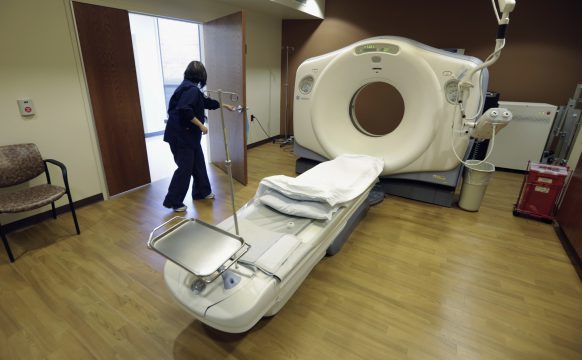
In this Jan. 9, 2013, file photo, a CT scan technician prepares for a patient at the Silver Cross Emergency Care Center in Homer Glen, Ill. The Trump administration is quietly trying to weaken radiation rules, relying on scientific outliers who argue that a little radiation damage is actually good for you -- like a little bit of sunlight. M. Spencer Green | AP
 = new reply since forum marked as read
Highlight:
NoneDon't highlight anything
5 newestHighlight 5 most recent replies
= new reply since forum marked as read
Highlight:
NoneDon't highlight anything
5 newestHighlight 5 most recent replies

no_hypocrisy
(54,903 posts)

Rhiannon12866
(255,524 posts)These are scary times. 

NNadir
(38,034 posts)...exposure to zero - which poorly educated people seem to think appropriate - every living thing on the planet would die. Potassium is essential to life, and all of the potassium on Earth is radioactive.
It would be a less stupid world in which regulation of exposure to the potentially harmful materials were risk based using epidemiological data.
The number of deaths from cancer and other diseases from radiation are trivial when compared to deaths from combustion products.
That people get excited about potential exposure to radiation and basically ignore combustion products they are continuously exposed to is a reflection of vast public ignorance.
If Trump says it's a good thing that the sky is blue, that does not imply that we insist it be green.

defacto7
(14,162 posts)The argument given refers to radiation damage. We're bombarded by radiation constantly, it's part of being a living biological organism in our universe. How much radiation damage should we allow this adminitration to subject us to for the sake of a buck?
NNadir
(38,034 posts)Last edited Wed Oct 3, 2018, 03:37 PM - Edit history (1)
...a huge number of people have had somatic mutations, some but not all resulting in carconogenesis, from endogenous Potassium 40. It has a very energetic decay level, on the order of MeV.
Of course, in the sense that radiation drives germ mutations - as do chemotoxic planar molecules by the way - this may account for the existence of human beings, since evolution is driven by mutation. Planar molecules that insert into major and minor groove of DNA are PAHs in dangerous fossil fuel waste and PDBE flame suppression agents in electronic waste is teams a well known mutagenic mechanism demonstrated by high resolution mass spec.
PDBEs and PAHs are found in every living thing on this planet in known physiologically problematic amounts.
By contrast, radioisotopes although present in amounts so low as to complicate epidemiological studies in such a way as to differentiate effects from noise, are not known to be anywhere near physiological meaningful physiological relevant levels, since they are swamped by potassium, and in seafood by Po 210. The authors of the Fukushima Tuna Fish paper in PNAS were clearly exasperated by the public reaction to their paper in which they made this reality very clear.
This is not about money or "bucks." This about risk management.
If, I think that radiation regulation does not reflect risk/benefit reality, being too absurdly strict for radiation and not nearly strict enough on combustion products, this does not make me a White supremacist Neonazi Trump supporter. If Trump does something right albeit for the wrong reason, I am not about to insist he do the wrong thing for an ersatz "right" reason.
The Volkswagen bug probably prevented some air pollution deaths in the 1950s and 1960s by having better gas mileage than other cars in that era. The fact that Hitler ordered the car's development has no bearing on that fact.
defacto7
(14,162 posts)Have you looked at the EPA proposed regulation changes to determine if they are within some reasonable bounds? I have not, nor would I be capable of making that determination. I distrust this administration enough to be wary of any relaxation of any restrictions on any subject knowing their haphazard way of making decisions that usually do boil down to money and control by the few for the few at the expense of the rest. Maybe this is different.
I've come to trust your expertise and strongly consider your opinions. If anyone would know the limitations necessary and whether this is a reasonable proposal in that regard I imagine it would be you. D7
NNadir
(38,034 posts)...smoothly type on a cell phone (and to fight off the autocorrect) given my fat fingers, but you seem to have gotten the basic idea despite my sloppy typing which I had no time to correct.
We all distrust Trump, but keep in mind he's a monstrously stupid man, too stupid even to understand if he is accidentally doing good in spite of himself.
I have no interest in looking at the proposed regulations, but let me say this:
When I started investigating nuclear energy issues seriously, I began from the position of being a rote anti-nuke. Even as I began to change my mind about whether nuclear energy was a horrid technology or whether it was in fact a superior technology, I passed through a phase where I considered that the escape of any radionuclide was unacceptable and tried to envision ways in which every atom could be contained indefinitely.
I was, in short, a moron.
One hears from very, very, very, very stupid organizations like say, these people, who want you to get your hair to stand on end because (gasp) there's cesium from Sellafield in the Arctic ocean: OH MY GOD!!!! SELLAFIELD CESIUM IN THE ARCTIC!!!
These functional morons even tell us how much Sellafield cesium is in the arctic, 40,000 billion bequerel!!!!! (Their calculation, given their stupidity is probably not valid, but it doesn't matter. Even if they're right, it's an idiotic concern.
A curie is 3.7 X 10^10 Bequerel. It is the unit originally associated with the number of decays in one gram of radium, radium being an element that is extracted from rock as a side product of gas fracking and dumped, without restriction in flowback water. It has since been rounded, for convenience, to round numbers.
Thus, 40,000 billion bequerel is a little under 1100 curies.
Scary, huh?
Sometime ago, by appeal to rather simple arithmetic and reference to a few basic calculations, I calculated what I consider to be a very reasonable estimate the total radioactivity of the ocean from radioactive potassium-40 alone. I posted my calculation on the internet here: How Radioactive Is the Ocean?
In this calculation, I completely ignored the other sources of radioactivity in the ocean, specifically the 5 billion tons of uranium in equilibrium with its decay daughters. (This is the source of Po-210 found in all fish.)
I showed, by appeal to a few scientific references, that the oceans contain roughly 530 billion curies of potassium 40 alone. Thus all of the cesium from Sellafield reported by the dumb shit anti-nukes at "WISE" is roughly is roughly 2 billionths of the radioactivity that the ocean contains naturally from K-40 alone.
If anyone would like to challenge my calculation, I invite them to do so.
Now, since these people elevate their idiot paranoia and ignorance over the the deaths of seven million people each year from air pollution, they don't address what I call the "Richter question" posed by the late Nobel Laureate Barton Richter in his comment on a scare mongering paper about "Fukushima in California" written by the lawsuit happy idiot professor at Stanford, Mark Z. Jacobson, a pretty boy with a weak mind in my opinion.
He didn't try to sue Richter of course, but Richter's paper cut to the chase: Opinion on “Worldwide health effects of the Fukushima Daiichi nuclear accident” by J. E. Ten Hoeve and M. Z. Jacobson, Energy Environ. Sci., 2012, 5, DOI: 10.1039/c2ee22019a
Since Richter's paper is apparently not open sourced, I'll quote from Richter's remarks:
The bold is mine. Being demonstrably (by orders of magnitude) a far better scientist with far greater competence than Jacobson - whose response to another criticism by a body of scientists criticizing another of his mindless papers - Richter noted that the death toll from not using nuclear power in Japan would have been higher than the high extreme calculated by Jacobson from air pollution.
In other words, not building nuclear power plants because one confidently and correctly predicted the event at Fukushima would have killed more people than radiation did (or will, since not many people have demonstrably died from radiation, although some long term radiological consequences are worthy of anticipation.)
Many other smart people have made this point.
Now, what are the real health consequences for Sellafield releasing one 2 billionths of the radioactivity the ocean contains from natural and biologically essential oceanic potassium? Are they likely to compare to the health consequences that would have been obtained were the fuel reprocessed at Sellafield never existed, the Richter question?
It is not necessary for nuclear power to be risk free to be vastly superior to all other options. It is only necessary for it to be vastly superior, which it is.
For the record, over its lifetime Sellafield released (to the ocean) more cesium-137 than Fukushima did. My personal opinion is that this was unnecessary and unwise, since it prevented the isolation of the Cs-137 to do the wonderful things that gamma radiation can do when concentrated, but any health effects, should they have existed, are easily dwarfed by the far more dangerous and deadly use of combustion. To the extent that the existence of Sellafield restrained the use of combustion, it saved lives.
I have, in the past, looked into the risk calculations for radionuclides and the criteria by which they are used, but not recently. Since I was better educated at the time I looked into it than I was as I was first emerging from anti-nuke credulity, I recall being somewhat astounded at the low levels of risk being proposed as actionable limits for radionuclides, given I live on a planet where 7 million people die each year from breathing largely unregulated or barely regulated combustion products.
We lack balance, and this has nothing to do with Trump. If he accidentally improves the world by relaxing radioactive standards, we can be sure that his intent was to screw the world with his contempt for humanity, but that, in spite of his attempts to express his puerile contempt for humanity, the actual effect may be to save lives, not that he cares about human life or the future.
Have a wonderful Friday.
defacto7
(14,162 posts)may be healthy.
