17 Blowout Craters Since 2013 In Yamal Region; 3D Modeling Seems To Point To Warming As Cause
Ed. - Top story from September, 2020
https://cdn.shortpixel.ai/client/q_glossy,ret_img,w_1000,h_532/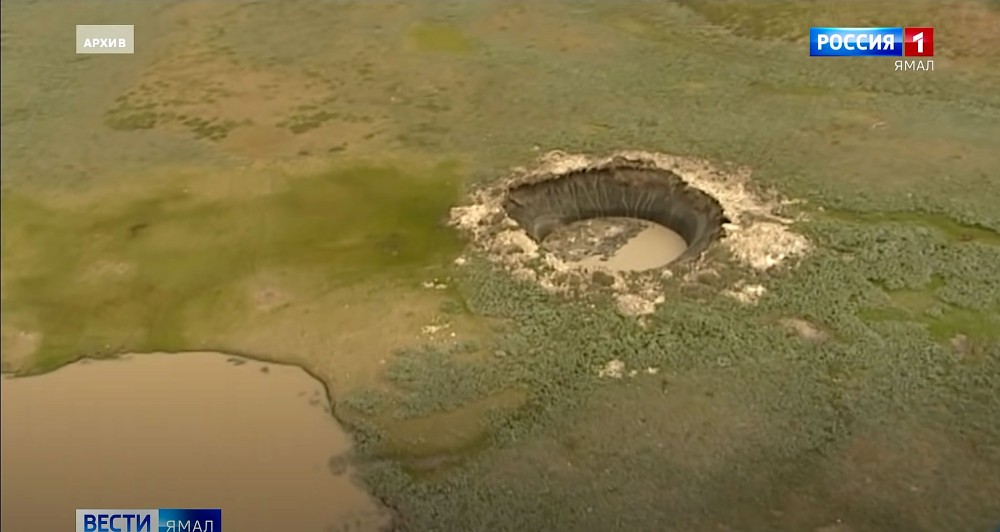
Journalists this summer came across a large crater in the tundra on the Yamal Peninsula. (Screenshot from Vesti Yamal via The Independent Barents Observer)
A team of journalists discovered another giant hole in the Russian tundra as they were flying over the area in a helicopter in July. The site has since been subject to close studies by researchers, regional television channel Vesti Yamal reports.
The hole, more than 20 meters wide, is the 17th of its kind discovered in the far northern Yamal region since 2014. The first discovery was made in 2014. Since then, a number of similar large holes in the ground have been found.
According to researchers, the tundra craters are created as large volumes of gas accumulate under the tundra permafrost and then ultimately explode. A number of more craters will appear in the near future. Around in the region are numerous small swollen hilltops just waiting to burst.
Researcher Vasily Bogoyavlensky told Vesti Yamal that the explosions happen when pressure in the ground reaches 12 atmospheres. The powerful explosions can throw soil several hundred meters from the epicenter.
EDIT
https://www.arctictoday.com/a-new-giant-crater-has-been-found-on-the-russian-arctic-tundra/
A 3D model of a massive 30-meter-deep crater on the Siberian tundra supports scientists previous suspicion that climate change is behind the explosions that form such craters.
CNN reports that explosion last year was the 17th blowout crater to appear in the remote Yamal and Gydanpeninsulas in Russia’s Arctic, since the first was spotted in 2013.
The new crater offered the first opportunity for scientists to use drones to build a 3D model of the crater. The 3D model largely confirmed what scientists had hypothesized: Methane gas builds in a cavity in the ice, causing a mound to appear at ground level.
The mound grows in size before blowing out ice and other debris in an explosion, leaving behind a massive crater. What’s still unclear is the source of the methane. It could be coming from layers deep within the Earth, or closer to the surface — or a combination of the two.
EDIT
https://www.arctictoday.com/a-new-3d-model-bolsters-the-case-that-climate-change-is-causing-mysterious-siberia-craters/

