Tim Flannery reviews 2 books: (probably behind a paywall), Coral Reefs: A Natural History by Charles Sheppard and Life on the Rocks: Building a Future for Coral Reefs by Juli Berwald, in the March 24 issue of the New York Review of Books.
A short excerpt:
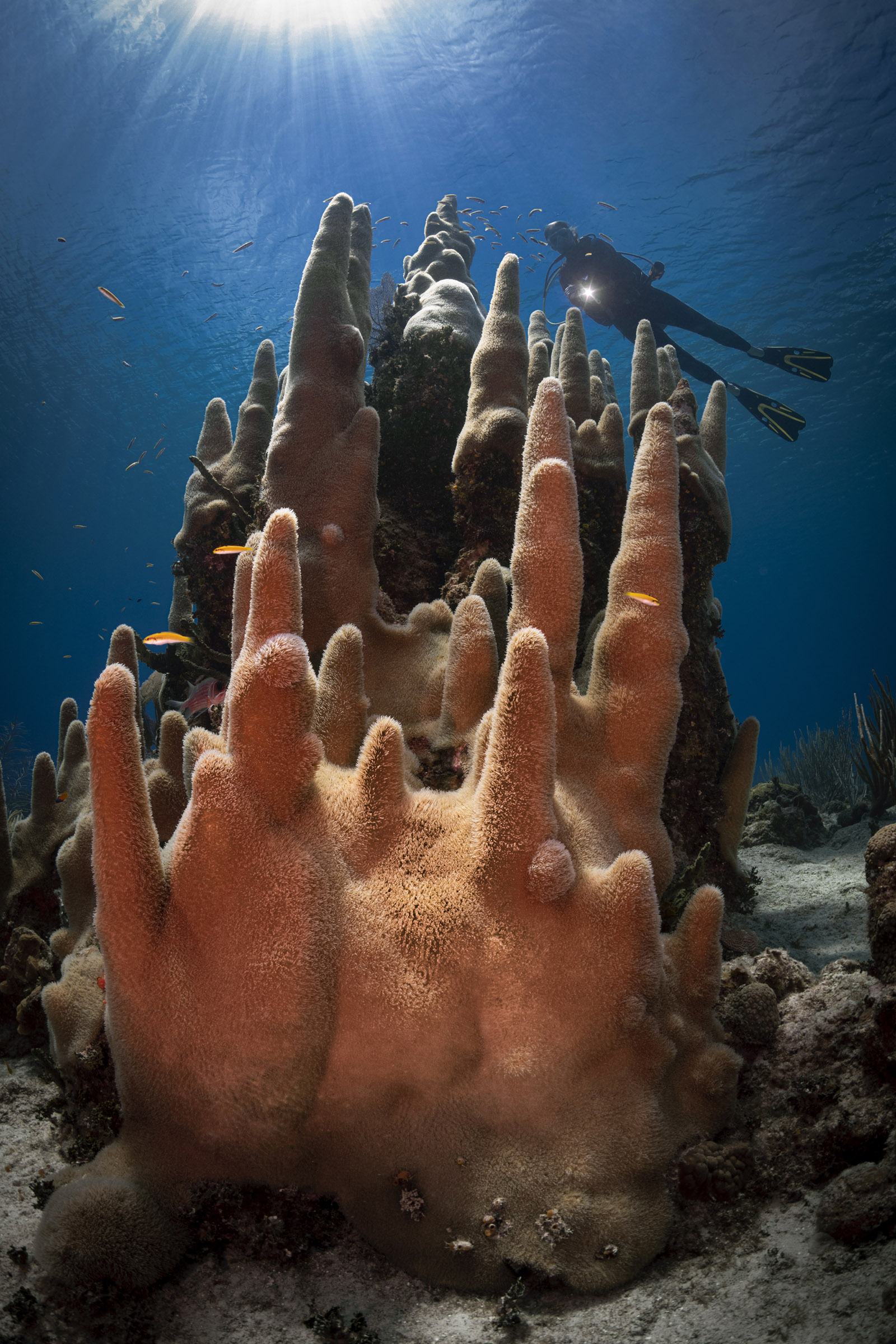
Pillar coral near Cayman Brac, Cayman Islands, 2019
_________________________________________________________________________________________________
...
The great majority of the damage inflicted on the world’s coral reefs has occurred within the lifetimes of researchers who are active in the field. The most visible and widespread damage is bleaching caused by global heating, and Berwald explains in detail how this occurs. Coral reefs come about, she says, because of a “badass merger” between the coral animal (a polyp like a miniature sea anemone) and single-celled algae. Both partners receive benefits—the algae get protection and the CO2 they need to grow, while the coral polyp receives food in the form of sugars produced by the algae during photosynthesis. So powerful is the partnership that it can increase the production of food a hundredfold.
Bleaching is visible evidence that the relationship has broken down. The corals are themselves colorless—it’s the algae that give color to the reef. Each coral has its own algal partner, and some kinds of algae don’t produce as much food when temperatures rise. Berwald writes that it’s not clear whether the coral animal actively ejects the algae or the algae leave of their own accord, but once the relationship ends, the coral loses most of its food supply. The algae won’t return until the water temperature falls, and if the algae are away too long, the coral dies of starvation.
Coral bleaching is the single greatest threat faced by coral reefs. Yet bleaching leading to widespread coral death was not observed until 1980, and the first such event in the Great Barrier Reef, according to Berwald, was observed only in 1998, by which time bleaching events had been seen around the world. By 2015 bleaching had taken on terrifying proportions, afflicting reefs from Guam to Hawaii and from Fiji to French Polynesia. Richard Vevers, a researcher who dived on the reefs as they died, recalls, “I can’t even tell you how bad I smelt after the dive—the smell of millions of rotting animals.”
Despite the scale of the threat, not all researchers agree that bleaching will cause the extinction of coral reefs. Misha Matz uses algorithms to assess the threat of bleaching. “I cannot make [reefs] go extinct,” he tells Berwald when she visits his lab. “I’m sorry, it’s impossible.” Matz’s optimistic view is clearly in the minority, but as Berwald tells it, the biological complexity of coral reefs is so great that it’s hard to draw firm conclusions about anything. Yet observations indicate that there are limits beyond which coral reefs experience catastrophic decline. Even if Matz is right and reefs don’t go extinct, is it acceptable if only 0.2 percent of corals escape bleaching after 2030, as the 2022 study predicted?
...

 = new reply since forum marked as read