Welcome to DU!
The truly grassroots left-of-center political community where regular people, not algorithms, drive the discussions and set the standards.
Join the community:
Create a free account
Support DU (and get rid of ads!):
Become a Star Member
Latest Breaking News
Editorials & Other Articles
General Discussion
The DU Lounge
All Forums
Issue Forums
Culture Forums
Alliance Forums
Region Forums
Support Forums
Help & Search
Environment & Energy
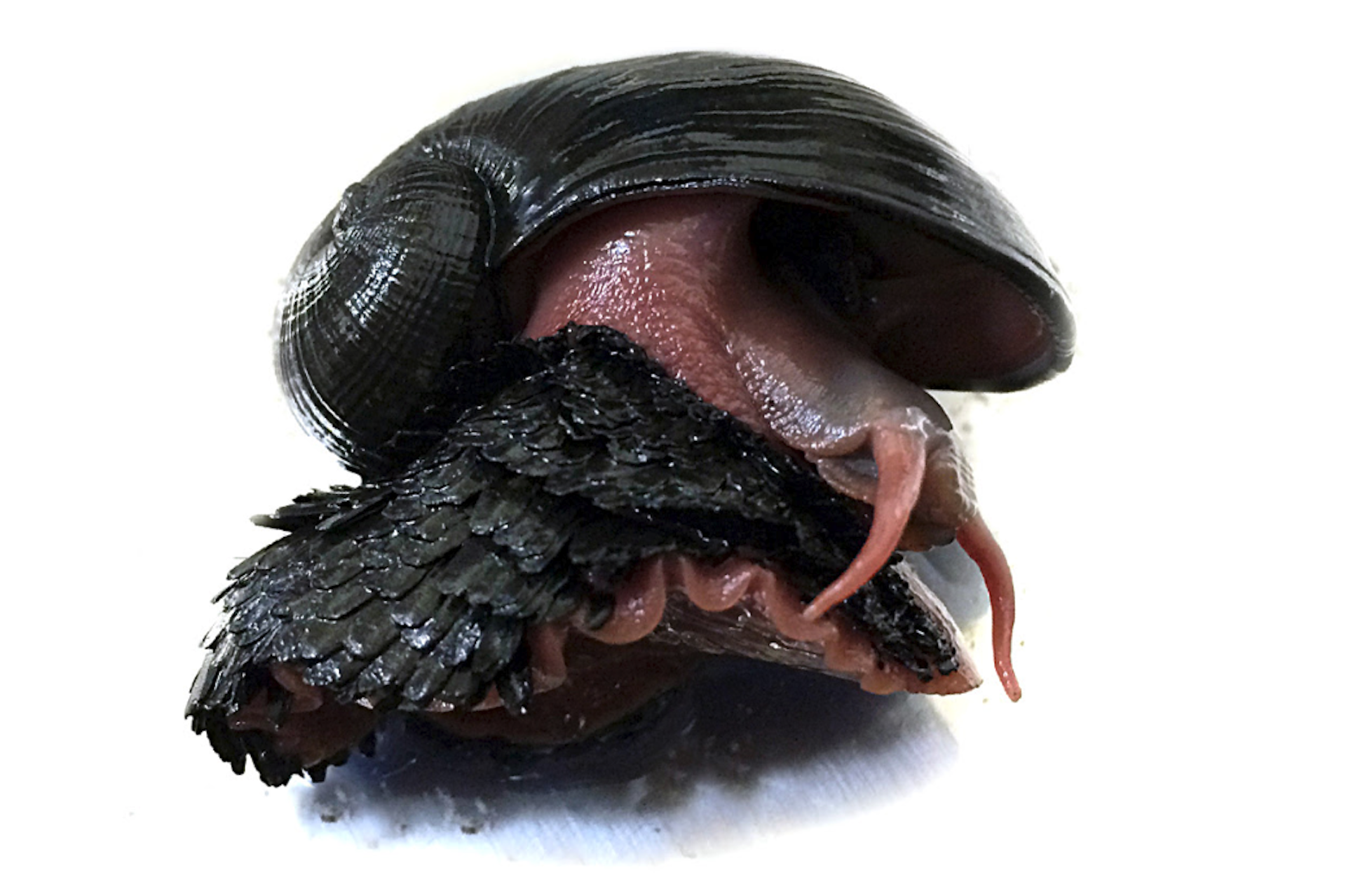
Related: About this forumMeet The Sea Pangolin: A Vanishingly Rare Thermal-Vent Snail With Iron Scales
?ixlib=rb-1.1.0&q=45&auto=format&w=926&fit=clip
A golden snail with a foot clad in iron scales seems like a creature from science fiction. But in a few remote spots of the Indian Ocean these snails are very real. It looks like an armoured knight crawling around on the deep-sea floor, says Julia Sigwart, a biologist at Frankfurts Senckenberg Research Institute and one of the only people to have seen a living scaly-foot snail (Chrysomallon squamiferum), also known as a sea pangolin.
The snails habitat is extreme. They live several miles below the ocean surface on searing hydrothermal vents, which are bathed in toxic chemicals and can reach temperatures of more than 300C (572F). The snails entire bodies and lifestyles revolve around bacteria growing inside a special pouch in their throat, which convert chemicals pouring out of the vents into energy and thereby provide all the snails food.
To keep their microbes well fed, scaly-foot snails evolved enormous gills to absorb oxygen and chemicals from seawater, then deliver it by way of their bloodstream and a hugely capacious heart. A human heart of equivalent proportions would be the size of our heads. In 2019, scientists worked out that the scales on the snails foot are not to protect against predatory attack but to avert a toxic threat that comes from within. The bacteria stashed in a scaly-foot snails throat release sulphur as a waste product, which is deadly to snails (its a common active ingredient in slug and snail-killing pellets).
The internal structure of their scales acts as tiny exhaust pipes, drawing the dangerous sulphur away from the snails soft tissues and depositing it as a harmless iron-based compound on the outside.
EDIT
https://www.theguardian.com/environment/2022/aug/03/discovered-in-the-deep-the-snail-with-iron-armour
2 replies
= new reply since forum marked as read

Highlight:
NoneDon't highlight anything
5 newestHighlight 5 most recent replies
Meet The Sea Pangolin: A Vanishingly Rare Thermal-Vent Snail With Iron Scales (Original Post)
hatrack
Aug 2022
OP
eppur_se_muova
(42,160 posts)1. So the scales are made of iron sulfide, not metallic iron ...
The soft tissue core of each sclerite was covered in conchiolin, which was in turn covered with pyrite (FeS2) and greigite (Fe3S4), two forms of iron sulphide (Warén et al., 2003). Its shell was also covered in the same material, making it the only known metazoan to use iron in its skeleton (Yao et al., 2010).
https://academic.oup.com/mollus/article/81/3/322/1087877?
Journos, even in science mags, so often confuse "iron-containing" with "made of iron". Iron sulfides are hard minerals, but not metallic like iron (although greigite is ferrimagnetic, which is interesting).
hatrack
(65,000 posts)2. True - "ferrous scales", maybe?
But I have to admit, it does look unusually bad-ass for a snail, in a submerged Game Of Thrones kind of way.