Melbourne researchers use sound waves to boost green hydrogen production 14-fold
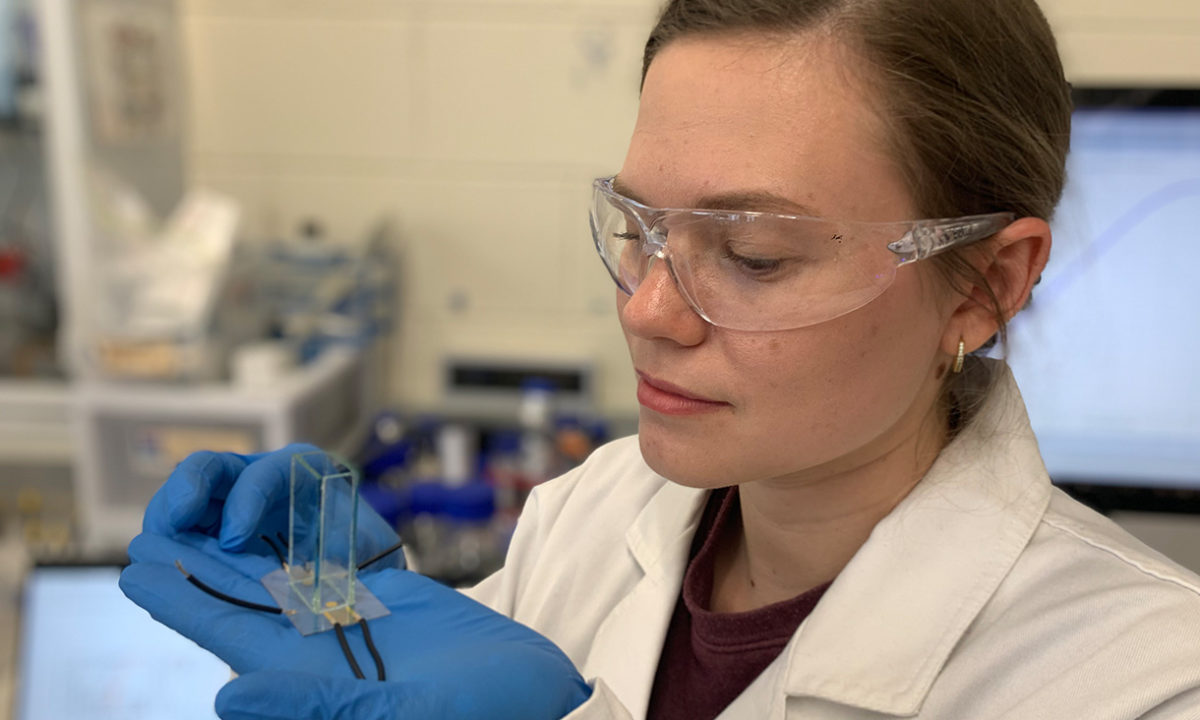 PhD researcher Yemima Ehrnst holding the acoustic device the research team used to boost the hydrogen production. Image: RMIT University
Melbourne researchers use sound waves to boost green hydrogen production 14-fold
PhD researcher Yemima Ehrnst holding the acoustic device the research team used to boost the hydrogen production. Image: RMIT University
Melbourne researchers use sound waves to boost green hydrogen production 14-fold
PV-Magazine-australia | Bella Peacock | December 13, 2022
Melbourne researchers have discovered sound waves can be used to “divide and conquer” water molecules during electrolysis, a process where electricity runs between two electrodes to split H2O molecules into oxygen and hydrogen gases which appear as bubbles.
“The electrical output of the
electrolysis with sound waves was about 14 times greater than electrolysis without them, for a given input voltage. This was equivalent to the amount of hydrogen produced,” RMIT engineering PhD researcher Yemima Ehrnst said.
The research, published in journal Advanced Energy Materials, is also consequential for bringing down green hydrogen’s production costs.
“One of the main challenges of electrolysis is the high cost of electrode materials used, such as platinum or iridium,” RMIT Associate Professor and research lead Amgad Rezk said.
By using sound waves to unlock more hydrogen, Rezk says it “eliminates” the need for expensive and corrosive materials like platinum or iridium... more
https://www.pv-magazine-australia.com/2022/12/13/melbourne-researchers-use-sound-waves-to-boost-green-hydrogen-production-14-fold/
RELATED:
Greek physicist Petros Zografos and his Hydrogen Energy Machine
Just before the end of 2016. the US based PBS network ran a story on Greek physicist Petros Zografos and his Energy Machine. Then they withdrew the clip with the following explanation:
“There have been questions raised concerning our report that aired on Dec. 27, 2016 about a Greek inventor who is developing a device that purports to turn water into power without requiring additional energy. Despite a team of Greek scientists praising the research, and the inclusion of an independent scientist dubious of the work, the News Hour acknowledges that our reporting of this segment should have been more skeptical. Our reporting and research should always ask more questions and seek greater insight. We are examining each step in our process, and we apologize to our audience for the lapses in this report. The PBS NewsHour is dedicated to presenting clear and thorough reporting on developments in science and technology, and we will be following up with more reporting on the important subject of clean energy as soon as possible.”
The core of the invention is the production of hydrogen and oxygen (hydroxy) from plain refreshing water from the tap or sea using high frequency electromagnetic pulse (in Terahertz Scale). These pulses have a frequency that "coordinate" the molecule of water, resulting in its decay. Petros Zografos as an excellent electronic Engineer invented a new way to multiply pulses @ 3 phases to achieve a high frequency result and thus discovered a new method of decomposition of molecules of water and hydrogen production: the PALMOLYSIS
Petros website:
http://www.hellagen.gr/
Petros might be on to something here

 = new reply since forum marked as read