Environment & Energy
Related: About this forum
Hopefully to be soon of historical interest only: Host/guest membrane separation of radionuclides.
The paper to which I'll briefly refer is this one: Host–Guest Recognition Boosts Biomimetic Mono/Multivalent Cation Separation Weisheng Yu, Chengpeng Wei, Kaiyu Zhang, Jianjun Zhang, Zijuan Ge, Xian Liang, Michael D. Guiver, Xiaolin Ge, Liang Wu, and Tongwen Xu Environmental Science & Technology 2023 57 (14), 5861-5871.
One of the things my son tells me about modern nuclear engineering research - the lab in which he works focuses on nuclear materials (a critical issue, particularly if we work toward process intensification - is that commercial enterprises have a hard time (in materials) embracing new and better materials. In many cases, people are fixated on materials developed in the 1960's and 1970's. Of course, these materials have worked spectacularly well. In the rising panic over climate change - nuclear energy is the only sustainable and reliable form of energy that can address it to the extent it can be addressed - there is a movement afoot to keep historic reactors operating well beyond their design life, something they're doing well.
There is always a tendency to do things "because that's the way it's always been done."
I am only vicariously a materials scientist; I'm a chemist. My interest has always been in the processing of used nuclear fuels to separate and recover the valuable materials therein.
"The way it's always been done" is solvent extraction, of which there are many relatively minor variations, the most prominent being Purex; there is also UREX, TRUEX, GANEX, TALSPEAK, DIAMEX and so on...
All of these processes rely on immiscible solvents, generally kerosene, and aqueous acids with organic complexing agents in the hydrophobic phase. to exploit redox chemistry.
That's the way it's always been done.
Just as my son favors new materials - as of course, does his advisor - I believe we need to exploit new modalities in nuclear separations, specifically a class of processing called "pyroprocessing" including electrochemical methods, distillation of metals and salts at high temperatures, and the use of molten salts, my favorite molten salts being rubidium salts (for chemical processing, not for heat transfer.) I prefer rubidium because it is also a fission product.
The water from "the way it's always been done," solvent extraction, will be radioactive, primarily from species like cesium and strontium as their iodides, bromides and nitrates (because dissolution of fuels utilizes nitric acid.)
Unfortunately, "the way it's always been done" utilizes sodium and potassium salts, which are somewhat challenging to separate from rubidium and cesium, the fission products. Sodium, potassium, rubidium and cesium are all monovalent; they all have only one oxidation state in aqueous solution, +1.
The authors of this paper claim they have a way to clean this up in a continuous process; continuous processes are almost vastly superior in economic, environmental and speed terms.
Some remarks from their paper:
...Currently, the only industrial-scale method for radioactive wastewater treatment is solvent extraction. In addition, solid adsorbents have been demonstrated to be an effective alternative approach for this. (16−19) However, there are still some unavoidable issues both for solvent and solid extraction, such as batch or discontinuous operation, inefficiency, and high energy consumption. (20,21) The membrane process represents a frontier in separation technologies due to its high efficiency and low energy cost, as well as continuous operation. (22,23) Some studies have suggested that an ion permselective membrane is a promising approach for nuclear wastewater treatment. (24,25) These approaches mainly rely on the size sieving effect to separate monovalent cations (K+, Na+) and radionuclide ions, such as UO22+, Eu3+, Th4+, and so forth. Given our previous successful biomembrane-inspired strategy, (13) here we propose a novel biomimetic ion channel membrane for the separation of monovalent cations and radionuclide ions. To mimic the configuration of biological ion channels, biomimetic functional molecules (which provide noncovalent interactions with specific ions (26)) should be embedded into an appropriate substrate...
The authors propose to functionalize graphene oxide, a single atomic layer of carbon atoms bonded to oxygen atoms, with a class of compounds known as 4-sulfocalix[4]arene, which as the following structure:
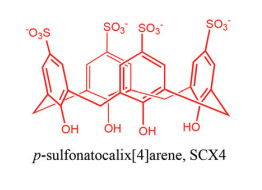
cf. Pal [iet al. Org. Biomol. Chem., 2016, 14, 11480–11487], scheme 1.
The authors show relatively robust separations of monovalent ions and some ions found in used nuclear fuel:
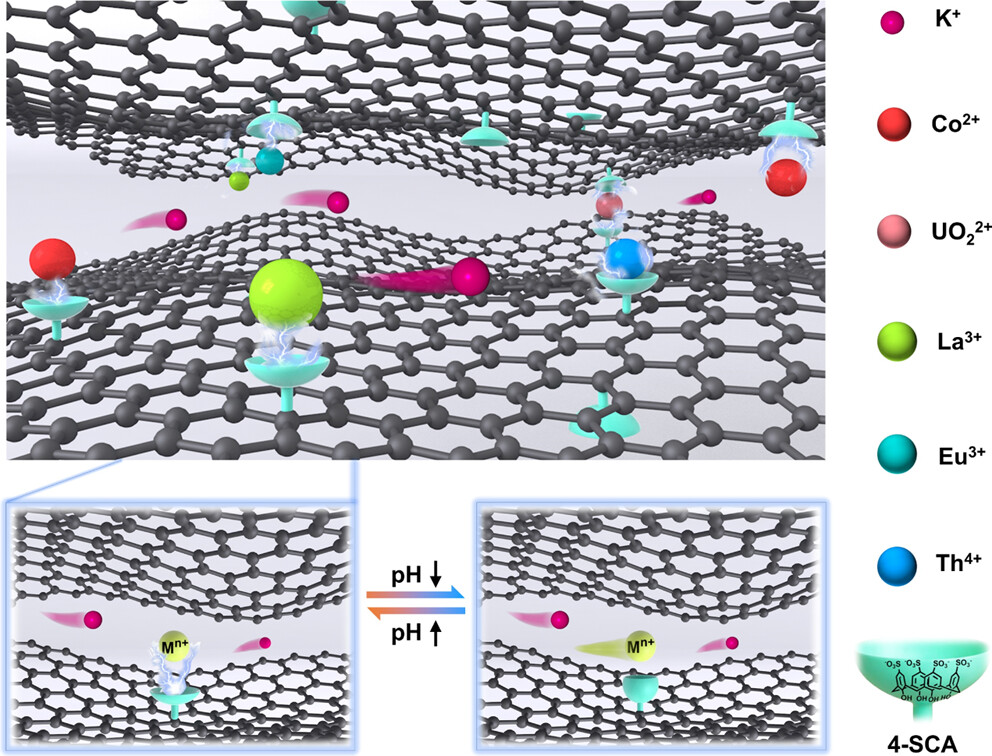
The caption:
The ions examined may be considered as reasonable surrogates of the many other ions found in aqueous solutions in solvent extraction processes.
Although nuclear fuel processing is, in my view, essential to saving what is left to save and restoring what can be restored on this planet, I think the best way to deal with radioactive water from the solvent extraction processes is to not make it in the first place.
This is why while the paper is interesting, perhaps in areas other than nuclear fuels, it strikes me, even if one can consistently make and functionalize graphene oxide, as somewhat impractical. So this is all I'm going to say about the paper.
I'd like to solvent extraction minimized - although I expect it will always have some specialized uses as well as habitual use. Pyroprocessing, it seems to me is a better option.
Just a note...
Have a nice day tomorrow.