Environment & Energy
Related: About this forum
The occurrence of PFAS in landfill gas.
The paper to which I'll briefly refer is this one:
Neutral Per- and Polyfluoroalkyl Substances in In Situ Landfill Gas by Thermal Desorption–Gas Chromatography–Mass Spectrometry Ivan A. Titaley, Florentino B. De la Cruz, Morton A. Barlaz, and Jennifer A. Field Environmental Science & Technology Letters 2023 10 (3), 214-221.
PFAS (Perfluoroalkyl substances) are now ubitiquous, persistent chemicals.
I have written a number of posts in this space on the subject.
One form of so called "renewable energy" - almost certainly more prevalent than solar and wind in terms of energy produced - is the combustion of "waste," typically municipal garbage. However because this, like biomass combustion, is a major driver of air pollution where it is used, the majority of municipal waste is still landfilled, whereby the associated toxicology, like climate change, is dumped on future generations.
On the bright side, or the dark side, depending on how it's used, landfills generate methane gas as waste decomposes. This gas can be and often is combusted in power plants, making landfills slightly less odious.
It appears that PFAS is a common component of landfills, and that it is found in this gas.
From the introduction:
While volatile (neutral) PFAS have been measured in the gas phase of air surrounding landfills, (10−13) their presence in the gas generated during the anaerobic biodegradation of waste buried in landfills (i.e., landfill gas (LFG)), (14−16) collected from within landfills (e.g., from a gas well or header pipe), has not been characterized, which is needed to estimate the mass released from landfills to the atmosphere. (17−19) Previous analysis of biogas collected from sewage sludge identified peaks corresponding to fluorinated compounds at less than the limit of quantitation (LOQ) and indicated the potential release of PFAS to the gas phase. (20) In contrast, the presence of nonvolatile (ionic) PFAS (e.g., perfluoroalkyl carboxylates and perfluoroalkyl sulfonates), in landfill leachate and in LFG condensates, is well documented. (7,17−19,21,22)
A methodology for sampling PFAS in LFG has not yet been described, but is challenging because LFG consists of 40%–60% (v/v) methane, (15,23−26) which is above the upper explosive limit of methane (17%). (27) For this reason, sampling equipment must be explosion proof. Given the likely higher concentrations of PFAS in LFG compared with ambient air, a technique for collecting lower volumes (less than 1 L) of LFG over shorter time periods is needed. Previously described passive and active sampling techniques for ambient air required collection of 100 to 1000 m3 over periods of hours to days. (10−13) Organics (non-PFAS) in biogas and LFG were previously analyzed using sorbents. (20,23) While thermal desorption (TD) was used for PFAS in ambient air (not associated with landfills), (28,29) indoor air, (30,31) and from aqueous film forming foam, (32) the TD-based approach has not been described for sampling PFAS in LFG given the complexity of LFG collection systems─composed of multiple sections─and the presence of several sampling locations at a given site. (15,23,24,26) Compared to other sampling strategies, TD is solvent free, suitable for collection of smaller volumes over shorter sampling periods, and interfaced directly with gas chromatography–mass spectrometry (GC-MS). Although a TD-based sampling methodology does not differentiate between gas- and particle-phase PFAS, data for neutral PFAS in ambient air near landfills determined that the particle–gas phase ratios for neutral PFAS ranged from 0.001 to 1, which indicates that neutral PFAS are predominantly in the gas phase, (12,13) further supported by past works. (33−35) In contrast, a ratio of 1–10 was reported for ionic PFAS of the same carbon length. (12,13)
A sampling system was constructed to collect LFG from both individual gas wells and the main pipe (header), which collects gas from an entire landfill, (26) for the analysis of neutral PFAS by TD-GC-MS. The method was optimized for up to 25 target neutral PFAS across eight different classes and to detect 14 suspect PFAS from four classes. The optimized method was demonstrated using LFG samples collected from landfills in the southeastern U.S. The methodology is a prerequisite for a larger study aimed at quantifying the emissions of neutral PFAS from ∼30 landfills of various climates across the U.S...
Some graphics and some findings from the brief paper:
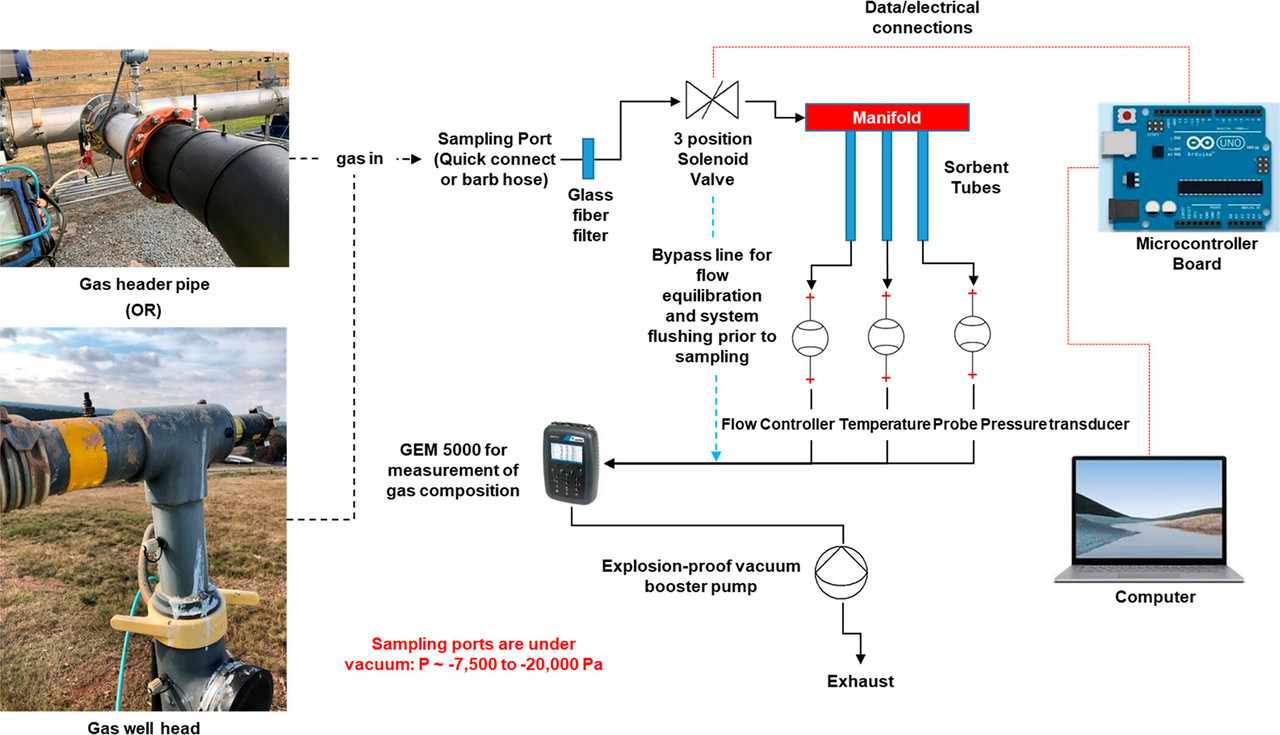
The caption:
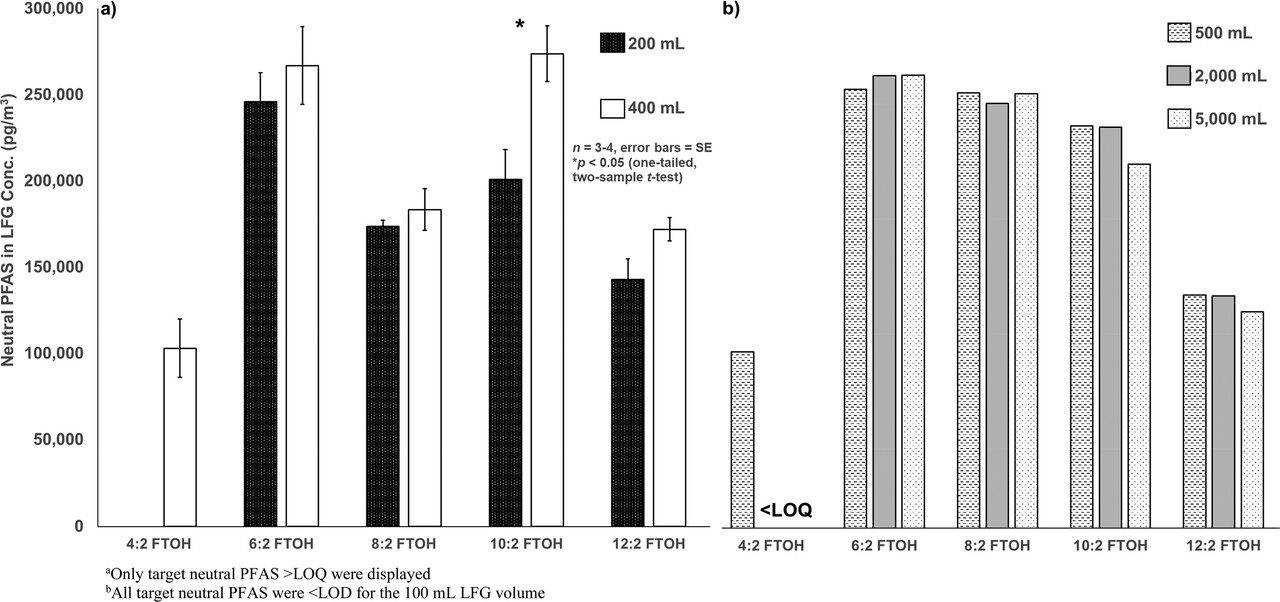
The caption:
A table of results:
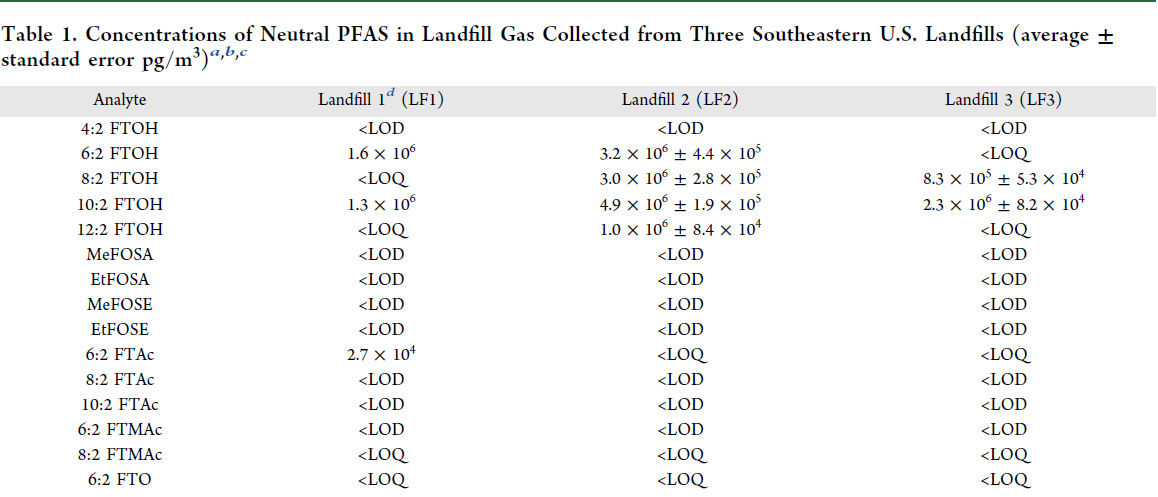
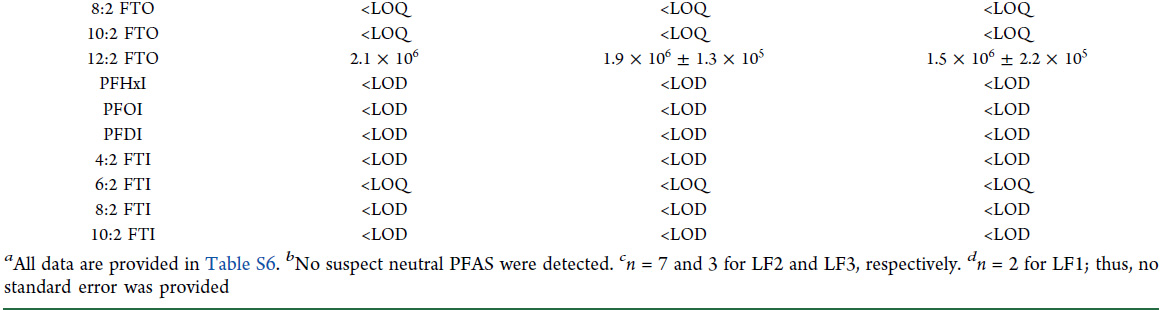
On the bright side, as I noted elsewhere, PFAS are thermally degraded, at least partially, by heat. Thus burning the gas will lead to its decomposition, albeit generating some fluorophosgene, difluorocarbene, and trifluoroacetic acid.
I noted this mechanism recently in this space:
Some Aspects of the Thermal Degradation of Gaseous Perfluorinated (PFAS) Substances.
For the record, I favor the high temperature steam or dry (CO2 as the oxidant) reforming of municipal and some agricultural wastes using nuclear heat, particularly in a radiation field, mineralizing PFAS into barium or calcium fluoride and barium or calcium carbonate.
The journal in which this paper appears has a nice article on the subject of the degradation of short chained fluorinated acids, suggesting that the growing crisis with trifluoroacetic acid concentrations may also be addressed using radiation fields:
Transient Kinetics of Short-Chain Perfluoroalkyl Sulfonate with Radiolytic Reducing Species Zhiwen Jiang, Daniel Adjei, Sergey A. Denisov, Mehran Mostafavi, and Jun Ma Environmental Science & Technology Letters 2023 10 (1), 59-65
The paper, which I meant to cover here, but never found the time to do so, focuses on short chain perfluorosulfonates, but probably has implications for TFA, PFA, BFA...etc...
Steam or dry reforming of municipal waste would have the advantage of CO2 capture for use, as well as the destruction of persistent organic pollutants, of which PFAS are merely a subset.
This is feasible to my mind and it is a topic I attempt to discuss with my son as frequently as is possible, since he may be in a position some day, some time off, to actually realize this dream of mine, albeit after I'm dead.
Have a nice day tomorrow.