Welcome to DU!
The truly grassroots left-of-center political community where regular people, not algorithms, drive the discussions and set the standards.
Join the community:
Create a free account
Support DU (and get rid of ads!):
Become a Star Member
Latest Breaking News
Editorials & Other Articles
General Discussion
The DU Lounge
All Forums
Issue Forums
Culture Forums
Alliance Forums
Region Forums
Support Forums
Help & Search
Environment & Energy
Related: About this forumRealClimate: What is happening to the Atlantic Meridional Overturning Circulation?
(by Stefan Rahmstorf, one of the world's leading climate scientists)
For various reasons I’m motivated to provide an update on my current thinking regarding the slowdown and tipping point of the Atlantic Meridional Overturning Circulation (AMOC). I attended a two-day AMOC session at the IUGG Conference the week before last, there’s been interesting new papers, and in the light of that I have been changing my views somewhat. Here’s ten points, starting from the very basics, so you can easily jump to the aspects that interest you.
...
4. The AMOC is now weaker than any time in the past millennium. Several groups of paleoclimatologists have used a variety of methods to reconstruct the AMOC over longer time spans. We compiled the AMOC reconstructions we could find in Caesar et al. 2021, see Figure 3. In case you’re wondering how the proxy data reconstructions compare with other methods for the recent variability since 1950, that is shown in Caesar et al. 2022 (my take: quite well).
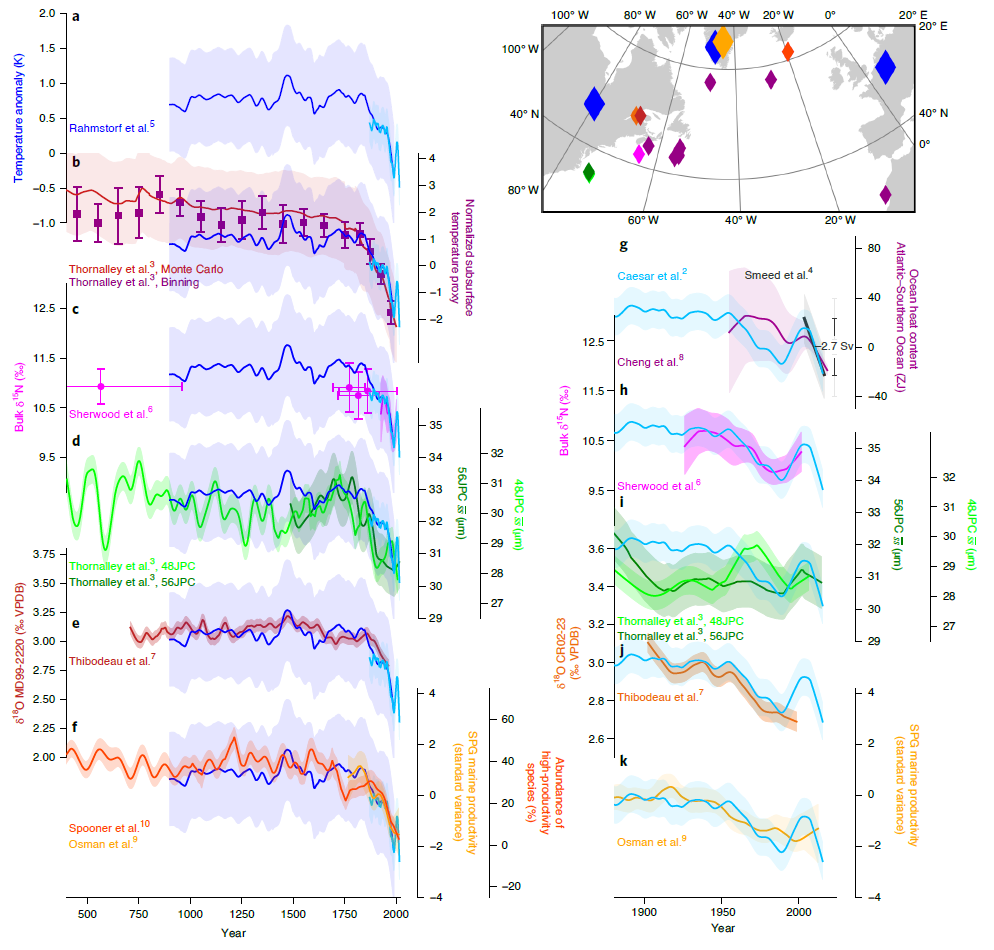
...
6. The AMOC has a tipping point, but it is highly uncertain where it is. This tipping point was first described by Stommel 1961 in a highly simple model which captures a fundamental feedback. The region in the northern Atlantic where the AMOC waters sink down is rather salty, because the AMOC brings salty water from the subtropics to this region. If it becomes less salty by an inflow of freshwater (rain or meltwater from melting ice), the water becomes less dense (less “heavy”), sinks down less, the AMOC slows down. Thus it brings less salt to the region, which slows the AMOC further. It is called the salt advection feedback. Beyond a critical threshold this becomes a self-amplifying “vicious circle” and the AMOC grinds to a halt. That threshold is the AMOC tipping point. Stommel wrote: “The system is inherently frought with possibilities for speculation about climatic change.”
...
Conclusion
Timing of the critical AMOC transition is still highly uncertain, but increasingly the evidence points to the risk being far greater than 10 % during this century – even rather worrying for the next few decades. The conservative IPCC estimate, based on climate models which are too stable and don’t get the full freshwater forcing, is in my view outdated now. I side with the recent Climate Tipping Points report by the OECD, which advised:
https://www.realclimate.org/index.php/archives/2023/07/what-is-happening-in-the-atlantic-ocean-to-the-amoc/
...
4. The AMOC is now weaker than any time in the past millennium. Several groups of paleoclimatologists have used a variety of methods to reconstruct the AMOC over longer time spans. We compiled the AMOC reconstructions we could find in Caesar et al. 2021, see Figure 3. In case you’re wondering how the proxy data reconstructions compare with other methods for the recent variability since 1950, that is shown in Caesar et al. 2022 (my take: quite well).
...
6. The AMOC has a tipping point, but it is highly uncertain where it is. This tipping point was first described by Stommel 1961 in a highly simple model which captures a fundamental feedback. The region in the northern Atlantic where the AMOC waters sink down is rather salty, because the AMOC brings salty water from the subtropics to this region. If it becomes less salty by an inflow of freshwater (rain or meltwater from melting ice), the water becomes less dense (less “heavy”), sinks down less, the AMOC slows down. Thus it brings less salt to the region, which slows the AMOC further. It is called the salt advection feedback. Beyond a critical threshold this becomes a self-amplifying “vicious circle” and the AMOC grinds to a halt. That threshold is the AMOC tipping point. Stommel wrote: “The system is inherently frought with possibilities for speculation about climatic change.”
...
Conclusion
Timing of the critical AMOC transition is still highly uncertain, but increasingly the evidence points to the risk being far greater than 10 % during this century – even rather worrying for the next few decades. The conservative IPCC estimate, based on climate models which are too stable and don’t get the full freshwater forcing, is in my view outdated now. I side with the recent Climate Tipping Points report by the OECD, which advised:
Yet, the current scientific evidence unequivocally supports unprecedented, urgent and ambitious climate action to tackle the risks of climate system tipping points.
https://www.realclimate.org/index.php/archives/2023/07/what-is-happening-in-the-atlantic-ocean-to-the-amoc/

11 replies
 = new reply since forum marked as read
Highlight:
NoneDon't highlight anything
5 newestHighlight 5 most recent replies
= new reply since forum marked as read
Highlight:
NoneDon't highlight anything
5 newestHighlight 5 most recent replies
= new reply since forum marked as read
Highlight:
NoneDon't highlight anything
5 newestHighlight 5 most recent replies
RealClimate: What is happening to the Atlantic Meridional Overturning Circulation? (Original Post)
muriel_volestrangler
Jul 2023
OP
Think. Again.
(22,456 posts)1. If the AMOC fails...
...all bets are off.

cbabe
(6,415 posts)2. What happens when it fails?

OKIsItJustMe
(21,711 posts)3. "All bets are off"
(Sorry, I couldn’t resist.)
What is the Atlantic Meridional Overturning Circulation (AMOC)?
What is the Atlantic Meridional Overturning Circulation (AMOC)?
The AMOC is a system of ocean currents that circulates water within the Atlantic Ocean, bringing warm water north and cold water south.

The global conveyor belt, shown in part here, circulates cool subsurface water and warm surface water throughout the world. The Atlantic Meridional Overturning Circulation is part of this complex system of global ocean currents. This illustration is captured from a short video produced by NOAA Science on a Sphere.
The ocean’s water is constantly circulated by currents. Tidal currents occur close to shore and are influenced by the sun and moon. Surface currents are influenced by the wind. However, other, much slower currents that occur from the surface to the seafloor are driven by changes in the saltiness and ocean temperature, a process called thermohaline circulation. These currents are carried in a large "global conveyor belt," which includes the AMOC.
AMOC stands for Atlantic Meridional Overturning Circulation. The AMOC circulates water from north to south and back in a long cycle within the Atlantic Ocean. This circulation brings warmth to various parts of the globe and also carries nutrients necessary to sustain ocean life.
…
The AMOC is a system of ocean currents that circulates water within the Atlantic Ocean, bringing warm water north and cold water south.
The global conveyor belt, shown in part here, circulates cool subsurface water and warm surface water throughout the world. The Atlantic Meridional Overturning Circulation is part of this complex system of global ocean currents. This illustration is captured from a short video produced by NOAA Science on a Sphere.
The ocean’s water is constantly circulated by currents. Tidal currents occur close to shore and are influenced by the sun and moon. Surface currents are influenced by the wind. However, other, much slower currents that occur from the surface to the seafloor are driven by changes in the saltiness and ocean temperature, a process called thermohaline circulation. These currents are carried in a large "global conveyor belt," which includes the AMOC.
AMOC stands for Atlantic Meridional Overturning Circulation. The AMOC circulates water from north to south and back in a long cycle within the Atlantic Ocean. This circulation brings warmth to various parts of the globe and also carries nutrients necessary to sustain ocean life.
…
cbabe
(6,415 posts)4. So, it brings warm temps north. Failure means no more warm temps and Europe freezes?
OKIsItJustMe
(21,711 posts)5. That's one of the dangers, yes.
Also, note that last little bit I quoted: “… carries nutrients necessary to sustain ocean life …”
(That's kind of a big deal.)
cbabe
(6,415 posts)7. Ok. Thanks. Yes, those tiny ocean lives are the critical link in the food chain.
localroger
(3,782 posts)8. Yes. Most of Europe is about at the same latitude as Siberia.
The US East Coast will be in for a bumpy ride as well, and as for Atlantic storms who the hell knows.
Think. Again.
(22,456 posts)6. Basically...
A majority of Earth's surface becomes a festering, stagnant pond.

Trueblue Texan
(4,263 posts)9. So it's like the Earth's circulatory system...the heartbeat. nt
OKIsItJustMe
(21,711 posts)10. Yeah, nothing particularly important...
The planet already has a sucking chest wound, why should it circulate bad blood?

Delphinus
(12,487 posts)11. I like
the way you phrase that.