Environment & Energy
Related: About this forum
Quantifying the Environmental Impacts and Human Health Risks of Global Cobalt Mining and Processing
The paper I'll discuss in this post is this one: Quantifying the Environmental Impacts and Human Health Risks of Global Cobalt Mining and Processing Zhaohui Feng, Lingqing Wang, Tao Liang, Lijun Dai, Xiao Yang, Guangjin Zhou, Yizhong Huan, Peng Wang, Wenxian Li, Alice C. Hughes, and Stefan Giljum Environmental Science & Technology 2026 60 (1), 581-594.
There is, unfortunately, a wide spread belief that energy storage is "green," which is directly tied to absurd belief that the reactionary impulse to embrace so called "renewable energy" is green. These beliefs do nothing other than to demonstrate ignorance of a set of physical laws that even Albert Einstein defined as among the most important laws of physics, the laws of thermodynamics.
The laws of physics are not changed by wishful thinking.
Cobalt, as much as the lithium after which lithium batteries are named, remains to this day, an essential component of the main industrial (and consumer) scale energy storage, batteries. Cobalt is decidedly not an element that is available in an infinite supply, and it is decidedly not "renewable." In Earth's crust, cobalt is roughly 40,000 times less common than iron, and is less common than other elements that will make hundred Exajoule per year scales for so called "renewable energy" unsustainable, 41% as common as copper, 30% as common as nickel, 60% as common as neodymium, 4% as common as fluorine, and 2% as common as phosphorous. (Lest I be accused of negativity, I'm happy to announce that cobalt is 4.8 times more common than dysprosium. We're saved!)
Abundance of elements in Earth's crust
All of the elements described above are critical to so called "renewable energy" either in wind turbines, transmission, or batteries. Their abundance calls into question, to repeat "as the day repeats its colors", whether so called "renewable energy" is, in fact, "renewable."
In response to an antinuke - the purpose of hyping "renewable energy" hype has nothing to do with addressing the collapse of planetary atmosphere and is largely connected with antinuke cults - who claimed the world would be saved by Elon Musk's Powerwall® batteries, sometime ago in this space, I demonstrated how much cobalt would be required to address an episode of dunkleflaute in Germany:
The Number of Tesla Powerwalls Required That Would Address the Current German Dunkleflaute Event.
It is claimed they have a useable capacity of 13.5 kWh after being charged with 14 kWh of electricity, presumably at 25°C, with a putative thermodynamic efficiency - should you choose to believe it - of 96%. The maximum continuous power output is said to be 5 kW. The power requirements to match the combined coal and gas average continuous power of combined German coal and gas over the last 30 days, 44.4 GW would require 8,880,000 million Powerwalls®, to cover each day of Dunkelflaute; for 30 days, given that the wind wasn't blowing that much over that period, 266,400,000 Powerwalls®.
The specifications say that each Powerwall® weighs 114 kg, meaning that 30,369,600,000 kg of Powerwalls® would be required just for Germany.
According to Forbes, 15% of the weight of a Tesla Powerwall is cobalt, mined by Elon's happy Congolese slaves, meaning that the happy Congolese cobalt slaves would be required to mine and isolate 4,555,400 metric tons of cobalt to make Powerwalls® to cover this instance of Dunkleflaute with batteries.
This is 31.63 times as large as the world production of cobalt in 2021 according to the US Geological Survey
I'm sorry!!! I forgot to use "percent talk!" The demand for cobalt to cover month long Dunkleflaute in Germany observed in Nov-Dec 2022 would be 3163% the demand for all the world cobalt supply in 2021.
In any case, I often rail here about the moral implications of cobalt mining, specifically human slavery in the "Democratic" "Republic" of the Congo, but the paper cited at the outset broadens the issue.
From the paper's introduction:
The rapidly growing demand for Co has increased the extent and intensity of its mining, which has driven deforestation, landscape transformation, and biodiversity loss. (9) Both the direct extraction expansion and the indirect impacts of supporting roads, waste rock dumps, and tailing storage facilities have driven deforestation, which is clear in regions such as the Brazilian Amazon and African continents. (10) However, the extent of deforestation caused by global cobalt-containing metal ore mining remains unclear. Over 14% of protected areas (PAs) globally have mines within or near boundaries, despite bans on mining and prospecting activities. (11,12) At least 171 downsizing or downgrading PAs have increased pressure on biodiversity conservation and ecosystem service. (13,14) A deep understanding of the impacts of cobalt mining on the ecosystem and biodiversity is crucial for managing mining activities to guide conservation efforts. Additionally, the fragmented landscapes caused by mining activities have decreased the landscape ecological security level, brought about certain landscape ecological risk, and even altered ecosystem stability. (15,16) Therefore, the unknown landscape disturbances and landscape ecological risks associated with mining need to be analyzed comprehensively and systematically.
The health effects of Co are highly worthy of attention due to its high level of toxicity, and it has been up-classified as a Category 1B carcinogen by the European Commission since 2020. (17) Cobalt mining affects the health of miners through heavy metal poisoning, skin allergies, respiratory problems, cancers, DNA damage, and even life-threatening collapse accidents because of the lack of formal mining regulations and safety gear. (18) Environmental pollution caused by mining dust, tailings, and other mining wastes also bring nearby residents serious health risks. (19) Moreover, the release of toxic substances such as cobalt dust, fumes, and residues from cobalt smelting and cobalt product processing have posed significant health risks to workers and nearby residents and induced respiratory problems, cardiovascular diseases, etc. (20−22) Thus, the corresponding health risks should be assessed to release appropriate protective measures, given the lack of human health impact estimates of cobalt.
Given the significant importance of cobalt in the development of clean energy and the various adverse effects of cobalt product sources and processing on the environment and human health, this research investigated the environmental impacts of cobalt mining as well as the human health impacts of cobalt smelting and processing. As cobalt is typically found in coproduced ores with other metals, throughout this paper the term “cobalt mining” denotes the extraction of ores containing cobalt
The forest loss, biodiversity threats, and landscape disturbance within and around mining areas were quantitatively analyzed combined with spatial overlay analysis, the biodiversity impact index, and landscape pattern indices. They were based on the redeveloped global cobalt mining data set with 5166 mining polygons, the global forest change data set, (23) the world database on protected areas data set (WDPA), (24) and the first global 30-m land-cover dynamic monitoring product (GLC_FCS30D), (25) respectively. Simultaneously, we collated 148 references to conduct the meta-analysis and analyzed the effect sizes of blood, urine, hair, and nail samples under cobalt exposure....
Without intending too much criticism of the authors, it does seem, under the circumstances, that the description of cobalt's problematic health and environmental risks calls into question the word I have bolded, "clean."
A few figures from the text:
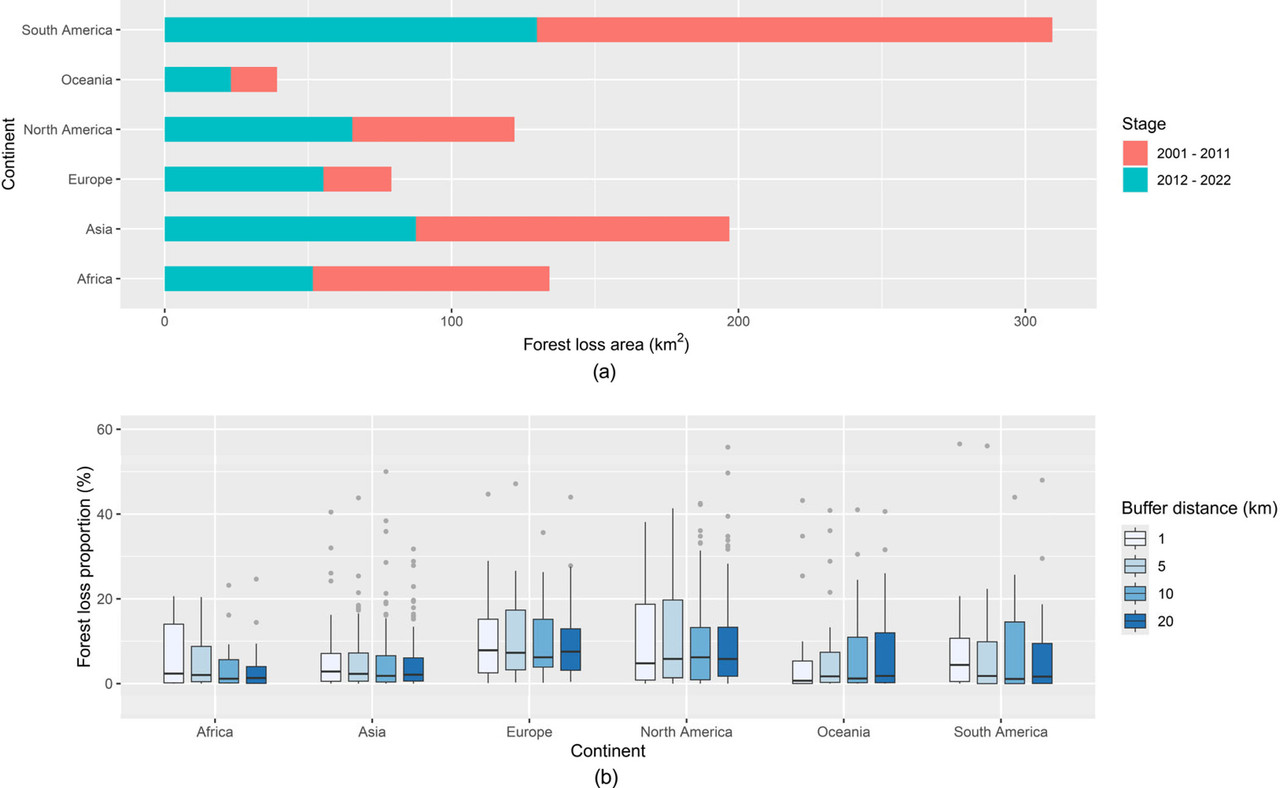
The caption:
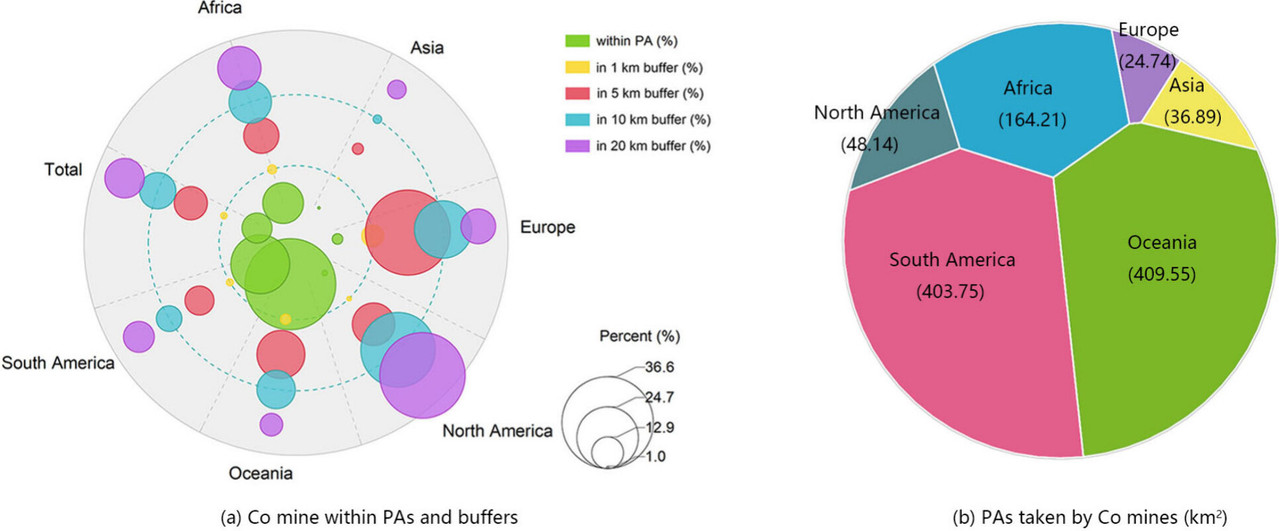
The caption:
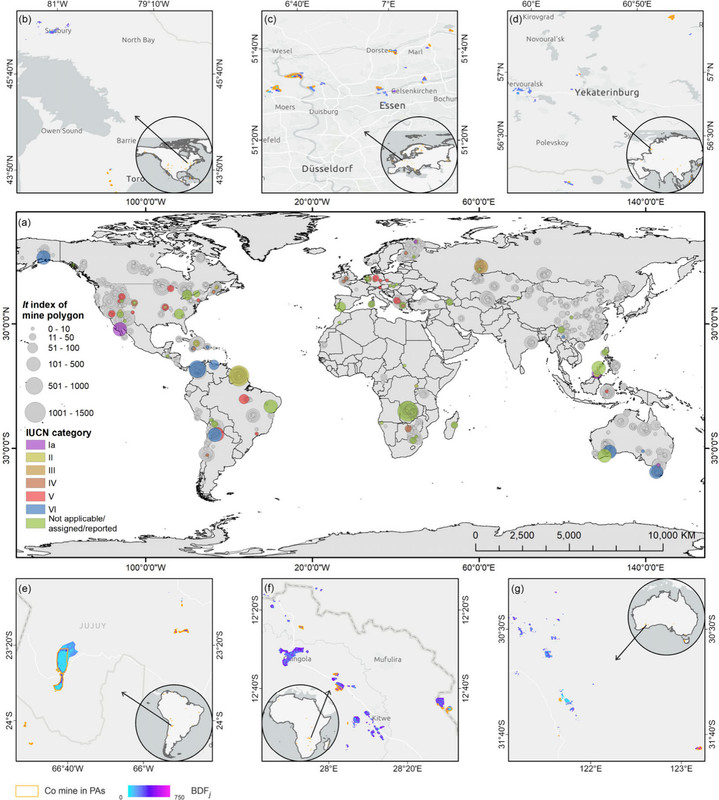
The caption:
The authors note that cobalt is a 1B class carcinogen, that is a carcinogen known to cause cancer in animal studies but has not been verified for humans.
They extensively discuss the role that cobalt mining plays in deforestation, not just in Africa, but elsewhere.
It is already too late to do this to prevent a disaster, but to the extent we can do so to limit the disaster we have already caused, we really should stop lying to ourselves.
I wish you a pleasant weekend.